12th. Capt. Nettleton called and gave me a line from home and told me about his visit. Read two or three good lectures in “Currents and Countercurrents.” Went down to Co. H in the evening. Visited with the boys.
March 2013
Thursday March 12th 1863
A bright pleasant morning but followed by snow and wind, quite cold tonight. Capt Swan came up from the Army and called on me today. Maj E. P. Taft got a furlough to go home and was in one of the Govt offices this morning haveing his papers approved when he fell down in a fit in the office and was insensible for some time. He recovered however after an hour or two and started for home on the 61/2 train. The attack was occasioned no doubt by mental excitement on account of dispatch which he had read relating to his little boys sickness together with considerable physical debility. Met Norton Spencer, son of A.O.S., formerly of Lyons. I have not seen him for some years. He was one of McClellans aids on the Peninsula last summer. Also met at the National my old friend A B Dickerson, U.S. Minister to Nicaragua, just returned, had a long conversation with him in reference to that country. He has just been appointed US Marshall of the Northern District of NY. No news of any great importance today. The N.H. Election came off on the 10th, result uncertain. I fear there will be trouble in some of the Northern States on account of the Conscription. It is thought by many that a Draft will be resisted with arms. I think that those who go into that will get into bad business and come to grief.
Near Helena, Thursday, March 12. Fine weather. Washed my clothes in the forenoon. In the afternoon joined in the funeral procession of a member of Co. G., 72nd Illinois. Laid him in the swamp and left him in the cheerless spot, a soldier’s grave. Many of the boys in spite of high water, went out foraging and brought in fresh pork and beef in plenty.
Thursday. 12th—Came (Regiment) down through Shelbyville to near Dolittle. I stopped at Lee Stewart’s and got dinner. Came on to Camp.
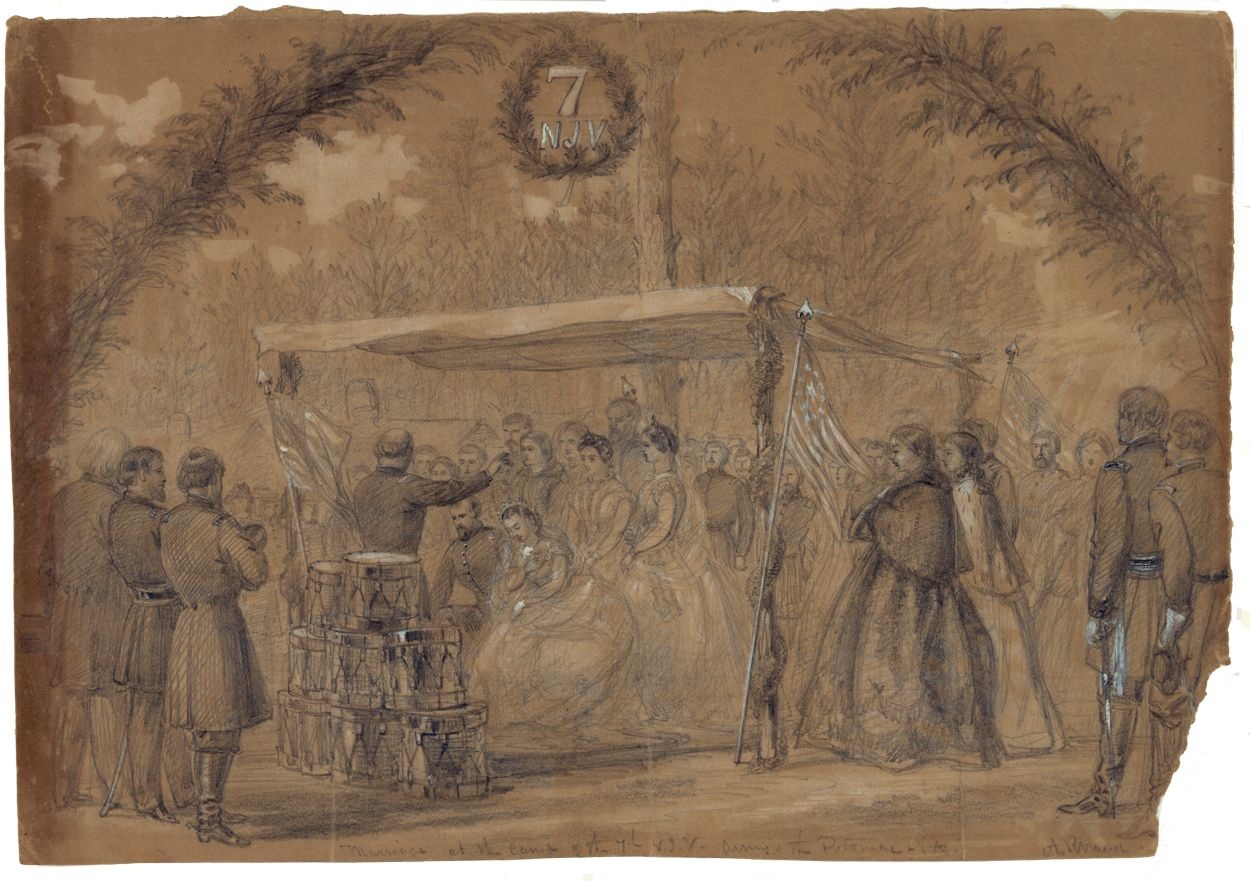
Marriage of Captain Daniel Hart and Nellie Lammond, March 12, 1863.
______
On the 12th inst., marriage rites were celebrated in camp, this being the first occasion of the kind that has ever transpired in the army of the Potomac. Of course it “drew,” as all novelties do, and created a sensation in camp for a week preceding the affair. We, being on the staff, of course received a card…
(Troy NY Daily Times, March 24, 1863)
_____
WE reproduce on page 216 a picture of Mr. Waud’s, representing A MARRIAGE IN THE CAMP OF THE SEVENTH NEW JERSEY VOLUNTEERS in the Army of the Potomac. Mr. Waud writes:
“An event to destroy the monotony of life in one of Hooker’s old regiments. The camp was very prettily decorated, and being very trimly arranged among the pines, was just the camp a visitor would like to see. A little before noon the guests began to arrive in considerable numbers. Among them were Generals Hooker, Sickles, Carr, Mott, Hobart Ward, Revere, Bartlett, Birney, Berry, Colonel Dickinson, and other aids to General Hooker; Colonels Burling, Farnham, Egan, etc. Colonel Francine and Lieutenant-Colonel Price, of the Seventh, with the rest of the officers of that regiment, proceeded to make all welcome, and then the ceremony commenced. In a hollow square formed by the troops a canopy was erected, with an altar of drums, officers grouped on each side of this. On General Hooker’s arrival the band played Hail to the Chief, and on the approach of the bridal party the Wedding March. It was rather cold, windy, and threatened snow, altogether tending to produce a slight pink tinge on the noses present; but the ladies bore it with courage, and looked, to the unaccustomed eyes of the soldiers, like real angels in their light clothing. To add to the dramatic force of the scene, the rest of the brigade and other troops were drawn up in line of battle not more than a mile away to repel an expected attack from Fredericksburg. Few persons are wedded under more romantic circumstances than Nellie Lammond and Captain De Hart. He could not get leave of absence, so she came down like a brave girl, and married him in camp. After the wedding was a dinner, a ball, fire-works, etc.; and on the whole it eclipsed entirely an opera at the Academy of Music in dramatic effect and reality.” (Harper’s Weekly, April 4, 1863)
Drawing by Alfred R. Waud, Maarch 18, 1863.
Library of Congress image.
Marriage at the camp of the 7th N.J.V. poster available at Zazzle.com
by John Beauchamp Jones
MARCH 12TH.—To-day we have no army news.
Mr. Richard Smith issued the first number of The Sentinel yesterday morning. Thus we have five daily morning papers, all on half sheets. The Sentinel has a biography of the President, and may aspire to be the “organ.”
John Mitchel, the Irishman, who was sentenced to a penal colony for disturbances in Ireland, some years ago, is now the leading editor of the Enquirer. He came hither from the North recently. His “compatriot,” Meagher, once lived in the South and advocated our “institutions.” He now commands a Federal brigade. What Mitchel will do finally, who knows? My friend R. Tyler, probably, had something to do with bringing him here. As a politician, however, he must know there is no Irish element in the Confederate States. I am sorry this Irish editor has been imported.
The resignation of Gen. Toombs is making some sensation in certain circles. He was among the foremost leaders of the rebellion. He was Secretary of State, and voluntarily resigned to enter the army. I know not precisely what his grievance is, unless it be the failure of the President to promote him to a higher position, which he may have deemed himself entitled to, from his genius, antecedents, wealth, etc. But it is probable he will cause some disturbance. Duff Green, who is everywhere in stormy times, told me to-day that Gen. Toombs would be elected Governor of Georgia this fall, and said there were intimations that Georgia might make peace with the United States! This would be death to the government—and destruction to Toombs. It must be a mistake. He cannot have any such design. If he had, it would be defeated by the people of Georgia, though they sighed for peace. Peace is what all most desire—but not without independence. Some there are, in all the States, who would go back into the Union, for the sake of repose and security. But a majority would not have peace on such terms.
Still, it behooves the President to be on his guard. He has enemies in the South, who hate him much.
March 12th, 1863.—More bad news to write in my diary. Sweet little Susie died before day this morning. She was so pretty. Except cousin Rich, she was the best looking one of the family. She loved him devotedly and ever since he was killed she seemed to be thinking of him all the time. When she was dying she asked to be buried beside him. Our “God’s Acre,” is filling fast. Aunt Nancy is so frail we fear she cannot stand this fresh blow.
March 12.—The expeditionary force under Major-General Gordon Granger, which moved on Monday against Van Dorn’s rebel army, returned to Franklin, Tenn., this afternoon, having driven the enemy beyond Duck River. The infantry went no farther than Rutherford Creek, but the cavalry, under Colonel Minty, of the Fourth brigade, made a thorough reconnoissance of the country beyond the creek to Duck River.
The second day’s march brought the expedition to Rutherford Creek, where, for a time, the rebels promised fight. Their positions were well chosen, their artillery commanding the pike and several crossings. A blinding rain, however, prevented General Granger attempting the passage of the stream, which was flood-high and foaming.
The troops bivouacked for the night, expecting to drive the enemy on the succeeding day. Yesterday came in clear and beautiful, giving the artillerists a fine opportunity for practice, which they improved excellently by numerous shots. Preparations were made for an advance, and the infantry skirmishers were thrown out. The cavalry, under Col. Minty, supported by the Thirty-eighth Illinois infantry, made a crossing two miles up the creek in the face of the enemy who, however, fell quickly back from the National approaches. Soon word came back that the rebels were in rapid retreat, and finally at night the cavalry returned, announcing that all the rebels had fled beyond Duck River, which, of course, determined the return of the expedition.
The different cavalry skirmishes resulted in the loss on the National side of two killed and seven wounded.—Cincinnati Gazette.
March 11.—In the rebel Congress, in session at Richmond, Va., Mr. Conrad, of Louisiana, offered the following peace preamble and resolution:
“Whereas, The present administration of the United States, by its reckless disregard of all constitutional restraints, by its persistent efforts to subvert the institutions of these States, and the ferocious war which it is waging for that purpose, has more than realized the worst apprehensions of our people, and fully justified their wisdom and foresight in averting, by timely separation from the Union, the calamities which a longer continuance in it would have rendered inevitable; and
“Whereas, A portion of the people of the United States have recently manifested their disapproval of the war, of the objects for which and the manner in which it is conducted, and their desire for its speedy termination, and several foreign Powers, notably the government of France, have expressed a similar desire;
“Now, therefore the Congress of the confederate States, deeply impressed with the conviction that it is their duty to leave no means untried to put an end to a contest injurious to the civilized world and disastrous to the parties engaged, believing that its prolongation can only tend to embitter and perpetuate feelings of hostility between States which, however politically disunited, must ever be intimately connected by identity of language and of religion, and by the immutable laws of geographical amity and of mutual demand and supply, deem the present time, when there is a momentary pause in conflict, a suitable one to utter the words of peace. The Senate and House of Representatives of the confederate States do therefore resolve that they will cordially cooperate with the Executive in any measures it may adopt, consistent with the honor, the dignity and independence of these States, tending to a speedy restoration of peace with all or with any of the States of the Federal Union.” The resolution was referred without debate to the Committee on Foreign Affairs.
—Governor Cannon, of Delaware, issued a proclamation enjoining upon the people of that State that they should hold true allegiance to the Government of the United States as paramount to that of the State of Delaware, and that they should obey the constituted authorities thereof before the Legislature of the State of Delaware, or any other human authority whatsoever.—(Doc. 134.)
—The National Union Club, of Philadelphia, Pa., was inaugurated at that place this evening.— A brief skirmish took place at a point twelve miles east of Paris, Ky., between a party of rebel guerrillas and the guard of a National forage train, resulting in a repulse of the guerrillas.—Major-General Schenck, at Baltimore, Md., issued an order prohibiting the sale within his command of pictures of rebel soldiers and statesmen.
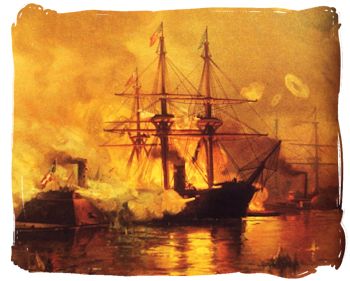
March 11th. At five-thirty A. M. got under way, and continued on up the river. At nine A. M. brought ship to anchor off the city of Baton Rouge, La. The crew have been employed to-day coaling ship.


