Following the American Civil War Sesquicentennial with day by day writings of the time, currently 1863.

March 2013


March 10th, Tuesday.

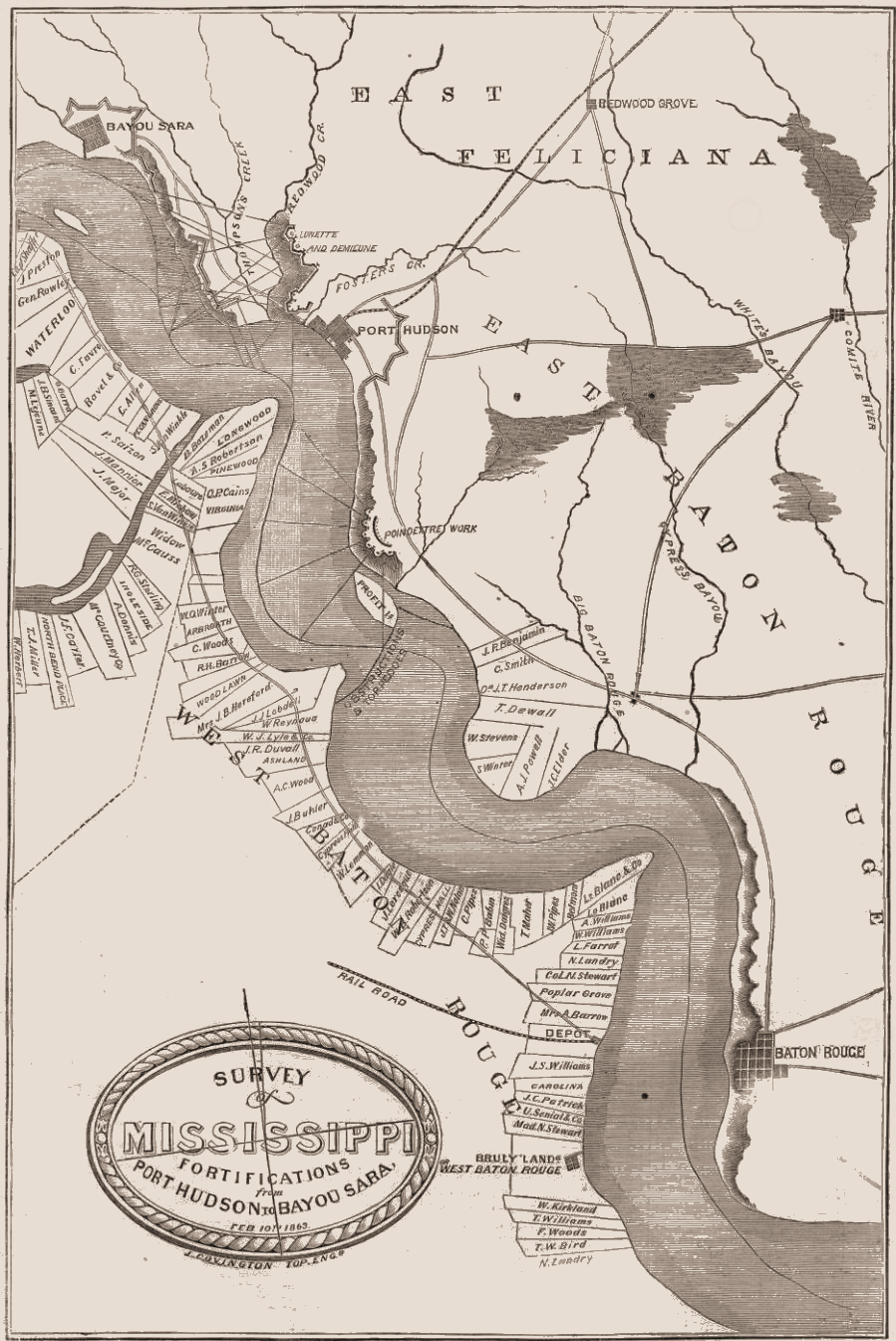
I had so many nice things to say — which now, alas, are knocked forever from my head — when news came that the Yankees were advancing on us, and were already within fifteen miles. The panic which followed reminded me forcibly of our running days in Baton Rouge. Each one rapidly threw into trunks all clothing worth saving, with silver and valuables, to send to the upper plantation. I sprang up, determined to leave instantly for Clinton so mother would not be alarmed for our safety; but before I got halfway dressed, Helen Carter came in, and insisted on my remaining, declaring that my sickness and inability to move would prove a protection to the house, and save it from being burned over their heads. Put on that plea, though I have no faith in melting the bowels of compassion of a Yankee, myself, I consented to remain, as Miriam urgently represented the dangers awaiting Clinton. So she tossed all we owned into our trunk to send to mother as hostage of our return, and it is now awaiting the cars. My earthly possessions are all reposing by me on the bed at this instant, consisting of my guitar, a change of clothes, running-bag, cabas, and this book. For in spite of their entreaties, I would not send it to Clinton, expecting those already there to meet with a fiery death — though I would like to preserve those of the most exciting year of my life. They tell me that this will be read aloud to me to torment me, but I am determined to burn it if there is any danger of that. Why, I would die without some means of expressing my feelings in the stirring hours so rapidly approaching. I shall keep it by me.

Such bustle and confusion! Every one hurried, anxious, excited, whispering, packing trunks, sending them off; wondering negroes looking on in amazement until ordered to mount the carts waiting at the door, which are to carry them too away. How disappointed the Yankees will be at finding only white girls instead of their dear sisters and brothers whom they love so tenderly! Sorry for their disappointment!

“They say” they are advancing in overwhelming numbers. That is nothing, so long as God helps us, and from our very souls we pray His blessing on us in this our hour of need. For myself, I cannot yet fully believe they are coming. It would be a relief to have it over. I have taken the responsibility of Lydia’s jewelry on my shoulders, and hope to be able to save it in the rush which will take place. Down at the cars Miriam met Frank Enders, going to Clinton in charge of a car full of Yankees, — deserters, who came into our lines. He thinks, just as I do, that our trunks are safer here than there. Now that they are all off, we all agree that it was the most foolish thing we could have done. These Yankees interfere with all our arrangements.

I am almost ashamed to confess what an absurdly selfish thought occurred to me a while ago. I was lamenting to myself all the troubles that surround us, the dangers and difficulties that perplex us, thinking of the probable fate that might befall some of our brave friends and defenders in Port Hudson, when I thought, too, of the fun we would miss. Horrid, was it not? But worse than that, I was longing for something to read, when I remembered Frank told me he had sent to Alexandria for Bulwer’s “Strange Story” for me, and then I unconsciously said, “How I wish it would get here before the Yankees!” I am very anxious to read it, but confess I am ashamed of having thought of it at such a crisis. So I toss up the farthing Frank gave me for a keepsake the other day, and say I’ll try in future to think less of my own comfort and pleasure.

Poor Mr. Halsey! What a sad fate the pets he procures for me meet! He stopped here just now on his way somewhere, and sent me a curious bundle with a strange story, by Miriam. It seems he got a little flying-squirrel for me to play with (must know my partiality for pets), and last night, while attempting to tame him, the little creature bit his finger, whereupon he naturally let him fall on the ground, (Temper!) which put a period to his existence. He had the nerve to skin him after the foul murder, and sent all that remains of him out to me to prove his original intention. The softest, longest, prettiest fur, and such a duck of a tail! Poor little animal could n’t have been larger than my fist. Wonder if its spirit will meet with that of the little bird which flew heavenward with all that pink ribbon and my letter from Mr. Halsey?

March 10, Tuesday. I saw last evening a communication from the State Department inclosing several pages of regulations for letters of marque. The subject was to-day before the Cabinet, and there is a stronger disposition for the policy than I expected. I told the President I had given the proposed regulations but a cursory examination. The subject was therefore postponed to our Friday meeting, with an understanding that I should in the mean time examine them and report if they were objectionable. On looking over the sections, I find they are a transcript of the laws of 1812 and 1813, which the Secretary of State has embodied in a series of regulations which he proposes to issue. The old laws of half a century ago have expired. It is not pretended they have vitality. But the Secretary of State legislates by regulations. I am not favorably impressed with the law or the regulations, nor with the idea of sending out privateers against a couple of piratical cruisers, even if there are private parties fools enough to go on that hunt, which he says there are, but I doubt. The law undertakes to delegate legislative power to the President, which is in itself wrong. But the subject is, I fear, a foregone conclusion. Both Seward and Chase favor it, and the commercial community is greatly exasperated against the robbers. If the subject goes forward, S. will turn the whole labor and responsibility over to the Navy Department.

March 10.—We have just received a box full of good things, from the Hebrew Military Aid Society in Mobile; preserves, sardines, wines, oysters, spices, and also twenty-four pairs of socks; we also received five hundred dollars, sent by Daniel Wheeler, Esq., from the Richmond fund in Mobile, all of which is most acceptable.

1 received a letter a few days ago from Mr. Ellman, president of the Hebrew Military Aid Society, with a list of the articles in the box, informing me of its having been sent. I had told some of the patients what they might expect, and they have been anxiously looking for the arrival of the box. I have an invitation to a grand ball, to be given in honor of General Johnston, our commander-in-chief; of course I have no idea of accepting.

Mrs.W. and I live like Sisters of Charity; we get up in the morning about 4 o’clock, and breakfast by candle-light, which meal consists of real coffee without milk, but sugar, hash, and bread; we eat it in our room. Unless we get up early, we find it impossible to get through with our duties. Mrs. W. prepares toddies and egg-nogs; I see that the delicacies for the sick are properly prepared. After the duties of the day are over, we then write letters for the men, telling their relations they are here, or informing them of their decease; other times mending some little articles for them. Mrs. W. is up many a night till 12 o’clock, working for her “dear boys,” as she calls them.

We have a very nice set of men as cooks, who will not let us do any thing for ourselves, if they can help it. They make our fires, and bring us wood and water; in fact, we want for nothing they can procure for us. In the language of Mrs. W., I say, “God bless them all.” Our head cook is a young man about nineteen, by the name of Gordon Halford; he was very sick when he first came here; we paid him some little attention, and he is so grateful that he seems to think he can never repay us; he is a perfect treasure. We have another one, who is now quite sick, whose name is Allen; he is one of John Morgan’s squadron, and the best of men. I can scarcely keep from laughing when I see him standing by the stove, turning batter-cakes; he is so tall. There is also a Mr. Drew, who came here sick; these men are serving their country as effectually as if they were in the field, and much better, for they could not stand field service; they get many a sneer for being here, but people who do what they feel to be their duty need not mind that.

The great trouble about hospitals is the sameness of the diet; in the morning we have batter-cakes made of the mush left from the previous meal, rice, and stale bread, (I do not mean what the men leave, as nothing is used which has been in the wards,) hash made out of the soup-meat, toast, mush, milk, tea, coffee, and beefsteak. Our batter-cakes never have eggs in them; they have a little flour and soda, and are very nice. For dinner, we have and chicken soup, potatoes, rice, dried fruit, and for dessert a luxurious baked pudding, made of the same materials as the battercakes, with molasses for sweetening, with the addition of spices. For each meal we have what is called special diet, for the worst cases sometimes, as is specially ordered by the surgeons, and others whatever we can get the patient to eat; it generally consists of light diet, such as chicken and beef-tea, arrow-root, sago, boiled milk thickened with flour, milk, tea, and toast. We get a good deal of milk and eggs now. For supper we have dried fruit, toast, tea, and coffee.

Our kitchen is a nice one; it has a distributing room next to it. Our quartermaster, Captain Gribble, is very kind in supplying us with as many dishes as we want.

There is a large kitchen and convalescent dining-room down-stairs, and an officer’s table, in a room by itself. The diet of the latter is the same as that of privates; the diet is far from being what it ought to be, but it is the best that can be had. We have trouble in keeping tableware, no matter how closely it is watched; soldiers will carry it off; they seem to think that government property is theirs, and they have a right to take it whenever they please. We lose dozens of spoons, cups, plates, knives, and forks in this way. On the tables for the convalescents we have table covers, although I prefer a wellscoured bare table; but the surgeons wish to make the hospital as much like home as possible.

There is one department in which I think there could be a great improvement—the laundry. When the men come in, their clothes are taken off and clean ones put on; their dirty ones are put in their haversacks, just as they are when taken off. When the men leave to go to another hospital, their soiled ones are put on again. I told Dr. Hunter I did not think it was right; he replied, it could not be avoided, as hundreds are coming and going daily. The fact is, it is almost impossible to get people to do washing.

Mrs. Lyon’s Diary.

Fort Donelson, March 10, 1863.—Raining all day. Captain Woodman and the Rugers took dinner with us. The Armeda came with the rest of the ladies. They came around by Paducah. Only two ladies out of 24 went home.

10th. After breakfast got up the rations and got shaved. Read some in the Ledger. Bought some maple sugar. Took a little down to Thede. In the evening wrote to Sarah Felton and a little to Fannie. Got a good letter from Minnie and Mother. Checkers with Mason and Mac.

Tuesday March 10th 1863

It has snowed and rained the most of the day and been as unpleasant as ever. Maj E P Taft came down from the Fort today and called upon me at the office. Staid till near three o’clock and I went down to the Hotel with him where I met “Carrie” Knowles who has been down to visit her husband. Lieut Col Seward was also there. The news boys were crying the evening papers vociferously, “Latest News Capture of Vandorns Rebel Army.” Well there is such a report in the papers tonight, but only a report. We shall know more in a day or two about it. At Vicksburgh Genl Grant is fighting the Rebels with Water and threatening to deluge the whole Country by turning the Waters of the Miss River. The papers say that the inhabitants are much alarmed. Outrages in this City are becoming quite frequent. Last night there was one man murdered on P.A. Ave and two roberies in frequented parts of the City in the evening. Men were knocked down in the street & robed. I think I will stay in as I have this evening, but the mud kept me in tonight. I sent off the soldiers money this afternoon and enclosed a good deal more and directed for soldiers while at the Express office. Wrote home & may go home the last of the week.

On the Mississippi, Tuesday, March 10. Arose with but poor rest, it having rained all night, and lying on deck with the tarpaulin but poorly arranged. Got very wet. Rained steadily all day. Amused myself best I could reading what I could in the crowded cabin filled with the tobacco fumes, and boisterous with card players. 4 P. M. mail arrived. Rec’d a letter from J. L. and T. L. and three papers. All well. Brother James lame by accident, poor fellow, but thanks to kind Providence, he is under the nursing of a devoted mother and tender sisters. Priceless boon.

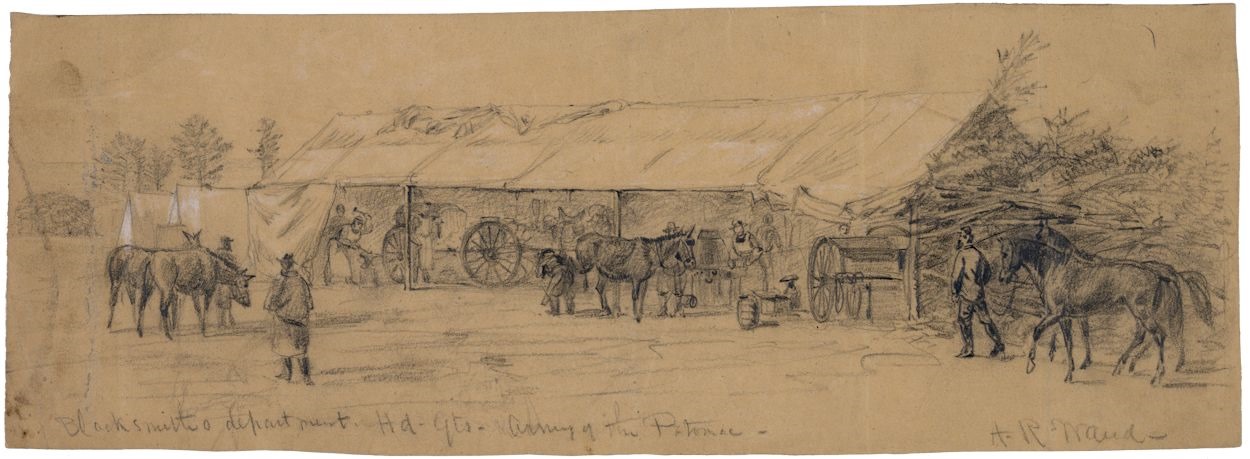
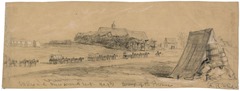
Blacksmiths department Hd. qts. Army of the Potomac 21397uWE devote pages 244 and 245 to illustrations of the HEAD-QUARTERS OF THE ARMY OF THE POTOMAC, from sketches by Mr. A. R. Waud.

Mr. Waud writes:

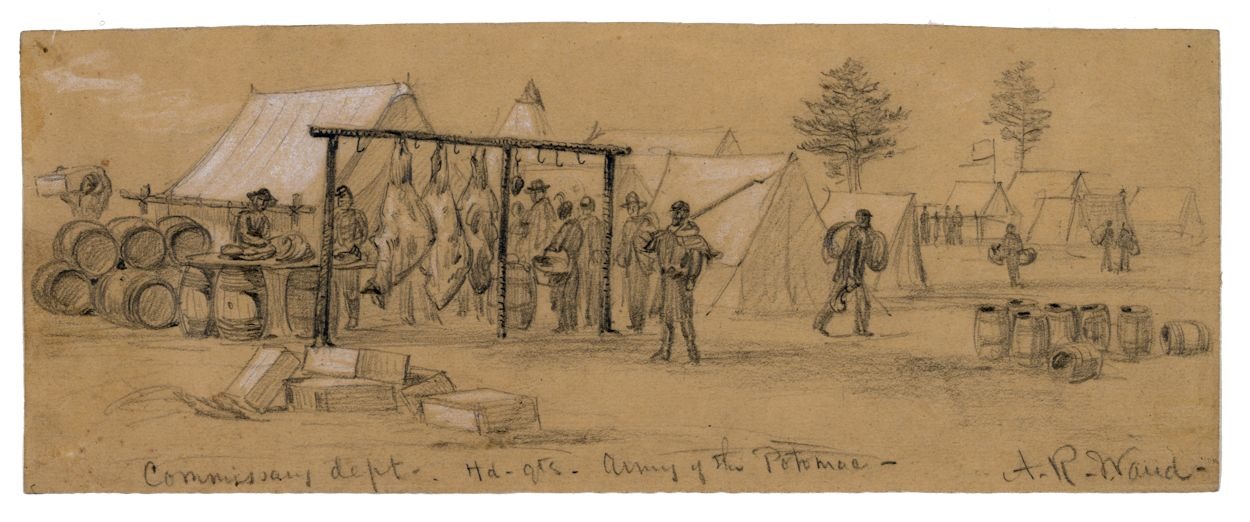
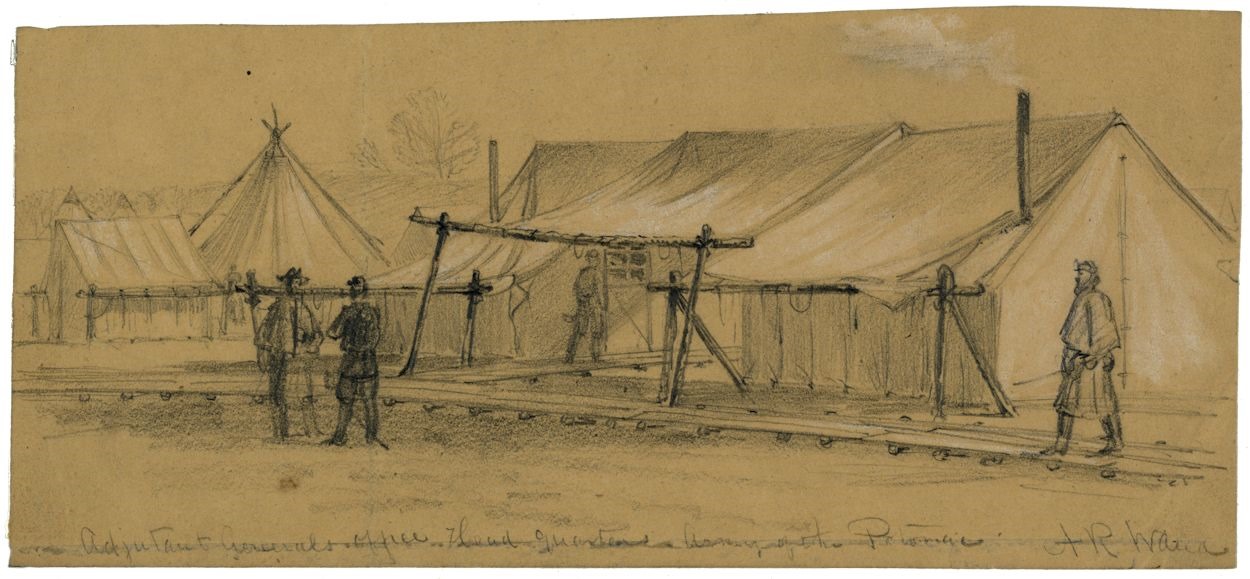
Stables and Negro servants tent, hd.qtrs Army of the Potomac 20918u“The term headquarters’ conveys but a vague idea to the uninitiated. Most people are aware that the general lives and has his tent there, but of the necessity and use of the large train of Genl. J. Hooker's. Tent Hdqts. Army of Potomac 20891uofficers that accompany the general few out of the army have a correct idea. In the first place, the general must have his personal aids, whose duty it is to be always in attendance, to assist their commander in his plans, carry dispatches of importance, make themselves Army Mail leaving Hd.Qts. Post Office. Army Potomac 21422uconversant with the position of the army and the roads, and in battle direct, under the general’s orders, the movements of the various corps, etc., etc. The chief of staff, whose tent is always near the Provost Marshals department. Hd. qtrs. Army Potomac 21388ugeneral’s, has a very onerous position. He must keep himself accurately posted on the actual condition of the army in all its departments, the intention and results of its movements, reconnoissances, etc. Commissary dept. Hd.qts. Army of the Potomac 21050uThrough him the general’s orders are transmitted, and it is his duty to furnish the commander-in-chief and the head of the War Department tables of the strength and position of corps and posts, Adjutant Generals office head quarters, Army of the Potomac 20919ureports of operations, and all necessary information. Next to the commander, the chief of staff is the man of the whole army who can do the most good if he is capable, and the most harm if deficient in ability.
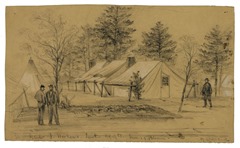
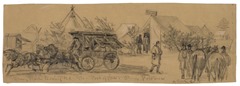
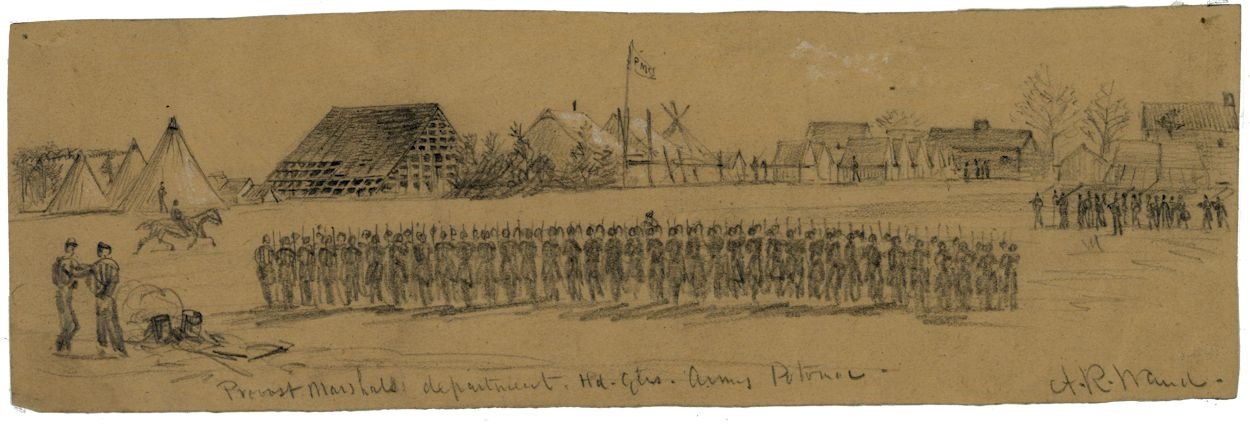
“The remainder of the officers of head-quarters are chiefs of the departments in which the army is divided and their aids. The Adjutant-General’s department, through which orders are published, reports and returns received and disposed of, tables formed of the state and detail of the army, records made, and much more. The Engineers’, whose duty it is to construct fortifications, field defenses, roads, bridges, etc., and remove obstructions. The Topographical Engineers’, whose duty it is to survey and map the country in which the army is to operate, attend reconnoissances, examine routes of communication by land and water both for supplies and military movements, and lay out new roads. The Chief of Artillery, in a siege or battle, directs the position of the artillery, and is responsible for the condition of that arm of the service. The Chief of Cavalry has similar duties in the cavalry. The Chief of Ordnance has charge of and furnishes all ordnance and ordnance stores for the military service; also equipments for mounted troops. The Inspector-General’s duties are to inspect and report upon stores and animals, and every thing required to keep the army in good condition. The Medical Director attends to the entire working of that department, and after a battle makes lists of the killed and wounded; and at other times regulates the management of the hospitals, the distribution of medical supplies, etc. The Chief Commissary, through whom the army is fed. The Chief Quarter-master, by whom it is clothed, provided with tents and transportation. The Provost-Marshal General, who receives prisoners, and attends to the police of the army, including the secret-service department. The Chief Signal-officer, and many minor departments or sub-departments, such as the telegraph-office, the post-office, the balloon party, and others—all tend, with their necessary complement of clerks for office-work, orderlies for out-door purposes, servants, and grooms, to swell the proportions of the camp at head-quarters, which is, in fact—under the orders of the War Department —the seat of government, the metropolis, or capital, of the community which is formed by the presence of the army.” (Harper’s Weekly, April 18, 1863)

Tuesday, 10th—Could not get forage.

Map of the Course of the Mississippi from Bayou Sara to Baton Rouge.

Harper’s Weekly, April 4, 1863