March 5—Up to to-day there is nothing worth recording, although we are getting black as negroes on account of our burning green pine.
March 2013
March 5, Thursday. Went on the evening of the 3d inst. to the Capitol. Spent most of the time until eleven o’clock in the President’s room. It is my first visit to the Capitol since the session commenced. Was for half an hour on the floor of the House. Thirty-four years ago spent the night of the 3d of March on the floor of the Representatives’ Chamber. It was in the old Representatives’ Hall. Andrew Stevenson was Speaker. I first saw Henry Clay that night. He came from the President’s room to the House about ten. It was to him the scene of old triumphs, and friends crowded around him.
I subsequently went into the Senate Chamber, a much larger but less pleasant room than the old one, which I first visited in the last days of the second Adams. If the present room is larger, the Senators seemed smaller. My first impressions were doubtless more reverential than those of later times.
The deportment of the Members in both houses was calm and in favorable contrast with what I have ever seen of the closing hours of any session, and I have witnessed many. There was nothing boisterous, and but little that was factious. It was nearly midnight when we left. On the morning of the 4th I was at the Capitol, from ten till twelve. All passed off harmoniously.
The recent dispatches of Consul Morse at London, and information from other sources, render it necessary measures should be taken to prevent the Rebels from getting a considerable naval force afloat.

Mrs. Lyon’s Diary.
March 5, 1863.—Stayed with Mrs. Hewitt all night. We hardly slept a bit. We were afraid of guerillas. There were strange men all through the camp in the day time. We were afraid they might come again at night. There is but a small guard left here to protect us. No boat yet.
Thursday, 5th—We had regimental and camp inspection this morning at 10 o’clock, conducted by a major of General McPherson’s staff. We came out in splendid order. The officers of the Eleventh Iowa met at 6 o’clock this evening to draw up resolutions demanding the hunting down of all Copperheads in the North. The steam tug was started on the lake today to inspect and make sure of the outlets from Providence Lake through the Tensas river to the Red river. These outlets must all be open before we let the water into the lake.
Washington Thursday March 5th 1863.
We are disappointed today as the report last night of the Capture of Fort McAllister is contradicted today. Still, there is something that is favorable to the Union cause as gold has fallen down to 150, or twenty percent in one day. We will hear news in a day or two, I think. I notice that the Town Elections in N York are going Democratic all over. But that does not indicate disloyalty to the Union, it is more like an expression of want of confidence in the Managers of the war. Very few democrats at the North (I think) would be willing to see the Union divided or that would consent to it without a much longer Struggle. But they do not want to see our Strength frittered away and are willing to rebuke those in power for their ineficiency and blunders. A few Victories will put the matter all right and I have the faith to believe that we shall soon hear of them. I attended the Lodge till nine o’clock and called on Mr Lieb (Profs). Judge Lieb the Uncle was there, his daughter, and Chas and Sallie. The air is quite keen tonight and it freezes quite hard. I called at Dr Munsons this morning. We have a large quantity of Union news papers to send to the Camps and Hospitals. They are sent from NY for distribution, gratis.
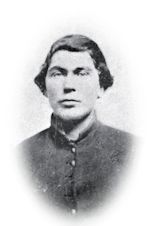
Grand Lake Landing, Thursday, March 5. Up early; got the horses; then got the carriages off the “Tecumseh” which was rather tough work. Came into park right by the levee and stretched our picket rope and put up the tarpaulin. Very wet all around. On guard. Health very good.
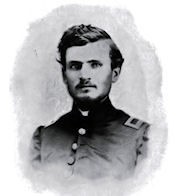
5th. My back quite well. Not much going on during the day. In the evening the boys mostly went out to town and mobbed the “Crisis” and then went to the “Statesman” but did no damage. Medary and the press were in Cincinnati. The boys carried off all the books, etc., they could find.
Note: The episode briefly referred to under date of March 5, 1863, was of this nature: At that time Samuel Medary, formerly a state official of considerable prominence, was conducting a weekly newspaper called “The Crisis” at Columbus. This periodical was perhaps the most bitter and dangerous and disloyal “Copperhead” sheet published in the North. Its utterances distinctly encouraged the Rebellion, instigated desertions of Union soldiers and thus promoted disunion, prolonged the war and increased the slaughter of Union troops. On the night of March 5th, a considerable number of Second Ohio boys mysteriously got through the guard line of the Camp Chase encampment, went quietly down town, threw out pickets for protection from the police, entered “The Crisis” office and thoroughly gutted it, throwing the type, presses, paper, etc., out of the back windows into the Scioto River. Then as quietly as they came they returned to camp, still unobserved by the sentinels on guard at camp, and went to bed. As mentioned in the subsequent entries in the diary, it proved impracticable to identify any of the participants and nobody was punished. The then Colonel of the Regiment, August V. Kautz of the Regular Army, and a son-in-law of then Governor Tod, was naturally greatly wrought up over the circumstance.—A. B. N.
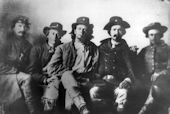
Thursday, 5th—Still on picket.

March 5th.—Spent last night in Richmond with my friend Mrs. R. This morning we attended Dr. Minnegerode’s prayer-meeting at seven o’clock. It is a blessed privilege enjoyed by people in town, that of attending religious services so often, particularly those social prayermeetings, now that we feel our dependence on an Almighty arm, and our need of prayer more than we ever did in our lives. The President has issued another proclamation, setting aside the 27th of this month for fasting and prayer.
Again I have applied for an office, which seems necessary to the support of the family. If I fail, I shall try to think /that it is not right for me to have it. Mr ——’s salary is not much more than is necessary to pay our share of the expenses of the mess. Several of us are engaged in making soap, and selling it, to buy things which seem essential to our wardrobes. A lady who has been perfectly independent in her circumstances, finding it necessary to do something of the kind for her support, has been very successful in making pickles and catsups for the restaurants. Another, like Mrs. Primrose, rejoices in her success in making gooseberry wine, which sparkles like champagne, and is the best domestic wine I ever drank; this is designed for the highest bidder. The exercise of this kind of industry works two ways: it supplies our wants, and gives comfort to the public. Almost every girl plaits her own hat, and that of her father, brother, and lover, if she has the bad taste to have a lover out of the army, which no girl of spirit would do unless he is incapacitated by sickness or wounds. But these hats are beautifully plaited of rye straw, and the ladies’ hats are shaped so becomingly, that though a Parisian milliner might pronounce them old-fashioned, and laugh them to scorn, yet our Confederate girls look fresh and lovely in them, with their gentle countenances and bright, enthusiastic eyes; and what do we care for Parisian style, particularly as it would have to come to us through Yankeeland? The blockade has taught our people their own resources; but I often think that when the great veil is removed, and reveals us to the world, we will, in some respects, be a precious set of antiques. The ladies occasionally contrive to get a fashion-plate “direct from France,” by way of Nassau; yet when one of them, with a laudable zeal for enhancing her own charms by embellishments from abroad, sends gold to Nassau, which should be kept in our own country, and receives in return a trunk of foreign fabrics, she will appear on the street immediately afterwards in a costume which seems to us so new and fantastic, that we are forced to the opinion that we would appear to the world ludicrously passé. A gentleman, lately from Columbia, tells me that the South Carolina girls pride themselves on their palmetto hats; and the belle of large fortune, who used think no bonnet presentable but one made by the first New York or Parisian milliner, now glories in her palmetto. The balmoral, too, the product of our own spinning-wheel and loom, would show well with the prettiest imported ones. I have seen several, which the young wearers told me were “dyed in the wool, spun, and woven by the poor of our own neighbourhood. The dye-stuffs were from our own woods.” These are little things, but, proving the independence of our people, I rejoice in them.; The croakers are now indulging themselves with fears of famine; they elongate their gloomy visages, and tell us, in sad accents, that butter was $3.50 per pound in market this morning, and other things in proportion. I am sorry to say that it is true, and that it is evident we must have scarcity, particularly of such things as butter, for the cattle must go to feed the army. The soldiers must be fed; our gardens will give us vegetables; God will give us the fruits of the earth abundantly, as in days past, and if we are reduced, which 1 do not anticipate, to bread and water, we will bear it cheerfully, thank God, and take courage:
“Brought safely by his hand thus far,
Why should we now give place to fear?”
The poor, being well supplied with Government work, are better off than usual.
All quiet in the army. This may portend a storm. Several pieces of cannon passed this morning on the Fredericksburg train. Raids still continue in the Northern Neck, keeping us very uneasy about our friends there.

MARCH 5TH.—Yesterday the government seized the flour in the mills and warehouses; and now the price has risen from $30 to $40 per barrel. I wrote to the Commissary, in view of the dissatisfaction of the people, and to prevent disturbances, advising him to seize the 5000 barrels in the hands of the small speculators, and to allow so many pounds per month to each inhabitant, at the rate paid by government. This would be beneficent and popular, confining the grumblers to the extortioners. But he will not do it, as the Constitution only provides for impressments for the public use.
Our dinner to-day (for seven, for the servant has an equal share) consisted of twelve eggs, $1.25; a little corn bread, some rice and potatoes. How long shall we have even this variety and amount? Bad beef in market, this morning, sold at $1.25 per pound.
After bombarding FortMcAlister on the 3d inst. and all night, the enemy’s fire ceased. The fort was not much injured, says the dispatch. There is a rumor to-day that the fort has been reduced—but no one believes it.
Gen. Van Dorn has had a fight in Tennessee, killing and wounding 1000 and capturing 2600 prisoners. Our loss is said to have been heavy.
Gen. Lee writes that now, since Lincoln may call out 3,000,000 men, and has $900,000,000 voted him, we must put out all our strength, if we expect to keep the field. We shall certainly have an exciting time. But there may be use for some of the Federal troops in the North! If not, I apprehend that Richmond must withstand another siege and assault. It is said they have dropped the “Constitution and the Union” in the United States, and raised the cry of the “NATION” and the “FLAG.” This alarms me. If they get up a new sensation, they will raise new armies.
Gold is selling at a premium of $4.25 in Confederate notes.
We bought a barrel of flour to-day (that is, my wife paid for one not yet delivered), from a dealer who was not an extortioner, for the moderate sum of $28.00. This, with what we have on hand, ought to suffice until the growing wheat matures.
For tea we had meal coffee, and corn cakes without butter. But we had a half-pint of molasses (for seven) which cost 75 cts. The gaunt specter is approaching nearer every day!
Every morning there is a large crowd of Irish and Germans besieging Gen. Winder’s office for passports to go North. Is it famine they dread, or a desire to keep out of the war? Will they not be conscripted in the North? They say they can get consular protection there.


