
Friday, 6th—I was detailed to go on picket with Company D. Had quite a thunderstorm this evening.
March 2013
Washington Friday March 6th 1863.
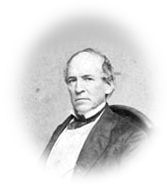
No news today of any importance from the armies or from the southern coast. We are in a State of great anxiety just now. It seems so important that we should now hear of Victories and I cannot but think that our troops will be successful wherever they strike at the Rebels. We are in a better condition now to strike hard blows than we have ever been before. Our armies now in the field are stronger than ever before, if not as numerous, for they have got rid of the most of the inefficient officers as well as soldiers. The “weak kneed” and the faint hearted have gone been going home by the thousands every week all winter. I have been in the office today as usual. After leaving it I went down on to the Ave, droped into Bradys Photograph Gallery which is one of the Institutions of Washington. Genl Sumner of the Army was there and I was introduced to him by my friend the Artist Mulvaney and had some conversation with him. He is not as white haired and bearded as the Pictures represent him, his hair and beard is a fair iron grey. I told him that I found him a much younger looking officer than I expected, which seemed to please him, as he said he the pictures did not do him justice. I spent an hour at Charleys and then was over to Doct Munsons where I staid an hour more.
Grand Lake Landing, Friday, March 6. Cloudy and windy. General Quinby went down on the “Superior” to Providence, returned in the evening. In the afternoon David Evans and myself went down stream on the levee, bareback about three miles, where the engineers were at work digging out the levee. Took a drink in Louisiana and returned to camp with no better impression of the sunny South.

6th. In the morning the colonel called the officers together and stated in tears that he should resign if the thing were not ferreted out. I was in Case’s tent. C. and H. burned their property. Officers feigned a search but found nothing. In the evening officers held a meeting and passed resolutions. Medary received at the cars by democrats.
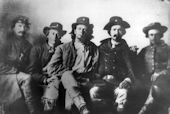
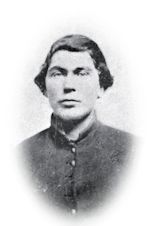
Friday, 6th—Relieved by K. and F. Raining all day and night. Sent on bread detail with Big Ugly, got back after night, raining.
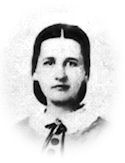
March 6th, 1863.—It is hard to even think, because I want to see Grandpa so bad. We were going to him in the summer and now I will never see him again. Father says I will see him in that beautiful Heaven, which he loved to talk of but it seems so far away. Grandma has sent me a lock of his lovely snow-white hair, but there is no comfort in that, for it only makes me long the more to put my arms about his neck and kiss the soft thick hair which glistened like silver.
His will has been read and he has left Uncle Kinchen and Aunt Amy in Mother’s care for the remainder of their lives; all their children were given to Mother, so they will not be separated from their family. Father has sent money to pay their way down and Uncle Kinchen is such a good traveler, they will get on all right.
Grandpa was buried in the cemetery at Enfield. He had stated in his will that he must be brought to Florida and buried beside Grandmother in our “God’s Acre,” but when he was dying he told them not to try to take his body back to Florida, the whole country is in such an upset condition on account of the war and he did not know what complications might arise. I wish he could have been brought here so we could take him flowers every day. I know what I can do, I can bear in remembrance the many talks we have had and try to be just what he wanted me to be.

MARCH 6TH.—I have meditated on this day, as the anniversary of my birth, and the shortening lapse of time between me and eternity. I am now fifty-three years of age. Hitherto I have dismissed from my mind, if not with actual indifference, yet with far more unconcern than at present, the recurring birthdays which plunged me farther in the vale of years. But now I cannot conceal from myself, if so disposed, that I am getting to be an old man. My hair is gray—but nevertheless my form is still erect, and my step is brisk enough. My fancies, tastes, and enjoyments have not changed perceptibly; and I can and often do write with-out glasses. I desire to live after this war is over, if it be the will of God—if not, I hope to exist in a better world.
We have no news of interest to-day. A letter says the non-combatants, even the women and children, heedless of danger, were voluntary spectators of the bombardment of Vicksburg the other day. The shells often exploded near them, and behind them, but the fascination was so great that they remained on the ground; even one had an arm carried away by a ball! Can such a people be subjugated?
Houses (furnished) are beginning to be offered more plentifully than ever before; their occupants and owners finding their ordinary incomes insufficient for subsistence. I suppose they mean to find in the country an escape from famine prices prevailing in the city.
There is a rumor this evening of the fall of Vicksburg; but that rumor has been whispered here several times during the last few months. No one believes it. When Vicksburg falls, many an invader will perish in its ruins.
March 6.—The ship Star of Peace was captured and burned by the rebel privateer Florida, under the command of Captain J. N. Maffit.—General Hunter in command of the Department of the South, from his headquarters at Port Royal, S. C, issued an order drafting for garrison duty all the able-bodied negroes in his department, not otherwise employed in the service of the National government.—General Orders, No. 17.
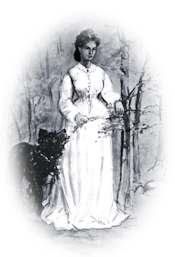
March 5th [1863]. We have company all day long. I think I prefer the fashionable way of receiving—only on reception days. I hate the custom, but acknowledge the wisdom of it. I can not read, write, or do anything I wish, people are so very social. Mrs. Waugh brought us an armful of books this morning. She is so kind, so true, that she is no restraint on one, as some other people are. She respects and comprehends opinion, though that opinion may not agree with her own. She is accustomed to luxury, but is so simple-mannered that I do not mind carrying on any of my work before her. I told her she always saw me au naturelle—she laughed and said she felt highly complimented. I wish we might have her for a neighbor always. She says we shall not be separated in another world. I willingly give a morning to her. This afternoon there were others here, but somehow they slip my mind.
The Greatest Victory of the War, La Bataille des Mouchoirs.
Fought Friday, February 20th, 1863.
Of all the battles, modern or old,
By poet sung, or historian told,
Of all the routs that ever were seen,
From the days of Saladin to Marshal Turenne,
Of all the victories later yet won,
From Waterloo’s field to that of Bull Run,
All, all must hide their fading light
In the radiant glow of the Handkerchief Fight.
And a paean of joy must thrill through the land
When they hear the deeds of Banks’ band.
‘Twas on the levee, where the tide
Of Father Mississippi flows,
Our gallant lads, our country’s pride,
Won this victory o’er their foes,
Four hundred Rebels were to leave
That morning for Secessia’s shades,
When down there came, you’d scarce believe,
A troop of children, wives and maids
To wave farewells, to bid God speed,
To shed for them the parting tear,
To waft them kisses, as the meed
Of praise to soldier’s heart most dear.
They came in hundreds. Thousands lined
The streets, the roofs, the shipping too,
Their ribbons dancing in the wind,
Their bright eyes speaking love’s adieu.
‘Twas then to danger we awoke,
But nobly faced the unarmed throng,
And beat them back with hearty stroke,
Till reinforcements came along.
We waited long; our aching sight
Was strained in eager, anxious gaze,
At last we saw the bayonets bright
Flash in the sunlight’s welcome blaze;
The cannon’s dull and heavy roar
Fell greeting on our gladdened ear,
Then fired each eye, then glowed each soul,
For well we knew the strife was near.
“Charge!” rang the cry and on we dashed
Upon our female foes,
As seas in stormy fury lashed
When’er the tempest blows.
Like chaff their parasols went down,
As on our gallants rushed,
And many a bonnet, robe and gown,
Was torn to shreds, or crushed.
Though well we plied the bayonet,
Still some our efforts braved;
Defiant both of blow and threat
Their handkerchiefs still waved.
Thick grew the fight, loud rolled the din,
When “Charge!” rang out again,
And then the cannon thundered in,
And sounded o’er the plain.
Down ‘neath the unpitying iron heels
Of horses, children sank,
While through the crowd the cannon wheels
Mowed rows on either flank;
One startled shriek, one hollow groan,
One head-long rush, and then—
Huzza, the field was all our own,
For we were Banks’ men.
That night relieved from all our toils,
Our danger past and gone.
We gathered up the spoils
Our chivalry had won.
Five hundred kerchiefs had we snatched
From Rebel ladies’ hands;
Ten parasols, two shoes not matched,
Some ribbons, belts and bands,
And other things that I forget;
But then you’ll find them all,
As trophies, in that hallowed spot,
The cradle—Faneuil Hall.
And, long on Massachusetts’ shores,
Or on Green Mountain’s side,
Or where Long Island’s breakers roar,
And by the Hudson’s tide,
In time to come, when lamps are lit,
And home-fires brightly blaze,
While round the knees of heroes sit
The young of happier days,
Who listen to their storied deeds,
To them sublimely grand,
Then Glory shall award its meed,
Of praise to Banks’ band,
And Fame proclaim that they alone,
In triumph’s loudest note,
May wear henceforth, for valor shown,
A woman’s petticoat!
This poem is written by no one knows who, and printed sub-rosa. An order was issued sometime back by General Banks, attaching severe penalties to throw scorn upon any United States officer. This order was issued in Butler’s behalf, I believe, as the streets were at one time filled with accusatory and satirical productions inspired by that famous general. I have heard that Banks has seen this poem and that he is very angry. I have heard, too, that he had nothing to do with having the cannon sent upon the women and children, and that the infamy of the whole affair rests with Colonel French. Oh, well, I have also a surreptitious ode commanding this dear Crescent City to “Cheer up,” so I suppose that our day is coming. Thornton wanted the Cavalry armed with cowhides.
Mrs. Norton has a written bet on hand with Mayor Miller—formerly on Shepley’s staff—that Port Hudson would yield to Federal forces on or before the 4th of July. The stake, a basket of champagne. Mrs. Norton advised him to marry a Southern heiress and to change his politics. I would not let the upstart think, even in jest, that a Southern woman would marry him. He is good natured, but to my certain knowledge he is not honest. He lives in a “captured house” and broke open the trunks which Mrs. Brown left there, in search of sheets and table cloths. This he said himself.
The Indianola war ram has been captured by the Confederates. She passed the batteries at Vicksburg between the coal barges, which we also have taken. She was boarded, and the Queen of the West, which had also passed the batteries and been previously captured, was used in the fight against her old friend. She now floats another flag. We now have the river between Vicksburg and Port Hudson free of Federal vessels. Our trade from Red River, on which our soldiers so much depend, is still undisturbed. The last New York papers seem quite jubilant because their boat succeeded in passing the stronghold—but they were captured even before the news of the passing reached there. We are getting quite a navy. We have captured so much in Virginia, that the letters U. S. are stamped upon most everything we use—even the wagons and horses. Captain Semmes has been entertained at Kingston, and made a speech. People are anxiously looking for French recognition. Louis Napoleon is a deep character. I, for one, have no faith in his disinterestedness, and I am afraid to accept an overture of any sort from him. Should we be entangled with his politics I think our people would have more to remember than Louis XVI gave our forefathers. Recognition, perhaps, is our due, and nothing withholds it but a selfish fear of being accused of being too anxious to divide these States. That Europe desires the separation, we have had proof. Intervention (armed) I do not want. We have sustained ourselves so magnificently, that I feel a pride to fight all our own battles—fight them we can, both on sea and land.
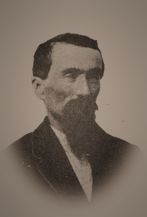
March 5 — To-day a little before noon the Yankees advanced with two regiments of infantry, cavalry, and two pieces of artillery. They drove in our pickets at Fisher’s Hill in a business-like manner and tried to make a big splutter, as though they intended to make a dashing advance and capture the Valley in one fell swoop. We were ordered out immediately and moved rapidly down the pike, but before we got to Woodstock we halted for further orders and tidings from the front. The Yankees’ advance was like an old woman’s dance,— powerful at first, but soon over. They fell back again toward Winchester this afternoon. We went back again to our old camp.


