March 30. — Colonel Stuart came up from Aquia Creek with one company. Captain Slosson’s boats were moved to-day. Captain Strang back from Washington.
March 2013
by John Beauchamp Jones
MARCH 30TH.—Gen. Bragg dispatches the government that Gen. Forrest has captured 800 prisoners in Tennessee, and several thousand of our men are making a successful raid in Kentucky.
Gen. Whiting makes urgent calls for reinforcements at Wilmington, and cannot be supplied with many.
Gen. Lee announces to the War Department that the spring campaign is now open, and his army may be in motion any day.
Col. Godwin (of King and Queen County) is here trying to prevail on the Secretary of War to put a stop to the blockade-runners, Jews, and spies, daily passing through his lines with passports from Gens. Elzey and Winder. He says the persons engaged in this illicit traffic are all extortioners and spies, and $50,000 worth of goods from the enemy’s country pass daily.
Col. Lay still repudiates Judge Meredith’s decision in his instructions to the Commandants of Camps of Instruction. Well, if we have a superabundance of fighting men in the field, the foreign-born denizens and Marylanders can remain at home and make money while the country that protects them is harried by the invader.
The gaunt form of wretched famine still approaches with rapid strides. Meal is now selling at $12 per bushel, and potatoes at $16. Meats have almost disappeared from the market, and none but the opulent can afford to pay $3.50 per pound for butter. Greens, however, of various kinds, are coming in; and as the season advances, we may expect a diminution of prices. It is strange that on the 30th of March, even in the “sunny South,” the fruit-trees are as bare of blossoms and foliage as at mid-winter. We shall have fire until the middle of May,—six months of winter!
I am spading up my little garden, and hope to raise a few vegetables to eke out a miserable subsistence for my family. My daughter Ann reads Shakspeare to me o’ nights, which saves my eyes.
March 30.—President Lincoln issued a proclamation designating and setting apart Thursday, the thirtieth day of April, as a day of national humiliation, fasting, and prayer.—(Doc. 151.)
—The correspondence between the rebel agent in London, J. M. Mason, and Earl Russell, the British Minister of Foreign Affairs, concerning the questions of the blockade of the Southern ports, and foreign intervention in the affairs of America, was made public.—See Supplement.
—A battle was this day fought near Somerset, Ky., between a National force under General Gillmore, and the rebel army under General Pegram, resulting in a defeat and rout of the latter with great loss.—(Doc. 152.)
—Washington, N. C., garrisoned, by two thousand National troops under the command of General Foster, was attacked this morning by a strong force of rebels under Generals Hill and Pettigrew. The Union pickets and skirmishers were driven in with considerable loss, but the gunboat Commodore Hull opening on the rebels with shell, they were driven back to the hills surrounding the town, where they immediately commenced to fortify themselves.—National Intelligencer.
—Mount Pleasant, Va., was this day captured and plundered by a numerous band of rebel guerrillas under Colonel Jenkins. The town was garrisoned by a company of the Thirteenth Virginia volunteer infantry, under the command of Captain Carter. They intrenched themselves in the court-house, where they were attacked by the rebels, but after a four hours’ contest, in which the rebels had twenty killed, twenty-five wounded, and twenty-seven of their number captured, they hastily retreated from the town, many of them throwing away their booty.—(Doc. 153.)
—General McClernand took possession of the town of Richmond, Miss., with a small force, driving the rebel cavalry from the place after two hours’ sharp fighting.
— The rebel schooner Expeditious was captured in the Savannah River. The vessel was from Nassau, N. P., with a cargo of three hundred and forty sacks of salt, and attempted to run past Fort Pulaski up to Savannah. In the darkness she missed the channel and went into Calibogue Sound, where she was discovered at daylight A detachment of the Forty-eighth regiment was at once put on board the Mattano and despatched to secure her, which they did.
Sunday, 29th.—Very hard storm of wind and rain last night; Steamboat “Vicksburg” broke loose and went off down the river. Regiment on guard in town; went back to camp and found almost every tent blown down.
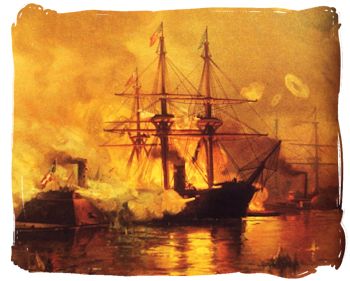
March 29th. Last evening at eight o’clock a severe storm set in, the wind blew very heavy; it rained, thundered and lightened exceeding anything I have ever seen before; at eleven o’clock we were obliged to let go our port anchor, as it was discovered that the ship was dragging. Half of the ship’s company were kept stationed at their guns, to be ready in case of any emergency, while the balance of the men were below sleeping in their hammocks; the night was dreadful. At one A. M. an object was seen moving down the river; it was reported by the lookout forward; the rattle was immediately sprung, calling all hands to quarters; those who were below in their hammocks were suddenly aroused from their slumbers, “and such a getting up stairs you never did see.” The object drifted down with the current until opposite our ship, and here it fetched up on the left bank of the river, which is, of course, the secesh side. Great excitement prevailed–the night being so very dark and stormy, it was feared that it might be one of the enemy’s boats stealing its way down to make an attack upon us. It is a mistaken idea of theirs, if they think they will catch us napping; however, this mysterious object, after the elapse of half an hour or so, was made out to be a steamer of some kind. We did not fire, although every gun was primed and ready, and every lock-string held taut, only waiting for the word of command to fire, but it was not deemed necessary, and one watch was sent below to turn in, while the other watch remained on deck at their guns, keeping a bright lookout for the enemy. At three o’clock the storm cleared up, the wind was still blowing very heavily, however; at daylight, this morning, the weather was quite clear, although very chilly. By this time we were informed that the mysterious object which caused so much excitement last night, was no less than the steamer Vicksburg, which had been tied up to the wharf, under the batteries of Vicksburg, for a long time. It is quite evident that she broke loose from her moorings in consequence of the heavy storm which prevailed. This afternoon, two of our boats’ crews were dispatched to board her; they returned, stating that she was a mere hulk, no machinery in her whatever; each of the men brought off something as a trophy, such as blankets, old boots, and a few old pictures, also half a dozen good muskets.
Sunday, 29th—We had a heavy rainstorm last night, blowing down several tents. Today it is quite rainy with a cool wind blowing. Being off duty today I remained in camp and read through the Book of Psalms.
March 29. — This forenoon, we are encamped at Donaldsonville, — a point fifty or sixty miles below Baton Rouge, on the western bank of the great river. It is the pleasantest camp we have ever had. The neighborhood of this town, and the country along the bayou La Fourche, which here opens out of the Mississippi, is said to be the garden of Louisiana.
The landscape just about the camp here must be very like Holland. The tents are pitched in a perfectly level field, — stretching, without a fence, far and wide, with only here and there a tree. Along one side of the field runs the bayou, behind its Levee. The water now brims up nearly to the edge of this Levee, though on the land side there must be a slope of six or eight feet from the top of the bank to the surface of the land. If an opening were made in the Levee, our camp would be instantly drowned by the rush of waters. Sloops and schooners of considerable tonnage sail up and down the bayou, and one full-sized clipper-ship lies at anchor just opposite us. To see these craft, we are obliged to look up. The water-line of the bayou is about on a level with our eyes; so that the hulls and rigging of the vessels are in the air, over our heads. At the mouth of the bayou is a fort, with pointed angles, smoothly cut, and turfed with green. It is very regularly built, with ditch, counterscarp, bastion, and berme. This again, I imagine, is a feature which this landscape has in common with that of the Low Countries. Vauban himself might have built this little fort; and Marlborough and Villars would feel quite at home manœuvring here.
Of course, we have very little idea where we are going, or what we are to encounter; for we are the soldiers of a general who keeps his own counsel. In a day or two, we expect to march from here to Thibodeaux, and thence onward to Berwick Bay. We have left Baton Rouge, probably not to see it again during our term of service. We marched in the moonlight aboard the transport that was to bring us here, two or three nights ago. I lay on the upper deck, propped up by my knapsack, and took my farewell of the buildings on the Levee. I have taken my farewell of Ed.’s grave. I have done my best for it. The cross stands firm and straight at the head: the mound above it is high and smooth, and green with clover. The vine above, now full of blossoms, has snowed down upon the turf a whole deep drift of white petals; and sweet baby-buds, cradled among the whispering leaves and sprays, rock to and fro over it constantly in the wind of spring.
March 29—Here still, but positively don’t know where we are.
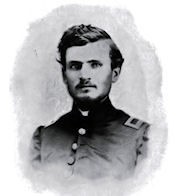
29th. After breakfast cleaned up and changed my clothes. Thede brought a note from home through Tully. Got a lesson and recited to Capt. N. Our new Chaplain, Brown, has been very busy visiting the companies. Hope he may do much good. How we need some religious influence. I long for a closer walk with God. Read Independent and “Guide to the Savior.”
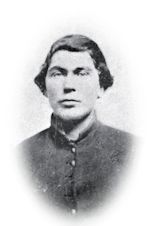
On the Coldwater, Sunday, March 29. Cold, disagreeable. Sleet and rain part of the time. Health much better. Tied up near shore. Got our horses off across the “White Rose”; gave them good exercise. Stretched a picket, left them for the night. A solitary tent with two cases of small-pox was to be seen, left by the Louisiana fleet. Wrote home.


