Following the American Civil War Sesquicentennial with day by day writings of the time, currently 1863.

March 2013

Church Service.

March 29. Church service today for the first time in several weeks; we occupied the Methodist church. Chaplain James discoursed on neutrality. He said there could be no such thing as neutrality; a man must be one thing or the other, and those who do not declare for the government, should be treated as its enemies. The house was well filled with soldiers and the galleries running around three sides of the house were filled with darkies, who somewhat resembled an approaching thunder squall.

29th [March]. A vote of thanks has been passed in our Confederate Congress to all those who were true and brave enough to refuse allegiance to the United States. This is well; I feel glad and proud and a thrill passes through me, knowing that I never, for one instant, faltered; neither did Ginnie. We were both begged, too, and considered obstinate and romantic. No outsider can ever realize the state of mind to which the people of this city were reduced in those days. Our ideas of Butler’s character enabled us easily to realize in full force any evil which report proclaimed him about to do. Prison, hard labor; exile we feared; evils of all sorts. A cotton press was fixed up by the authorities for some purpose. Report instantly proclaimed that it was for “Rebel women”—intended to put them to work at it. So also with a large stable which underwent some repairs; the women were to be confined there and made to wash and cook for Yankee soldiers. We tied up the few relics which we thought to conceal; burned many a dear old letter and made a general consignment to those who had taken the oath, then sat down patiently to wait our fate.

We knew that Butler had vowed to humiliate the women of New Orleans. We knew that the police were bribed as well as the servants to inform on every member of every household who had defied him, and the sufferings of Mrs. Phillips and Mrs. Coan in solitary confinement on Ship Island enabled us to realize any fate which the tyrant might choose for us. Until the coming of General Banks we never knew what would be done with us or to us. How can an outsider ever know what a temptation it was to us to take that oath. Many women, and men, too, took it in tears. Some went with the intention of taking it, and found they could not. Some fainted and some went crazy. Upon the whole, my opinion of the earnestness of our people was greatly strengthened by the hateful tests which Butler applied to their character. Mrs. Norton would go to town every day while the oathing was going on, and return each day with new reports. “We will be alone, girls, I do believe,” she would say; “everybody is taking the oath.” So we knew there would be no escape for us. I had really forgotten that Mrs. Roselius had taken it, although she had used so many arguments to make us do so, and to-day sent her Doctor Palmer’s letter on the oath-taking. I was sorry for it afterward. She came over after dinner and cried as bitterly as she did the day she took it. She does not spare herself. “I should not have yielded to Mr. Roselius,” she does not scruple to say. She is the warmest of Confederates and continues to talk like one, and hates the Yankees a thousand times worse than before. Mr. Roselius, though he made her take the oath, continually throws up the recollection to her. I despise French husbands! He is a Federal, too!

Mrs. Norton has been watching constantly for the policeman to whom she entrusted the warrant for Mary. He has discovered that Mary is with Jake, Emma and Reuben, her husband. Just three weeks ago she ran in to her mistress for protection against Reuben, who had threatened to kill her. Mrs. Norton went to Mary’s to get Jake, and Reuben slammed the door in her face—her hand barely escaping. Her hand was resting on the side of the jamb. He gave her much impudence, too, she says; so did Mary. The policeman came to-night late, saying that he had just got the three in jail; she has to appear early tomorrow in court and swear that Mary stole Jake; she has asked me to go with her. It makes me nervous to think of it. We have all advised and begged her not to meddle with her negroes now, knowing that the Federals will protect them, no matter what Mrs. Norton can say or do. Ginnie saw Reuben in this part of town to-day, pointing out this house to negro soldiers, and Jane saw white ones stoop and look at the name on the gate.

Camp at Lagrange, Tenn.,

March 29, 1863.

All perfectly quiet except the regular picket firing every night which here exceeds anything I ever before met in my experience. ‘Tis singular, too, for we have a large force of cavalry here and I should think the rascals would hardly dare to venture so near them. A few days since three guerrillas came up to one of our cavalry pickets, and while he was examining one of their passes the others watching their chance gobbled him. They at once retreated. The sergeant of the picket heard a little noise on the post and just got there in time to see the secesh disappear. He raised the alarm, and a party followed them on the run for 15 miles, rescued our man, killed three and captured four of the rascals, Yesterday some of Richardson’s men displaced a rail on the track ten miles west of this place, and captured a train. They got away with their prisoners, but hadn’t time to destroy the cars. ‘Tisn’t safe to go three miles from camp now, although 100 men can go 40 miles in any direction safely. Do you hear of any deserters returning under the President’s proclamation? I hope to the Lord that my black sheep won’t come back. A letter came for him to-day, and I opened it. ‘Twas from his father advising him to get out of this “Abolishun” war as quickly as he could. His “Pa and Ma” are welcome to him. Generals Sullivan, Denver and Hamilton have all left this country within the last few days, for Vicksburg. General Smith commands our division now. We are now in the 2d Brigade, 1st Division, 16th Army Corps. The colonel of the 6th Iowa is the ranking officer in the brigade but he is now sick, so Colonel Wolcott of the 46th Ohio now runs. Two captains of the 46th Ohio, and myself have been constituted by Smith a “Board of Survey,” to appraise damages committed by our army in the property of loyal citizens here. I think he has just done it to get the citizens off his hands. Have no idea that they will ever be allowed anything for their losses. There were three bills, each over $2,500, sent in to us yesterday. I hope the general will allow us to drop the business this week; if he will not, however, we can be kept busy for almost any length of time. By Smith’s orders the reveille is sounded now at 4 o’clock a.m. and the men appear with arms and accoutrements, and form line of battle. This is to avoid any bad consequnces which follow a Rebel cavalry dash at daylight, if we should be found in our tents. I think ’tis an excellent policy to be always ready for the enemy, but I declare I dislike this early rising very much.

March 29. —Went over to the 10th Massachusetts, with Whittier.[1] Saw Ropes, Macy, and Holmes. Was not very successful in regard to George. From the loth we went to General Whipple’s headquarters, where we saw Henry Dalton. From there went to General [Charles] Griffin’s, and then to [George M.] Barnard’s. Started from the i8th Massachusetts to the 1st Massachusetts Cavalry, where I saw Clapp and Bowditch.[2] Spoke to Clapp about coming here as inspector-general. He said he would like to come. Day very pleasant, but windy.


[1] Charles A. Whittier, my classmate.

[2] Charming Clapp, and Nathaniel I. Bowditch.

by John Beauchamp Jones

MARCH 29TH.—No news. Yet a universal expectation. What is expected is not clearly defined. Those who are making money rapidly no doubt desire a prolongation of the war, irrespective of political consequences. But the people, the majority in the United States, seem to have lost their power. And their representatives in Congress are completely subordinated by the Executive, and rendered subservient to his will. President Lincoln can have any measure adopted or any measure defeated, at pleasure. Such is the irresistible power of enormous executive patronage. He may extend the sessions or terminate them, and so, all power, for the time being, reposes in the hands of the President.

A day of reckoning will come, for the people of the United States will resume the powers of which the war has temporarily dispossessed them, or else there will be disruptions, and civil war will submerge the earth in blood. The time has not arrived, or else the right men have not arisen, for the establishment of despotisms.

Everything depends upon the issues of the present campaign, and upon them it may be bootless to speculate. No one may foretell the fortunes of war—I mean where victory will ultimately perch in this frightful struggle. We are environed and invaded by not less than 600,000 men in arms, and we have not in the field more than 250,000 to oppose them. But we have the advantage of occupying the interior position, always affording superior facilities for concentration. Besides, our men must prevail in combat, or lose their property, country, freedom, everything,—at least this is their conviction. On the other hand, the enemy, in yielding the contest, may retire into their own country, and possess everything they enjoyed before the war began. Hence it may be confidently believed that in all the battles of this spring, when the numbers are nearly equal, the Confederates will be the victors, and even when the enemy have superior numbers, the armies of the South will fight with Roman desperation. The conflict will be appalling and sanguinary beyond example, provided the invader stand up to it. That much is certain. And if our armies are overthrown, we may be no nearer peace than before. The paper money would be valueless, and the large fortunes accumulated by the speculators, turning to dust and ashes on their lips, might engender a new exasperation, resulting in a regenerated patriotism and a universal determination to achieve independence or die in the attempt.

March 29.—The schooner Nettie was captured by the United States steamer South-Carolina, about twenty-five miles east of Port Royal, with a cargo consisting of cotton, mostly damaged.— A party of blockade runners was captured at Poplar Hill Creek, Md., by a detachment of the First Maryland regiment, under the command of Lieutenant J. L. Williams.

—A detachment of the Sixth Illinois cavalry, under the command of Colonel Loomis, while encamped near Somerville, Tenn, were surprised by a large force of rebel guerrillas under Colonel Richardson, but after a desperate conflict, in which the National party had over forty of their number killed and wounded, the rebels were beaten off and retreated.—Chicago Times.

—Early this morning the National pickets in the vicinity of Williamsburgh, Va., were attacked by an overwhelming number of rebel cavalry, killing two, wounding six—including Lieutenant Wingel, of the Fifth Pennsylvania, in command of the pickets —and taking three prisoners. Eight horses were killed, one of which received as many as thirteen balls.

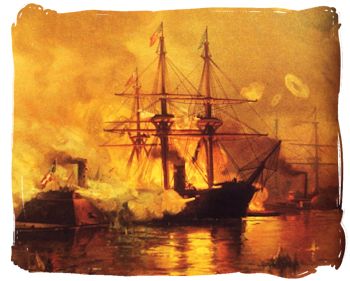
March 28th. This morning at four o’clock all hands were called; five A. M., got ship under way; five-thirty A. M., opened fire upon the batteries at Warrenton again; the enemy fired very few shots. Our loss is two very slightly wounded; the vessel sustained no injury except being hulled once, and the chain cable attached to lower yard arms cut in one place. Weather very fine; lay all day at anchor below Warrenton.

Camp White, March 28, 1863.

Dearest: — I received yours last night. It is a week this morning since you left. We have had rain every day, and in tents in the mud it is disagreeable enough. The men still keep well. We have plenty of rumors of forces coming in here. It does look as if some of the posts below here might be attacked.

You went away at just the right time as it has turned out. A few weeks hence it will be good weather again and you would enjoy it if we are not too much annoyed with the rumors or movements of the enemy.

Nothing new to talk about. General Cox is quite certainly not confirmed, ditto his staff officers, Bascom, Conine, and Christie. It is now a question whether they revert to their former rank or go out of service. At any rate, we are probably not to be under them. At present we are supposed to report to General Schenck at Baltimore. We like General Schenck but he is too distant and we prefer on that account to be restored to the Department of the Ohio under General Burnside.

We have had two bitterly cold nights the last week; with all my clothes and overcoat on I could not keep warm enough to sleep well. But it is healthy!

Love to all the boys, to Grandma and “a smart chance” for your own dear self.

Same as before, yours lovingly,

R.

Mrs. Hayes.

Saturday, 28.— Rain all night. Yesterday, a clear, cold morning; a white frost; cloudy and hazy all day; rain at night.

P. M. Rode with Dr. Webb, Lieutenant McKinley, and a dragoon out on road to Coal Forks as far as Davis Creek, thence down the creek to the Guyandotte Pike (river road), thence home. Crossed the creek seven times; water deep and bottom miry.

Today a fight between four hundred Jenkins’ or Floyd’s men and two hundred and seventy-five Thirteenth Virginia [men] at Hurricane Bridge. Rebels repulsed. Our loss three killed and six wounded, one mortally. Floyd’s men coming into Logan, Boone, Wayne, Cabell, and Putnam [Counties], reporting Floyd dismissed and his troops disbanded. The troops from being state troops refuse to go into Confederate service but seem willing to fight the Yankees on their own hook.

MARCH 28, 1863.—Guerrilla attack on Steamer Sam. Gaty.
Report of Maj. Gen. Samuel R. Curtis, U. S. Army.

Headquarters,
Saint Louis, Mo., April 3, 1863—8 p. m.

A band of guerrillas took steamer Sam. Gaty, and murdered several soldiers and 9 contrabands. General Loan telegraphs that Colonel King, in pursuit, had two fights yesterday with guerrillas, totally routing them, mortally wounding their chief.

SAML. R. CURTIS, Major-General.

Maj. Gen. H. W. Halleck, General-in-Chief.