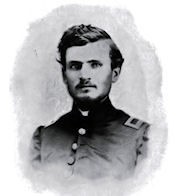
28th. Tended Rowena, my saddle mare, and got rations from the Post Commissary. About noon Bob came. Glad to be relieved. Letters from Lucy R., Ella Clark and Sarah Felton. All very good and quite acceptable. In the evening went to class. After it, beat Capt. N. three games of chess. Boiled eggs. Sleeked up the commissary for Sunday and chopped wood. Unusual.
March 2013
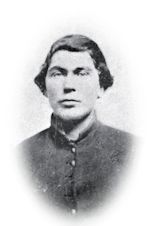
On the Coldwater, Saturday, March 28. Met six boats from below. Report General Quinby’s headquarters 190 miles at the mouth of Tallahatchie. Boats badly seamed.
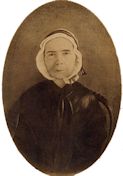
March 28th.—A letter from ——. She tells me that W. B. N. and E. C. both passed through the fierce fight at Kelly’s Ford uninjured. How can we be grateful enough for all our mercies? Letters also from B., by underground railroad. That sweet child and her whole family surrounded and roughly treated by the Yankees; and so it will be as long as Millroy is allowed to be the scourge of the Valley.

Saturday, 28th [March]. Mr. Randolph here, and we all talked about Farragut and the Hartford for about two hours. He will have it that we have both. Nowadays there seem to be but two classes of individuals, those that believe everything and those who believe nothing. I have fallen into a state of general infidelity. My head is dazed with talk and rumors. Mr. Randolph has his spy story. A Confederate officer is in, in Federal uniform; he says that Farragut never passed all the batteries at Port Hudson, but being crippled by passing the first, was forced to surrender. He was then sent as a prisoner to Jackson and thence to Richmond. The Hartford still floating the Federal stars and stripes, then proceeded on her way to Vicksburg, and as we had captured the signals, she lies there to entice other Federal vessels from the other fleet to run the Vicksburg batteries to come to her assistance; should they do so, they will fall into our hands, as did the Queen of the West and others. The officer says, too, that the Indianola is safe. The Federals here say that she sank and rose no more. He says, too, that the Confederates are coming soon to the defence of this poor city. Mr. Randolph believes in this officer, and says he has good reason to do so. We told him of our general infidelity which, for our better spirit’s sake, he tried to combat.
The Era reports Farragut safe at the mouth of the famous canal, waiting for coal barges to pass down to him; it gives a threatening letter of his to the Mayor of Natchez, said threats to be carried out should the guerrillas fire on him. (The Era distinguishes these irregulars as “Gorillas”). The capture of this famous rear-admiral is a great deal to us Confederates. He is a brave fellow, and his loss would give our enemies quite a blow, and the more of that stamp they lose the better. It seems a silly thing to me that he should place himself in such a dangerous position—parted from his fleet and hemmed in by batteries, deadly in their effectiveness. If we do not catch him, we should. In spite of the bravado and inflation of the Era, a very sensible fear of the Admiral’s position appears. Banks is safe here in the city, and all his military show towards Port Hudson has come to naught. He says that he has done all that he wished to do—which was to march in great array out of Baton Rouge and then make a hasty retreat thereto without striking a blow at our strong point. The Federals, I believe, have changed their tactics; finding that the “gorilla” is strong, they very sublimely sit themselves down until he starves to death. It is amusing to hear how dreadfully we need everything (from their papers). Our people are suffering from the want of many accustomed luxuries, but the blessings of freedom and peace, I pray God, may so entice them from the future that they may continue to bear a bold front toward a ruthless and home-desolating foe. Mr. Randolph tells us that if the Confederates do not come in for fifty days, quite a large sum of money will be saved to him; but, said he, “I would rather have them in to-morrow, and lose it.” He comes of the blood of old John Randolph; if he had taken the oath, he says, his mother and his brothers in the army would have disowned him. “When the oath-taking was going on last summer, he was so disheartened by the sight that he came up from town one day, just to be cheered by the sight of those he knew would never take it. He brought us one of the ballads which flood the city. It represents the reception of old John Brown into a place which shall be nameless in these decorous pages. He brought something better, however—Doctor Palmer’s letter to Mr. Perkins on the subject of the oath-taking in this city. It is a fine thing, this letter, but I think, much too severe, and would have come with much better grace from one who had remained here and suffered the various influences of temptation which surrounded our poor people here under Butler’s brutal reign.
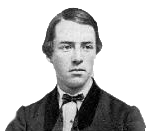
Headquarters Engineer Brigade,
Near Falmouth, March 28, 1863.
Dear Father, — Do you know of any good engineers in Boston, who would like commissions in this brigade? I wish you would write me, and let me know, as General Benham wants to find some good engineers to commission. I told him that I would write you, and see whether you knew of any such.
I received your letter inclosing George’s recommendations, and sent them over instantly to Captain Abbott of the 20th, a friend of mine and a classmate.[1] He is a son of Judge Abbott. I could not deliver them personally, as my duties kept me closely confined in camp. I sent a very strong letter of recommendation with them, and told Abbott that I would consider it a personal favor if he would recommend George. I also told him that I would be over at his camp to-morrow and see him about it. He sent back word that he would make it all right when I came over. I also asked him to show the recommendations to Major Macy, who is in command. I shall go over tomorrow and see him personally. Even if I could not get George a place there, I feel quite sure I could get him one in this brigade. You need not say anything about it, as I do not wish to raise any false hopes. You can let George know that I am doing my best for him.
I hear that Longfellow’s son ran away, and enlisted as a private in the 1st Massachusetts Battery, and that Senator Sumner sent for the captain of the battery, and told him that he would get L. a commission in the regular army if he (the captain) thought him fit for it.
General Benham is trying to collect the brigade together, and soon we shall have most of the companies near headquarters, together with a band. At present the brigade is very much scattered, some being at Harper’s Ferry, some at Washington, and the rest scattered throughout the army.
I am still acting adjutant-general, and do not know how soon I shall be relieved.
The general is going to appoint an inspector-general on his staff. If I can find a good fellow, I shall get him on the staff. The new aide, whom I got, is a very nice fellow. His name is Perkins.
Yesterday was a delightful day, but to-day we have one of those everlasting rains. It has cleared up again to-night.
General Birney’s division had races yesterday. There were some 10,000 spectators present. As usual, there were some accidents, men being thrown and breaking their legs.
The army is in good spirits, and very good discipline. As soon as we can move, we shall do so. . . .
[1] Henry L. Abbott, of the 10th Massachusetts, who showed great military ability. He was killed later in the war.
March 28. Day cloudy and rainy. Saw Colonel Schriver in the evening, in regard to the appointment of an inspector-general. He said we were en titled to one. Went over to General Sedgwick’s in the evening.
by John Beauchamp Jones
MARCH 28TH.—We have nothing additional or confirmatory from the West. A letter from Gen. Beauregard states that he has but 17,000 men in South Carolina, and 10,000 in Georgia, 27,000 in all. He asks more, as he will be assailed, probably, by 100,000 Federals. The President refers this important letter to the Secretary of War, simply with the indorsement, “this is an exact statement of affairs in South Carolina and Georgia.”
Col. Lay predicts that we shall be beaten in thirty days, or else we shall then be in the way of beating the enemy. A safe prediction—but what is his belief? This deponent saith not. There will be fearful odds against us, and yet our men in the field fear nothing.
We are sending Napoleons up to Lee. But the weather, which has been fine for the last two days, is wet again. If Hooker makes a premature advance, he will be sure to “march back again.”
An amusing letter was received from an officer Tennessee to-day. He was taken prisoner by seven Federals when straying some distance from camp, and subsequently hearing the men express some anxiety to be at home again with their families, gave them some brandy which he happened to possess. He then suggested a plan by which they might return to their homes, viz., to become his prisoners, and being paroled by him. After consultation, they agreed to it, and released him. He then paroled them, giving them the usual certificates to exhibit to their officer, and so, taking another drink, they pursued their different ways. If this disposition prevails extensively among the Western Federals, we may look for speedy results in that quarter. Rosecrans may lose his laurels in a most unexpected manner.
March 27.—The following bill was this day presented to the Legislature of Virginia: “Be it enacted by the General Assembly of Virginia, That if any person buy any article of food (including salt) for man or beast, and withhold the same from market, or ask and receive more than five per centum commission or profit on cost and transportation, such person shall be deemed guilty of misdemeanor, and shall forfeit the article so bought—one half to the informer and the other to the Commonwealth: Provided, That this act shall not apply to market-men collecting supplies for daily city consumption, or to any person bringing such food from beyond the confederate army lines, or purchases for family consumption.
“This act shall be in force from its passage, and continue during the war.”
—Ant important debate took place in the British House of Commons, concerning the depredations of the rebel privateer Alabama.
—Jacksonville, Fla., was burned, after its evacuation, this day by the National forces under Colonel Rust.—(Doc. 148.)
—Colonel Talcott, of the rebel army, was arrested at New-York City.—The English steamer Aries, while endeavoring to run the blockade, was captured by the gunboat Stettin, off Bull’s Bay, S. C.—Robert Gay of company D, Seventy-first Indiana volunteers, convicted of desertion to the rebels, was shot at Indianapolis, Ind.—Fast Day in the rebel States.—Some clergymen in Norfolk, Va., attempted to hold service in their churches, in conformity with Jeff Davis’s fast proclamation, but were prevented from so doing by the Union soldiers in that place.
—This morning the United States steamer Hartford, the flag-ship of Admiral Farragut, engaged the rebel batteries at Warrenton, three miles below Vicksburgh, and passed below.
March 28.—The Legislature of Massachusetts adopted unanimously a resolution tendering to the soldiers of that State the thanks of the Commonwealth for the services they had rendered in the war for the restoration of the Union, and pledging such reinforcements to their support as the National authority should from time to time demand.—The National gunboat Diana, was this day captured by the rebels near Pattersonville, La.— (Doc. 149.)
Thiess morning Coles’s Island, nine miles from Charleston, S. C, was taken possession of by the One Hundredth New-York volunteers, under the command of Colonel George F. B. Dandy.— (Doc. 150.)
—The rebels burned the temporary bridge with which the National forces had replaced the Stone Bridge at Bull Run, Va. They also were engaged in collecting all the grain and other supplies they could obtain in Loudon and Fauquier counties in that State.
—The steamer Sam Gaty was stopped and boarded at Sibley, Mo., by a gang of rebel guerrillas who killed a number and robbed all of the passengers of their money and wearing apparel; captured eighty negroes, twenty of whom they wantonly killed, and destroyed a quantity of government stores. The boat was then allowed to proceed on her voyage.—(Doc. 161.)
—The expeditionary force of National troops under the command of Colonel Fairchild, of the Second Wisconsin infantry, returned to Belle Plain, Va., to-day after a successful foraging expedition to Northern Neck. One thousand pounds of pork, three hundred pounds of bacon, three thousand bushels of corn, and a large quantity of wheat, beans, and oats were secured. The cavalry portion of the escort seized a number of horses and mules, captured several prisoners, and broke up the ferries at Union and Tappahannock. The force also burned a schooner engaged in smuggling contraband goods into Virginia.—Baltimore American.
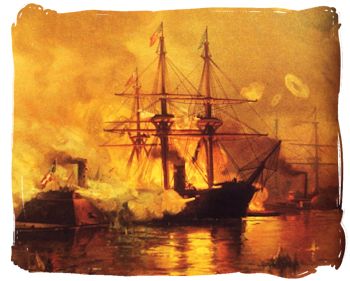
March 27th. We are still lying at our anchorage above Warrenton; everything quiet.


