Following the American Civil War Sesquicentennial with day by day writings of the time, currently 1863.

November 2013

Kelly’s Ford, Va,, Nov. 13, 1863.

Dear Sister L.:—

I received your and Charlie’s letter. Your expressed wish to see me will not yet be gratified, I fear. I have heard nothing yet from Washington and I would take about ten cents for my chance of a commission. I do not entirely give it up yet, but my expectations are dwindling fast. One of the Forty-fourth New York, who was examined the day after I was, got First Lieutenant, First Class. That I am morally certain of, and he has not got his appointment yet. Until he gets his I shall not entirely give it up.

I copy a portion of the last “General Order” in relation to the fight at Rappahannock Station:

“The enemy was attacked in an entrenched position of great strength in enclosed works, defended by artillery and infantry, and compelled to surrender, after a sharp conflict, to an assaulting column actually inferior in numbers to the force defending the works.

Four pieces of artillery, four caissons filled with ammunition, the enemy’s pontoon bridge, eight battle flags, two thousand stand of small arms, one thousand six hundred prisoners, including two brigade commanders and one hundred and thirty commissioned officers, are the fruits of the victory.”

November 13.—Dr. Bemiss left to-day. He is going to assist Dr. Stout . We all regret his leaving. To use the phrase of a friend, “he is a gentleman and scholar, with his heart in the right place.” A more devoted patriot we have not in the cause.

Dr. J. N. Hughes of Kentucky is his successor, and I am told is a true patriot and a high-toned southern gentleman.

Our wounded are doing badly; gangrene in its worst form has broken out among them. Those whom we thought were almost well are now suffering severely. A wound which a few days ago was not the size of a silver dime is now eight or ten inches in diameter.

The surgeons are doing all in their power to stop its progress. Nearly every man in the room where they were so full of jokes has taken it; there is very little laughing among them now. It is a most painful disease, and plays sad havoc with the men every way. We can not tempt them to eat, and we have very little sweet milk, and that is the cry with them all. Many a day I have felt as if I would walk any distance to get it for them. It is distressing to go into the wards for I hear but the one cry— milk!

I have told every body that I have met about it, but with no effect. If all would give a very little, there is no end to the amount of good of which it would be productive.

The people say that they use it for their negroes and children, as they have no fresh meat; but I expect they could spare a little for these wounded patriots.

Mrs. Johnston’s little boy, my talkative friend, comes every day with milk. His mother tolls mo that she can not get him to taste it himself, for he desires to bring his share to the soldiers.

We have had a number of ladies from the country visiting the wounded; many of them have come twenty miles. They bring baskets full of all kinds of eatables. It does me good to see them come, as the very best we can give wounded men is not enough. And another thing: the diet is a change; they bring ham, biscuits, chickens, pies, cakes, etc.

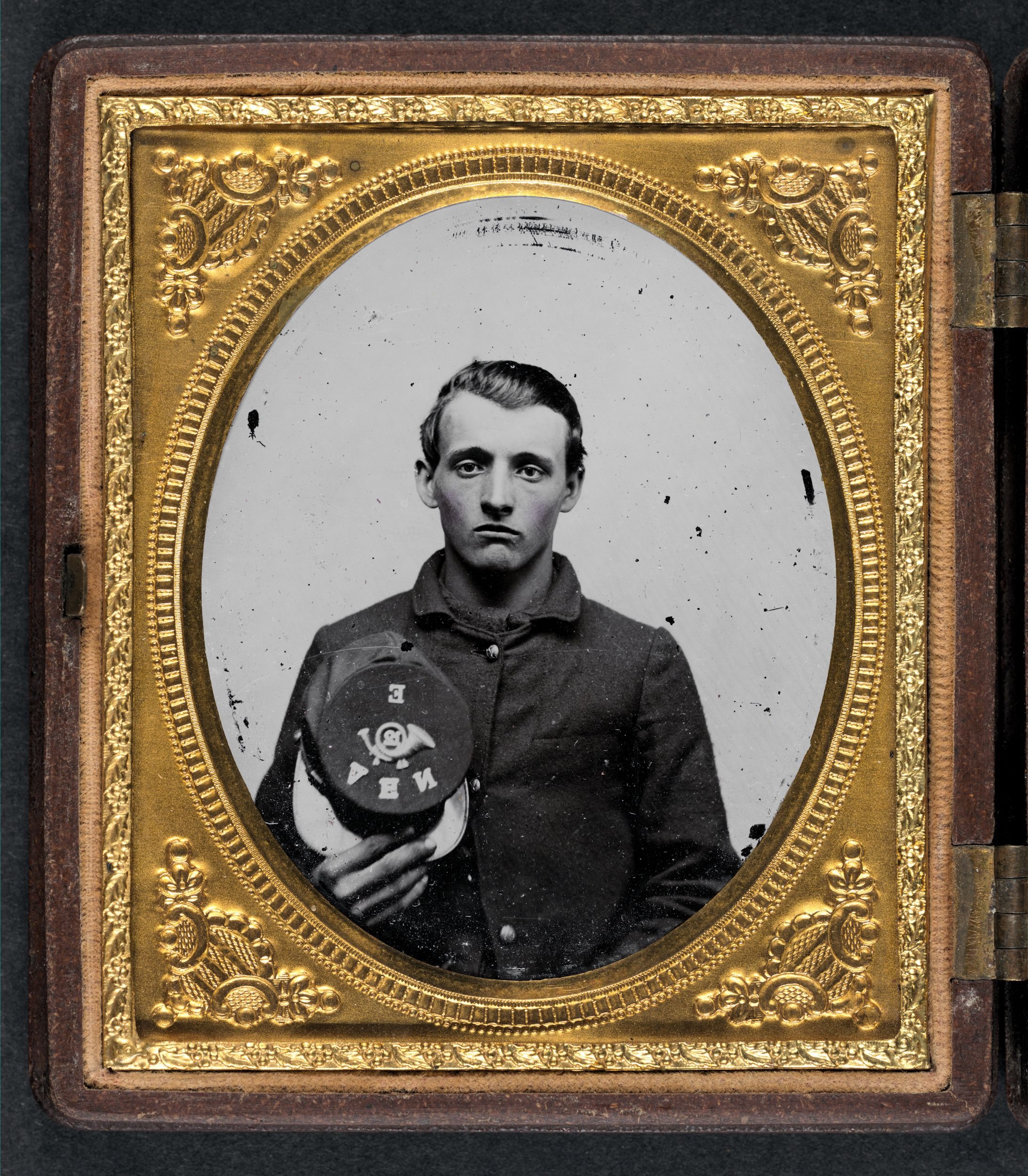
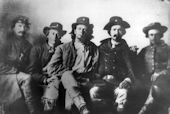
Unidentified soldier in Union uniform with Company E in frame

Unidentified soldier in Union uniform with Company E, 12th Regiment New Hampshire Volunteers hat

__________

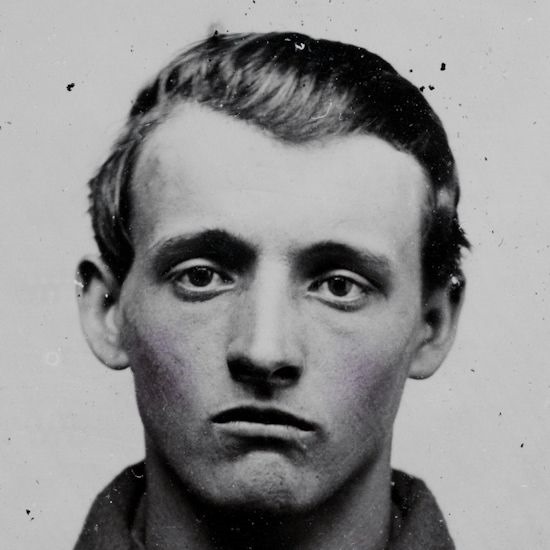
Close-up crop

Unidentified soldier in Union uniform with Company E

__________

Sixth-plate ambrotype, hand-colored ; 9.5 x 8.4 cm (case)

Liljenquist Family Collection of Civil War Photographs; Ambrotype/Tintype photograph filing series; Library of Congress Prints and Photographs Division.

Record page for image is here.

__________

digital file from original, tonality adjustedNote – This image has been digitally adjusted for one or more of the following:

    • fade correction,
    • color, contrast, and/or saturation enhancement
    • selected spot and/or scratch removal
    • cropped for composition and/or to accentuate subject matter
    • straighten image

Civil War Portrait 092

Camp on the mountains, Friday, Nov. 13. Broke camp at Winchester before daylight and moved out in advance of the other brigades. Crossed the R. R. south of Decherd and kept along the track southeast until we reached Cowan Station, when we travelled toward the hills. Halted half an hour to strip the chest of all knapsacks, the cannoneers being obliged to carry everything after the style of infantry. At about half past twelve o’clock we mounted and started up the mountain. The foot was covered with white large stones smooth as ice. Both of my horses fell the first pull, but soon gathered and we made the ascent in about two hours. The road was very stony and most of the horses poorly shod, very steep in places, but we made it without an accident or a balk, although four of our teams had a span of mules in. The General and staff were very much scared, it is said, and thought it not safe to ride up so they dismounted, lamenting our fate, but our horses did it all right. The road followed the summit which was perfectly level, rather sandy. Passed two or three houses inhabited, but I know not how. Came into camp; old camping ground, first rebel and then federal. Had but one load of corn for to-night and to-morrow morning, so we had but eight ears to a horse. Drew two little crackers in the morning which was all we had till the wagons came up late at night, and we were a set of very hungry boys. Sow belly and hard-tack went as good as the best of suppers at home. Camp as merry as ever, singing and cracking jokes by the bright camp fires, although we were weak in the center.

by John Beauchamp Jones

            NOVEMBER 13TH—No news of battles yet. But we have a rumor of the burning of the fine government steamer R. E. Lee, chased by the blockaders. That makes two this week.

            Gen. Lee dispatched the President, yesterday, as follows:

            “Orange C. H., Nov. 12th.—For the last five days we have only received three pounds of corn per horse, from Richmond, per day. We depend on Richmond for corn. At this rate, the horses will die, and cannot do hard work. The enemy is very active, and we must be prepared for hard work any day.—R. E. LEE.”

            On the back of which the President indorsed: “Have the forage sent up in preference to anything else. The necessity is so absolute as to call for every possible exertion.—JEFFERSON DAVIS.”

            Perhaps this may rouse the department. Horses starving in the midst of corn-fields ready for gathering! Alas, what mismanagement!

I cut the following from the Dispatch :

            “FLOUR.—We heard yesterday of sales of flour at $110 per barrel. We do not, however, give this as the standard price; for, if the article was in market, we believe that even a higher figure would be reached. A few days since a load of flour was sent to an auction-house on Cary Street to be sold at auction. The proprietors of the house very properly declined to receive it, refusing to dispose of breadstuffs under the hammer, where men of money, and destitute of souls, would have an opportunity of buying it up and withdrawing it from market.

            “CORN-MEAL.—This article is bringing from $18 to $20 per bushel, and scarce at that.

            “COUNTRY PRODUCE AND VEGETABLES.—We give the following

as the wholesale rates: Bacon, hoground, $2.75 to $3; lard, $2.25 to $2.30; butter, $3.75 to $4; eggs, $2 to $2.25 ; Irish potatoes, $7.50 to $8; sweet potatoes, $10.50 to $12; tallow candles, $4 per pound ; salt, 45 cents per pound.

            “GROCERIES.—Coffee—wholesale, $9 per pound, retail, $10; sugar, $2.85 to $3.25; sorghum molasses, wholesale, $10, and $14 to $15 at retail; rice, 30 to 35 cents.

            “LIQUORS.—Whisky, $55 to $70 per gallon, according to quality, apple brandy, $50; high proof rum, $50; French brandy, $80 to $100.

            “In the city markets fresh meats are worth $1.25 to $1.50 for beef and mutton, and $2 for pork; chickens, $6 to $8 per pair; ducks, $7 to $8 per pair; butter, $4.50 to $5 per pound; sweet potatoes, $2.50 per half peck; Irish potatoes, $2 per half peck.

            “LEATHER.—Sole leather, $6.50 to $7.50 per pound; upper leather, $7.50 to $8; harness leather, $5.50 to $6; hides are quoted at $2.50 to $2.75 for dry, and $1.50 for salted green; tanners’ oil, $4 to $5 per gallon.

            “TOBACCO.—Common article, not sound, $1 to $1.25; medium, pounds, dark, $1.30 to $2; good medium bright, $2 to $2.75; fine bright, $2 to $4; sweet 5’s and 10’s scarce and in demand, with an advance.”

            My friend Capt. Jackson Warner sent me, to-day, two bushels of meal at government price, $5 per bushel. The price in market is $20. Also nine pounds of good beef, and a shank—for which he charged nothing, it being part of a present to him from a butcher.

November 13.— A skirmish took place near Natchez, Miss., between company H, of the Seventy-first Illinois regiment, and a few volunteers of the Sixth Mississippi regiment of loyal colored troops, and the rebel cavalry under Adams and Mosby. The circumstances are as follows: The wagons of the above command were sent out for forage, the company just designated was detailed as an escort, and left camp at seven A.M. After proceeding about one mile and a half a small force of rebels was seen, the company halted, and a messenger was despatched to inform the commanding officer, and report for instructions. Immediately on receipt of the news, Colonel Smith took the camp-guard and proceeded out on the Washington road, came up to where the foraging party had halted, and ordered it forward. [It is necessary here to state that this road leads to a village, bearing the same name, some six miles distant from this place, and two miles out it intersects the Palestine road, both of which run quite close together for a mile or more.] Both commands marched on to the “forks,” when it was decided that Captain O. H. Hitchcock, with his company, should proceed with the train toward Palestine, as was originally intended. Colonel Smith, taking the guard, followed the other road, and after marching more than a mile ordered a halt, and threw out a picket still farther on, as the rebels had been there but a few moments before. Presently a volley was heard, then another, and still another. He immediately “doublequicked” his men back, but arrived too late to participate in the engagement. Lieutenants Richards and Green, who were some distance in advance of the train, on horseback, met a squad of eight or ten cavalry coming around a bend in the road at full speed. They therefore fell back, hotly pursued by the rebels, who, when they came, in sight of the party immediately fled, and on meeting their comrades, they all joined and came back, and found the colored troops prepared to give them battle. Captain Hitchcock, not knowing the strength of his opposers, fell back a short distance, and the enemy rallied and charged furiously again. The rebel captain ordered Hitchcock to surrender, firing at the same time his revolver at Corporal John Heron, who dropped unhurt to his knees, and sent a ball through the miscreant’s breast, which proved fatal. Rebel citizens state that the opposing force numbered fifty men, and acknowledge their loss to be one captain, sergeant, and two privates killed, and eight wounded. The Union loss was as follows:

Killed—George Diegs, company H; Lewis Taylor, company H; Peter Grant, company H; Samuel Moden, company G. Wounded—William Gallin, company B; Henry Brown, company H; Mil Beckford, company H; William Hegdon, company H; Zeno Callahan, company H; Duncan Turner, company H; John Bodly, company H.

—John C. Crane, acting quartermaster at Nashville, Tenn., in a note to Andrew Johnson, Governor of that State, says:

“The bearer, (colored,) Jane Woodall, is my house-servant. She is a slave, claimed by Christopher Woodall, a resident of Tennessee. It is said that he is disloyal, and on a previous occasion the military authorities prevented him from taking her.

“Has Mr. Woodall any right, under the President’s Proclamation, and military law, to take this woman?

“It strikes me not, as we have taken possession of rebel property without compensation. Requesting your decision in the premises, I am, Governor, very respectfully, your obedient servant.”

The governor’s response.

Executive Office

“Nashville, Tenn. November 18,1863.

Respectfully returned. If the girl referred to within is willing to return with Mr. Woodall, she should be allowed to go, but, if not willing, she will not be compelled to go with him. “Andrew Johnson,

“Military Governor.”

—In accordance with an order from the War Department, Major-General John A. Logan surrendered his command of the Third division of the Seventeenth army corps. In addressing the officers and soldiers of the different brigades, he reminded them of the history the division had made for itself—a history to be proud of; a history never to be forgotten; for it is written as with a pen of fire dipped in ink of blood on the memories and in the hearts of all. He besought them always to prove themselves as loyal in principle, as valiant in arms, as their record while under his command would show them to have been; to “remember the glorious cause you are fighting for, remember the bleaching bones of your comrades killed on the bloody fields of Donelson, Corinth, Champion Hill, and Vicksburgh, or perished by disease during the past two years of hardships and exposure—and swear by these imperishable memories never, while life remains, to prove recreant to the trust high heaven has confided to your charge.” He assured them of his continued sympathy and interest in their wellbeing, no matter how great a distance might separate them; and closed by heartily recommending them to their future commander, his own companion in arms, and successor, Brigadier-General Leggett.
Thursday, 12th—Went over to Mr. Thomas’. I made a girth for him. From there to Miss Kate Carter’s. Mr. Shirry and two other gents came in, gentlemanly, merry.

12th. Late in the morning sent June and squad out for more cattle. Killed three beeves for 2nd Ohio. Went to town and saw Div. coming. Lot of clothing came. Got some horse shoes. George very bad face. Powder exploded and burned his face badly. Letter from Fannie. How anxious I have been and still am. Oh the future—dark.

Thursday, 12th—The two brigades of General Crocker’s Division were at his request ordered back to Natchez today, because of a threatened attack of the rebels at that place.

November 12—Renewed our march this morning down the Culpeper plank road toward Fredericksburg some three or four miles, then turned off to the right and marched in a southerly course, crossed the Orange plank road and arrived at Spottsylvania Court House little before sunset; then moved down the Fredericksburg road and camped three miles below Spottsylvania Court House. The village of Spottsylvania Court House is composed of three dwelling houses, one church, the court house, and jail. The court house is brick, very small, and only one story high; a little portico at the side entrance and one at the front compose all the superfluous ornamentation on the exterior.

The country right around the village is nearly level, but the encroaching hills are not far away; from the general appearance of the land it is not very fertile. The principal part of our march to-day was through the Wilderness, a scope of country so called from its resemblance to a wild and barren waste. For miles and miles to-day we saw nothing but a vast plain nearly level, and covered with a thick growth of a kind of scrubby oak, averaging about fifteen feet in height and so thick and bushy that a man can hardly pass through the tangled mass. Here and there I saw a few cleared little patches, with a live hut in the center of each, that looked dismal, dilapidated, forlorn, and ought to be forsaken. The whole of the Wilderness is in Spottsylvania County.