Following the American Civil War Sesquicentennial with day by day writings of the time, currently 1863.

November 2013

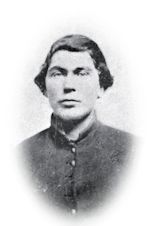
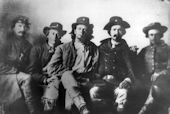
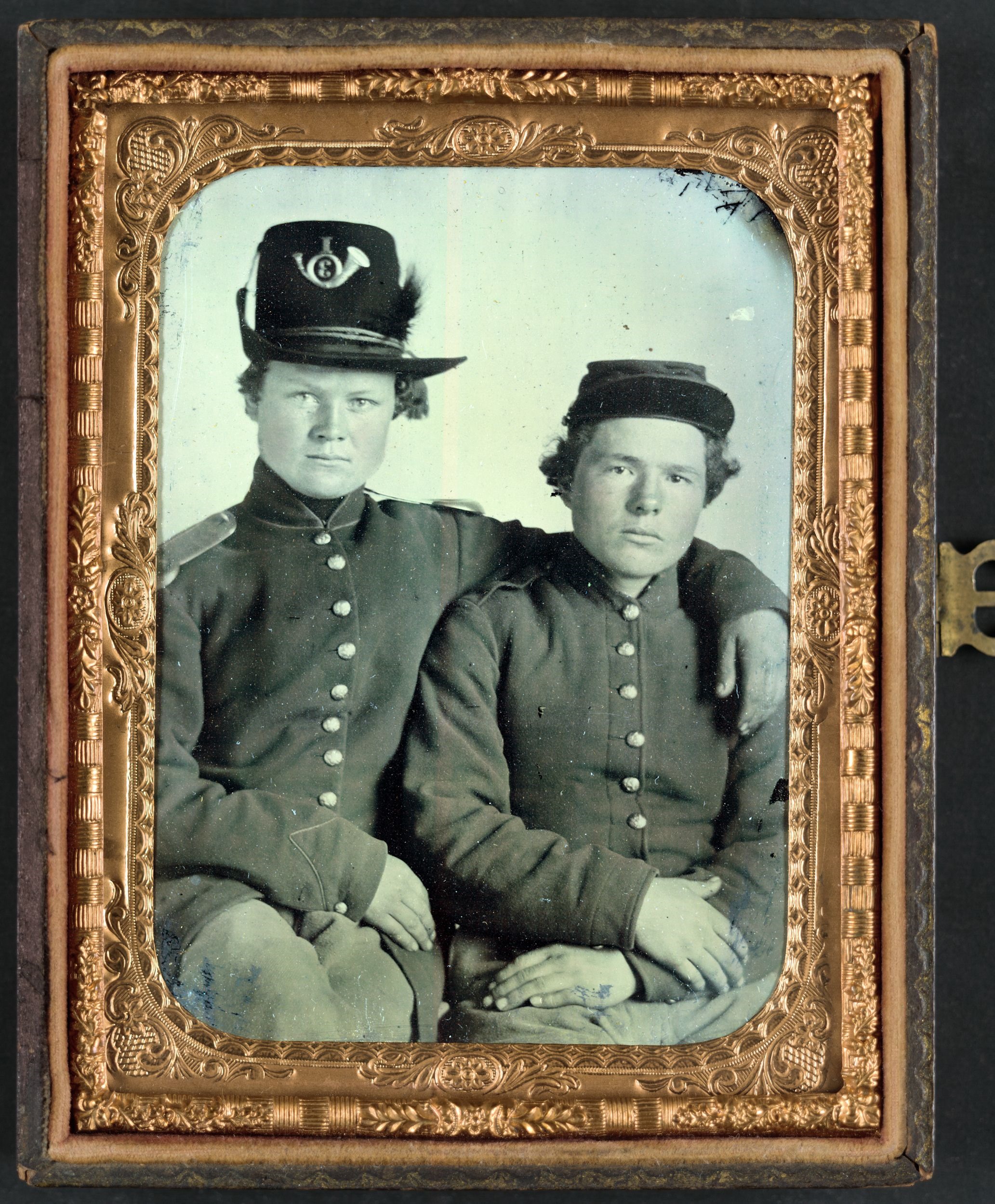
Brothers Private Hiram J. and Private William H. Gripman of Company I, 3rd Minnesota Infantry Regiment, one with his arm around the other -- in frame


Brothers Private Hiram J. and Private William H. Gripman of Company I, 3rd Minnesota Infantry Regiment, one with his arm around the other.

__________

Quarter-plate tintype ; 12.0 x 9.3 cm (case)

Liljenquist Family Collection of Civil War Photographs; Ambrotype/Tintype photograph filing series; Library of Congress Prints and Photographs Division.

Record page for image is here.

__________

digital file from original itemNote – This image has been digitally adjusted for one or more of the following:

    • fade correction,
    • color, contrast, and/or saturation enhancement
    • selected spot and/or scratch removal
    • cropped for composition and/or to accentuate subject matter
    • straighten image

Civil War Portrait 091

Winchester, Thursday, Nov. 12. Lay in camp all day. 3rd Brigade came up early. The weather very raw and blustering. Forage trains went out seven miles and returned loaded with good corn. Wrote two letters but no mail came in. To-morrow we are to start across the mountains. If half of what is said of it be true, we will have hard times to cross it with our teams. The cavalry say we will not be able to cross it in two days. 1st Brigade of Stanley’s Cavalry Division is here. Winchester is the county seat of Franklin County and a good business town as large as Fayetteville. Mr. Lester brought Nashville papers of to-day into camp, the first we have seen since the 22nd of last month.

November 12th. General Meade issued an order to-day congratulating the army on its successful crossing of the Rappahannock in the face of the enemy, and compelling them to withdraw behind the Rapidan, mentioning especially Sedgwick, who captured four guns, two thousand stand of arms, eight battle flags, and sixteen hundred prisoners.

by John Beauchamp Jones

            NOVEMBER 12TH.—No accounts of any fighting, but plenty of battles looked for.

            A. A. Little writes to the Secretary of War from Fredericksburg, that the attempt to remove the iron from the Aquia Railroad by the government having failed, now is the time for private enterprise to effect it. If the Secretary “will say the word,” it can be done. He says the iron is worth “millions, its weight in gold!” Will Mr. Seddon let it be saved? Yes, indeed.

            Mr. Heyliger, agent at Nassau, writes on the 3d instant (just a week ago), that he is shipping bacon by every steamer (three or four per week), leather, percussion caps, and a large amount of quartermaster’s stores. But the supply of lead and saltpeter is exhausted, and he hopes the agents in Europe will soon send more. About one in every four steamers is captured by the enemy. We can afford that.

            The President sent over to-day, for the perusal of the Secretary of War, a long letter from Gen. Howell Cobb, dated at Atlanta, on the 7th instant. He had just returned from a visit to Bragg’s army, and reports that there is a better feeling among the officers for Gen. Bragg, who is regaining their confidence. However, he says it is to be wished that more cordiality subsisted between Generals Bragg and ______, his _______ in command. He thinks Generals B_____ and C_____ might be relieved without detriment to the service, if they cannot be reconciled to Bragg. He hints at some important movement, and suggests co-operation from Virginia by a demonstration in East Tennessee.

            It is generally believed that France has followed the example of England, by seizing our rams. Thus the whole world seems combined against us. And Mr. Seward has made a speech, breathing fire and destruction unless we submit to Lincoln as our President. He says he was fairly elected President for four years of the whole United States, and there can be no peace until he is President of all the States, to which he is justly entitled. A war for the President!

November 12.—A very spirited skirmish with the rebels occurred at a point about ten miles from the Cumberland Gap, in Virginia. A forage train of twenty-one wagons had been sent out with a guard of twenty-eight men. The wagons were loaded, and started for the Gap, with no appearance of danger, when suddenly a party of seventy guerrillas rushed from a convenient ambush, overpowering the guard, and compelling a surrender. The officers’ clothing was immediately transferred to rebel backs, and their wallets appropriated. Ten minutes after the capture, Colonel Lemert, commanding the forces at the Gap, appeared in a bend of the road. Whilst the rebels were approaching, Colonel Lemert immediately led the charge with ten men of the Fourth battalion Ohio volunteer cavalry. A fierce hand-to-hand sabre-fight occurred for a few minutes, when the rebels left the field. The train and prisoners were recaptured, eleven of the enemy captured, two killed and four wounded, and some small arms and horses taken. An exciting chase of ten miles failed to overtake the fleeing rebels.

—Major-General Dabney H. Maury, in command of the rebel forces at Mobile, Ala., sent the following to Adjutant-General Cooper, at the war department at Richmond, Va.:

“The following despatch from Tunica, Miss., was received yesterday, dated tenth instant, from Colonel Harry Maury, commanding Fifteenth cavalry regiment: ‘We dashed in yesterday above Bayou Sara on a plundering party of Yankees, three hundred strong, and drove them to their iron-clads with great slaughter. We brought off their wagon-trains and twenty-five prisoners from under the broadsides of their gunboats. Only three wounded of ours.'”—Two Bridges and trestlework on the Tennessee and Alabama Railroad at Caligula, near Lynnville, Tenn., were destroyed by a party of rebel cavalry under the command of the partisan Roddy.—A cannonading between the rebel batteries on Lookout Mountain and the Union forces at Moccasin Point, took place today.

—In the rebel Senate, in session at Richmond, Va., Mr. Brown, of Mississippi, offered the resolution:

Resolved, That in the present condition of the country, Congress ought, with the least practicable delay, to enact the following:

“1. To declare every white male person residing in the confederate States, and capable of bearing arms, to be in the military service of the country.

“2. To repeal all laws authorizing substitutes or granting exemptions.

“3. To authorize the President to issue his proclamation requiring all male persons claiming and receiving foreign protection to make their election within sixty days, to take up arms or quit the country.

“4. To detail from those in the military service such only as are absolutely needed in civil pursuits, having reference in making such details to competency alone.

“5. To levy a direct tax of —— per cent on every kind of property, according to its value in confederate notes, including the notes themselves.

“6. To make confederate notes a legal tender in payment of debts, after the expiration of six months.

“7. To prohibit the buying and selling of gold and silver coin, or the notes on banks in the United States, or United States Treasury notes, during the war, under heavy penalties, or, in lieu thereof, to prohibit ‘running the blockade’ by individuals, under pain of forfeiture of the goods brought in, and imprisonment during the war.

“8. Declare these laws war measures, and make those who violate them amenable to the military courts.”

—The City Council of Richmond, Va., made an appropriation of sixty thousand dollars for the purchase of a family residence for General Robert E. Lee.
Wednesday, 11th—I spent the day and night at Mr. Hatchers.

Lenoir, Tenn., November 11th, 1863.

This morning we were aroused by the Orderly at 3 o’clock, with orders to be ready to move at daylight. We sprang out of bed, built fires, cooked breakfast, which consisted of pancakes made of wheat flour and corn meal, issued in place of bread, beefsteak and coffee; packed up, and then sat down to await the coming of day. At 6 o’clock the bugle sounded, and we fell in and stacked arms. We then received orders to go to our quarters and be ready to fall in at a minute’s notice. And so the matter has stood all day, and still remains. The reason for the movement is as follows: The Second Division has been engaged today in throwing a pontoon bridge across the Holston about a mile from here, and, not knowing the strength of the enemy, on the opposite side, we are to be ready to support them if necessary.

The bridge is nearly completed, and the Rebels have not shown themselves. Tomorrow the Second Division is to cross over. I understand they are to build winter quarters on the other side.

A “contraband” came into camp yesterday and reported himself direct from Rebeldom. He appeared intelligent, and told a straightforward story. He reports the Rebels in strong force across the river, and says they are building pontoons in which to cross over to attack us. His information was considered so important General Ferrera sent him, under guard, to General Burnside at Knoxville.

Winchester, Tenn., November 11, 1863.

We arrived here at 9 this a.m., our brigade making the distance from Salem, 11 miles, in three hours. That, we call fast walking. I wrote you last from Florence., Ala., on the 1st inst. From there we marched to Rodgersville and thence up the right bank of Elk river to Fayetteville, where we crossed there onto this place. Rumor says that we draw 20 days’ rations here. It is three-fourths official, too. It is certain that we leave here in the morning, but nobody knows where for. We could certainly march to Chattanooga in six days, but could go much quicker by the railroad from Decherd station, which is only two miles from here. The wagon road from here to Chattanooga is awful. But one brigade has ever marched it. The mountains commence right here and continue to, the Lord knows where. Our brigade is to be mounted immediately. In the last 60 miles marching we have mounted 800 or nearly half. The citizens along the road very kindly furnished all of stock and equipments. My company was mounted four days ago. Company C is to be mounted next. As fast as the men are mounted they are put out as foragers for more horses, etc. The first day my company was mounted we got 30 horses, and would have done better, but confound me if I could take horses from crying women, although I am satisfied that half of their howling is sham, got up for the occasion. My first day’s foraging almost used me up. We had fed our horses and I went to unhitch a mule from the fence to give him in charge of one of the men, and the brute scared and jerked the rail from the fence and started like lightning. The end of the rail struck me on the calves of my legs and elevated my boots five feet. The attraction of gravitation brought me down to the globe and I landed with a great deal of vim on a rock about the size of our parlor floor, and as smooth as a peach stone. The only severe injury either the rock or myself sustained was a very badly sprained wrist. I got that. My left hip and left shoulder were hurt some, but the wrist has pained me so confoundedly that I don’t count them. It has pained me so for the last two days and is so tender that I could stand neither the jolting of a horse or wagon. I tried to ride my horse this morning; we were in column and had to strike a trot and that beat me. Think I will be all right for the saddle in a few days, though will have a tender wrist for a good while. Well, our division came through in the advance and our brigade has had the lead most of the time. We have had plenty of forage, but light issues of regular rations probably average. Half Morgan L. Smith’s and John E. Smith’s divisions are close up to us, will be here to-morrow. Osterhaus and Dodge are behind them. We have five divisions all told, probably 25,000 or 30,000 men. We met here the first troops belonging to the Army of the Cumberland.

11th. Sent out June for cattle. Brought in several nice ones. About noon drew rations and issued them to the 2nd and 7th Ohio. Did the work myself with the help of Mose. The detail for the boys was received. They reported. Mail came. Nothing for me. Oh!

Wednesday, 11th—It is very pleasant after four or five days of quite warm weather. I was on picket again, the first time for a week. Two brigades of General Crocker’s Division arrived from Natchez to reinforce the troops here at Vicksburg. Two negroes entering an old vacant Confederate magazine today were blown to pieces. They were smoking and it is supposed that the loose powder on the floor in some way became ignited. The explosion was heard for miles around. So much again for the filthy habit of smoking.