November 7th. At break of day the whole corps marched to Warrenton Junction, thence via Bealton Station and Morrisville, to within three-quarters of a mile of Kelly’s ford; arrived there at 5 P. M. and went into bivouac for the night; marched twenty-one miles in the face of a frightful wind and blinding clouds of dust heard heavy cannonading towards evening in front, where the cavalry are pushing the advance. Another battle supposed to be imminent.
November 2013
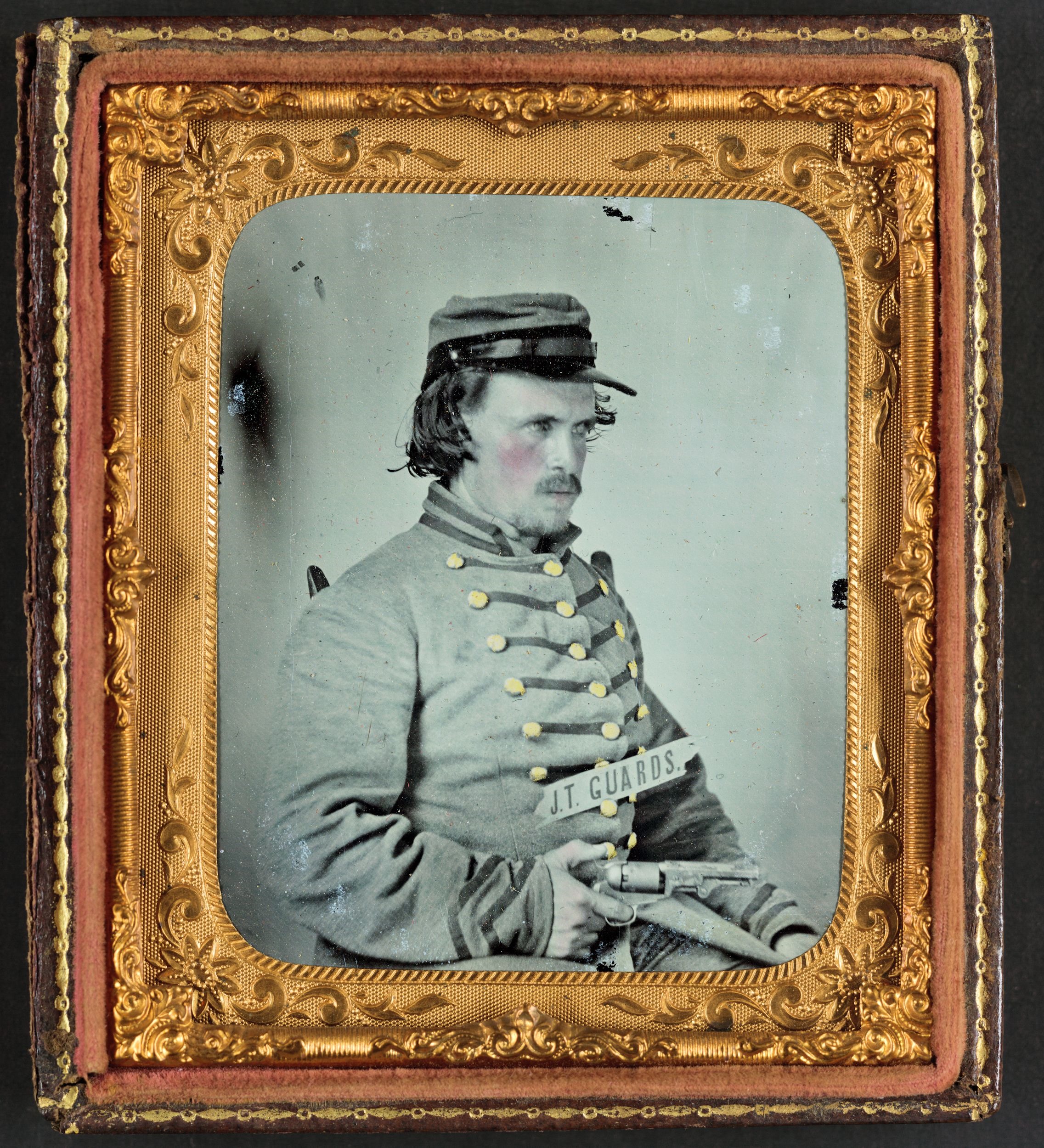
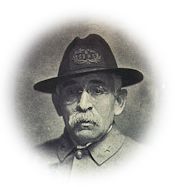
Unidentified corporal in Confederate uniform of Company K, “Jake Thompson Guards,” 19th Mississippi Infantry Regiment, with revolver
__________
Sixth-plate ambrotype, hand-colored ; 9.3 x 8.2 cm (case)
Liljenquist Family Collection of Civil War Photographs; Ambrotype/Tintype photograph filing series; Library of Congress Prints and Photographs Division.
Record page for image is here.
__________
 Note – This image has been digitally adjusted for one or more of the following:
- fade correction,
- color, contrast, and/or saturation enhancement
- selected spot and/or scratch removal
- cropped for composition and/or to accentuate subject matter
- straighten image
Civil War Portrait 086
by John Beauchamp Jones
NOVEMBER 7TH.—No news from any quarter, except the continued bombardment of the debris of Fort Sumter, and the killing and wounding of some 10 or 12 men there—but that is not news.
There is a pause,—a sort of holding of the breath of the people, as if some event of note was expected. The prices of food and fuel are far above the purses of all except speculators, and an explosion must happen soon, of some sort. People will not perish for food in the midst of plenty.
The press, a portion rather, praises the President for his carefulness in making a tour of the armies and ports south of us; but as he retained Gen. Bragg in command, how soon the tune would change if Bragg should meet with disaster!
Night before last some of the prisoners on Belle Isle (we have some 13,000 altogether in and near the city) were overheard by the guard to say they must escape immediately, or else it would be too late, as cannon were to be planted around them. Our authorities took the alarm, and increasing the guard, did plant cannon so as to rake them in every direction in the event of their breaking out of their prison bounds. It is suspected that this was a preconcerted affair, as a full division of the enemy has been sent to Newport News, probably to co-operate with the prisoners. Any attempt now must fail, unless, indeed, there should be a large number of Union sympathizers in the city to assist them.
Several weeks ago it was predicted in the Northern papers that Richmond would be taken in some mysterious manner, and that there was a plan for the prisoners of war to seize it by a coup de main, may be probable. But the scheme was impracticable. What may be the condition of the city, and the action of the people a few weeks hence, if relief be not afforded by the government, I am afraid to conjecture. The croakers say five millions of “greenbacks,” and cargoes of provisions, might be more effectual in expelling the Confederate Government and restoring that of the United States than all of Meade’s army. And this, too, they allege, when there is abundance in the country. Many seem to place no value on the only money we have in circulation. The grasping farmers refuse to get out their grain, saying they have as much Confederate money as they want, and the government seems determined to permit the perishable tithes to perish rather than allow the famishing people to consume them. Surely, say the croakers, such a policy cannot achieve independence. No, it must be speedily changed, or else worse calamities await us than any we have experienced.
Old Gen. Duff Green, after making many fortunes and losing them, it seems, is to die poor at last, and he is now nearly eighty years old. Last year he made a large contract to furnish the government with iron, his works being in Tennessee, whence he has been driven by the enemy. And now he says the depreciation of the money will make the cost of producing the iron twice as much as he will get for it. And worse, he has bought a large lot of sugar which would have realized a large profit, but the commissary agent has impressed it, and will not pay him cost for it. All he can do is to get a small portion of it back for the consumption of his employees, provided he returns to Tennessee and fulfills his iron contract.
November 7.—Major-General George H. Thomas issued an order complimenting the troops composing Generals Turchin’s and Hazen’s brigades for their skill and cool gallantry at Brown’s Ferry, Georgia, and the column under Major-General Hooker, which took possession of the line from Bridgeport to the foot of Lookout Mountain, for their brilliant success in driving the enemy from every position which they attacked. “The bayonet-charge made by the troops of General Howard, up a steep and difficult hill, over two hundred feet high, completely routing the enemy, and driving him from his barricades on its top, and the repulse by General Geary’s command of greatly superior numbers, who attempted to surprise him, will rank among the most distinguished feats of arms of this war.”—A sharp fight occurred at Stevensburgh, Virginia, between General Kilpatrick’s cavalry and a party of rebels, who were defeated.
—The battles of Rappahannock Station and Kelly’s Ford, Virginia, were fought this day, resulting in the retreat of the rebels across the Rappahannock River.—(Doc. 10.)
—General Duffie, in command of the National forces, occupied Lewisburgh, Virginia, this morning; the rebels had passed through in their retreat from General Averill, just previous to his arrival. General Duffie captured the rebel camp, tents, provisions, and one cannon, many prisoners and one hundred head of cattle.—General Kelley’s Despatch.
November 7—To-day, as several of us went to get some straw near Kelly’s Ford, we heard firing, and the long roll beat. Looking up we saw the Yankees crossing the river. We double-quicked to camp and got there just in time to fall in with our regiment, to intercept the enemy, but they had already crossed the river before we got there. We maneuvered about until dark, when my corps of sharpshooters was ordered out. We were within one hundred yards of the Yankees, and saw them around their fires very plainly. On the morning of the 8th we retreated in very good order. I certainly was glad of it, as we were in a very bad fix. We marched until sun-up and halted on Stone Mountain, passed through Stevensburg. Stayed here all night, and resumed our march and halted on the morning of the 9th. We then crossed the Rapidan at the Raccoon Ford, and are now camped at our old camp at Moulton Ford. We marched, since leaving Kelly’s Ford, forty miles. The distance is only seventeen miles. We were certainly surprised for the first time since the war. We did not dream the enemy was on us before the firing commenced. Our brigade was cut off from the army twice, but our General Daniels got us through safe. Nothing new up to the 26th.
Camp on Richland Creek, Tenn., Friday, Nov. 6. Got up at 3 A. M. Moved out at 5 A. M. A clear cold morning, the roads very muddy. We soon struck a range of hills which we rode over. They were, of solid rock broken off in ledges, very hard to travel with artillery, especially with the wheel horses. For six miles it was a continual stony bed, very steep hills and rocky declivities. Eight miles on we struck the Nashville and Decater R. R. at Prospect. Followed it north for two miles through a very fertile valley well laden with corn. I got a handkerchief full of Irish potatoes from under a farm house, satisfied the negro for them, the master not at home. The track was in good running condition, built of “T” rails bolted together at the ends and the filling is of crushed stone. Turned east, leaving the R. R. to our left. Climbed a very high hill or mountain, a mile long, stopped an hour for dinner on the top. The wheel was locked for over a hundred yards going down, over the roughest road man ever travelled. Struck Richland Creek at the bottom, a stream as large as Big Black Muddy, unlike all other streams of this country. Followed it up stream for two miles, a fine stone wall built along the other side of the road, three feet at the bottom, two feet on top, and five feet high, of quarried limestone, inside of which was a beautiful cornfield. I got a feed for my team out of it. Forded the creek below Tom Brown’s Mill. The regiment halted, stacked arms, took off shoes, stockings and pants, then waded in it. It was a rare sight, several hundred men walking through at once, bare legged, their unmentionables thrown over shoulder and musket high in the air. The water was waist deep and quite cold. To any but soldiers it would be a serious necessity. They took it very as a lark, each one vieing with the other to make the more noise by the way of singing, hooting, plunging, etc. Came into camp on the bank of the creek in a pretty grove half an hour of sundown. 2nd Brigade here ahead of us. Y —— tied to the gun all day with two feet of rope, for mutinous conduct and offering violence to officer.
Tuesday, 3rd—Friday, 6th—Start this morning I and James Pickle down the country, stopped at Mr. Gillam’s and took dinner. From there to Mr. Kit Dodd’s and staid all night.
6th. After breakfast sent out forage and provision detail. About 8 heavy firing in the direction of Rogersville. Ordered to be ready to march as soon as detail sent for comes in. Got in. Just got supper ready and had to move out. Rested an hour in field—disgusting. A very tedious night ride, heavy frost, boys without coats and half naked. A great number of stragglers—getting warm. Clear. Thousand fires.
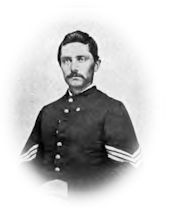
Friday, 6th—I was on fatigue again, but on account of rain last night the detail did not go to work until 1 o’clock this afternoon. Some of the heaviest siege guns obtainable are being mounted on raised platforms in the forts.
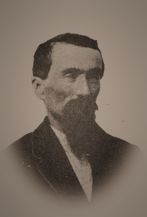
November 6 — Renewed our march this morning with Rosser’s brigade. We crossed the Hazel, passed through Amissville, a small village on the Sperryville and Warrenton road, and arrived late this evening at Gaines’ Cross Roads, in Rappahannock County, about fifteen miles east of Front Royal.
We are camped one mile west of Gaines’ Cross Roads, in one of General Rosser’s old camps.


