Following the American Civil War Sesquicentennial with day by day writings of the time, currently 1863.

November 2013

November 5 — We had a grand review to-day. General Stuart’s cavalry corps and horse artillery passed in general review before General R. E. Lee and John Letcher, Governor of Virginia. We arrived on the field early in the day. A great many of the cavalry were then already arriving on the review ground from two or three different directions, and the whole field was soon covered with bodies of horsemen in their cleanest attire and best appearance, all carefully prepared and trying to look pretty for review. Some of us men tried to blacken our shoes by rubbing them over a camp kettle.

On the east side of the field on a small wave-like hill was a flagstaff with a large, new, beautiful Confederate flag proudly floating in the crisp November breeze. At twelve o’clock the troops were all formed and ready for the grand reviewing exhibition. General R. E. Lee and staff, General Stuart and staff, and Governor Letcher rode in a gentle gallop along the whole length of the line, then quickly repaired to the review station and assembled in the rippling shadow of the large Confederate flag that moved above their heads.

When the resplendent and brilliant little cavalcade, with the grand old chieftain, R. E. Lee, in the center, had settled down for business, the column of horsemen began to move like some huge war machine. The horse artillery moved in front, then came the cavalry in solid ranks and moving in splendid order,— horsemen that have followed the feather of Stuart in a hundred fights. General Wade Hampton’s mounted band was on the field and enlivened the magnificent display with inspiring strains of martial music. The review was held on John Minor Botts’ farm. After the review we came back to camp, when the first section of our battery was detached from the battalion and ordered to report to our old brigade, now commanded by General Rosser.

We immediately prepared to march after we received the order, and at dusk we left the battalion camp and started for Rosser’s brigade. At ten o’clock to-night we arrived at Rosser’s camp near Major’s house on the Rickseyville road, about eight miles north of Culpeper Court House. We had very dark and difficult marching to-night on a cut across the country road; at one place one of our horses fell in a ditch, which detained us some little time to extricate it from its doubled-up, hors de ditch situation.
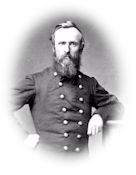
November 5, 1863. — A warm fall evening. How I am moved as I read the letter below. My own dear boys, and my feelings towards the soldiers who are kind to them; Willie too — the name of sister Fanny’s lost boy. Oh, and my dear sister too. How many will love General Sherman for that letter who would never care for any laurels he might earn in battle.

[Pasted in the Diary is a copy of General Sherman’s famous letter to Captain C. C. Smith of the Thirteenth Regulars, thanking the regiment — in which his little son Willie had fancied himself a sergeant — for the “kind behavior” of its officers and soldiers to his “poor child.” “Please convey to the battalion,” the letter says in conclusion, “my heartfelt thanks, and assure each and all that if in after years they call on me or mine, and mention that they were of the Thirteenth Regulars, when poor Willy was a sergeant, they will have a key to the affections of my family that will open all it has, that we will share with them our last blanket, our last crust.”]

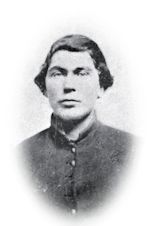
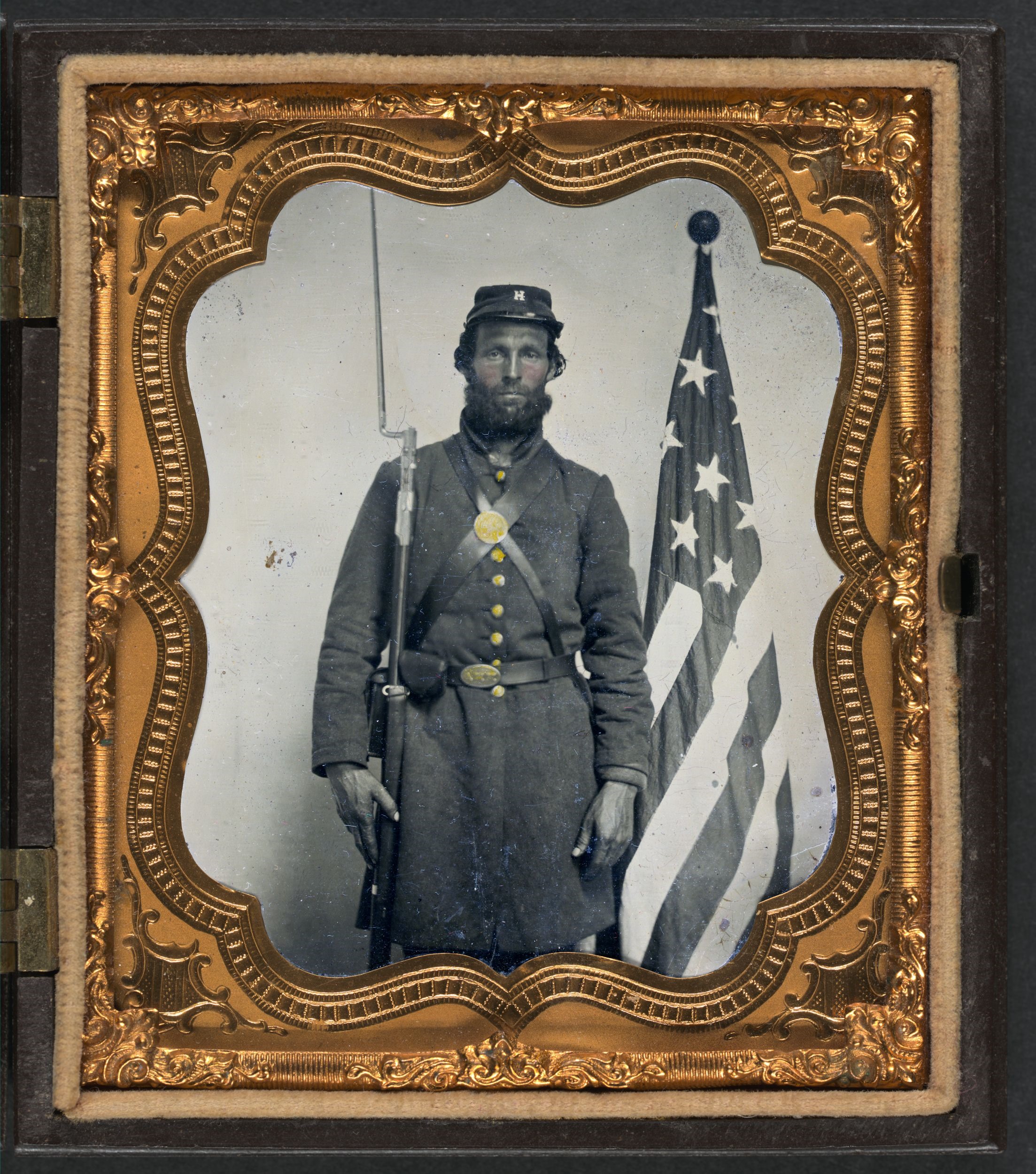
Unidentified soldier in Union uniform and Company H cap with bayoneted musket, cap box, and Volunteer Maine Militia (VMM) belt buckle in front of American flag in case

Unidentified soldier in Union uniform and Company H cap with bayoneted musket, cap box, and Volunteer Maine Militia (VMM) belt buckle in front of American flag

__________

Sixth-plate tintype, hand-colored ; 9.5 x 8.4 cm (case)

Liljenquist Family Collection of Civil War Photographs; Ambrotype/Tintype photograph filing series; Library of Congress Prints and Photographs Division.

Record page for image is here.

__________

digital file from original itemNote – This image has been digitally adjusted for one or more of the following:

    • fade correction,
    • color, contrast, and/or saturation enhancement
    • selected spot and/or scratch removal
    • cropped for composition and/or to accentuate subject matter
    • straighten image

Civil War Portrait 084

by John Beauchamp Jones

            NOVEMBER 5TH.—The President has not yet returned, but was inspecting the defenses of Charleston. The Legislature has adjourned without fixing a maximum of prices. Every night troops from Lee’s army are passing through the city. Probably they have been ordered to Bragg.

            Yesterday flour sold at auction at $100 per barrel; to-day it sells for $120! There are 40,000 bushels of sweet potatoes, taken by the government as tithes, rotting at the depots between Richmond and Wilmington. If the government would wake up, and have them brought hither and sold, the people would be relieved, and flour and meal would decline in price. But a lethargy has seized upon the government, and no one may foretell the consequences of official supineness.

            The enemy at Chattanooga have got an advantageous position on Bragg’s left, and there is much apprehension that our army will lose the ground gained by the late victory.

            The Commissary-General (Northrop) has sent in his estimate for the ensuing year, $210,000,000, of which $50,000,000 is for sugar, exclusively for the hospitals. It no longer forms part of the rations. He estimates for 400,000 men, and takes no account of the tithes, or tax in kind, nor is it apparent that he estimates for the army beyond the Mississippi.

            A communication was received to-day from Gen. Meredith, the Federal Commissioner of Exchange, inclosing a letter from Gov. Todd and Gen. Mason, as well as copies of letters from some of Morgan’s officers, stating that the heads of Morgan and his men are not shaved, and that they are well fed and comfortable.

November 5.—The United States transport Fulton captured the rebel blockade steamer Margaret and Jessie, this morning, at seven o’clock, when off Wilmington, N. C. The look-out at the foretop masthead made out a suspicious steamer painted entirely white, and burning soft coal, three points on the port-bow ; immediately gave chase, which resulted in her altering her course several times; following her, after a short time it was discovered that she was throwing cargo overboard, which confirmed our first suspicions that she was a blockade-runner. There was also in sight a fore-and-aft-rigged gunboat, five points on our port-bow. She remained in sight for a short time, when we lost sight of her astern. At ten A.M., made a side-wheel gunboat on the port-beam, (afterward ascertained to be the Keystone State.) About this time we fired three shots at the chase from a twenty-pound Parrott gun, falling short of the mark. At eleven A.M., made a side-wheel gunboat, (afterward ascertained to be the Nansemond,) three points on the port bow, also in pursuit. From this time until four P.M., continued in pursuit, gradually widening the space between us and the gunboats, and nearing the chase, when, after having fired fifteen shots, some of which passed entirely over the object, and others striking quite near, and after leaving our competitors far astern, the prize hove to. At this time the Keystone State was about ten miles astern, and the Nansemond about five miles. When the prize hove to, a prize crew, in charge of our first officer and the purser, was immediately sent on board, and a hawser from our stern attached to the prize— now ascertained to be the steamer Margaret and Jessie, of Charleston, from Nassau, N. P., for a confederate port The gunboat Nansemond arrived alongside the prize about half an hour, and the Keystone State about one hour after our hawser was made fast to the prize. This steamer is a valuable vessel, of about eight hundred tons burden, and has on board an unusually valuable cargo.—Official Report.

—The bombardment of Fort Sumter was kept up by slow firing from the monitors and land batteries.

—General Sanders, in command of a Union cavalry force, overtook a rebel regiment at Motley’s Ford, on the Little Tennessee River, charged and drove them across the river, capturing forty, including four commissioned officers. Between forty and fifty were killed or drowned, and the entire regiment lost their arms. Colonel Adams, who led the charge, lost no man or material.— Tbe ship Amanda was captured and burned, when about two hundred miles from Java Head,

by the confederate steamer Alabama.—Brownsville, Texas, was occupied by the National troops, under the command of Major-General Banks, the rebels having evacuated the place, after destroying the barracks and other buildings.—(Doc. 6.)

En route, Wednesday, Nov. 4. Reveille sounded at 3 A. M. and the sleepy camp was soon ready to march. Started at 5. It was a dense, foggy morning and the red glare of innumerable camp fires lit up the infantry in heavy columns, giving the surroundings of the camp a wild and terrible aspect. We moved out moodily, the stars lighting us on our way for nearly three miles and a half before daylight appeared. The road was rough and covered with pebbles which made it very bad for the horses. One of mine being barefooted is somewhat lame. 10 A. M. We came up on to the camp of the 2nd Brigade at Rogersville, the town half a mile to the left of us. The 4th Division had just returned, having found the bridge over Elk River destroyed. Then it moved out on another road leading north, which gives twenty miles more travel I understand. We halted for three hours, unhitched and unharnessed, cleaned off our horses and fed them. The 2nd Brigade moved out soon after we came in. The 3rd Brigade came up at 12 M. At 1 P. M. we again took the road and an easy march of six miles took us to camp on a good creek, an old fashioned breast-wheel grist mill close by, the name I did not learn. The first five miles was a flat timbered country, uncultivated, but when we came towards the creek it broke up in hills and rocks where poor folks lived and picked up a scanty living. As soon as we approached camp, guns were heard in every direction, more than last night. Several bullets flew directly over camp, but fortunately nobody was hurt. Officers of the day and staff officers galloped in every direction endeavoring to stop it. A camp guard was thrown around the infantry with orders to keep all men from going in who had guns. But General Smith had commenced too late to stop this Division from foraging. The guards sat down and always looked the wrong way, and meat in plenty was brought. Our mess had laid in a supply early in the morning; six chickens, a beef and a goose was our stock for eight men. Mail received late in the evening but I received “nary” one.

Charles Francis Adams, Jr., to his mother.

Camp of 1st Mass. Cav’y
Near Warrenton, Va., November 4, 1863

Contrary to my expectations in my last we are daily expecting a movement of some kind, though what, we are at a loss to imagine. I look for it with mixed emotions. I know that we ought to move and by offensive operations keep a portion of the burden of the war from the shoulders of our armies in Tennessee, and I am in so far willing to be sacrificed; but every man in this army to whom bitter experience has taught the first principles of strategy, feels that it will be all sacrifice, that of ourselves we can effect nothing. We know now that every movement or raid to Richmond is foredoomed to disappointment; that Washington cannot be covered and Richmond taken at the same time. Our situation is that of a man fighting for his life, with one hand tied behind his back. Of course this condition of affairs bears more heavily on the Cavalry than on any other arm of the service. We are fairly used up, knocked off our legs. Marches, scouts, reconnoissances and battles have done their honest work and not much more can be gotten out of the Cavalry Corps this year. To show results let me state my own experience in a few words. In June I commanded two companies and had one hundred and ten men in the field. I now command three and have about forty effectives, not twenty of whom would be left at the end of four days hard service. The men are well enough, but the horses! Such a collection of crow’s bait the eye of man never saw. Solomon’s song of the war-horse was the most bitter satire ever conceived. He may have been wise in his day and generation, but he evidently never saw field-service, and they did n’t know everything down in Judee. . .

Charles Francis Adams to his son

St. Leonards, November 4, 1863

On this side we are now enjoying a period of repose. The only question of interest to us is that connected with the outfit of war vessels for the rebels. The appeal from the decision of Baron Pollock in the case of the Alexandra is just now coming on. Singularly enough the Baron shows symptoms of change of mind in regard to his own charge, the practical effect of which is to embarrass the proceeding, and perhaps to lead to the necessity of a new trial. I do not know whether this is to be regarded as a favorable result or otherwise. My theory heretofore has been that delay is a very good thing. But I am not sure that the Court of Exchequer is not now prepared to act upon the subject in a right spirit; which, if it were so, would put an end to farther question. Barring this, I know not that there is at present any cause of serious difficulty between the two countries. . . .

4th. Aroused before daylight. Struck tents and loaded wagons. About 8 A. M. again pitched tents and sent out forage detail. Voted on re-enlistment question. Co. C, 21. Well done for it. Felt proud, better than most companies. Had good visit with many of the boys. Finished “Lillian.” Thede got some apples. Pleasant day.

Wednesday, 4th—It is still quite warm. I was on fatigue at the fortifications. The men are pulling down some fine residences and using the material in building the forts. It is pretty harsh and severe business to order a family, brave enough to stay all through the siege, out of their home and tear down their house before their eyes, to build into fortifications, but this is war. We are fortifying the place so that ten thousand men can hold it against any force that has a mind to come.