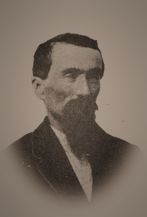
November 4 — We renewed our move this morning, and joined the battalion in camping about three miles northwest of Brandy Station.
November 2013
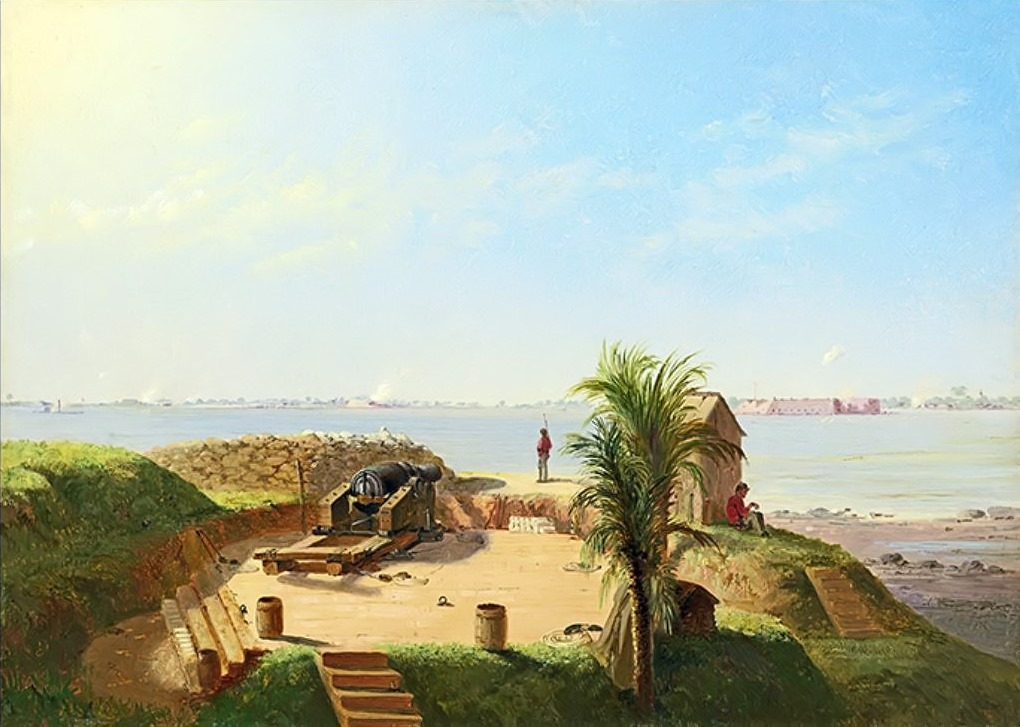
Painting by Conrad Wise Chapman.
This battery only had one gun and was close to Fort Moultrie. Forts Sumter and Johnson are seen in the distance. Near the palm tree was an old hotel – the Moseley House. A gun boat is out in the bay; and a shell can be seen bursting over Fort Sumter; the more shells that struck Sumter, the more impregnable it became, as their only effect was to level it and make it harder to take.” – Conrad Wise Chapman, 1898
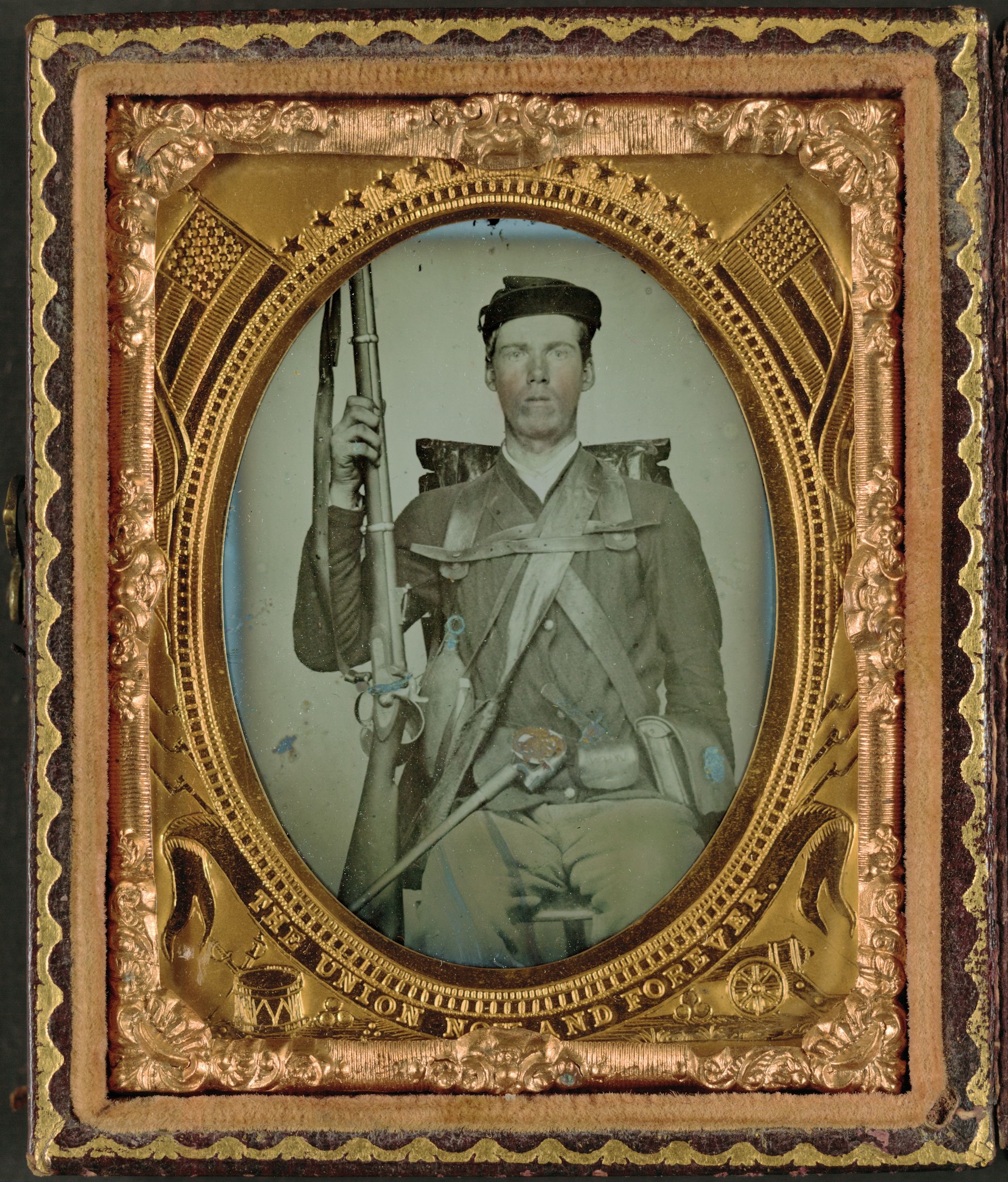
Unidentified infantry soldier in Union uniform in full marching order with musket, canteen, cartridge box, cap box, and knapsack
__________
Ninth-plate ambrotype, hand-colored ; 7.5 x 5.8 cm (case)
Liljenquist Family Collection of Civil War Photographs; Ambrotype/Tintype photograph filing series; Library of Congress Prints and Photographs Division.
Record page for image is here.
__________
 Note – This image has been digitally adjusted for one or more of the following:
- fade correction,
- color, contrast, and/or saturation enhancement
- selected spot and/or scratch removal
- cropped for composition and/or to accentuate subject matter
- straighten image
Civil War Portrait 083
by John Beauchamp Jones
NOVEMBER 4TH.–Mr. M_______, Major Ruffin’s commissary agent, denies selling government beef to the butchers; of course it was his own. But he has been ordered not to sell any more, while buying for the government.
Mr. Rouss, of Winchester, merchant, has succeeded in getting some brown cotton from the manufacturer, in Georgia, at cost, which he sells for cost and carriage to refugees. My wife got 20 yards to-day for $20. It is brown seven-eighth cotton, and brings in other stores $3 per yard. This is a saving of $40. And I bought 24 pounds of bacon of Capt. Warner, Commissary, at $1 per pound. The retail price is $2.50—and this is a saving of $36. Without such “short cuts” as these, occasionally, it would be impossible to maintain my family on the salaries my son Custis and myself get from the government, $3000.
How often have I and thousands in our youth expressed the wish to have lived during the first Revolution, or rather to have partaken of the excitements of war! Such is the romance or “enchantment” which “distance lends” “to the view.” Now we see and feel the horrors of war, and we are unanimous in the wish, if we survive to behold again the balmy sunshine of peace, that neither we nor our posterity may ever more be spectators of or participants in another war. And yet we know not how soon we might plunge into it, if an adequate necessity should arise. Henceforth, in all probability, we shall be a military people. But I shall seek the peaceful haunts of quiet seclusion, for which I sigh with great earnestness. O for a garden, a vine and fig-tree, and my library!
Among the strange events of this war, not the least is the position on slavery (approving it) maintained by the Bishop of Vermont.
November 4.—The troops belonging to the National expedition, under the command of Major General Banks, successfully landed at Brazos de Santiago, Texas, nine miles from the mouth of the Rio Grande del Norte.—(Doc. 6.)
—The bombardment of Fort Sumter continued.—Jefferson Davis visited James Island, Forts Pemberton, and Johnson, and all the rebel batteries around Charleston.
—The rebel Generals Chalmers and Lee attacked Moscow and La Fayette, Tenn., on the Memphis and Charleston Railroad, this day, at noon. They burned La Fayette, and some small bridges on the road. The Nationals repulsed them at Moscow. Colonel Hatch’s cavalry followed their retreat, and forced them to another fight four miles out, and again repulsed them. Between twenty and thirty of their dead were found on the field, among them three officers. Their dead and wounded were scattered along the road. In addition, three wagon-loads were taken away. Their loss probably reached one hundred. The Union loss was three killed, forty-one wounded, and forty-one missing. Colonel Hatch, of the Second Iowa, commanding the brigade, was seriously though not dangerously wounded, a ball piercing his right lung.
En route, Tuesday, Nov. 3. Called out at 3 A. M., and I thought it was no more than ten as I was very sleepy. At 5 A. M. we moved out, marched through the sleeping town with drum and fife playing, colors flying. Florence like most southern towns, is built with due regard to elegance and comfort, roomy sidewalks with spacious door yards filled with fine shrubbery and trees. Took a northerly course and marched twenty miles with no unnecessary delays and very fast. The infantry many of them falling back long before night; frequent rests were given of about twenty minutes in length. Crossed Shoal Creek at 10 A. M. A fine bridge over it built on stone piers and carefully enclosed, the stream about 100 yards wide, shallow but very swift, over a rocky bed. Passed some very fine country, but mostly inhabited by the poorer class and cultivated by white labor. Saw but very little cotton growing, and that of an inferior quality. Foraging done on a large scale by our boys. Sweet potatoes and chickens in plenty. Division commissary getting up beef cattle as we march. Came into camp near a very pretty creek with high rocky banks, the name of which I did not learn, at 1 P. M. As soon as we came in sight of camp, the infantry went out in squads in search of meat, with guns. The woods were full of hogs, and it soon sounded like heavy skirmishing, General Smith riding in great fury back and forth, endeavoring to punish the guilty parties and put a stop to it. He tied up several men by the limbs all night, but the boys got their hogs. He is getting unpopular very fast with his men. J. Wolf, S. Beaver and M. Dziewanowski detailed in the morning to go with E. W. E. in search of horses. They returned late, having found forty mules in all but no horses. We got twenty of them for the Battery and they will be put in the teams instead of the broken down horses.
This was election day for Wisconsin. The polls were opened by a commissioned officer about half an hour of sundown, and the electors soon deposited their votes with no fuss or talk as is usual on such occasions, more weighty matters being on hand. Lewis led Palmer (for governor).
3rd. In the morning went up and saw Provost Marshal about Hayes, also saw him. Fear he will be caused some trouble before getting away. Inspection at 1 P. M. Horses, men and arms. Co. C did itself up in array. Col. P. loaned me “Lillian.” Finished up Quartermaster and clothing, camp and garrison equipage.

Tuesday, 3d—Though the weather has been warm for two days, we are fixing up our tent for any cold snap that may come later on, for the report now is that we will remain here at Vicksburg all winter. I finished building the fireplace in my tent. The quartermaster has a detail of men with teams cutting and hauling wood from the timber for the winter.
November 3 — To-day we were ordered to rejoin the battalion of horse artillery. This war business is full of mysterious — and to a high private in the rear rank — unaccountable movements. The horse artillery camp is only about three miles from where we were camped to-day, yet we started so late this evening that it will require two moves to reach it, for darkness overtook us before we moved a whole mile, and we stopped by the wayside and camped for the night, about half a mile north of the Botts house.

November 3.—A very warm day, and our patients are suffering very much. If the weather was cool it would be better for them. One of the wards, called the carriage ward (as it had been a carriage house), has about fifty patients, and it is heart-breaking to hear them groan. I think it is even worse than Corinth, as the men here seem to suffer much more. There they either died or were taken to another hospital. Fresh wounds are scarcely ever as painful as old ones.
This ward is a large, low-roofed, whitewashed room, roughly boarded, so that there are not a few openings where the daylight peeps through.
On entering, the first man to the right is Mr. Robbins, about fifty years of age. The doctors say he is one of the worst wounded men we have. His appearance is weak and languid, and there is very little hope of his recovery. Near him is Mr. McVay, an Irishman, much emaciated. One of his legs has been amputated above the knee, and the bone is protruding about an inch, which is very painful.
To the left is Mr. Groover, wounded in both knees. While marching, a cannonball took off the cap of one, and the under part of the other, and his back is one solid bed-sore. We have tried to relieve his suffering in every way. The very sight of his face is distressing, and makes me feel as if I would sacrifice almost any thing to palliate his pain. The effluvia from his wounds is sickening.
Further on are a dozen or so badly wounded: one without a leg; another without an arm, and some with wounds which are awful to look at, but their faces denote all they need is plenty to eat. I passed on, telling them that they are beneath my notice.
At the head of this group is Mr. Conda, an Irishman, with his leg in a sling. His wound, though not a bad looking one, is very painful, and he sleeps but little day or night. The clammy sweat constantly on his forehead tells how acutely he suffers; so that there is no need of asking him how he is.
Opposite him is Mr. Horton, another great sufferer. Just beyond is a man who has about two inches of his shin-bone cut out, and it is growing up.
Along side of him is Mr. Sparks, who came here with apparently a slight wound in the leg. It is now so painful that he not only groans day and night, but many a time his plaint can be heard in the street. His nose is pinched, and all his features have the appearance of a great sufferer. A little ways from him is Mr. Robinson, a lad about seventeen. The calf of his leg is a solid sore. He wails most dolefully, and we find it impossible to assuage his pain.
He and many of the others might have their limbs amputated, but the doctors say that their systems are not in a fit state, and that they would not stand the shock. There are many other badly wounded men in the ward, but they do not seem to suffer so acutely.
In looking over letters received from a friend in Mobile, I was a little astonished at an assertion in one about the planters. It seems they will not sell produce unless at an exorbitant price, and many will take nothing in return but gold and silver. If this is really the case, which I have no reason to doubt, I am at a loss to understand how they can be so blinded. Are they not aware that we are blockaded, and can only procure food from them; and do they not also know, if the enemy succeed— which they assuredly will, if the planters and others act as they are now doing— that they will be ruined, as well as every body else? Heaven help the country! I am getting sick at heart with seeing men from whom we expected so much acting as they are now doing. I wonder if they expect men to fight for them and their property, if they leave their wives and children to starve? The men will be more than mortal if they do it.
It is too bad that President Davis can not devise some way of making these Esaus, who would not only sell their own birthright, but ours, for a mess of pottage, give up their stores. They are ours by right. God did not shower his blessing on the land, as he has done this summer, for them alone.
It is said the planters were to blame for the fall of Vicksburg, and that after its fall the enemy came and took all their cotton, corn, and every thing else they had. If this report be true, it is a just judgment on them. And will they not all suffer the same?
“Men of the South! look up, behold
The deep and sullen gloom
Which darkens o’er your sunny land,
With thunder in its womb!
Are ye so blind ye can not see
The omens in the sky?
Are ye so deaf ye can not hear
The tramp of foemen nigh?
Look north, look west, the ominous sky
Is moonless, starless, black,
And from the east comes hurrying up
A sweeping thunder rack!”
When I think of these wretches, and of the men who are lying here, having suffered so much to save them and their wealth, I can scarcely keep from crying out on them. What is every bushel of corn and acre of land these planters have compared with the sacrifice these men have made? A mere cipher. Why, such comparisons are odious!
I noticed a very good article in a Mobile paper, signed “Gray Hairs.” The writer is calling on the people to try and improve the currency, and denouncing the grand jury for not doing something about the matter.
The papers are filled with good advice, if the people would only take it, and be warned before it is too late.
Many are placing their hopes of peace on the peace party in the North. I do think we have had enough of that. The North always seems to get as many men as they want in spite of “peace parties” and every thing else.


