Following the American Civil War Sesquicentennial with day by day writings of the time, currently 1863.

November 2013

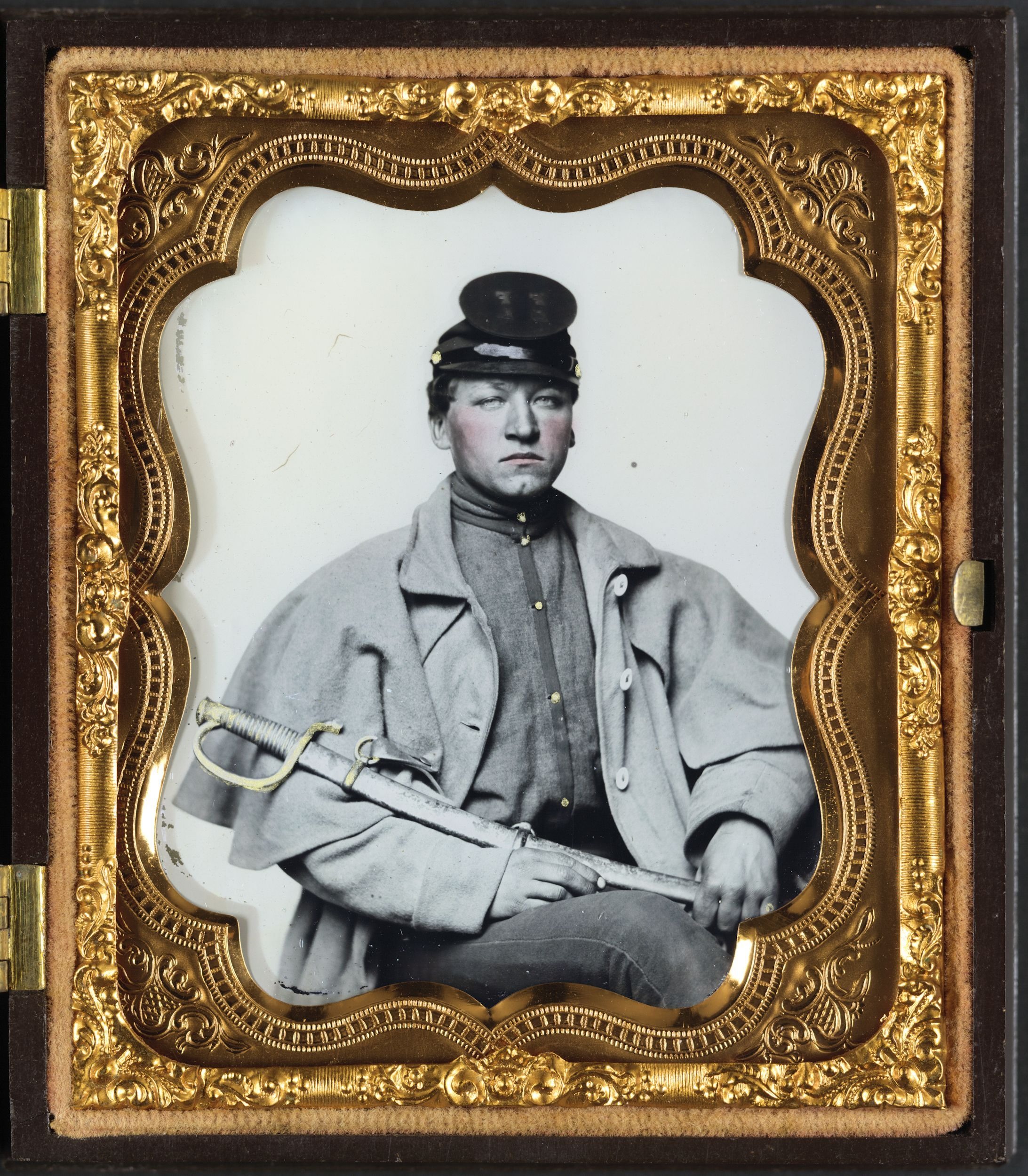
Unidentified soldier in Confederate artilleryman uniform and greatcoat with sword in case

Unidentified soldier in Confederate artilleryman uniform and greatcoat with sword

__________

Sixth-plate tintype, hand-colored ; 9.5 x 8.4 cm (case)

Liljenquist Family Collection of Civil War Photographs; Ambrotype/Tintype photograph filing series; Library of Congress Prints and Photographs Division.

Record page for image is here.

__________

digital file from original itemNote – This image has been digitally adjusted for one or more of the following:

    • fade correction,
    • color, contrast, and/or saturation enhancement
    • selected spot and/or scratch removal
    • cropped for composition and/or to accentuate subject matter
    • straighten image

Civil War Portrait 082

November 3. — Colonel Fitzgibbon, of the Thirteenth Michigan infantry, overtook the combined forces of Cooper, Kirk, Williams, and Scott, numbering four hundred men, this morning, at Lawrenceburgh, thirty-five miles south of Columbia, Tenn. After a severe hand-to-hand fight, he defeated them with a loss on his part of three men wounded, and eight horses killed. The rebel loss was eight killed, seven wounded, and twenty-four prisoners, among them one captain and two lieutenants. General Bragg’s forage-train, sent up Lookout Valley, in front of his position, was captured. The train was sent to camp. The train-guard was also captured.—Official Report.

—General Saxton issued a circular to the freedmen of South-Carolina, authorizing them to locate in the lands in that department which were about to be sold by the Tax Commissioners, not exceeding twenty acres for each head of a family. The description of the land, when located, to be accompanied by the deposit of the Government price, about one dollar and twenty-five cents per acre.

—Major-General Grander reported, from Nashville, Tennessee, that he sent a detachment of cavalry from that place, under Colonel Shelby, to pursue Hawkins and other guerrillas. He overtook Hawkins near Piney Factory, and routed and pursued him to Centreville, where he made a stand; routed him again, and pursued him until his forces dispersed. The rebel loss was fifteen or twenty killed, and sixty-six prisoners. The Union loss was slight.—General Thomas’s Report.

—The battle of Bayou Grand Coteau, La., also known as the battle of Bayou Bourbeaux, was fought this day.—(Doc. 7.)

Colliersville, Tenn., was attacked by a body of rebels, belonging to the command of General Chalmers, who was repulsed with some loss, by the Nationals, under the command of Colonel Hatch.
November 3—Went on picket on the Rappahannock at Norman’s Ford, six miles from camp.

by John Beauchamp Jones

            NOVEMBER 3D.—Gen. Lee writes that he will endeavor to protect the workmen while removing the iron at Aquia Creek, but he fears the work has been too long delayed. The government has been too slow.

            Gen. Sam Jones writes from Abingdon that his cavalry was at Jonesborough on the 30th ult., although the enemy’s raiding parties were on this side. He says if he had a little more infantry, he could soon clear East Tennessee of the foe; and asks that an order from Gen. Cooper (A. and I. G.), calling for two of his best regiments of cavalry, be revoked.

            In Gen. Lee’s recent campaign beyond the Rappahannock, our losses in killed, wounded, and missing amounted to 1740; the enemy’s losses must have been three times that number.

            The President made a speech in Charleston on the 1st instant. We have copies from him to day of his correspondence with Gen. Bragg since he left Chickamauga field. Gen. B. says he will immediately call for Hardee’s brigades, promised him, and without delay commence operations on the enemy’s left (it is too wet on the right), and drive Burnside out of East Tennessee. But he complains of Gen. Buckner, who assumes to have an independent command in East Tennessee and West Virginia. The President replies that neither Bragg nor Buckner has jurisdiction over Gen. Jones in West Virginia, but that he gets his orders from Richmond. He does not promise to remove Buckner, whom he deems only impatient, but says he must be subject to Bragg’s orders, etc.

            Gen. Bragg has applied for Gen. Forrest (who went some time since to Mobile and tendered his resignation, in a pet with Gen. Bragg) to command a cavalry force in North Mississippi and West Tennessee. In short, the President is resolved to sustain Gen. Bragg at the head of the army in Tennessee in spite of the tremendous prejudice against him in and out of the army. And unless Gen. Bragg does something more for the cause before Congress meets a month hence, we shall have more clamor against the government than ever. But he has quashed the charges (of Bragg) against Gen. Polk, and assigned him, without an investigation, to an important command.

Florence, Ala., Monday, Nov. 2. Reveille sounded at 5 A. M. this morning, and at 6 we were on the road. We marched by brigades. The 2nd is a day’s march ahead and the 3rd behind. In this way all the necessary delays in marching along are avoided. The Division train generally moves with us. The first five miles was rocky and stony with plenty of beautiful springs, but after that the country was more level, of red clayey soil. We passed some fine fields but a large portion of it is in its wild state waiting for the hand of enterprise and industry to convert it into productive fields of wealth. Halted at Cypress Mills half an hour at 3 o’clock. Watered our horses in creek of same mill. A good water power here which used to move a large cotton factory owned by the furious rebel John Morgan. The factories were burned last May by Colonel —— as they were manufacturing for the C. S. A. The people here were represented to be all Union people. Squads of factory girls were strung along the road, some of them good looking, others passable. An old woman did good business selling milk at 5 cts. a drink. Many of them wore Union badges and inquired for the Alabama Cavalry. This was three miles from Florence and we reached it by 4 P. M. Went into camp on the outskirts of the town. A beautiful college located here, three stories high, of brick, and built after, the manner of ancient castles. Tuscumbia is on the other side of the Tennessee River. A branch R. R. five miles long formerly connected the two places. Rebs represented to be at Tuscumbia in force and to shoot every blue “breech” they see on this side. R. Randolph captured by rebs and paroled. He was detailed to go with forage train in the evening, strayed off, and was gobbled up by a couple of cavalry. Paroled and sent back. He arrived in camp after night completely worn out. His parole was not properly drawn, and will not be respected by our authorities. 2nd Brigade moved out at 5, after drawing five days’ rations from Division teams. We have forty-seven miles to go in the next two days.

Monday, 2nd—Remain in Camp all day.

2nd. Wrote a letter home. Helped make our ordnance returns —about square in everything. Was kept busy till quite late. Ordered to be ready to march tomorrow at daylight. Plenty of rumors. Col. Kautz came to inspect the cavalry—all wished he would come to stay.

Monday, 2d—It was my turn on the picket line today. Our picket post is three miles below Vicksburg on the main road to Warrington, and I was stationed right on the bank of the Mississippi. Our reserve post has one lieutenant, one sergeant, two corporals and thirty privates. Six men under a sergeant go out on the public highway from four to six miles, twice a day, to see that there are no rebels advancing.

Camp near Warrenton, Va.,
Monday, Nov. 2, 1863.

Dear Sister L.:—

I got back to camp last Thursday night. Next morning early we marched about six miles and brought up on the Branch railroad, about three miles from Warrenton. I do not as yet know any more of the result of my examination than I wrote you from Washington. My papers have not arrived yet.

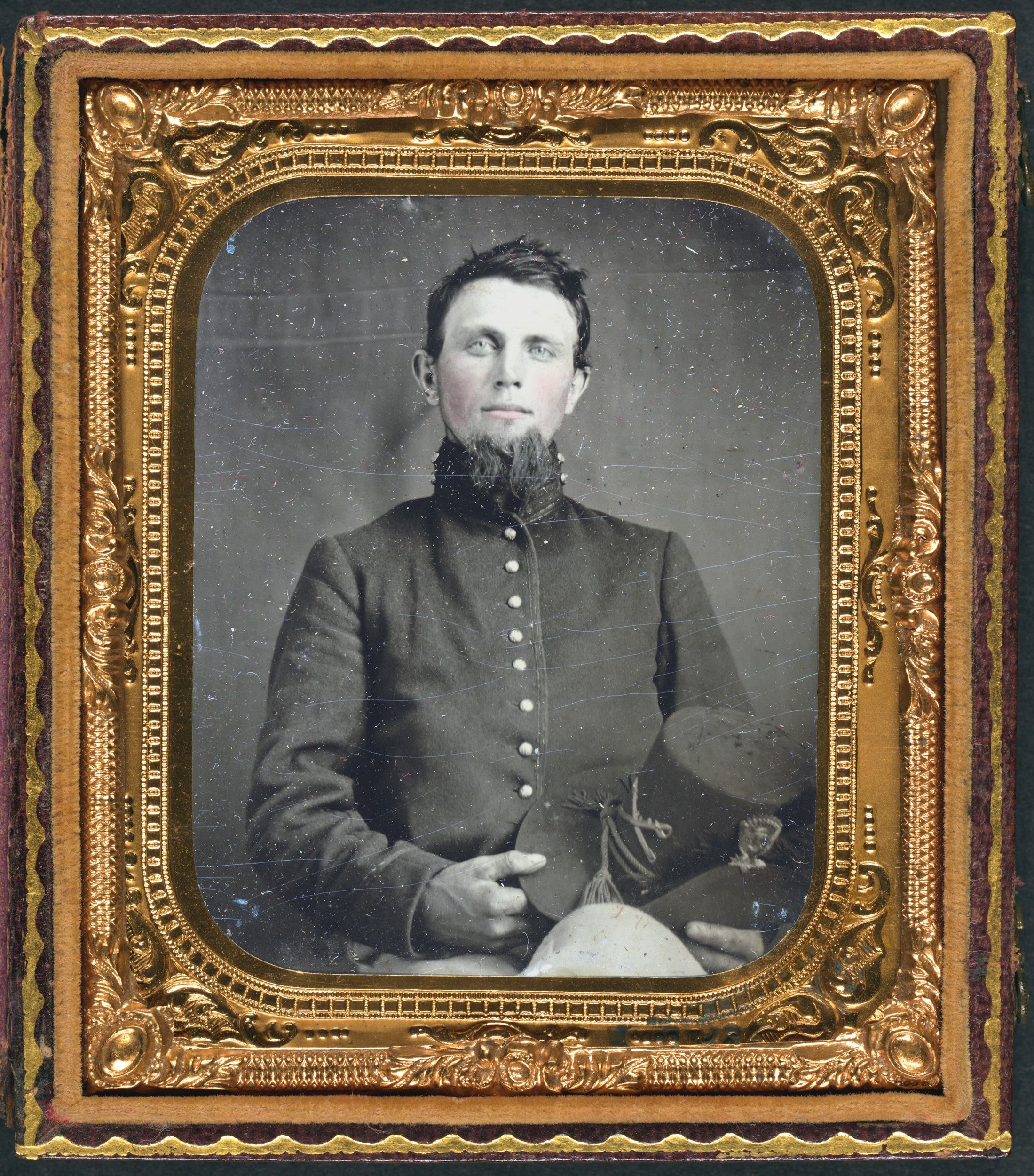
Unidentified soldier in Union uniform holding Hardee hat in case


Unidentified soldier in Union uniform holding Hardee hat

__________

Sixth-plate tintype, hand-colored ; 9.5 x 8.4 cm (case)

Liljenquist Family Collection of Civil War Photographs; Ambrotype/Tintype photograph filing series; Library of Congress Prints and Photographs Division.

Record page for image is here.

__________

digital file from original, tonality adjustedNote – This image has been digitally adjusted for one or more of the following:
    • fade correction,
    • color, contrast, and/or saturation enhancement
    • selected spot and/or scratch removal
    • cropped for composition and/or to accentuate subject matter
    • straighten image

Civil War Portrait 081