Following the American Civil War Sesquicentennial with day by day writings of the time, currently 1863.

Saturday, February 5, 2011

FORT SUMTER, S.C., February 5, 1861.
(Received A. G. O., February 8.)

Col. S. COOPER, Adjutant-General:

COLONEL: The character of the work on the end of Cummings Point nearest to us is, I think, now pretty well established. It seems to be a bomb-proof, with embrasures for the guns, the embrasures cut in a sloped wall, formed of heavy timbers, which is now being covered with railroad bars. This battery, though too far off for doing much damage to our walls, unless they have or get heavy rifled guns, will be pretty safe from the effect of our horizontal fires. They appear to be at work to-day connecting this battery with one between it and the battery which fired on the Star of the West, by means of a covered way. Their engineering appears to be well devised and well executed, and their works, even in their present condition, will make it impossible for any hostile force, other than a large and well-appointed one, to enter this harbor, and the chances are that it will then be at a great sacrifice of life. Our 10-inch columbiads are now in position. One points towards the city, one towards Fort Moultrie, and the third can be directed either towards Fort Moultrie or Morris Island. They are at an angle of from 30° to 35°. I tried a shell, a few evenings ago, and we calculated that from a charge of two pounds we got a range of about two thousand yards. I have also four 8-inch seacoast howitzers planted in the area at an angle of 39°. These bear upon Morris Island. I am now removing the pieces of flagging from the area of our work, as I want it clear, hoping that should any shells fall in it they will probably sink so deep that they will not do much, if any, damage. Captain Foster is engaged in experimenting with one of the iron shutters, trying to see whether we can use them in the lower embrasures. It is very desirable that these embrasures shall be made as secure as possible.

I am, colonel, respectfully, your obedient servant,

ROBERT ANDERSON,

Major, First Artillery, Commanding.

P. S.–Of course, in speaking of forcing an entrance, I do not refer to the little stratagem of a small party slipping in.

FORT SUMTER, S.C.,
February 5, 1861.

General Jos. G. TOTTEN,
Chief Engineer U.S. A., Washington, D.C.:

GENERAL: The sketch upon the margin below gives a pretty correct idea of the position of the works on Cummings Point, thrown up by the South Carolinians. Of course it is subject to errors, arising from the distance at which I am obliged to obtain the information by means of the spy-glass alone.
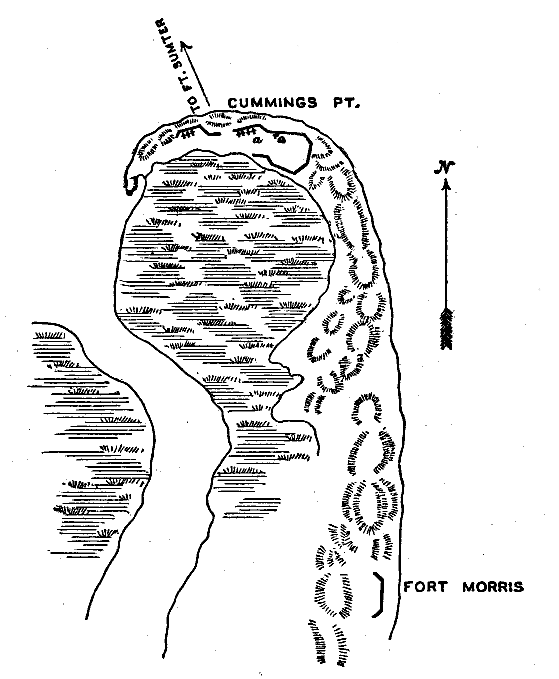
Position of the works on Cummings Point, Charleston Harbor, February 1861, South Carolina

The lines of the work are not yet complete, the main efforts having been directed to getting ready those guns that are intended to fire upon this work. All the guns that I have indicated by a + are (or appear to be) in position and covered by bomb-proof roofs.

Those at a a are covered by heavy timbers, laid horizontally upon firm timber supports, similar to the marginal sketch. The revetment of the cheeks of the embrasures appear to be formed of palmetto logs, as also the revetment of the interior slope near the guns. The horizontal timbers are large 14-inch raft, sticks, covered apparently by a lighter timber, or planking, running at right angles to the timbers. The guns at a a were being put upon their carriages (which I suspect, from their using a gin in the operation, are some of the barbette carriages <ar1_165> from Castle Pinckney or Fort Moultrie) at the time I wrote to you this morning. Subsequently the rough opening of the embrasures was made and the revetment of the cheeks commenced.
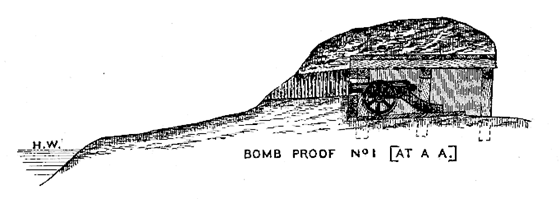
Bom Proof on Cummings Point, Charleston Harbor, February 1861, South Carolina

The second bombproof battery is built differently. The timbers on top are sloped at an angle of 45°, about as in the sketch. They rest upon two horizontal supports parallel to the direction of the battery, one higher than the other, and these are supported by stout posts, about 5 feet from each other. Upon the timbers are placed at right angles a stout planking, and upon this again another covering running up and down. This last consists of railroad iron, apparently the T rail. The work has only progressed thus far, although there is no doubt that the whole is to be covered with sand. The guns are mounted and the openings for embrasures formed.
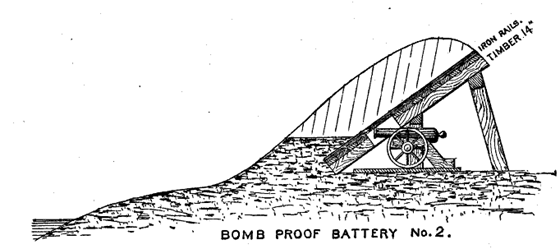
Bom Proof on Cummings Point, Charleston Harbor, February 1861, South Carolina

The work is carried on quite rapidly, considering the heavy nature of the work. The idea of covering the bomb proof with iron and giving it an inclination is no doubt derived from the Sardinian method for forming the sides of a man-of-war, so as to deflect the shot.

A large force of negroes is employed in extending the embankment of the parapet so as to connect this battery with the field work.

The guard-boats are very active at night, and some are always on the watch by day.

Inside this fort the work of preparation goes steadily on. My force is now employed in clearing the parade of the stone flagging. I am also having all the material on hand made into sand bags.

Very respectfully, your obedient servant,

J. G. FOSTER,

Captain, Engineers.
FORT PICKENS, FLA., February 5, 1861.

SIR: Having heard rumors that the forts and other public property in Pensacola Harbor were to be seized by troops under the orders of the governor of Florida, and having been advised of the seizure of the forts in Mobile Bay, I deemed it proper, having received no instructions from Washington, to endeavor to prevent, by all the means in my power, a like seizure here.

On the morning of the 7th ultimo, accompanied by Lieutenant Gilman, I called upon the commander of the navy-yard, Commodore Armstrong, to consult with him in reference to some plan to be adopted to insure the safety of the public property. We had a similar consultation on the evening of the same day and on the morning of the 8th. The commodore, in the absence of any orders, deemed it inexpedient to cooperate with us.

On the morning of the 8th I removed all the powder from the magazine in the Spanish battery of Fort Barrancas to the inner magazines, because, from its exposed position, it was liable to seizure at any moment. I also caused all the batteries to be put in working order, and at night placed a sergeant’s guard in the fort with the drawbridge raised. That night a body of men (about twenty in number) came to the fort with the evident intention of taking possession. The corporal of the guard caused the alarm to be given, upon which the assailants retreated precipitately. The guard was immediately strengthened by half the company, but nothing further occurred that night.

On the morning of the 9th I received through the mail a letter, of which the following is a copy:

HEADQUARTERS OF THE ARMY,
Washington, January 3, 1861.

First Lieut. A. J. SLEMMER,
……..First Artillery, or Commanding Officer Barrancas Barracks, Fla.:
SIR: The General-in-Chief directs that you take measures to do the utmost in your power to prevent the seizure of either of the forts in Pensacola Harbor by surprise or assault, consulting first with the commander of the navy-yard, who will probably have received instructions to co-operate with you.

……..I am, sir, very respectfully, your obedient servant,

…..GEO. W. LAY,……..
Lieutenant-Colonel, A. D. C.

Immediately on its reception, accompanied by Lieutenant Gilman, I called on Commodore Armstrong to consult with him. He had received orders to co-operate with me. We decided that with our limited means of defense we could hold but one fort, and that should be Fort Pickens, as it commanded completely the harbor and the forts, and also the navy-yard, and, in case of necessity, could be more readily re-enforced than either of the others, and presented the best means of defense. In order to act on this decision, the commodore promised to send the U.S. steamer Wyandotte at 1 o’clock p.m. to take us over, to give us all the men he could possibly spare, and to allow the steamer Wyandotte and the storeship Supply to anchor under the guns of the fort, in order to protect the land approach.

At 10 o’clock a.m. I came with the greater part of my command, Company G, First Artillery, to Fort Pickens to mount guns and make necessary preparations for defense, leaving Lieutenant Gilman at Barrancas Barracks with the remainder to make the necessary arrangements for removal. At 1 p.m. Lieutenant Gilman, seeing no signs of the promised assistance, called to see the commodore, and was informed by him that the only assistance he could afford would be to furnish some provisions and take the command over, which fact Lieutenant Gilman reported to me at Fort Pickens. I immediately stopped all work, sent the men back, and with Lieutenant Gilman went to see the commodore. I stated that I had been deceived by him; that he had promised me men and the co-operation of the two vessels of war, besides the mere fact of giving us provisions and taking us over; that with my command, only 46 strong, I should never dream of defending so large a work, calculated for upwards of 1,200 men; that I had been at work on that promise, and had thus lost a day’s time in the preparation of Fort Barrancas for defense; that he had distinctly promised me what I asseverated. The commodore then sent for Commander Farrand, Lieutenant Renshaw, and Lieutenant-Commander Berryman, and gave instructions for carrying out the original design.

Captain Berryman, of the steamer Wyandotte, promised to be ready to leave his wharf at 5 p.m., at which time all should be in readiness at the Barrancas wharf for removal. I immediately returned to Barrancas Barracks to make preparations. As time was very limited all means were used to place the public property on the wharf for removal. Night came, and yet no signs of assistance. The company labored until 12 m., when a heavy fog coming in rendered it highly improbable that the steamer would come that night. At 8 a.m. on the 10th a flat-boat was sent to the wharf, which was loaded, as well as all the small boats which could be had. We were landed at Fort Pickens at about 10 a.m. On the way over, Captain Berryman turned over to me thirty ordinary seamen from the yard, without arms or equipments of any kind. We labored all day until night carrying up the stores to the fort, and arranging for its defense. I directed that all the powder in Fort Barrancas should be taken out and rolled to the beach, for transportation if possible; if not, for destruction. Nearly all the powder and all the fixed ammunition for the field battery was brought over that day. All the guns bearing on the bay were spiked by my orders, in position, as I had neither means nor time to dismount them. The provisions required were, by agreement with the commodore, to be drawn from the Supply as they were wanted, instead of sending them from the yard; yet, almost the instant we landed the master of the yard came with some small stores in a barge, bringing with him an order from Commodore Armstrong to land the stores immediately and proceed to anchor off the  center wharf of the yard. As I was not ready to receive the stores, the Supply remained at her anchor that night.

On the morning of the 11th I was informed by Captain Walke that he had received another order from Commodore Armstrong to deliver the stores and return to the navy-yard. Captain Berryman also told me that he expected to sail that evening or the next morning for the south side of Cuba. I immediately caused the following note to be addressed to the commodore by my acting adjutant, Lieutenant Gilman: [click to continue…]

TUESDAY 5

The Unionists carried the State Virginia yesterday by a large majority and everyone has felt better today. I think the Secession Movement has reached its climax and a re-action will now take place, but perhaps the wish is Father to the thought. The Chief Engineer of U.S. Navy was with me an hour or two today in the office, had long conversation upon Steam and Steam Engines. He is a knowing man. Bot H N Jr suit of clothes tonight. Was in at Willards and saw numerous friends and almost innumerable strangers. Weather pleasant.

______

The three diary manuscript volumes, Washington during the Civil War: The Diary of Horatio Nelson Taft, 1861-1865, are available online at The Library of  Congress.

—The Peace Convention, at Washington, organized permanently, with Ex-president John Tyler in the chair; J O. Wright, of Ohio, secretary.—Herald, Feb. 6.