Following the American Civil War Sesquicentennial with day by day writings of the time, currently 1863.

Tuesday, February 22, 2011

—The people of Charleston, S. C., celebrated Washington’s birthday with great enthusiasm. The Pickens cadets paraded for the first time, and were presented to Governor Pickens by Lieutenant Magrath. The Governor made the company a brief address, urging upon its members the bright and shining example of Washington as deserving imitation. Subsequently a banner was presented to the Washington Light Infantry, and in the evening the company reassembled in Hibernian Hall, where it was addressed by Colonel Edward Carroll, in an oration of a rather sanguinary hue. Other companies also celebrated the day in their own w ay.—Louisville Journal.

—The Collector of Charleston gives official notice that all vessels from foreign States, except Texas, will be treated as “foreign vessels,” and subjected to the port dues and other charges established by the laws of the Confederated States.—Charleston Courier.

FRIDAY 22

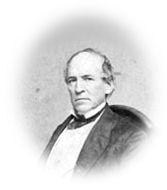
This has been a delightful day, rather cool, but pleasant. The celebration of Washingtons birth day called out a grand display of the Military of the District in the morning. The U.S. troops paraded afterwards by themselves. The order for their appearance in the morning with the Militia was for some reason not now understood countermanded. Wife and family went to the Ave at 10. o’clock and witnessed the display from C Woodwards Balcony. I dined by invitation at the National with some Gentlemen from NY City. A salute of 34 guns was fired, and the “Stars & Stripes” were flying from every point today. Spent the evening at home.

______

The three diary manuscript volumes, Washington during the Civil War: The Diary of Horatio Nelson Taft, 1861-1865, are available online at The Library of  Congress.

CONGRESS, February 22, 1861.

Mr. Bartow, from the Committee on Military Affairs, reported the following resolution, which was adopted, viz:

Resolved, That the President of the Confederate States be requested to communicate, in such manner as he may deem expedient, to the governors of South Carolina and Florida the resolution of Congress concerning Forts Sumter and Pickens.

[Copy of the resolution above referred to.]

RESOLUTION in relation to the occupation of Forts Sumter and Pickens.

Resolved by the Confederate States of America in Congress assembled, That it is the sense of this Congress that immediate steps should be taken to obtain possession of Forts Sumter and Pickens, by the authority of this Government, either by negotiations or force, as early as practicable, and that the President is hereby authorized to make all necessary military preparations for carrying this resolution into effect.

Passed February 15, 1861.

Hon. A. G. Jenkins, Member of Congress from Virginia, informed why a Route Agent in his District was removed.

Post-office Department, February 22, 1861.

Dear Sir,—Your letter of the 20th inst. is received, requesting ” distinct and specific answers” to the following interrogatories,—viz.:

1. What are the grounds of the removal of Thomas J. West, late route agent on the line from Grafton to Parkersburg, Va., and of the substitution of another person in his place?

2. Why is it that these proceedings have been carried out on my part without affording you any information of my contemplated action?

3. Upon whose suggestion was I led to remove Mr. West, and by whose recommendations was I induced to appoint his successor?

4. And, finally, whether the same policy of secretly decapitating your friends is to be acted upon hereafter as the settled rule of the Department?

These are plain questions, stated nearly in your own language, and, in view of the custom which for a number of years has prevailed in the Department, of consulting members of Congress in regard to appointments and removals in their respective districts, it is not unnatural and perhaps not unreasonable that you should ask them. But you will excuse me for remarking, in all kindness, that, in the first place, it is contrary to the rule of the Department to communicate written answers to such inquiries; and, secondly, that the right which you seem to claim, of controlling the appointments in your district, has no existence in fact. Excepting the comparatively few cases in which the law imposes this duty on the President and Senate, the power of appointing the officers of this Department rests exclusively with the Postmaster-General, who alone is responsible for its proper exercise. By courtesy, the member, when agreeing politically with the administration, is very generally consulted with respect to appointments in his district; but his advice is by no means considered as binding on the Department, nor is the Postmaster-General precluded, even by courtesy, from making removals or appointments on satisfactory information, as in the present instance, exclusively from other reliable sources. When the member is politically opposed to the administration, it is not usual to consult him.

Here I might close; but, since you have asked these questions, evidently under the honest impression that it is my duty to answer them, I will disregard the rule so far as to reply to the first, second, and fourth, simply stating, with reference to the third, that I respectfully decline giving the names of the parties by whose suggestions and recommendations I have been guided in making the change.

To the first, then, I have to inform you that Mr. West was removed for leaving his route without permission from the Department, and actively engaging in a movement the avowed object of which is to induce the withdrawal of Virginia from the Union. In other words, he was discharged for undertaking to destroy the Government from whose treasury he was drawing the means of daily subsistence and whose Constitution he had solemnly sworn to support.

Your second and fourth interrogatories may be answered together. I did not advise with you because I had good reason to believe that you were yourself, honestly, I doubt not, fully committed to the secession interest in your State. As to the policy to be pursued in the future towards your friends in office, I can speak only of what may be done in the few remaining days of this administration; and I hesitate not to assure you that if, during this short time, any other cases like the present come before me, I shall esteem it my imperative duty to pursue the course adopted in this instance.

This being not strictly an official letter, I may be pardoned for adding that I am for the Union without reservation, equally against disunionists at the South and abolitionists at the North, and for the just rights of all sections in the Union.

I have the honor to be,

Very respectfully, your obedient servant,

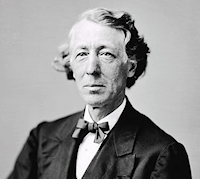
Horatio King.

Hon. A. G. Jenkins,

House of Representatives.
HEADQUARTERS OF THE ARMY,
New York, February 22, 1861.

[COL. L. THOMAS, A. A. G. :]

SIR: I have the honor to acknowledge the receipt of your confidential letter of the 21st instant, conveying instructions of the General-in-Chief. I have already taken steps towards executing those instructions, by conferring with Captain Ward, of the Navy, and the quartermaster and commissary of subsistence on duty in this city. I shall see Major Thornton to-morrow. Captain Ward will not be able to take any bales of hay for bedding purposes, and at his suggestion I propose to send mattresses to Fort Sumter instead, unless objected to by the General-in Chief. Captain Ward will provide the coal and wood which Lieutenant Hall’s memorandum calls for. In relation to clothing, I am unable to make out what the memorandum requires. Instead, therefore, of writing myself to Philadelphia, I beg that the necessary orders may be given from Washington to the clothing officers in Philadelphia to send to Colonel Tompkins here the clothing required by the memorandum, and the garrison flag and cord for lanyards on this same memorandum. I shall see that everything else on the memorandum is provided here, including such groceries as might be for sale to officers, &c. The clothing should be put up in small bales, so that it may be distributed among the vessels. Colonel Tompkins will attend to its proper marking after its arrival here. Please let me know as soon as you give the order to the clothing-department. I saw Commodore Bruce, who will do all that he can, but hopes to receive instructions.

Very respectfully, your obedient servant,

H. L. SCOTT.

—–

P. S.–I have arranged with Captain Ward to send all the stores, &c., on board the North Carolina, addressed to him. He will attend to their distribution among his vessels.

H. L. S.,

Lieutenant-Colonel.

.

.FORT SUMTER, S.C.,

February 22, 1861.

Col. S. COOPER, Adjutant General:

COLONEL: I have the honor to report that they are forming three embrasures in the work near the bomb-proof battery. We are, as I write (12 m.), firing a national salute from our battery in honor of the day.

I am, colonel, very respectfully, your obedient servant,

ROBERT ANDERSON,

Major, First Artillery, Commanding

—–

FORT SUMTER, S.C., February 22, 1861.

General Jos. G. TOTTEN,
Chief Engineer U. S. Army, Washington D.C.:

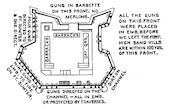
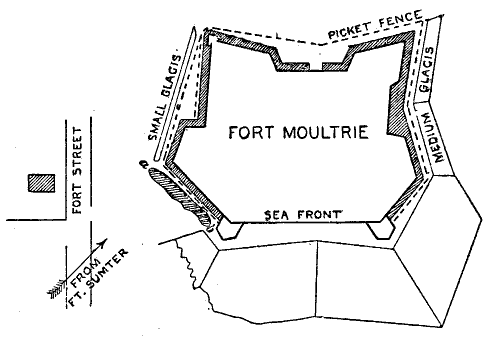
GENERAL: The work on the third breaching battery on Cummings Point has progressed so that the embrasures, three in number, are being commenced. Some work was also done on Fort Moultrie yesterday and the day before; at least it was commenced the day before. This consists of a parapet of earth in front of the scarp wall of the front that faces us, apparently intended to serve as a glacis, as it rises to the height of the cordon. It is revetted on the side next the scarp wall with barrels, and has a pretty steep slope upon the side towards us.

Fort Moultrie, Charleston, South Carolina, Harbor, February 22, 1861

The parallelogram a b shows its position very nearly. This sketch in black shows in a rough way the condition of the fort when we left it,  being bordered on all sides but one with a shallow wet ditch and picket fence, which fence was again protected by a small glacis in front of it. The large glacis on the sea front was very nearly completed, and the second caponiere would have been completed and the guns mounted in four days.

This morning at sunrise a salute of thirteen guns was fired from Castle Pinckney. I understand that Major Anderson has ordered a salute to be fired at noon to-day.

I have the honor to be, very respectfully, your obedient servant,

J. G. FOSTER,

Captain of Engineers.

EXECUTIVE OFFICE,
Montgomery, Ala.,

February 22, 1861.

His Excellency Governor PERRY:

SIR: The subjoined resolution was passed by Congress, in secret session, and the injunction of secrecy, you will perceive, has been removed only so far as to authorize me to communicate in the manner deemed expedient, and I must, therefore, ask that you consider it as confidentially done. The resolution suggests two methods by which possession of the forts may be had. It was not intended, however, that the progress of the one should retard or affect the preparations for the other; while, therefore, steps are being taken for negotiation, earnest efforts have been made to procure men of military science and experience, and to seek for munitions and machinery suitable to remedy the supposed or known deficiencies in the existing supplies. Congress, probably, did not design to interfere with the progress of Constructions which had been commenced by State authority, the instruction of troops or other preparation, which will be useful in further operations, and I hope you will continue thus to prepare for whatever exigency may arise. As soon as a skillful engineer is available he will be sent to make an examination of the fort within your State and to aid in the works needful to the execution of the resolution of Congress, should force be the means to which we must resort.

Very respectfully and truly, yours,

JEFF’N DAVIS.