Following the American Civil War Sesquicentennial with day by day writings of the time, currently 1863.

February 2011

SATURDAY 16

A delightful and bright warm day, but muddy in the streets. Worked pretty busily in the office today. Prof Rogers was in with a working model of his Steam and air Engine operating upon the principle of the “Jefford Injector” for Steam Boilers. In Rogers Engine the Steam took in a current of air into the Steam chest. He claims a gain of nearly 100 pr cent over the Comn [common?] S Engine. A boy brought a Box of excellent Cigars, present from W A Lighthall. Was in at Willards this evening. Saw W VanMaster from Lyons there, bot “Times.”

______

The three diary manuscript volumes, Washington during the Civil War: The Diary of Horatio Nelson Taft, 1861-1865, are available online at The Library of  Congress.

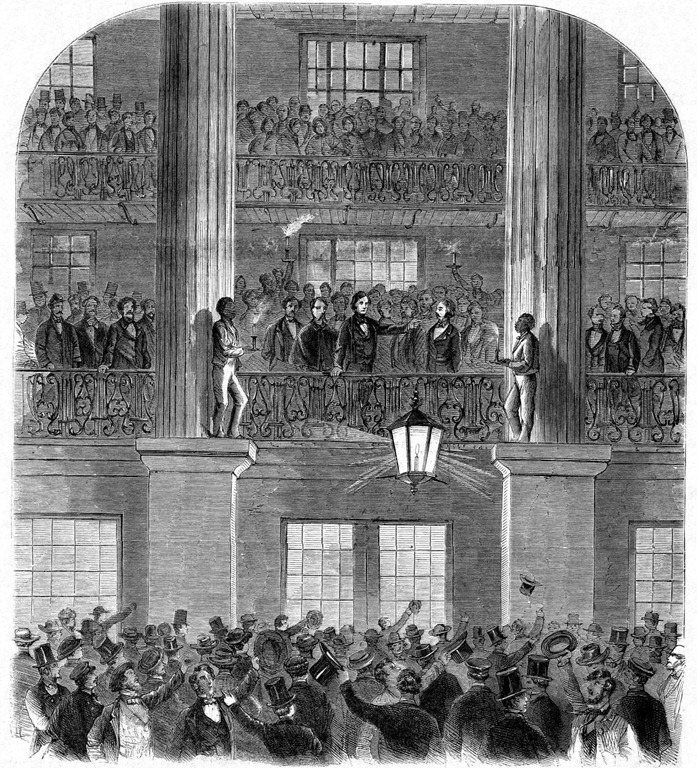
The Hon. Jefferson Davis, President-elect of the new Southern Confederacy, addressing the citizens of Montgomery, Ala., from the balcony of the Exchange Hotel, on the Night of February 16th, 1861, and previous to his inauguration. – from a sketch by our special artist (Frank Leslie’s Illustrated Newspaper)

jefferson_davis-in_montgomery

The strain upon the affections, and the anxieties that tried the separated members of many a Kansan family in those days, are apparent in the next letters.
Mrs. Brown wrote to her husband, on February 15th, from Utica, New York:

The world seems dark to me, so long without you. When shall we meet? . . . What do you conclude? I little thought of such a long separation when I left you. If I had one hundred dollars I would go back in April—unless you  conclude it is best to come here. … I am feeling so distressed about Spencer that it takes the spirit all out of me, but I do try to commit him to my Saviour and trust that He will take care of him. If you come, if we can learn whether he is still at Newport, Kentucky, would it not be well for you to come by way of Cincinnati and get a proper situation for him, and take him, he being under age?

Appended to the letter given above is one to Mr. Brown from his eldest daughter.

My Dear Father: . . . I presume you have about made up your mind to come this way as soon as possible. I want to see you very much, and a change will perhaps do you good; but I hope you will not take final leave of Kansas, because a roof there, though humble, is better than no roof at all—to say nothing of a farm. . . . With a friendly President, who knows but brighter days are dawning for us? After living in the West, the East does not seem so pleasant, unless one is very rich.

What do you think about Spencer? It seems dreadful to me.

Monday morning, February 18, 1861. We received your letter Friday evening, and a portion of it was published in this morning’s paper. . . . There also came a letter from Spencer, from Newport Barracks, Kentucky. He has been sick. Grandpa seems to feel very bad about him, and says he thinks you could claim him, as he is under age. . . . Could you not write and claim him?

Your loving daughter,

Kitty.

FRIDAY, FEBRUARY 15, 1861.

This has been a peculiar day as regards the weather. Sunshine and rain alternating all day with high wind and threatening Cloud occasionaly. No particular news. The Peace convention will not I fear amount to much in the end. As it regards the question of Slavery, I think, it & Congress may agree upon terms of settlement. But as regards what the south Claims viz the right of Secession the north will never agree with the south. Hon M Butterfield M.C. from NY, wife & daughter, Doct Everitt, wife & Brother, spent the evening with us. All very pleasant. Bed 11 1/2 o’clock.

______

The three diary manuscript volumes, Washington during the Civil War: The Diary of Horatio Nelson Taft, 1861-1865, are available online at The Library of  Congress.

CINCINNATI, February 15, 1861.

DEAR UNCLE:—. . . The reception given to the President-elect here was most impressive. He rode in an open carriage, standing erect with head uncovered, and bowing his acknowledgments to greetings showered upon him. There was a lack of comfort in the arrangements, but the simplicity, the homely character of all was in keeping with the nobility of this typical American. A six-in-hand with gorgeous trappings, accompanied by outriders and a courtly train, could have added nothing to him; would have detracted from him, would have been wholly out of place. The times are unsuited to show. The people did not wish to be entertained with a display; they did wish to see the man in whose hands is the destiny of our country. You will read the speeches in the papers, and search in vain for anything to find fault with. Mr. Lincoln was wary at all times, wisely so I think, and yet I hear no complaint. Our German Turners, who are radical on the slavery question and who are ready to make that an issue of war, planned to draw from him some expression in sympathy with their own views. They serenaded him and talked at him, but they were baffled.¹ In private conversation he was discreet but frank. He believes in a policy of kindness, of delay to give time for passions to cool, but not in a compromise to extend the power and the deadly influence of the slave system. This gave me great satisfaction. The impression he made was good. He undoubtedly is shrewd, able, and possesses strength in reserve. This will be tested soon. . . .

Sincerely,

R. B. HAYES.

S. BIRCHARD.

_______

¹ Mr. William Henry Smith happened to be present when the Germans serenaded Mr. Lincoln. He made a shorthand report of Mr. Lincoln’s reply. The speech is preserved in print in Francis F. Browne’s “Everyday Life of Lincoln,” p. 385.

WASHINGTON, D. C., February 15,1861.

SIR: In compliance with your letter of this date, I have the honor to submit the following complete report of the surrender of the United States Arsenal at Augusta, Ga.:

On the morning of the 23d of January, ultimo, I received from the governor of Georgia, then in Augusta, backed by a superior force of State troops, numbering some six or seven hundred, a verbal demand of the arsenal, which I refused. Shortly after came through his aide de-camp a written demand in the following terms, the substance of which was telegraphed by me to the War Department, to wit:

AUGUSTA, January 23, 1861.

SIR: I am instructed by his excellency Governor Brown to say to you that, Georgia having seceded from the United States of America and resumed exclusive sovereignty over her soil, it has become his duty to require you to withdraw the troops under your command, at the earliest practicable moment, from the limits of the State.

He proposes to take possession of the arsenal, and to receipt for all public property under your charge, which will be accounted for on adjustment between the State of Georgia and the United States of America.

He begs to refer you to the fact that the retention of your troops upon the soil of Georgia after remonstrance is, under the laws of nations, an act of hostility, and he claims that the State is not only at peace but anxious to cultivate the most amicable relations with the United States Government.

I am further instructed to say that an answer will be expected by to-morrow morning at 9 o’clock.

……..I am, sir, very respectfully, your obedient servant,

HENRY R. JACKSON,
Aide-de-Camp, &c.

About 1 o’clock on the night of the 23d of January, ultimo, I received from the War Department the following reply to my telegram, to wit:

Washinton, January [23, 1861.]

Capt. ARNOLD ELZEY,
……….Second Artillery, Commanding Augusta Arsenal, Ga.:

The governor of Georgia has assumed against your post and the United States an attitude of war. His summons is harsh and peremptory: It is not expected that your defense shall be deeper. If forced to surrender by violence or starvation, you will stipulate for honorable terms and a free passage by water with your company to New York.

J. HOLT,
Secretary of War.

To have resisted such a force, then ready to attack me, with my kbowledge of large re-enforcements at Savannah and Atlanta, ready to come up by rail at a moment’s warning, would have been desperation in my weak position. I therefore directed my adjutant to address and convey the following note in reply to the governor’s demand:

HEADQUARTERS AUGUSTA ARSENAL,
January 24, 1861.

Col. H. R. JACKSON, A. D. C.

SIR: I have the honor to inform you that I am directed by Captain Elzey, commanding this post, to say, in reply to the demands of the governor of Georgia, made through you yesterday, requiring in to withdraw his command beyond the limits of the State, he begs to request an interview with his excellency the governor for the purpose of negotiating honorable terms of surrender at as early an hour this morning as practicable.

……….I have the honor to be, very respectfully, your obedient servant.

J. P. JONES,
Lieutenant, Second Artillery, Post Adjutant.

About 10 o’clock of the same morning (24th) the governor, accompanied by his staff and Brigadier-General Harris, commanding the troops, rode up to my quarters and were received by me, when the following honorable terms were agreed upon and executed, to wit:  (see inclosure to report of January 24, 1861)

……….I have the honor to be, very respectfully, your obedient servant,

ARNOLD ELZEY,
Captain, Second Artillery.

Col. S. COOPER, Adjutant-General U. S. Army.
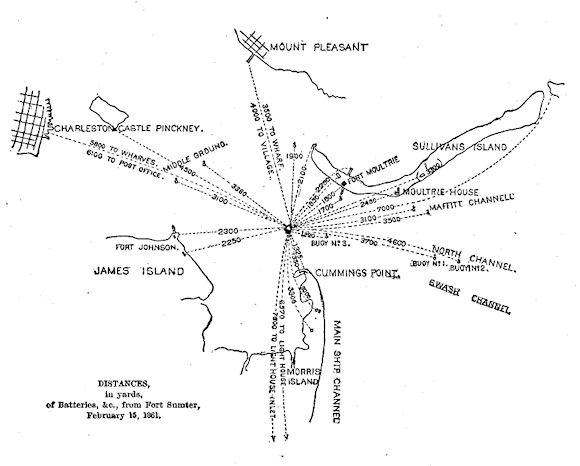
Distances of South Carolina batteries from Fort Sumter

THURSDAY 14

This day has passed off much as others have of late, nothing very startling having occured. J C Wright, a member of the “Peace Convention” from Ohio, died yesterday. His funeral took place in the Hall of the Convention today. We attended the Musical soire of Miss Douglass this evening. A great crowd there and some of the notables of this City, some Members of the Cabinet, some M.C.s, some Artists &c. Music was fine, refreshments very nice. The crowd very genteel but quite too large. Got home 1/4th past 11 o’clock but left the crowd there.

______

The three diary manuscript volumes, Washington during the Civil War: The Diary of Horatio Nelson Taft, 1861-1865, are available online at The Library of  Congress.

From the following brief article the reader can form some idea of the persecution to which Union men had to submit in the town of Fredericksburg as early as the 14th of February, 1861, the date of its publication :—

“Why is it that secessionists talk of compromise with derision? Why is it that they wish to precipitate Virginia out of the Union? Why is it that they call conservative or Union men ‘Submissionists,’ ‘Black Republicans,’ ‘Abolitionists,’ ‘ Traitors and enemies to the South,’ &c. &c.? Are secessionists more intellectual than Union men? In what have they displayed it? Are they more patriotic? What proofs have they given of the fact? Are they more brave? Why then did they vacate their seats in the Senate and Congress halls of the United States, thus virtually surrendering all their rights into the hands of their enemies? Why, in the hour of their country’s peril, did they retreat into the Gulf States, having as a safeguard the Atlantic Ocean on the one side, and the border States between them and danger on the other side? There is no submission in all this, is there? Very brave, is it? In what have Union men compromised their honor or dignity? It is not honorable, not dignified, for a man to stand his ground and fight for his rights on his own soil, and sacredly maintain the trust the people have confided in him! But it is very honorable, quite dignified, for a man to throw down his legal weapons of defence and run away, and belt on the sword, and swear if the enemy comes to him he’ll thrash him out! This is very brave, is it?

“What rights have secessionists to protect that Union men have not? Have Union men no civil, religious, and domestic rights to protect? We think it bad policy for secessionists who would break up the peace and harmony of the Government, and plunge the whole country into civil war, to be accusing their fellow-citizens, who are trying to pour oil upon the troubled waters and are making all possible efforts to bring about peace and harmony, of being ‘Submissionists,’ ‘Black Republicam,’ ‘Abolitionists,’ and ‘ Traitors’ and ‘Enemies to the South'”

_______

“The Conspiracy Unveiled. The South Sacrificed; the Horrors of Secession.” Rev. James W. Hunnicutt (Editor of the Fredericksburg (Va.) Christian Banner); 1863, Philadelphia; J. B. Lippincott & Co.

“The Union, Now and Forever, One and Inseparable.”

HEADQUARTERS, FORT SUMTER, S.C.,
February 13, 1861.

His Excellency F. W. PICKENS.
Governor of South Carolina:

SIR: Knowing that your desire to prevent, and your determination, as far as in your power, to guard against the recurrence of anything calculated to add to the excitement which already unfortunately exists, I deem it my duty to report that the guard-boats, and occasionally small row-boats from Morris Island, have recently violated your orders by coming too near our walls. Yesterday morning one of the steamers–the General Clinch, I think–passed very near and last night the guard-boats came nearer than was proper, twice–once about midnight, and again at 3.30 a.m.–when a steamer, although warned off by the sentinel, continued to approach, head on, until he fired his musket over her, when she altered her course. The gun-battery guard, I am happy to say, did not deem it necessary to fire.

Assuring you that every exertion will be made by me to guard against  any wrong act on the part of my command, and hoping that these boats will henceforth be more particular in obeying your instructions,

I am, sir, with sentiments of the highest regard, &c.

ROBERT ANDERSON,

Major, U.S. Army, Commanding.