June 23—Moved our camp two miles up the road toward Richmond. It is a very bad camp—low ground and muddy. But there is a factory here, and plenty of girls to make up for the damp ground.
June 2012
June 23d. Hot during the day, nothing important to note. In the course of the night it rained and blew terrifically. I was awakened by the tent blowing down on top of me and was obliged to crawl out and run to the guard house for assistance. Puffy, the quartermaster, who tents with me crawled out too, on the other side, swearing like a Dutch trooper. After a considerable struggle we succeeded in getting it up again and making the pegs hold; the difficulty is the ground is all sand and when it rains hard the pegs will not hold, and, consequently, the tent must come down. We got a famous bath by the operation.
June 23.—The London Times, of this date, said that whatever might be the result of the civil war in America, it was plain that it had reached a point at which it was a scandal to humanity. It had become a war of extermination. Utter destruction might be possible, or even imminent, but submission was as far off as ever. Persons who listened to the excited railers on either side might think that there was no alternative but to let a flood of blood pass over the land; but, at that calm distance, it might perhaps be wisely calculated that such voices did not represent the mind of the American people. Both parties ought by this time to be tired of the strife. There had been blood enough shed, fortunes enough made, losses enough suffered, and wrongs enough inflicted and endured. The opportunity ought to be either present or at hand when some potent American voice, prudently calling, “Peace,” might awaken an universal echo.
—Martial law was proclaimed in the cities of Norfolk and Portsmouth, Va., by order of Brig. General E. L. Viele, Military Governor.
— Brigadier- General Schofield, Military Commandant District of Missouri, this day issued a General Order from his headquarters, St Louis, warning the rebels and rebel sympathizers in Missouri that he would hold them responsible in their property and persons for any damages that might thereafter be committed by the lawless bands of armed men which they had brought into existence, subsisted, encouraged, and sustained up to that time.
—The Third battalion, Fifth Pennsylvania cavalry. Col. Campbell, stationed at Gloucester Point, made a reconnoissance under the command of Major Wilson, into the counties of Gloucester and Mathews, Va., for the purpose of capturing a body of rebel cavalry, who were overrunning those counties, arresting deserters, and impressing others into their service who were unwilling to volunteer.
On arriving at Mathews’s Court-House, Major Wilson found he was a day too late. The rebel cavalry had been there, and arrested twenty-four men as being deserters from their army.
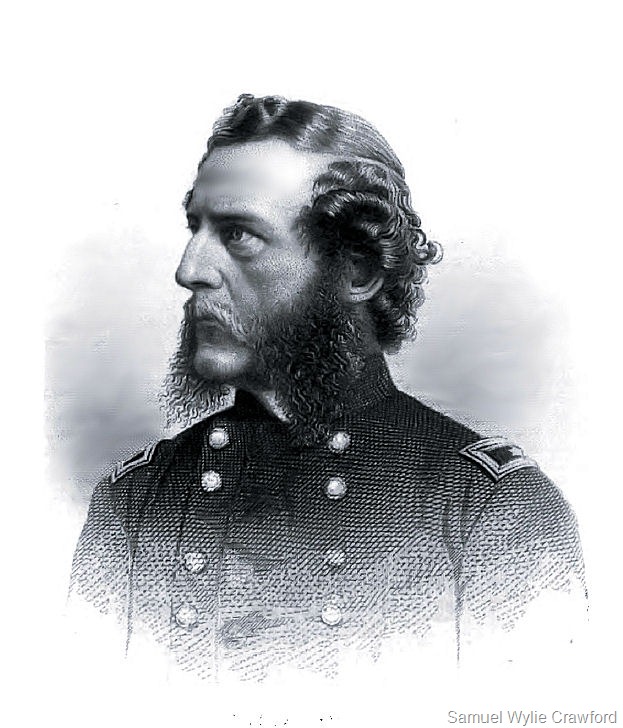
Samuel Wylie Crawford (Wikipedia) was the surgeon on duty at Fort Sumter, South Carolina, during the Confederate bombardment in 1861, which represented the start of the Civil War. Despite his purely medical background, he was in command of several of the artillery pieces returning fire from the fort.
A month after Fort Sumter, Crawford decided on a fundamental career change and accepted a commission as a major in the 13th U.S. Infantry. He served as Assistant Inspector General of the Department of the Ohio starting in September 1861. He was promoted to brigadier general of volunteers on April 25, 1862, and led a brigade in the Department of the Shenandoah, participating in the Valley Campaign against Stonewall Jackson, but the brigade saw no actual combat.
June. — There was great excitement in prayer meeting last night, it seemed to Abbie Clark, Mary Field and me on the back seat where we always sit. Several people have asked us why we sit away back there by old Mrs Kinney, but we tell them that she sits on the other side of the stove from us and we like the seat, because we have occupied it so long. I presume we would see less and hear more if we sat in front. To-night just after Mr Walter Hubbell had made one of his most beautiful prayers and Mr Cyrus Dixon was praying, a big June bug came zipping into the room and snapped against the wall and the lights and barely escaped several bald heads. Anna kept dodging around in a most startling manner and I expected every moment to see her walk out and take Emma Wheeler with her, for if she is afraid of anything more than dogs it is June bugs. At this crisis the bug flew out and a cat stealthily walked in. We knew that dear Mrs Taylor was always unpleasantly affected by the sight of cats and we didn’t know what would happen if the cat should go near her. The cat very innocently ascended the steps to the desk and as Judge and Mrs Taylor always sit on the front seat, she couldn’t help observing the ambitious animal as it started to assist Dr Dagget in conducting the meeting. The result was that Mrs Taylor just managed to reach the outside door before fainting away. We were glad when the benediction was pronounced.
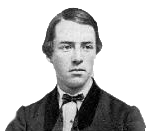
Headquarters 5th Prov. Army Corps,
Camp near New Bridge, June 22, 1862.
Dear Father, — Why don’t they send us reinforcements? From present appearances, we shall stay here all summer sweltering under this powerful sun, our ranks daily .decreasing from sickness and exposure, all from want of reinforcements. Unless we are attacked by the enemy, or unless General McClellan gets some very favorable chance to attack them, there will be no fighting for some time, and in case of a battle the result, to say the least, is extremely doubtful. They greatly outnumber us, and are daily throwing up trenches and batteries right opposite our army. In the face of all these facts, and notwithstanding McClellan’s frequent and earnest appeals for more troops, the Government at Washington refuses us any reinforcements. The Abolitionists in Congress have a great deal to do with this, and are purposely protracting the war in order to render emancipation necessary, and are so endangering our existence as a nation united and whole. It is decidedly disagreeable to sit down here and see things go on so, and feel that we are liable to be whipped at any time, when victory could be made certain for us. McDowell holds hack as long as he can, and would be glad to see McClellan defeated. If he were anything of a general he could defend Washington or the Rappahannock, with 20,000 men and let the rest come here. At the end of the war, I think that a history of these facts will come out, which will fully vindicate McClellan, and show up Stanton and Co. in their true light. By the way, I heard of a remark he made when coming into office. “McClellan organizing the army? It is the Democratic party he is organizing I’ll clip his comb for him.” Now General McC. would not accept of the Presidency if it were offered him, according to the most positive assertions of his friends. He has a complete copy of all telegrams, etc., received from Stanton, which his friends will let out at the proper time. All this, of course, is to be kept for yourself and no one else.
I called on Colonel Barnes the other day and had a very kind reception from him. I also saw my captain. I don’t think there will be any chance for my promotion unless it comes in the regular order from vacancies arising in my regiment which will push me along.
I have got some things which I am going to send home. One is a club which I got from Sayres’s house where Mrs. General Lee was imprisoned. The family have all left, leaving the place in charge of negroes. One of the women, who let me in the house, said the club was one which belonged to John Brown, and which was taken from him at Harper’s Ferry. Then I have some fossils, etc., which I took from a pretty collection there called the Marlborne collection. Also a book which I found in the house, everything except the cabinet being taken away. Also a shell which the rebels fired at us a day or two ago from the other side of the Chickahominy. . . .

Sunday, 22d—We had company inspection at 5 o’clock this evening. Our chaplain, John S. Whittlesey, died of diphtheria on May 11th at Durant, Iowa, and our regiment has no chaplain at present. We have no services on Sunday now, except that some of the companies occasionally have prayer meetings.
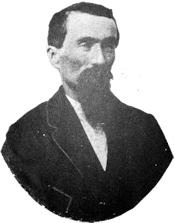
June 22 — We had preaching in camp to-day again, and we are getting in a goodly supply of heavenly ammunition from the arsenal of truth — in double doses, preaching in the morning and prayer meeting at night. The ammunition is fixed and ready to fire at all times and under all circumstances, and I hope that we may all pack at least some of it away in the cartridge box of fortitude for immediate and constant use, and not act like the great majority of the world, both saints and sinners, who use it all up in empty ceremonials on Sunday, having not enough left on Monday morning to make a decent skirmish against the inroads of wrongdoing, hypocrisy, and rascality.
This evening at dusk our chaplain held a prayer meeting in camp. It was in a beautiful part of the woods where his tent stood, and the quartermaster pro tern, of Heaven was standing in the door of his tent and issued with lavish supply the rations of holy manna from the Sacred Receptacle that was stocked by Moses, David, and Christ in the dim ages of long ago. Two little tallow candles stuck against the black bark of a rough oak tree, with vacillating and flickering gleam, was the grand chandelier that furnished the light. Mother Earth strewn and carpeted with last autumn’s brown leaves provided vast and ample seating accommodations for the sun-tanned warriors that rode and fought with Ashby through storms of shot and shell, but now had sheathed their trusty blades, and in reverence received their holy rations of moral rectitude in perfect silence and with good behavior, without the least murmur or complaint of who was to have first choice.
Bright stars that flashed their silvery light from the silent dome of the temple here and there peeped through the little interstices in the thick foliage of the overarching forest trees. A solitary cricket not far away chirped its vesper hymn in measured cadences in the same tone and strain that its kindred chanted in the crevices of the old brick fireplace around the hearthstone at home when I was a child. Oh, how nimbly and vividly thought plays on the harp of memory when its sleeping strings are touched by the fingers of the past!
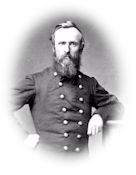
“Same as before,” June 22, 1862. Sunday. — A warm, beautiful, Sunday morning; all things bright and cheerful. Inklings and hints of matters before Richmond are more encouraging. But these delays of McClellan are very wearisome.

22nd. Sunday. Major Purington started at 5 for Ohio on 30 days furlough. Carried lots of money for the boys. We boys sent to Wilson Dodge, former Q. M,, to get the Major a ring worth $10. Got our pay. Commissary and Q. M. received alike this time.
Issued some rations and drew enough from Brigade Com’y for ten days.

“Wilson Small,” June 22.
Dear Mother, — Yesterday was a hard day, and not a very useful one. The result is that I am a little befogged this morning,—deaf, drowsy, and dull. Five hundred men came down last night, — the clearings-out of the regimental hospitals on the right. Our gentlemen were up all night. I was safe in my berth; but Georgy was in the tent till 3 A. M., though she had been up all the night before.
The Great Mogul, the Medical Inspector, Colonel Vollum, for whom Mr. Olmsted has been begging, has arrived. He is staying on board the “Small.” He ranks every other medical officer; therefore on him our hopes depend. The run to Yorktown on “special business” was made to give the Chief and the Inspector a chance of quietly discussing the whole matter. Mr. Olmsted has just been, full of brightness, to tell me that everything is arranged satisfactorily, and to read me the signed agreement. The Commission is to take: 1. All badly wounded men, all amputations and compound fractures of the lower extremities, and all other cases which ought not to travel at first (say five hundred, — a large estimate), and keep them, on board the “Knickerbocker” and the “St. Mark,” in the river until they can be moved. It engages to spend a sum not exceeding ten thousand dollars on the means of carrying out this first item. 2. It agrees to receive at Fortress Monroe three thousand other bad cases able to bear transportation, whenever a battle occurs; and four thousand five hundred more within twelve days of it, and transport them to New York, Washington, or elsewhere.
Thus, you see, the Commission gains the certainty that the worst cases and the greatest suffering shall be under its own eye and care. The rest — the slightly wounded, or those so wounded as to be able to help themselves — are the ones that are left to the Government. The country may feel assured that when the great battle occurs, provision is made for those who shall suffer most; and the Commission feels that the country will provide that it shall not fall short in its engagement. This enables us to contemplate a great battle with less of a nightmare feeling than we have had while there was nothing to expect but a repetition of past scenes. We feel that something is impending; the clearing out of the hospitals, the arrangements thus decisively made for the wounded, all seem to point to a coming emergency. Oh! can we help dreading it?
General Van Vliet has just been here,—a jolly old gentleman, with his shock of yellow-white hair, and his nice, old-fashioned politesse for “the ladies.” We fire a volley of questions at him. First, and before all else, “How is the General?” (meaning, of course, General McClellan.) “Ho! he’s well; quite got over that fever of yours,—what do you call it, typhoid?” Then we try to get out of him some information about the state of affairs. He said he dined at General Porter’s headquarters with several of the corps commanders yesterday, and it was universally agreed that General Porter’s position was not tenable any longer; that our line was far too long (I told you that our right was stretched out to touch McDowell). “Well,” says the General, “Porter is in what you may call a deadlock, — can’t get across the river; there’s a battery” (making a lunge at our best chair). “What they’ll do will be to try and turn our flank. Perhaps they’ll do it; perhaps not.” “And we?” we cried. “Oh, you!” he said, with his jolly laugh, “you’ll have to cut and run as best you can, and we’ll go into Richmond.” “Shall we go up the James River?” “How are you going into Richmond?” “Has Burnside got Fort Darling?” Here the General became impenetrable, but looked so profoundly wise that if he did not tell his secret, he at least told that he had one.
Captain Sawtelle sent me a present of mint to-day (his orderly could not restrain a smile as he gave it to me), and the Captain came just now with an eye, I fear, to that improper thing called a “mint-julep.” You may think it very vulgar, but let me tell you it is very good; and you would think so too if you had been up all night, with the thermometer at 90°. Georgy is flitting about, putting things to rights (or wrongs) with as much energy as if she had not been up two nights. She has hunted me into the smallest corner of the cabin, while she dusts and decorates the rest. Her activity is a never-ending marvel to me. I saw her today spring from the ground to the floor of a freight-car, with a can of beef-tea in one hand, her flask in the other, and a row of tin cups tied round her waist. Our precious flasks! They do us good service at every turn. We wear them slung over our shoulders by a bit of ribbon or an end of rope. If, in the “long hereafter of song,” some poet should undertake to immortalize us, he’ll do it thus, if he’s an honest man and sticks to truth: —
A lady with a flask shall stand,
Beef-tea and punch in either hand, —
Heroic mass of mud
And dirt and stains and blood!
This matter of dirt and stains is becoming very serious. My dresses are in such a state that I loathe them, and myself in them. From chin to belt they are yellow with lemon-juice, sticky with sugar, greasy with beef-tea, and pasted with milk-porridge. Farther down, I dare not inquire into them. Somebody said, the other day (a propos of what, I forget), that he wished to kiss the hem of my garment. I thought of the condition of that article, and shuddered. This state of “things” has reached its climax. “Georgy,” I said the other day, “what am I to do? I can’t put on that dress again, and the other is a great deal worse.” “I know what I shall do,” says Georgy, who is never at a loss, and suggests the wildest things in the calmest way: “Dr. Agnew has some flannel shirts; he is going back to New York, and can’t want them. I shall get him to give me one.” Accordingly, Santa Georgeanna has appeared in an easy and graceful costume, looking especially feminine. I took the hint, and have followed suit in a flannel shirt from the hospital supplies; and now, having tasted the sweets of that easy garment, we shall dread civilization if we have to part with what we call our “Agnews.”
Just as I was writing the last words, Dr. Coolidge came on board. I was delighted to see him. He has a sad story from his place of action,—as sad as ours; as sad as all that come from honest hearts and capable heads wherever they are. But let us hope for better things to come, — especially to-day.
Good-by! I have so many letters to write that sometimes I feel as if I could not write another word. I have twelve lying by me now, ready to go off, — soldiers’ letters, and answers to the friends of the dead. We receive such pathetic, noble letters from the parents and friends of those who have died in our care, and to whom it is a part of our duty to write. They will never cease to be a sad and tender memory to us. The mothers’ are the most noble and unselfish; the wives’ the most pathetic,—so painfully full of personal feeling.
[The letters of the following week are missing. The mails were stopped on account of the preparations for the “change of base,” and probably the letters were lost in them. The above is the last letter mailed from White House which came to hand; the next was brought down on the “Small,” and mailed from Fortress Monroe.]


