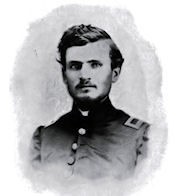
14th. Wrote a letter home. Mail came bringing home letters and Independent. Issued rations to four companies, to go the next morning on expedition five days. Moved the Second Battalion again half a mile. After work had a gay time finding our tent. Wandered all through the woods.
June 2012
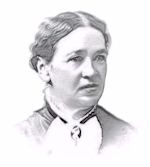
Written from the Sea islands of South Carolina.
[Diary] June 14, Saturday
Mr. McKim has returned from his excursion with Mr. French and he is so impressed by our dangerous situation, regarding the enemy and the climate, that he urges us to go home at once. Ellen and I are determined not to go and I think our determination will prevail over his fears, so that he will not order us home, as he has the power, I suppose. We are troubled about this. The military cram every newcomer with fears.
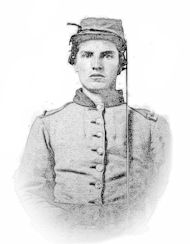
Saturday, 14th.—Started for Cumberland Gap, 10 A. M. After marching five miles became so sick could go no farther. Dr. Fowler said I would have to get back to Morristown as best I could. An omnibus coming by, I got in and rode back to Morristown.
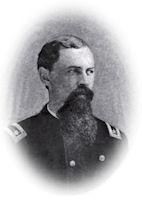
(Note: picture is of an unidentified Confederate soldier.)
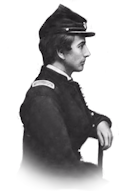
June 14th. Very hot; to-day about noon, the corps was reviewed by General McClellan and the Spanish general, Prim; all the troops not in the works were massed in close column of division in rear of their respective fronts, and made a fine appearance; the men cheered the general and his guest vociferously, and the rebels paid their respects by firing a good many shots at us, their balls whistling over our heads, rather inconveniently. The water here is wretchedly poor, and now that the weather is hot, and the men drink a good deal, the sick list is rapidly increasing. No military news of importance.
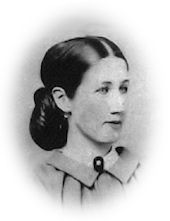
Harriet Roosevelt Woolsey to her sisters on the Virginia Peninsula, Georgeanna Woolsey and Eliza Howland.
New York, June.
Dear Girls: I write more for the sake of sending a letter by Dr. Draper, than because there is anything to tell you about. . . . I think Abby looks miserable and needs rest. I don’t believe even you, “the working sisters,” as Dr. Ferris calls you, do as much as Abby does, for there is certainly something that pays in giving nice little things to soldiers and having them so grateful to you and seeing them get well under your care,—there is an excitement in it all which cannot be got out of homely unbleached cotton, yards and yards and hundreds of square yards of shirts. . . .
Think of my having a chance of becoming a nurse up at the Mott Hospital in Fifty-first street. Mrs. Ferris offered me a place of that kind, out of consideration for my merits and the one hundred dollars Uncle E. had given them the week before, but I foolishly gave in to the family row. They had me laid out and buried twenty times over of malignant typhoid, diphtheria, and other ills which flesh is heir to.
. . . Carry is engaged in finding a summer retreat for the family. . . . The combinations absolutely necessary are: sea and mountain air, a place near the city with speedy communication, and no New Yorkers.
I send Charley’s wine, Dr. Draper having offered to take anything for us.
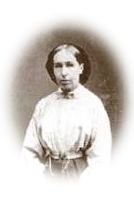 “Wilson Small,” June 14.
Dear Mother,—If I can give you a clear account of what occurred last night, I shall do a clever thing; for everybody is asking everybody else if he has any positive idea as to what the fuss was all about.
We were waiting in our tent for a train of sick men which had been due more than an hour. It was nearly seven o’clock, and everything was ready; presently the train came in, and five men, bleeding from fresh wounds, were brought out. The train had been fired into, a quartermaster had been killed, and five of the sick men wounded.[1] All this had happened about three miles from White House. We did not pay much attention to the story, for we were busy giving and sending food to the rest of the men. But presently Mr. Olmsted came up with an order from Colonel Ingalls: “The ladies will return at once to their boat.” Of course we obeyed, but as slowly as we could, asking questions as we went along. A second order came: “Report the ladies on board at once.” We obeyed. Presently Mr. Olmsted followed with a third order: “The wounded will be moved from the ‘Elm City’ to the ‘Small’ instantly; the latter will run down to the ‘Spaulding.’ This arrangement is made, as the shipping may have to be burned. Put the ladies behind the iron walls of the ‘Spaulding.'” Then came another hurrying order: “Let the ‘Elm City’ go down with her wounded on board, and rendezvous with the ‘Small’ alongside the ‘Spaulding.'” So away we went.
But Mr. Olmsted was not satisfied. I believe he felt that our right place was where we might be of service ; and after seeing the order obeyed, he took a boat and rowed himself back to the landing. The result was that an order was sent down soon after to bring the “Small” back to the wharf and take on the sick men who had arrived on the train. So we took a detail and thirty mattresses from the “Spaulding,” and went back as fast as we could. Captain Sawtelle came on board at once. Nothing very definite was known. A gap had occurred in our lines somewhere near Hanover Court-House. A regiment of cavalry was supposed to have got through. A good deal of harm had been done. Our hearts beat for the railroad-bridges (two distinct fires could be seen), and for a moment we felt gloomy. It would have been a serious business to cut off even one day’s supply to the army; it would have played into the enemy’s hands, — perhaps by forcing on a general engagement. Captain Sawtelle was arming every man capable of bearing arms, — teamsters, etc., — and was preparing to burn everything, shipping and all, if necessary. Two of our party, Mr. Woolsey and Mr. Mitchell, volunteered their services, and were under arms all night. A battery of artillery was hastily got together of guns that had arrived the night before; and this morning we learn that the Bucktail Rifles, Colonel Biddle’s regiment, which had gone up two days earlier, has returned to guard the railroad-bridges. These and the track are perfectly safe. The telegraph-wires have been cut. The two fires we saw were only some shipping — two or three schooners — five miles up the river. It is said that a body of guerillas from the country between the Pamunky and the Rappahannock, hearing of the dash of their cavalry, came across the Pamunky on five scows, and did some damage. I wonder if they were looking at us the other night from behind the cranes!
This is the resume of what we have heard from Captain Sawtelle, who pays his morning and evening momentary visit or look at us. Now you know all about the affair historically, — at least, as much as anybody knows; but there’s a dark, private aspect of it to me, and though I dare say I can tell it as a joke, it is like playing with something that has not yet lost its sting. Georgy and I were highly indignant at being sent away; we thought it shirking our duty, and very inglorious. At last our tongues got loose; we said all we thought, — at least I did. I said more than I thought, because I was in a passion; and all I got for it was the sense of having hurt and wounded Mr. Olmsted. Of course he was right; I can see now that he had to take care of us, even though it seemed absurd. This happened as we were going down to the “Spaulding.” Presently Mr. Olmsted was missing. He had taken a small boat, and was rowing himself back to the landing. I saw him shoot into the darkness, and I felt like a brute; I was so sorry for what I had said; I felt I had somehow goaded him,—and I thought of him, so delicate, and now really ill, making his way into danger in a horrid little boat.
Just then Dr. Jenkins told us that if we had valuables on board, we had better secure them, as the “Small” might have to be burned. While I was getting my bags ready, I remembered that Dr. Ware and David Haight were ashore, in charge of the sick who were left in the tents, and that all their things would be burned unless somebody saved them. So, without further thought, I went into the stateroom which they shared together, and spreading a huge shawl of Robert Ware’s on the floor, I proceeded to fill it with the entire contents of the room. I had just finished, and was knotting the ends of the shawl together, when Georgy came by. She stood like a mocking fiend, gazing at that wretched blue bundle; she drew such a picture of the possible morrow, and of my shame and confusion when I should have to explain what I had been about, that I was completely beaten down and humbled; and when Mr. Olmsted’s order came, recalling us, and I perceived that the “Small” was not likely to be burned, I fell into a perfectly abject state of mind. This mollified her. “Come,” said she, relenting, “there’s time enough; let’s go to work and put the things back.” How grateful I felt to her while I quickly untied the “pack,” as she persisted in calling it. I had a general idea where the coats and trousers ought to go; but where the minor articles belonged, who could tell? But I wouldn’t show perplexity under Georgy’s eye, and I popped them here and there with a semblance of order that stateroom did not wear when I went into it. Alas! This morning, through the ventilator, came the fatal cry: “Haight, take your things out of my bed!” “Where’s my hair-brush?” “Where’s mine?” “Upon my soul, I believe you’ve even got my tooth-brush!” Oh! if any one ever repented himself of philanthropy, I did then; and who shall guarantee me that Georgy will not come out and tell the whole story, and put me to open shame?
It took a very short time to turn our little home into a hospital. By 2 A. M. the men were all on board, and by four o’clock they were comfortable for the night. They are very sick, — perhaps the worst set together that I ever saw; scarcely any are in their right mind, some are raving, one is screaming now for “something hot,” “lucifer-matches.” They have been much shaken by the attack on the train, which has, I think, greatly aggravated their condition. One of them died this morning, unconscious, as usual, and so quietly that it was some minutes before I believed it, though Dr. Ware said it was so. He was speechless when he came into our hands, — sent down with no indication of name or regiment; and so he dies. There is another dying man lying next to where he lay; and though his eyes are bright and intelligent, he can give no sign, and I cannot discover anything about him. So many nameless men come down to us, speechless and dying, that now we write the names and regiments of the bad cases and fasten them to their clothing, so that if they are speechless when they reach other hands, they may not die like dogs, and be buried in nameless graves, and remain forever “missing” to their friends. This was Georgy’s thought, — so like her! How I love her practical tenderness!
Mr. Olmsted is puzzled what to do with these men. There is a standing order against any but wounded going upon the boats; but they can hardly be sent to the Shore hospital until the question as to what this raid really is, settles itself. I have no time to write more. We are short-handed, and can spare but little time from the men, and they, poor souls, are so noisy and crazy that they give us unusual care and anxiety. I am now going below to the main-deck saloon, where they are, for the night-watch.
The “Daniel Webster” reported herself at 4 p. M. Dr. Grymes and Captain Bletham came on board at once. The latter was much gratified by D. and A.’s visit to the ship at Boston. My precious cases are on board; but in the present condition of the “Small” they must remain on the “Webster.”
[1]Stuart’s raid. See Colonel von Borcke’a account of this “gallant” deed in “Blackwood’s Magazine ” for September, 1865.
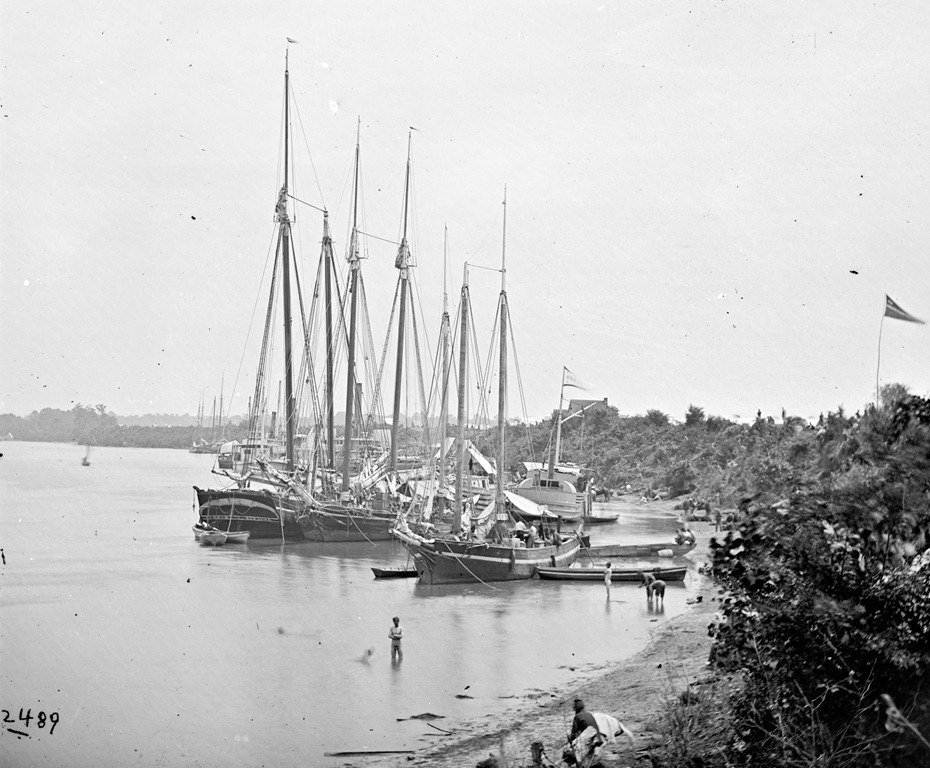
White House Landing, Va. View down river, with supply vessels
Civil War photographs, 1861-1865 / compiled by Hirst D. Milhollen and Donald H. Mugridge, Washington, D.C. : Library of Congress, 1977. No. 0057
Title from Milhollen and Mugridge.
Corresponding print is in LOT 4175.
Forms part of Civil War glass negative collection (Library of Congress).
Library of Congress Prints and Photographs Division Washington, D.C. 20540 USA
Record page for this image: http://www.loc.gov/pictures/item/cwp2003000057/PP/
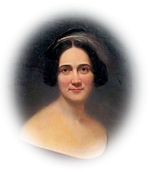
June 14th.—All things are against us. Memphis gone. Mississippi fleet annihilated, and we hear it all as stolidly apathetic as if it were a story of the English war against China which happened a year or so ago.
The sons of Mrs. John Julius Pringle have come. They were left at school in the North. A young Huger is with them. They seem to have had adventures enough. Walked, waded, rowed in boats, if boats they could find; swam rivers when boats there were none; brave lads are they. One can but admire their pluck and energy. Mrs. Fisher, of Philadelphia, née Middleton, gave them money to make the attempt to get home.
Stuart’s cavalry have rushed through McClellan’s lines and burned five of his transports. Jackson has been reenforced by 16,000 men, and they hope the enemy will be drawn from around Richmond, and the valley be the seat of war.
John Chesnut is in Whiting’s brigade, which has been sent to Stonewall. Mem’s son is with the Boykin Rangers; Company A, No. 1, we call it. And she has persistently wept ever since she heard the news. It is no child’s play, she says, when you are with Stonewall. He doesn’t play at soldiering. He doesn’t take care of his men at all. He only goes to kill the Yankees.
Wade Hampton is here, shot in the foot, but he knows no more about France than he does of the man in the moon. Wet blanket he is just now. Johnston badly wounded. Lee is King of Spades. They are all once more digging for dear life. Unless we can reenforce Stonewall, the game is up. Our chiefs contrive to dampen and destroy the enthusiasm of all who go near them. So much entrenching and falling back destroys the morale of any army. This everlasting retreating, it kills the hearts of the men. Then we are scant of powder.
James Chesnut is awfully proud of Le Conte’s powder manufactory here. Le Conte knows how to do it. James Chesnut provides him the means to carry out his plans.
Colonel Venable doesn’t mince matters: “If we do not deal a blow, a blow that will be felt, it will be soon all up with us. The Southwest will be lost to us. We can not afford to shilly-shally much longer.”
Thousands are enlisting on the other side in New Orleans. Butler holds out inducements. To be sure, they are principally foreigners who want to escape starvation. Tennessee we may count on as gone, since we abandoned her at Corinth, Fort Pillow, and Memphis. A man must be sent there, or it is all gone now.
“You call a spade by that name, it seems, and not an agricultural implement?” “They call Mars Robert ‘Old Spade Lee.’ He keeps them digging so.” “General Lee is a noble Virginian. Respect something in this world. Cæsar—call him Old Spade Cæsar? As a soldier, he was as much above suspicion, as he required his wife to be, as Cæsar’s wife, you know. If I remember Cæsar’s Commentaries, he owns up to a lot of entrenching. You let Mars Robert alone. He knows what he is about.”
“Tell us of the women folk at New Orleans; how did they take the fall of the city?” “They are an excitable race,” the man from that city said. As my informant was standing on the levee a daintily dressed lady picked her way, parasol in hand, toward him. She accosted him with great politeness, and her face was as placid and unmoved as in antebellum days. Her first question was: “Will you be so kind as to tell me what is the last general order?” “No order that I know of, madam; General Disorder prevails now.” “Ah! I see; and why are those persons flying and yelling so noisily and racing in the streets in that unseemly way?” “They are looking for a shell to burst over their heads at any moment.” “Ah!” Then, with a courtesy of dignity and grace, she waved her parasol and departed, but stopped to arrange that parasol at a proper angle to protect her face from the sun. There was no vulgar haste in her movements. She tripped away as gracefully as she came. My informant had failed to discompose her by his fearful revelations. That was the one self-possessed soul then in New Orleans.
Another woman drew near, so overheated and out of breath, she had barely time to say she had run miles of squares in her crazy terror and bewilderment, when a sudden shower came up. In a second she was cool and calm. She forgot all the questions she came to ask. “My bonnet, I must save it at any sacrifice,” she said, and so turned her dress over her head, and went off, forgetting her country’s trouble and screaming for a cab.
Went to see Mrs. Burroughs at the old de Saussure house. She has such a sweet face, such soft, kind, beautiful, dark-gray eyes. Such eyes are a poem. No wonder she had a long love-story. We sat in the piazza at twelve o’clock of a June day, the glorious Southern sun shining its very hottest. But we were in a dense shade—magnolias in full bloom, ivy, vines of I know not what, and roses in profusion closed us in. It was a living wall of everything beautiful and sweet. In all this flower-garden of a Columbia, that is the most delicious corner I have been in yet.
Got from the Prestons’ French library, Fanny, with a brilliant preface by Jules Janier. Now, then, I have come to the worst. There can be no worse book than Fanny. The lover is jealous of the husband. The woman is for the polyandry rule of life. She cheats both and refuses to break with either. But to criticize it one must be as shameless as the book itself. Of course, it is clever to the last degree, or it would be kicked into the gutter. It is not nastier or coarser than Mrs. Stowe, but then it is not written in the interests of philanthropy.
We had an unexpected dinner-party to-day. First, Wade Hampton came and his wife. Then Mr. and Mrs. Rose. I remember that the late Colonel Hampton once said to me, a thing I thought odd at the time, “Mrs. James Rose” (and I forget now who was the other) “are the only two people on this side of the water who know how to give a state dinner.” Mr. and Mrs. James Rose: if anybody wishes to describe old Carolina at its best, let them try their hands at painting these two people.
Wade Hampton still limps a little, but he is rapidly recovering. Here is what he said, and he has fought so well that he is listened to: “If we mean to play at war, as we play a game of chess, West Point tactics prevailing, we are sure to lose the game. They have every advantage. They can lose pawns ad infinitum, to the end of time and never feel it. We will be throwing away all that we had hoped so much from—Southern hot-headed dash, reckless gallantry, spirit of adventure, readiness to lead forlorn hopes.”
Mrs. Rose is Miss Sarah Parker’s aunt. Somehow it came out when I was not in the room, but those girls tell me everything. It seems Miss Sarah said: “The reason I can not bear Mrs. Chesnut is that she laughs at everything and at everybody.” If she saw me now she would give me credit for some pretty hearty crying as well as laughing. It was a mortifying thing to hear about one’s self, all the same.
General Preston came in and announced that Mr. Chesnut was in town. He had just seen Mr. Alfred Huger, who came up on the Charleston train with him. Then Mrs. McCord came and offered to take me back to Mrs. McMahan’s to look him up. I found my room locked up. Lawrence said his master had gone to look for me at the Prestons’.
Mrs. McCord proposed we should further seek for my errant husband. At the door, we met Governor Pickens, who showed us telegrams from the President of the most important nature. The Governor added, “And I have one from Jeems Chesnut, but I hear he has followed it so closely, coming on its heels, as it were, that I need not show you that one.”
“You don’t look interested at the sound of your husband’s name? ” said he. “Is that his name?” asked I. “I supposed it was James.” “My advice to you is to find him, for Mrs. Pickens says he was last seen in the company of two very handsome women, and now you may call him any name you please.”
We soon met. The two beautiful dames Governor Pickens threw in my teeth were some ladies from Rafton Creek, almost neighbors, who live near Camden.
By way of pleasant remark to Wade Hampton: “Oh, General! The next battle will give you a chance to be major-general.” “I was very foolish to give up my Legion,” he answered gloomily. “Promotion don’t really annoy many people.” Mary Gibson says her father writes to them, that they may go back. He thinks now that the Confederates can hold Richmond. Gloria in excelsisl
Another personal defeat. Little Kate said: “Oh, Cousin Mary, why don’t you cultivate heart? They say at Kirkwood that you had better let your brains alone a while and cultivate heart.” She had evidently caught up a phrase and repeated it again and again for my benefit. So that is the way they talk of me! The only good of loving any one with your whole heart is to give that person the power to hurt you.
June 14.—Capt Craven, of the United States steam sloop Brooklyn, sent a marine guard and party of seamen, numbering in all about one hundred men, under command of Lieut Lowry, to Bayou Sara, Louisiana, for the purpose of destroying the telegraph apparatus and cutting the wires. After an absence of two hours, Lieut. Lowry returned to the ship, having accomplished his work. (Doc. 133.)
—General James H. Van Ales, Military Governor of Yorktown, Va., issued an order directing that all negroes in his department, “contraband or otherwise, should be under the immediate charge and control of the Provost-Marshal—that they be allowed full liberty,” etc.
—Captain Atkison, of company C, of the Fiftieth Indiana volunteers, with twenty men, captured six thousand two hundred pounds of powder at Sycamore Mills, thirty miles below Nashville, Tenn., and five miles north of the Cumberland River. The company also stopped at Fort Zollicoffer, and brought off a gun.
Camp near Boonville, Miss., June 13, 1862.
This is the fourth camp that we have had to call as above. We have lived all around the burg, but to-morrow we leave. We have just got nicely arranged here after working hard all day, and now an order comes to move brigade headquarters back to Rienzi, nearly 10 miles toward Corinth. Bah! how sick it makes me to write that name. I haven’t seen the place yet, and have no desire to. I feel about once a week as though a little skirmish would do me good, but I don’t see any use in getting mad because they won’t give me a chance to fight. I couldn’t feel any more out of the war at home than I do here. The enemy have all gone further into Dixie and we’re left the undisputed occupants of this neck. Our headquarters here are about 25 miles south of Corinth, and we have pickets at Baldwin, 15 miles south of this. Pope’s whole division has moved back to just this side of Corinth except our brigade, so here we are, maybe 1,200 effective men, doing outpost duty nearly 40 miles in advance of the army. Yesterday the colonel, his A. D. C. and myself rode around our entire picket line, I mean the part of our brigade that is guarding the M. & O. R. R. There is only one regiment doing this, and they are strung out so that our ride was full 40 miles. When we were within two miles of our camp, coming in, I was galloping along ahead of the colonel, maybe 50 yards (’twas 10 p.m.) and I thought I heard a “halt,” but was so sure there were no pickets there (full a dozen miles inside of our corps’ pickets) that I didn’t mind it until bang, went an old musket, and the bullet zipped considerably over my head. I halted. They were some infantry pickets whose regiment was close by in the woods (some two miles). Well, we hadn’t the countersign and they wern’t going to let us pass. The colonel swore, I was awful hungry, and I cussed, the A. D. C. raved, but the picket sergeant was immovable. At last we coaxed him to send us in with a guard to his colonel. He sent six men with us as guard, and the cuss gave orders to shoot us if we tried to run. The chap that shot was one of the guard, and he told me that he shot over my head on purpose after he had halloed “halt” several times. They didn’t know there was cavalry outside of them and said they’d shot us sure if they hadn’t seen the glimmer of my straps in the moonlight. We got their colonel up, took a toddy with him and—home. Did I ever tell you about my darkey, “Charley”? We got him at Cape Girardeau. He informed our troops where his master and company had hidden some 14 kegs of powder and some arms. His massa found out he had informed and put him in irons four weeks. He escaped and came to us. We lost him at Madrid and never knew what had become of him until he turned up here a week since. He had been sick in the Cairo hospital. He comes very handy to me when I’m a little lazy, which, though, is only 30 or 40 times a day. He has my boots blacked and clothes brushed when I get up in the morning, is a splendid hand to take care of a horse, and all told a very handy institution. He wants me to promise to take him home with me. If you will have him, I’ll do it. He’d be right handy about our house. I have the nicest horse. He is a perfect staver. A little tiresome to ride because so anxious to go fast, but he is so strong and never tires. After that ride yesterday of 40 miles through a broiling sun he danced along at the last as much as when we started. We were coming in from a reconnoisance one night last week and about 10 p.m., dark as Egypt, an artillery wagon crowded me off a causeway and Siegel (my horse) went into the mud to his shoulders and I, over his head, gracefully. He got out and sloped, and I walked into camp. ‘Twas only a quarter of a mile. An artillery sergeant caught him and I walked out to the road just in time to see him passing. He dismounted very spryly. Siegel licks my hands just like a dog and he will follow me away from his oats any time. After he got away from me that night he went back again to where we fell and that’s where the sergeant got him. He is a large bay and I wouldn’t take anything for him. I was riding to-day with the colonel, and as we crossed the M. and O. R. R. I saw a couple of fellows 300 or 400 yards down the road coming towards us, and one of them threw up his hands. I thought he was a deserter and waited. They proved to be what I thought. One was an Alabamian and the other from Arkansas. They had seen our pickets further out but thought them Confederates and slipped by them through the brush. I took them to the colonel, and since then, this p.m., nine more have come in, and ’tis not a very good day for deserters either. These people here are very tired of war. You would be if this army should march through Canton, indeed you would. You can’t go into hardly a house here but what they’ll ask if you know anything of “my son,” “my brother,” or “my husband” that was taken prisoner at this place or that place, and then the poor creatures will cry as though their hearts were broken and you begin to feel queer about your throat, and—I can’t stand that at all. It hurts me under my vest to see these poor women suffering, for maybe not the fault of those they mourn, but of rich men and politicians who have by threats and lies induced these poor devils to leave their families to die of starvation, to fight for, they can’t tell what.
I have just seen a Mobile Register of the 5th. It says they have taken at Richmond 7,000 prisoners, 80 pieces artillery, wagons, etc., innumerable quartermaster and commissary stores in vast quantities. That McClellan is driven back 30 miles and his army is surrounded, but a few of them may escape by James river. Very jocular and highly edifying. They also claim 15,000 stands small arms captured.


