Following the American Civil War Sesquicentennial with day by day writings of the time, currently 1863.

June 2012

“Wilson Small,” June 12.

Dear A., —Yours of the 4th received, telling me you have sent some cases. How eagerly I shall look out for the “Webster!” I wish I could instruct you fully as to the late battle; but our work so fills both time and mind that I feel as if I lived out of the war now that I live in it. You have much fuller accounts in the New York papers than I can give you. The little that I know is, however, true, and that is more than can be said of all the papers tell you. The late battle was not a general engagement. The enemy attacked us on the left. Our left is composed of two corps d’armée, — General Keyes’s and General Heintzelmann’s. Each corps has two divisions, each division four or five brigades, each brigade four regiments. Our left has been for some time across the Chickahominy, although not so near Richmond as our right, which is now bridging the river and the swamps to cross higher up, and is composed of two corps, — General Franklin’s and General Fitz-John Porter’s; the latter stretching away to the right to form the desired junction with McDowell. The bed of the Chickahominy is narrow; but in wet weather it becomes nearly treble its width, making the bridges and causeways which we have built nearly impassable. The enemy, taking advantage of the great storm which flooded these bottom lands (destroying, so they hoped, our communications), attacked General Casey’s division on three sides. This division is part of General Keyes’s corps. It was clearly a surprise, some of the officers being killed at dinner in their tents. We were forced back, losing guns and ground, — which were recovered, however, when General Couch’s division (also of Keyes’s corps) came up. It is said that when General Kearny’s division (of Heintzelmann’s corps) reached the ground, the day was already redeemed. Our right was from four to seven miles distant from the scene of action, which was at a place called Seven Pines, on the line of the railroad. General McClellan, whose headquarters are on the railroad this side of the Chickahominy, and about the centre of our lines, crossed the river Saturday afternoon with General Sumner and his corps, and the next day (Sunday) defeated the enemy at all points.

This is all I know; and you won’t understand it without a map. I am sorry to say General McClellan is very unwell, if not seriously ill. I am told he has had the fever, which has left him with camp dysentery. I inclose a printed letter of Mr. Olmsted’s about the work of the Commission which we all like very much. I have made some notes to it, for I comprehend the family egotism about me enough to feel that you will read the letter with double interest if you know where I fit into it.

Last evening we made our first pleasure excursion. Mr. Olmsted begged us (“us” always means himself and staff) to take a run in the “Wheelbarrow,” “Wissahickon,” or “Wicked Chicken,” as we indiscriminately call our tug-boat, up the river beyond the burned bridge. We generally have one or two pleasant outsiders not far off. Last night it was Colonel Howland, who had ridden in from the front to spend a day with his wife. Oh, how we enjoyed our little holiday! It was sweet to run suddenly out of the noisy bustle of the wharves and the camp, out of the breath of hospitals, into the still river, shining with amber lights of sunset, where nothing broke the silence but the cranes — and we. We came home by moonlight, refreshed and happy.

To-day (very suddenly, and just at dinnertime) the Chief discovered that an ice-boat was missing; so we have dropped down to Cumberland in search of her. In other words, we have had a peaceful family dinner, safe from loafers and spongers; and now we are sitting on the after-deck, dreaming, reading, writing, and some of us, of course, smoking. I can’t tell you what a pleasure it is to be with these people who go right in to a thing thoroughly. Nobody is head here (except the Chief). We all do a little of everything, and pretty much what we please. I am, if anything, at the foot. This is not humility, but truth; the others are so prompt and efficient that they often take out of my hands that which I might do.

We are just passing the charred bones of a burned rebel gunboat. Oh, this pretty river! How I wish you could be beside me now! If you were, you should occupy our best chair, which once was cane-bottomed, but now has only the frame-work of the seat, on which we poise ourselves.

I am well, and shall last, I think, till we get to Richmond. Don’t be uneasy about me; if I should be ill, I shall take the mail-boat, and be at home before you can hear of it. To-morrow I take a ride in an ambulance, which equipage the surgeon-in-charge of the Shore hospital is to send down for us, that we may go up and organize a special diet kitchen for him, where proper sick-food can be prepared under the surgeons’ orders. All good hospitals ought to be self-supporting. Government furnishes an ample ration, which can be drawn in money (“commuted” they call it) and spent in proper food for the sick, instead of the ordinary mess diet. I should like to have charge of a hospital now. I could make it march, if only I had hold of some of the administrative power.

We have little to do at the present moment. From twenty-five to seventy-five sick men come down daily. We give them a meal as they arrive, and then they are taken to the Shore hospital. When a wounded man comes down he is put on the “Elm City,” now lying alongside the wharf. We have done nothing on board of her since we last fitted her up before the battle. She has her full complement of service, and the women’s department is in the competent hands of Mrs. Balestier and Miss Bradford. At present our time is divided between the tent and the “Small,” — the dear “Small!” I wonder whether we should like her as well under any other name. We have given quite a home-look to our little cabin, which is never without its bouquet of magnolia, jessamine, and honeysuckle. Our orderlies gather the flowers as an attention to “the ladies,” and every now and then Captain Sawtelle sends a bunch.

Heavy orders for intrenching-tools were filled and sent forward last night. This looks as if a battle were not in prospect. It is all very well for political idiots and men at ease to talk about “cutting our way into Richmond.” If they want it done, why don’t they give McClellan strength enough to do it? Colonel Howland says that we must trust him; that whatever he does, be it act or wait, will be well done. When will the nation learn that it is in the hands of its greatest man, and wait calmly for his results, only taking care in the mean time to strengthen his hands?[1] I hope you keep my letters (for my own benefit). I have no recollection of where I have been or what I have done. You can form no idea of the bewilderment and doubt in which we live as to times and seasons, hours of the day and days of the Week. It is really absurd. I am told to-day is Thursday; but I certainly thought it was Tuesday.


[1] It is perhaps as well to say here that my present opinion of General McClellan is somewhat different from what it was. I still think that he was an able general, and a noble and patriotic man, who sought to heal as well as to conquer. But he was, it seems, too slow for the work he had to do. He was an accomplished and careful soldier, even a great one; but he had not the genius of War, nor the dash that sometimes takes its place. On the other hand, we must remember that no great commander was ever so trammelled and thwarted by civilian ignorance and scheming. Had the powers ultimately given to General Grant been intrusted to General McClellan, he might, perhaps, have ended the war in this campaign.

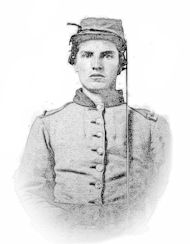
June 12.—We are more successful in Virginia than elsewhere. The whole Mississippi River, except Vicksburg and its environs, is now in the hands of the enemy, and that place must surrender, though it holds out most nobly, amidst the most inveterate efforts to take it. Memphis has fallen! How my spirit chafes and grieves over our losses! O God, let us not be given over a “hissing and a reproach to our enemies.”

Thursday, 12th.—Preparing for a march; took train for Knoxville at 6 P. M.


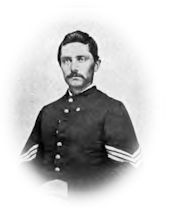
(Note: picture is of an unidentified Confederate soldier.)

June 12th. Struck tents early this morning, and marched nearly a mile to the rear; laid out a regular camp, and removed our accoutrements, so we shall have leisure to make ourselves decent and comfortable. I took a bath in a tub, being the first chance since the 31st. It has stopped raining, and the roads and fields are in good order again.

June 12. [Okolona, Mississippi]—I took a horseback ride, in company with Miss C. and Captain ——.

I had a chance of seeing a little of this prairie country. This is said to be one of the richest portions of Mississippi. I am very fond of a mountainous country and dense forests; so the scenery had little charms for me, although I could not but look with pleasure on the fine wheat and corn fields, which are here in abundance. The enemy say they will starve us into submission. I do not think we run much risk of starving, with such fields as these.

We had a pleasant ride. The captain is a fine-looking man, and, as a matter of course, is fully aware of the fact, as all good-looking men are. He had told Judge T. that he was a married man. As his manner does not indicate that he is, we think that he is only saying this for a joke; so we concluded to take him at his word, and treat him as such. The tables are completely turned, and nothing he can tell us to the contrary will make us change our minds. It worries him not a little to think that he should be so ignominiously laid on the shelf.

Mr. John Fowler from Mobile is here, taking care of his brother, who is quite sick. The latter is a captain in the Twenty-fourth Alabama Regiment. He is at a private house. I called on him, and he told me that the march from Corinth was terrible—enough to kill any one. I intend going home in company with these gentlemen. Mr. Miller has been here, and informed me that Mrs. Ogden and nearly all the other ladies from Mobile have gone home.

The wounded and sick at Mrs. T.’s are doing well. The Missourians are both improving. Mr. Curly has his brother with him, who takes care of both.

A lady called, a few days ago, to see Mr. Oliver. She is the wife of General Price’s chief surgeon. She told us that the last lady she spoke to before leaving Missouri was Mr. O.’s mother, who begged her, if any harm befell her son, to attend him. She could not help shedding tears when she saw the plight he was in. But he does not seem to mind it, and is, like all the others, perfectly cheerful and resigned. He does not seem to suffer near so much as his friend. His foot has been amputated above the ankle, while Mr. C. is wounded through the center of the foot, and it is a very painful wound.

When I first came here there was a very sick captain from Alabama. I made him a nice drink, thinking it would be a treat; but he did not like it, and took no pains to conceal his dislike. Miss G. remarked that, if I had made it for some Frenchmen who are in the house, they would have taken it for politeness’ sake, whether they liked it or not.

I hear many complaints about the bad treatment our men are receiving in the hospitals. I have been told that many a day they get only one meal, and that of badly-made soup, and as badly-made bread. I have asked some of the ladies of the place as to the truth of these reports, and have been informed that they are only too true.

The citizens have done what they could for them, and they are still doing; but there are so many that they require a great number to take care of them—more than there are at present.

If our government can not do better by the men who are suffering so much, I think we had better give up at once. But when I recollect how much mismanagement of this kind there was in the British army at the commencement of the Crimean war, it is not much to be wondered at if we, a people who have been living in peace so long, should commit errors at first.

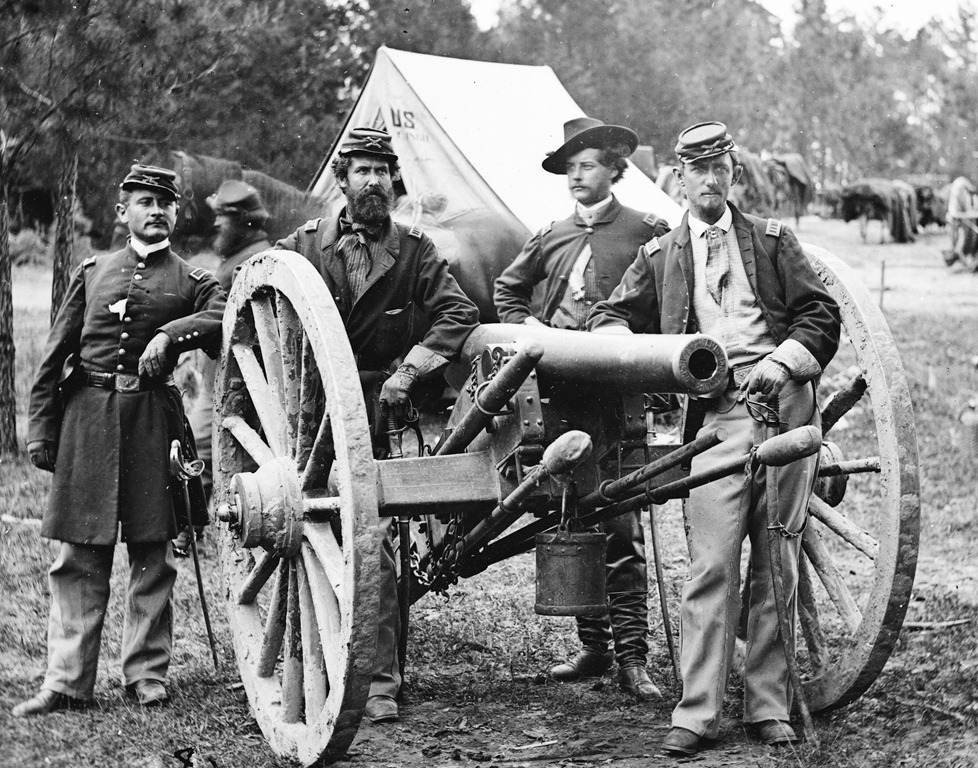
Fair Oaks, Va., vicinity. Lt. Robert Clarke, Capt. John C. Tidball, Lt. William N. Dennison, and Capt. Alexander C.M. Pennington

From Wikipedia:

The Horse Artillery Brigade of the Army of the Potomac was a brigade of various batteries of horse artillery during the American Civil War.

Made up almost entirely of individual, company-strength batteries from the Regular Army’s five artillery regiments, the Horse Artillery operated under the command umbrella of the Cavalry Corps. The Horse Artillery differed from other light artillery (also known as “mounted” artillery) in that each member of the unit traveled on his own horse, rather than the traditional light artillery practice of some riding horses, while others rode on the limbers and caissons, with still others traveling on foot. With each man on his own horse, the unit could travel faster and more efficiently. It was the brainchild of former artillery captain and Brig. Gen. William Farquhar Barry, Chief of Artillery for the Army of the Potomac, in 1861. With such a large percentage of the U.S. Horse Artillery being artillery batteries from the regular U.S. Army, it developed a superb reputation for military efficiency, accuracy of fire, and command presence in the field and in battle.

Battery A, 2nd U.S. Artillery (2nd Regiment of Artillery)

Commander: Captain John C. Tidball, USA, of Ohio

  • Lead (Right) Section Chief: First Lieutenant Alexander Cummings McWhorter Pennington, Jr., USA, of New Jersey
  • Rear (Left) Section Chief: First Lieutenant William Neil Dennison, USA, of Ohio
  • Center Section Chief: Second Lieutenant Robert Clarke, USA, of Pennsylvania

From Library of Congress:

Title:Fair Oaks, Va., vicinity. Lt. Robert Clarke, Capt. John C. Tidball, Lt. William N. Dennison, and Capt. Alexander C.M. Pennington

June 1862

Photographed by James F. Gibson

Photograph from the main eastern theater of war, the Peninsular Campaign

Civil War glass negative collection.  Library of Congress Prints and Photographs Division Washington, D.C. 20540 USA

Record page for this image: http://www.loc.gov/pictures/item/cwp2003000078/PP/

June 12th, 1862.—We have good news from the army of Northern Virginia; General Robert Lee has been appointed Commander in Chief. President Davis says there is not a more able officer in the Confederacy.

I finished my hundredth pair of socks today, usually I knit at night. We do not need a light to knit, but I wanted to finish this pair to complete the hundredth. I am learning to spin. The next pair I knit will be yarn of my own manufacture. Aunt Robinson, who taught me to knit, has completed three hundred pairs of socks and some stockings for herself. I do not believe I would ever have the patience to knit such long legs.

I am going boating this evening with Cousin Florence and Jewel Holland and Hattie. McBride is a pretty lake.

June 12th.—New England’s Butler, best known to us as “Beast” Butler, is famous or infamous now. His amazing order to his soldiers at New Orleans and comments on it are in everybody’s mouth. We hardly expected from Massachusetts behavior to shame a Comanche.

One happy moment has come into Mrs. Preston’s life. I watched her face to-day as she read the morning papers. Willie’s battery is lauded to the skies. Every paper gave him a paragraph of praise.

South Carolina was at Beauregard’s feet after Fort Sumter. Since Shiloh, she has gotten up, and looks askance rather when his name is mentioned. And without Price or Beauregard who takes charge of the Western forces? “Can we hold out if England and France hold off?” cries Mem. “No, our time has come.”

“For shame, faint heart! Our people are brave, our cause is just; our spirit and our patient endurance beyond reproach.” Here came in Mary Cantey’s voice: “I may not have any logic, any sense. I give it up. My woman’s instinct tells me, all the same, that slavery’s time has come. If we don’t end it, they will.”

After all this, tried to read Uncle Tom, but could not; too sickening; think of a man sending his little son to beat a human being tied to a tree. It is as bad as Squeers beating Smike. Flesh and blood revolt; you must skip that; it is too bad.

Mr. Preston told a story of Joe Johnston as a boy. A party of boys at Abingdon were out on a spree, more boys than horses; so Joe Johnston rode behind John Preston, who is his cousin. While going over the mountains they tried to change horses and got behind a servant who was in charge of them all. The servant’s horse kicked up, threw Joe Johnston, and broke his leg; a bone showed itself. “Hello, boys! come here and look: the confounded bone has come clear through,” called out Joe, coolly.

They had to carry him on their shoulders, relieving guard. As one party grew tired, another took him up. They knew he must suffer fearfully, but he never said so. He was as cool and quiet after his hurt as before. He was pretty roughly handled, but they could not help it. His father was in a towering rage because his son’s leg was to be set by a country doctor, and it might be crooked in the process. At Chickahominy, brave but unlucky Joe had already eleven wounds.

June 12.—A fight took place at Waddell Farm, near Village Creek, Arkansas, between a body of National troops under the command of Colonel Albert E. Brackett of the Ninth Illinois cavalry, and a party of rebels known as “Hooker’s company,” in which the latter were defeated with a loss of twenty-eight killed, wounded and prisoners. Col. Brackett’s loss was one taken prisoner and twelve wounded.—(Doc. 66.)

—A Detachment of the Richmond Blues had a skirmish near the Chickahominy on the right wing of the rebel army, with a body of Yankee infantry. The fire of the Blues killed six of the Federals and placed several hors du combat, when they retreated.—Richmond Examiner, June 14.

—General Fremont left Harrisonburgh, Va. The citizens expressed their delight by an illumination of every house in the town.

—A Small expedition of United States forces under Captain Hynes, Topographical Engineers, went up the Nansemond River without resistance.—(Doc. 71.)

—Mount Jackson, Va., was occupied by the Union army under General Fremont.—A daring though unsuccessful attack was made on a battery on James Island, S. C, by the Seventy-ninth New-York, Eighth Michigan, and Twenty-eighth Massachusetts regiments.

—About forty farmers of Conway County, Arkansas, came into the Union lines at Batesville, to volunteer for the Union.—Missouri Democrat.

Wednesday, 11th—I was on guard today at General Todd’s headquarters. The weather is very hot. The teams all went to the river for provisions. We are establishing a good camp at this place. We raised our wedge tents up from the ground and built bunks for our beds instead of lying down on the ground.[1]


[1] This was the first time that we built bunks for our beds, raised up from the ground.—A. G. D.