Following the American Civil War Sesquicentennial with day by day writings of the time, currently 1863.

June 2012

While we were lying at White House in the Wilson Small, one day, Mr. Olmsted came to G. with the statement that “young Mr. Mitchell of New York, who had come down to help in the Commission’s Quarter-master’s department, was ill on the supply boat Elizabeth.” G. went across the plank to him at once, and found a most attractive six or seven feet of future brother-in-law cramped into an uncomfortable little hole of a cabin. This was E. M.’s first introduction to the family; he was looked after a little, and sent home in a returning hospital ship to recruit. Mr. Olmsted had his father’s private instructions to keep him out of the army.


Abby Howland Woolsey a little later, writes:

Mr. Mitchell called yesterday afternoon to say good-bye and to offer to take anything to Georgy. Dr. Agnew had sent for him in a great hurry to go back as quartermaster on the Elm City. He had promised to go back on three or four days’ notice, and had hoped to spend those at the seaside, where his physician had told him he ought to go. We had nothing for Georgy, the Elm City lying at Jersey City, it would not have been convenient anyhow—but Carry took to his house in 9th street a letter to Georgy and a large bundle of candy for himself.—(C’s first present to her future husband).

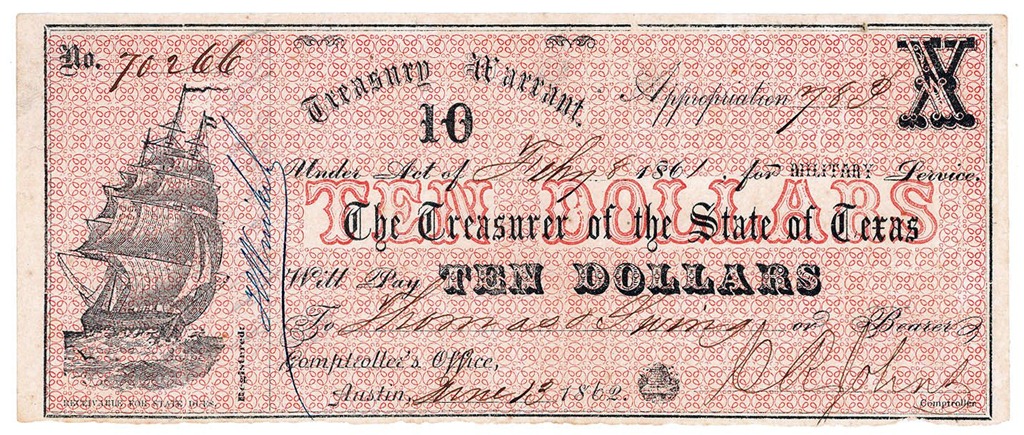
texas_treasury_warrant_June_13_1862

June 13th.—Decca’s wedding. It took place last year. We were all lying on the bed or sofas taking it coolly as to undress. Mrs. Singleton had the floor. They were engaged before they went up to Charlottesville; Alexander was on Gregg’s staff, and Gregg was not hard on him; Decca was the worst in love girl she ever saw. “Letters came while we were at the hospital, from Alex, urging her to let him marry her at once. In war times human events, life especially, are very uncertain.

“For several days consecutively she cried without ceasing, and then she consented. The rooms at the hospital were all crowded. Decca and I slept together in the same room. It was arranged by letter that the marriage should take place; a luncheon at her grandfather Minor’s, and then she was to depart with Alex for a few days at Richmond. That was to be their brief slice of honeymoon.

“The day came. The wedding-breakfast was ready, so was the bride in all her bridal array; but no Alex, no bridegroom. Alas! such is the uncertainty of a soldier’s life. The bride said nothing, but she wept like a water-nymph. At dinner she plucked up heart, and at my earnest request was about to join us. And then the cry, ‘ The bridegroom cometh.’ He brought his best man and other friends. We had a jolly dinner. ‘Circumstances over which he had no control’ had kept him away.

“His father sat next to Decca and talked to her all the time as if she had been already married. It was a piece of absent-mindedness on his part, pure and simple, but it was very trying, and the girl had had much to stand that morning, you can well understand. Immediately after dinner the belated bridegroom proposed a walk; so they went for a brief stroll up the mountain. Decca, upon her return, said to me: ‘Send for Robert Barnwell. I mean to be married to-day.’

“‘Impossible. No spare room in the house. No getting away from here; the trains all gone. Don’t you know this hospital place is crammed to the ceiling?’ ‘Alex says I promised to marry him to-day. It is not his fault; he could not come before.’ I shook my head. ‘I don’t care,’ said the positive little thing, ‘I promised Alex to marry him to-day and I will. Send for the Rev. Robert Barnwell.’ We found Robert after a world of trouble, and the bride, lovely in Swiss muslin, was married.

“Then I proposed they should take another walk, and I went to one of my sister nurses and begged her to take me in for the night, as I wished to resign my room to the young couple. At daylight next day they took the train for Richmond.” Such is the small allowance of honeymoon permitted in war time.

Beauregard’s telegram: he can not leave the army of the West. His health is bad. No doubt the sea breezes would restore him, but—he can not come now. Such a lovely name—Gustave Tautant Beauregard. But Jackson and Johnston and Smith and Jones will do—and Lee, how short and sweet.

“Every day,” says Mem, “they come here in shoals— men to say we can not hold Richmond, and we can not hold Charleston much longer. Wretches, beasts! Why do you come here? Why don’t you stay there and fight? Don’t you see that you own yourselves cowards by coming away in the very face of a battle ? If you are not liars as to the danger, you are cowards to run away from it.” Thus roars the practical Mem, growing more furious at each word. These Jeremiahs laugh. They think she means others, not the present company.

Tom Huger resigned his place in the United States Navy and came to us. The Iroquois was his ship in the old navy. They say, as he stood in the rigging, after he was shot in the leg, when his ship was leading the attack upon the Iroquois, his old crew in the Iroquois cheered him, and when his body was borne in, the Federals took off their caps in respect for his gallant conduct. When he was dying, Meta Huger said to him: “An officer wants to see you: he is one of the enemy.” “Let him come in; I have no enemies now.” But when he heard the man’s name:

“No, no. I do not want to see a Southern man who is now in Lincoln’s navy.” The officers of the United States Navy attended his funeral.
June 13.—This day a force of about three hundred rebel troops left Fort Chapman, and proceeded to Hutchinson Island, S. C, where they killed and wounded a number of negroes, and burned a chapel and dwelling-house. On the approach of the boats of the United States ship Dale, lying in St Helena Sound, the rebels retreated. About seventy negroes were taken on board the Dale, including several of the wounded.—(Doc. 69.)

—Colonel James R. Slack, commanding at Memphis, Tenn., issued the following order:

“Hereafter the dealing in and passage of currency known as ‘confederate scrip’ or ‘confederate notes’ is positively prohibited, and the use thereof as a circulating medium regarded as an insult to the Government of the United States, and an imposition upon the ignorant and deluded. “All persons offending against the provisions of this order will be promptly arrested and severely punished by the military authorities.”

— The Bank of Louisiana, at New-Orleans, being ordered by the Provost-Judge to pay a citizen in current funds his deposit formerly received by them in confederate notes, the Bank appealed to General Butler, who sustained the decision of the Judge.—Congress passed a joint resolution of thanks to Lieut. Morris and the other officers and men of the United States frigate Cumberland.

—The pickets of Gen. McClellan’s army near Richmond were driven in from Old Church, and large bodies of the rebels were discovered moving from the neighborhood of Mechanicsville bridge and Richmond towards the battle-field of Fair Oaks.—(Doc. 67.)

—At daylight this morning the rebels opened a sharp fire of artillery in front of Gen. Sumner’s position, in the vicinity of Richmond, which continued three hours, killing one and wounding another of the National troops.

—The United States flag was this day raised in the village of Gretna, La., amid the rejoicings of a large number of spectators. After the ceremony a series of patriotic resolutions were unanimously passed.

—The rebel transport Clara Dolsen was captured on the White River, Arkansas, by the tug Spitfire.—(Doc. 70.)

—A fight took place on James Island, S. C, between a body of Union troops and a much superior force of the rebels, resulting in the retreat of the rebels with a loss of nineteen killed and six wounded. The Union party lost three killed and nineteen wounded.—Official Report.

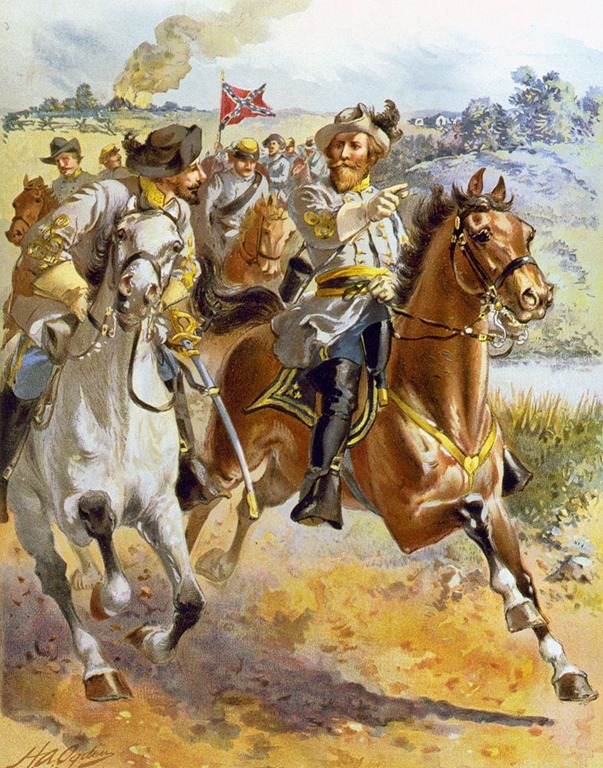
Gen. J.E.B. Stuart's raid around McClellan, June 1862

From Library of Congress:

Gen. J.E.B. Stuart’s raid around McClellan, June 1862

Henry Alexander Ogden

copyright  1900, Jones Bros. Pub. Co.

Library of Congress Prints and Photographs Division, Washington, D.C. 20540 USA

Record page for this image: http://www.loc.gov/pictures/item/93504431/

JUNE 11TH, 12TH.—Gen. Smith, the New York street commissioner, had been urged as commander-in-chief.

Thursday, 12th—The farmers living about here are cutting their wheat; some have already begun stacking. Wheat here is good, with some especially fine fields, but some fields were entirely destroyed during the siege of Corinth. The corn is not as good on account of the cold, wet spring.

June 12 — Moved camp to-day to Vernon Forge on South River, near Weyer’s Cave.

Flat Top Mountain, June 12, 1862. Thursday.—A warm, bright, seasonable morning. Heard of Fremont’s battle near Port Republic. As yet doubtful as to the result; shall look anxiously for the next news. . . . The battle before Richmond looks better, the more we see of it.

12th. Another false alarm. Whole brigade in arms. Scouted about some. Nothing unusual. Grazed my horse.