Following the American Civil War Sesquicentennial with day by day writings of the time, currently 1863.

June 2012

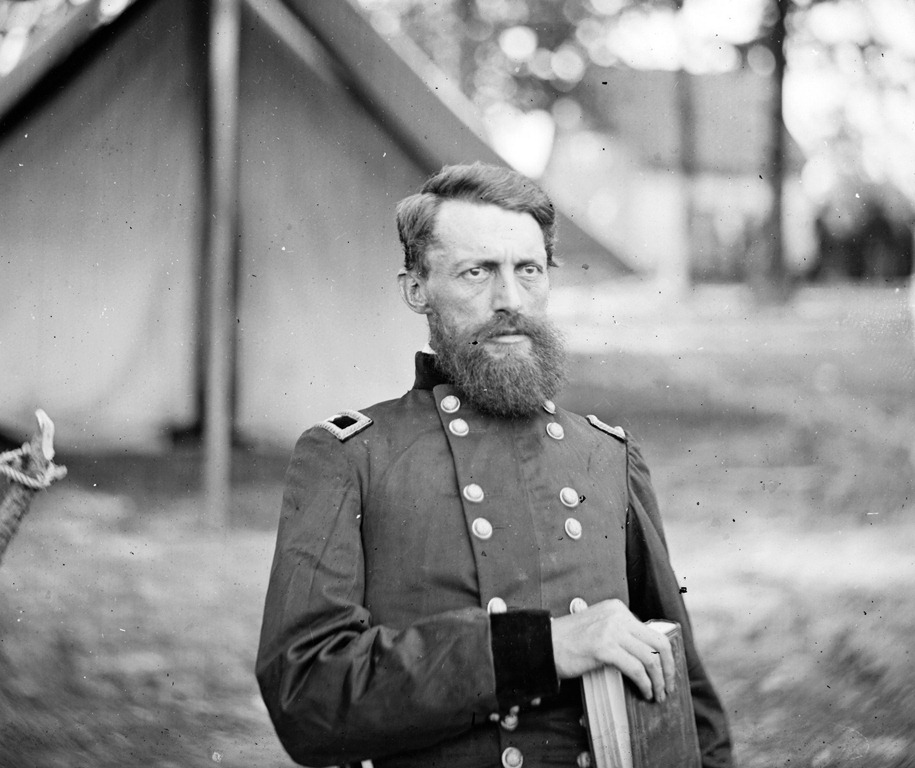
air Oaks, Virginia (vicinity). Gen. George Stoneman

Title: Fair Oaks, Virginia (vicinity). Gen. George Stoneman, U.S.A.

June 1862

Photographed by James F. Gibson

Photograph from the main eastern theater of war, the Peninsular Campaign

Civil War glass negative collection.  Library of Congress Prints and Photographs Division Washington, D.C. 20540 USA

Record page for this image: http://www.loc.gov/pictures/item/cwp2003005790/PP/

Wikipedia:  George Stoneman, Jr. (August 8, 1822 – September 5, 1894) was a career United States Army officer, a Union cavalry general in the American Civil War, and the 15th governor of California between 1883 and 1887.

June 10th.—General Gregg writes that Chickahominy¹ was a victory manqué, because Joe Johnston received a disabling wound and G. W. Smith was ill. The subordinates in command had not been made acquainted with the plan of battle.

A letter from John Chesnut, who says it must be all a mistake about Wade Hampton’s wound, for he saw him in the field to the very last; that is, until late that night. Hampton writes to Mary McDuffie that the ball was extracted from his foot on the field, and that he was in the saddle all day, but that, when he tried to take his boot off at night his foot was so inflamed and swollen, the boot had to be cut away, and the wound became more troublesome than he had expected.

Mrs. Preston sent her carriage to take us to see Mrs. Herbemont, whom Mary Gibson calls her “Mrs. Burgamot.” Miss Bay came down, ever-blooming, in a cap so formidable, I could but laugh. It was covered with a bristling row of white satin spikes. She coyly refused to enter Mrs. Preston’s carriage—”to put foot into it,” to use her own words; but she allowed herself to be overpersuaded.

I am so ill. Mrs. Ben Taylor said to Doctor Trezevant, “Surely, she is too ill to be going about; she ought to be in bed.” “She is very feeble, very nervous, as you say, but then she is living on nervous excitement. If you shut her up she would die at once.” A queer weakness of the heart, I have. Sometimes it beats so feebly I am sure it has stopped altogether. Then they say I have fainted, but I never lose consciousness.

Mrs. Preston and I were talking of negroes and cows. A negro, no matter how sensible he is on any other subject, can never be convinced that there is any necessity to feed a cow. “Turn ’em out, and let ’em grass. Grass good nuff for cow.”

Famous news comes from Richmond, but not so good from the coast. Mrs. Izard said, quoting I forget whom: “If West Point could give brains as well as training!” Smith is under arrest for disobedience of orders—Pemberton’s orders. This is the third general whom Pemberton has displaced within a few weeks—Ripley, Mercer, and now Smith.

When I told my husband that Molly was full of airs since her late trip home, he made answer: “Tell her to go to the devil—she or anybody else on the plantation who is dissatisfied; let them go. It is bother enough to feed and clothe them now.” When he went over to the plantation he returned charmed with their loyalty to him, their affection and their faithfulness.

Sixteen more Yankee regiments have landed on James Island. Eason writes, “They have twice the energy and enterprise of our people.” I answered, “Wait a while. Let them alone until climate and mosquitoes and sand-flies and dealing with negroes takes it all out of them.” Stonewall is a regular brick, going all the time, winning his way wherever he goes. Governor Pickens called to see me. His wife is in great trouble, anxiety, uncertainty. Her brother and her brother-in-law are either killed or taken prisoners.

Tom Taylor says Wade Hampton did not leave the field on account of his wound. “What heroism!” said some one. No, what luck! He is the luckiest man alive. He’ll never be killed. He was shot in the temple, but that did not kill him. His soldiers believe in his luck.

General Scott, on Southern soldiers, says, we have élan, courage, woodcraft, consummate horsemanship, endurance of pain equal to the Indians, but that we will not submit to discipline. We will not take care of things, or husband our resources. Where we are there is waste and destruction. If it could all be done by one wild, desperate dash, we would do it. But he does not think we can stand the long, blank months between the acts—the waiting! We can bear pain without a murmur, but we will not submit to be bored, etc.

Now, for the other side. Men of the North can wait; they can bear discipline; they can endure forever. Losses in battle are nothing to them. Their resources in men and materials of war are inexhaustible, and if they see fit they will fight to the bitter end. Here is a nice prospect for us— as comfortable as the old man’s croak at Mulberry, “Bad times, worse coming.”

Mrs. McCord says, “In the hospital the better born, that is, those born in the purple, the gentry, those who are accustomed to a life of luxury, are the better patients. They endure in silence. They are hardier, stronger, tougher, less liable to break down than the sons of the soil.” “Why is that?” I asked, and she answered, “Something in man that is more than the body.”

I know how it feels to die. I have felt it again and again. For instance, some one calls out, “Albert Sidney Johnston is killed.” My heart stands still. I feel no more. I am, for so many seconds, so many minutes, I know not how long, utterly without sensation of any kind—dead; and then, there is that great throb, that keen agony of physical pain, and the works are wound up again. The ticking of the clock begins, and I take up the burden of life once more. Some day it will stop too long, or my feeble heart will be too worn out to make that awakening jar, and all will be over. I do not think when the end comes that there will be any difference, except the miracle of the new wind-up throb. And now good news is just as exciting as bad. “Hurrah, Stonewall has saved us!” The pleasure is almost pain because of my way of feeling it.

Miriam’s Luryea and the coincidences of his life. He was born Moses, and is the hero of the bombshell. His mother was at a hotel in Charleston when kind-hearted Anna De Leon Moses went for her sister-in-law, and gave up her own chamber, that the child might be born in the comfort and privacy of a home. Only our people are given to such excessive hospitality. So little Luryea was born in Anna De Leon’s chamber. After Chickahominy when he, now a man, lay mortally wounded, Anna Moses, who was living in Richmond, found him, and she brought him home, though her house was crowded to the door-steps. She gave up her chamber to him, and so, as he had been born in her room, in her room he died.

______

¹ This must be a reference to the Battle of Seven Pines or to the Campaign of the Chickahominy, up to and inclusive of that battle.
June 10.—The Seward-Lyons Treaty for the suppression of the African slave-trade was officially promulgated. It is to remain in full force for the term of ten years. Instructions for the ships of the United States and British navies, and regulations for the mixed courts of justice, accompany the publication.

—The obsequies of Colonel J. Lafayette Riker, of the Sixty-second regiment of New-York volunteers and of Colonel James Miller, of the Eighty-first Pennsylvania regiment, took place in the city of New-York. — The schooner Julia was captured at Barataria, La., by master’s mate John H. Gregory, with a crew of twelve men from the United States gunboat Kittatinny.

—A fight took place on James Island, S. C, between a body of Union troops, and a large force of rebels. It was hotly contested for more than two hours, and ended in the rout of the rebels, with a loss to them of seventeen killed, thirty wounded, and six prisoners. The Unionists lost three killed and thirteen wounded.—Official Report.

—The Union army under General Fremont reached Port Republic, Va.—The rebels in front of the Union lines at Savage’s station, Chickahominy Swamp, Va., kept up a bombardment, without effect, their shells falling short of the mark.

Rienzi, Tishomingo Co., Miss., June 9, 1862.


Saturday morning the 5th inst. the colonel and myself started for a little pleasure ride as a relaxation from the many cares and troubles people in this profession are incident to. We started for Corinth, as neither of us had yet visited the place, and plodded along through dust in air and heat—words can’t tell how oppressive. We stopped at General Rosecrans about 1 p.m. and stayed and dined with him. The general was in his most pleasant mood and I thought him very engaging and winning in his manner. He told a number of amusing stories and ’twas all very pleasant, until somebody happened to mention General Fremont’s name. General Granger was also at the table and the two generals commenced and each tried to outdo the other in—yes, reviling the “bumble-bee catcher.”

They changed the subject over the wine and General Rosecrans became quite enthusiastic and prophetic in his conviction in regard to the war question, settlement thereof, etc. But I couldn’t see any remarkable difference between him and the rest of mankind, and the same remark will apply to all that I know of the other generals here. I remember he said that he considered “slavery a vile blot on the face of the earth,” and that unadulterated abolitionism alone was its equal; but I don’t claim that the speech showed any remarkable talent. We left him swearing at his A. Q. M. and journeyed on. We luckily met an old acquaintance of the colonel’s, a captain in the 1st Regular Infantry, and went with him to his quarters for the night. All the regimental officers quartered together in a very fine house that belongs to a secesh colonel. They were a jolly set of men, and the empty bottles lying around loose when we retired testified strongly thereto. I remember seeing one of them at Point Pleasant, Mo., have a couple of little fights (he commanded a two-gun battery of siege pieces) with a Rebel battery on the opposite shore.

We left Corinth early next morning for Farmington, and as we passed I saw where Major Applington fell. It was as I supposed about one-half mile from Corinth (hardly that) and what I did not know, was within 400 yards of the strongest part of the Rebel fortifications. We lunched at 10 a.m. and paid an old lady the modest sum of 50 cents for a piece of cornbread and a glass of buttermilk. She complained bitterly of some of Buell’s soldiers killing three of her chickens without paying for them, and just the day before her husband had been to Corinth and received meat, flour, etc., free from the aid society. She had three sons in the Southern Army. At 12 m. we drew rein 25 miles from Corinth at Iuka.

There are a couple of splendid springs in Iuka. One chalybeate, and the other sulphur water, and the town is the neatest I have seen in the country. Snuff-dipping is an universal custom here, and there are only two women in all Iuka that do not practice it. At tea parties, after they have supped, the sticks and snuff are passed round and the dipping commences. Sometimes girls ask their beaux to take a dip with them during a spark. I asked one if it didn’t interfere with the old-fashioned habit of kissing. She assured me that it did not in the least, and I marveled. There was only one regiment at Iuka, and they were expecting an attack from the hordes of guerrillas that infest the country all along our front from Memphis to Florence. I stayed at the hotel in town and had just retired (about 11) when crack, crack, two guns went, only about 60 rods from the house. There was a general shaking of the whole building, caused by the sleepers rising en masse and bouncing out on the floors. I thought if there was no fight I wouldn’t be fooled, and if there was I couldn’t do any good, so I kept cool. ‘Twas only a little bushwhacking. A soldier policeman having been shot at from the brush, and he returned the favor by guess. This infantry always thinks the enemy is just out of gunshot of them, and they are three-fourths scared to death all the time. At noon of Monday we left Iuka, rode to Burnsville, a place that I have spoken of in my letters before, as we scouted through it while lying before Corinth. None of our soldiers have camped there yet, and we were the only ones there while we stayed. The colonel took a nap to recover from the heat and fatigue of riding, and I strolled down town to look up some acquaintances I made while scouting. They treated me pretty well, and made me a letter carrier, as many of them had letters to send to their friends who are prisoners. At dark we started for Jacinto, ten miles south, but for so many hills had a splendid ride. ‘Twas through the woods, all the way, and over real young mountains. We got to Jacinto at 10 p.m. and concluded to stay all night. I laid down an hour or two, but the fleas were so bad that I got up and stayed up the rest of the night. I walked around the town and stopped at headquarters of the guard and talked with the boys. (They were of Jeff C. Davis’s division, of Pea Ridge, Ark., and Siegel.) They all think that Siegel is the only man and hate Davis like the devil. I waked the colonel at 4 p.m. and we started for home. The road from Jacinto, home, was lined with infantry, the whole left wing of our corps being on it. They had no tents but seemed to be preparing the ground for a camp. We got home in time for a little nap before breakfast, both of which I enjoyed very much. We found the garrison much excited about an attack that was expected every hour. The 2d Brigade of Cavalry had been about eight miles in front doing outpost duty, and having been alarmed by rumors had abandoned their camp and retreated to this place. Their sutler gave up his goods to the boys, preferring they should have them free, rather than the enemy. The next day (yesterday morning) a scout was sent out and found their camp just as they had left it. All of which was considered quite a joke on the 2d Brigade. The enemy may come up here and may whip us out, we are scattered so much, but they will have a riotous time of it. All told we had a very pleasant ride, but if we are gobbled up some of these times when riding around without an escort you must not be surprised. I don’t think it just the straight way of doing such business, but Charles can go where the colonel dares to, and my preference is for riding as far from a column as possible on several accounts. The colonel is a very interesting companion on such a trip, full of talk, and he has had six years experience on the frontier. I induced a very young lady with a well cracked piano to favor me with some music at Iuka. She sang “The Bonny Blue Flag That Bears a Single Star.” It was as near the music we used to hear in the old Presbyterian church at home as you could think, and that’s all that kept me from laughing in her face. We celebrated the capture of Richmond on the 4th, but are now trying to forget that we made such fools of ourselves. Damn the telegraphs. We have awful news from Richmond to-day. It would make me sick to write it. I would rather have the army whipped than McClellan.

JUNE 9TH.—It is now apparent that matters were miserably managed on the battle-field, until Gen. Lee assumed command in person. Most of the trophies of the victory, and thousands of arms, stores, etc. were pillaged by the promiscuous crowds of aliens and Jews who purchased passports thither from the Provost Marshal’s detectives.

Monday, 9th—It is dry and hot. We are at work building fortifications here on a large scale, Corinth being an important point for either army to hold, as it is the key to Mississippi and Alabama. The bulk of the Army of the Tennessee is left here, while detachments of the original hundred thousand under Halleck are being sent to other commands to act as reinforcements.

June 9 — Early this morning we received one hundred and fifty rounds of ammunition.

When we left camp old Stonewall’s cannon were thundering on the east side of the river below Port Republic, in front of General Shields. Shields had his forces strongly posted about one mile below Port Republic, his right on the river and his left butted up against a spur of the Blue Ridge that jutted boldly out into the plain. A little way up the side of the spur was a coaling which commanded the whole front of his line from the mountain to the river. General Shields quickly availed himself of the utility of this vantage ground on the extreme left of his line, by placing an eight-gun battery on the apparently invulnerable shelf up the mountain side, from which his batteries could sweep the whole field.

As we drew near and hastened toward the field the roar of battle grew fiercer and louder, the musketry being fearfully terrific. Just before we reached the field a goodly number of our wounded were returning to the rear, limping, bleeding, and groaning. Some of them greeted us to the field with the unpleasing and discouraging expression of “Hurry up; they are cutting us all to pieces.”

When we arrived in sight of the field and smelled the battle smoke one of Jackson’s aids came dashing from the front with a ready and prompt inquiry, “Whose battery is this?” “Chew’s,” was the quick response. “Have you plenty of ammunition?” The last question was answered in the affirmative, and the fleeting courier said, “Hurry to the front, captain.” “Forward, double quick!” was the ringing command of our calm but gallant captain, and in a very few moments after we wheeled in battery on the battle-field, under a raking fire from the eight-gun battery strongly posted on the coaling against the mountain side, and with perfect command of the field we were in.

The fire of that battery was terrible for a while. However, we held our ground and opened on the coaling with all our guns, with the utmost endeavor to give the enemy the best work we had in the shop. Some of Jackson’s batteries were in the same field with us, and were firing on the coaling battery. The air trembled with a continual roll of musketry and the thunder of the artillery shook the ground. The musketry right in front of us raged fearfully, far, far beyond the powers of description that my poor pencil can delineate. The shell from the battery on the coaling was ripping the ground open all around us, and the air was full of screaming fragments of exploding shell, and I thought I was a goner.

After we had been under this dreadful fire about thirty minutes I heard a mighty shout on the mountain side in close proximity to the coaling, and in a few minutes after I saw General Dick Taylor’s Louisianians debouching from the undergrowth, and like a wave crested with shining steel rush toward the fatal coaling and deadly battery with fixed bayonets, giving the Rebel yell like mad demons. The crest of the coaling was one sheet of fire as the Federal batteries poured round after round of grape and canister into the faces of the charging Louisianians. Yet the undaunted Southerners refused to be checked by the death and carnage in their ranks which the Federal batteries were so lavishly handing around, but rushed up the steep slope of the coaling like a mighty billow of glittering steel and closed in on the belching batteries and their infantry supports with the bayonet.

The fighting then grew dogged and stubborn. The opposing forces fired in each others’ faces. Bayonets gleamed in the morning sunshine one moment and the next they were plunged into living human flesh and dripping with reeking blood.

The Federals held to the coaling with bulldog tenacity, fighting like fiends, recognizing the fact that the point they were so gallantly defending was an all-important one, as it was the citadel of strength in Shields’s line and the key to his position. But the firm and unwavering courage and invincible prowess of Taylor’s Louisianians made them as persistent and obdurate in gaining and demanding, at the point of the bayonet, full possession and control of the death shelf as the Federals were in their inflexible stubbornness to hold it, and for a while the hand-to-hand conflict raged frightfully, resembling more the onslaught of maddened savages than the fighting of civilized men.

The hand-to-hand death grapple raged furiously over and around the Federal guns for a few moments, then Northern valor began to succumb to Southern courage. The Federals wavered, sullenly gave back, and finally broke and retreated hastily, abandoning the batteries for which they had fought so valiantly, and left them in full and undisputed possession of the Confederates.

When the Louisianians charged we ceased firing on the coaling battery, and immediately directed our fire on the infantry in the left center of Shields’s line.

Soon after the coaling battery was wrested from the Federals Shields’s whole line began to give back, and his army retreated in an almost routed fashion. We pursued them about five miles down the river. The track of the retiring foe was strewn with the accouterments of a discomfited army. Guns, knapsacks, overcoats, haversacks, and canteens were scattered all along the road. About three miles from the battle-field the retreating enemy abandoned a twelve-pound brass cannon. The carriage was disabled, and the gun was nicely spiked with a horseshoe nail.

When we returned from the pursuit we passed over the battle-field. Then the hills on the west side of the river were blue with Fremont’s infantry. There were several burying parties of our men on the field inhuming the slain, both Confederates and Federals, but they were sacrilegiously interrupted in their kindly service to the dead by being fired on by some of Fremont’s batteries on the hill beyond the river, an act in itself so atrocious that it would make even a barbarous vandal blush with shame to be guilty of its perpetration and consider it an infamy of the first water. This morning the butchering had commenced some time before we reached the shambles, and in going toward the field we passed a farmhouse that had been converted into an operating field hospital; dissecting room would be a more appropriate name, for as we passed the house I saw a subject on the kitchen table, on whom the surgeons were practicing their skillful severing operations. They tossed a man’s foot out of the window just as we passed.

The star of Stonewall Jackson’s fame as a brilliant strategist is growing brighter day by day. It has already won a worthy setting in the dazzling galaxy that flashes with martial splendor around the hero of Austerlitz. In the last month he, by quick and strategic movements, forced marches, deceptive maneuvering, and effectual fighting, has defeated and discomfited four Yankee generals — Milroy at McDowell, Banks at Winchester,— which was a perfect rout that landed Banks in Maryland and cast a tremor of fear over the Department of War at Washington — Fremont at Cross Keys; and to-day Shields, the ablest and most skillful of the four, was struck by lightning that flashed from the little faded cap, on the field at Port Republic.

Marched till ten to-night and camped halfway up the Blue Ridge on the Brown’s Gap road.

Flat Top Mountain, June 9, 1862. Monday. — Still cold weather. . . . Heard of the taking of Memphis after a battle of gunboats lasting an hour and twenty minutes. As reported it was a brilliant victory.

9th. Monday. Did very little save rest and graze my horse. Letters from Fannie, home and Sarah.

Written from the Sea islands of South Carolina.

[Diary] June 9.

This afternoon the cotton agent, or rather the sutler, Mr. Whiting, and his little wife, left the place. We are so glad to have their half of the house. Mr. Pierce left with me an injunction that they should take away none of the furniture, and they left most of it. Mr. Elmendorff gave into my charge some things which he should claim should he come again, but he has only the right of prior seizure to them.

To-night we all went to Rina’s house where the people had a “shout,” which Mr. McKim was inclined to think was a remnant of African worship.