Following the American Civil War Sesquicentennial with day by day writings of the time, currently 1863.

June 2012

“Wilson Small,” June 9.

Dear Mother, — I can’t retain the least recollection of when I write, or what I write, or to whom it is written. I only know that I do write to somebody nearly every day. You owe the multitude of my letters partly to the fact that they are written here and there at odd moments, and partly to the other fact that when we go off duty we go utterly off, and come up to our little haven of rest, the “Small.” When we get here we can’t sit and do nothing, we can’t think, we can’t read; what can we do but write? Sometimes the intense excitement of our lives finds vent and ease in writing; but at other times, when we have nothing pressing to do, we feel so inert that the effort to collect our thoughts to write even a line is too great. We have so many letters to scribble for the poor fellows that materials must always be handy. I go about with my notepaper rolled up in a magazine and stuck, with pens and ink, into an apron-pocket; and so it sometimes happens that a letter to you is begun, continued, or ended while on duty. Beside the letters we write and send off for the men, we have many from friends inquiring after husbands, sons, and brothers who are reported wounded. Such letters will never cease to be a sad and tender memory to us. One came last week from a wife inquiring after her husband, but none of us could attend to it until to-day. “Give him back to me dead,” she says, “if he is dead, for I must see him.” Mrs. Griffin remembered the name; he was one of the men whose funeral she attended ashore one Sunday evening. So to-day I went up and found him under the feathery elm-tree. I made a little sketch of the place and sent it to her, — all I could send, poor soul!

I am sitting now on a barrel in the tent, waiting for a train of sick men who were telegraphed to arrive an hour ago. A million of flies are buzzing and whirling and settling about me. If you doubt the number, “Count them, sir, count them,” as the waiter at Vauxhall said to the man who asked if there were really five millions of lamps, as advertised. Flies are much harder to count than lamps, so I let you off four millions.

I hear. that inquiries are being made as to how the Sanitary Commission uses its supplies. If they are made of you, say that so far as I have seen (and it is not too much to say that more than half of what is used on our boats passes under the women’s knowledge), there is no waste, but the most careful use. The Commission is not only doing in the best manner its own work, but it has supplied stores of hospital food, stimulants, and every thread of clothing, lint, bandages, sheets, articles and utensils of hospital use, and much else of a miscellaneous character, to the Government boats, besides the daily, I might almost say hourly, requisitions from the regimental hospitals. If people ask whether more can be wanted, let them consider this. Let them reflect that four times a week our own boats have to be fitted out. To be sure, the same things are to some extent used again; but, without waste, much must be lost. For instance, washing cannot be done here or on the boats; on the latter it would be dangerous. Much that is used has to be thrown overboard; it would be a risk to life to do otherwise. Large cases of soiled clothing, sheets, etc., are nailed up and sent North on the ships. Perhaps each of them carries two or three thousand of such articles. Of course the supplies diminish; though from time to time the washed articles come back.

Oh! if those at home could see all that I see, no trouble, no expense, no sacrifice would be thought too great to strengthen the hands of this Commission so that its work may not fail. I know of my own knowledge how the articles supplied by the women of the country go; and I know there is no waste. When hour by hour some direful necessity is brought to sight, much has to be given which never comes back into our hands; all given to the Government boats is, of course, never returned, — nor could that be expected. On our own boats, however, economy is practised just so far as not to interfere with the success of the work. Oh, how pressed we are for some things! Tin pails, lanterns, and things of that kind we are always begging for, and “annexing” where we can.

I ought to say that I believe the confusion and neglect on the part of the Medical Department which occurred last week was exceptional, and not likely to occur again. At least the authorities have now been warned, and I believe they will profit by the warning. Probably no army in the world ever advanced with so much to alleviate its hardships. Notwithstanding the suffering I see, I feel this; and when I reflect that I see all, or nearly all, there is of misery, I am ready to say that this war is not as dreadful as war once was. The men are well clothed and shod and fed; the ration (on which we live also) is excellent; the beef, rice, flour, and coffee as good as need be.1[1]


[1] I found this to be the case when I became, later, superintendent of a large United States Army General Hospital, where the articles composing the ration came directly under my observation. I never saw one of inferior quality. The ration of the United States soldier is: ¾ lb. of pork or bacon, or 1¼ lbs. of fresh or salt beef; 22 ounces of bread or flour, or 1¼ lbs. of corn-meal; to every hundred rations, 10 lbs. coffee, 1½ lbs. tea, 15 lbs. sugar, 1 lb. sperm candles, or 1½ lbs. tallow ditto, 4 lbs. soap, 2 quarts salt, 8 quarts beans or peas, 10 lbs. rice or hominy, 4 quarts vinegar, 1 gallon molasses (twice a week), 100 lbs. of fresh potatoes or 100 ounces dessicated vegetables (three times a week). Bacon means ham or middlings.
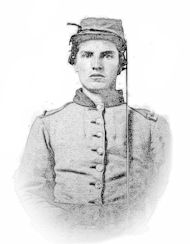

Sunday, 9th.—Train ran all night; arrived at Cattanooga 10 A. M. Yankees shelling the town from the north side of the river, but doing no damage.


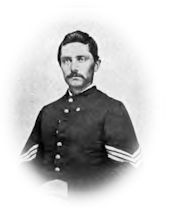
(Note: picture is of an unidentified Confederate soldier.)

9th, Night.—General Jackson is performing prodigies of valor in the Valley; he has met the forces of Fremont and Shields, and whipped them in detail. They fought at Cross Keys and Port Republic yesterday and to-day. I must preserve his last dispatch, it is so characteristic:

“Through God’s blessing, the enemy, near Port Republic, was this day routed, with the loss of six pieces of artillery.

“T. J. Jackson, “Major-General Commanding.”

And now we are awaiting the casualties from the Valley. This feeling of personal anxiety keeps us humble amid the flush of victory. What news may not each mail bring us, of those as dear as our heart’s blood? Each telegram that is brought into the hospital makes me blind with apprehension, until it passes me, and other countenances denote the same anxiety; but we dare not say a word which may unnerve the patients; they are rejoicing amid their pain and anguish over our victories. Poor fellows! dearly have they paid for them, with the loss of limb, and other wounds more painful still. They want to be cured that they may be on the field again. “Thank God,” said a man, with his leg amputated, “that it was not my right arm, for then I could never have fought again; as soon as this stump is well I shall join Stuart’s cavalry; I can ride with a wooden leg as well as a real one.”

The “Young Napoleon”, does not seem to be dispirited by his late reverses. The New York Herald acknowledges the defeat of the 31st, but says they recovered their loss next day; but the whole tone of that and other Northern papers proves that they know that their defeat was complete, though they will not acknowledge it. They are marshalling their forces for another “On to Richmond.” O God, to Thee, to Thee alone, do we look for deliverance. Thou, who canst do all things, have mercy upon us and help us!

Richmond, Va., vicinity. 1st New York Pettit's Battery, Artillery

Title: Richmond, Va., vicinity. 1st New York Pettit’s Battery, Artillery.

June 1862

Photographed by James F. Gibson

Photograph from the main eastern theater of war, the Peninsular Campaign

Civil War glass negative collection.  Library of Congress Prints and Photographs Division Washington, D.C. 20540 USA

Record page for this image: http://www.loc.gov/pictures/item/bcw2003000004/PP/

June 9th.—When we read of the battles in India, in Italy, in the Crimea, what did we care? Only an interesting topic, like any other, to look for in the paper. Now you hear of a battle with a thrill and a shudder. It has come home to us; half the people that we know in the world are under the enemy’s guns. A telegram reaches you, and you leave it on your lap. You are pale with fright. You handle it, or you dread to touch it, as you would a rattlesnake; worse, worse, a snake could only strike you. How many, many will this scrap of paper tell you have gone to their death?

When you meet people, sad and sorrowful is the greeting ; they press your hand; tears stand in their eyes or roll down their cheeks, as they happen to possess more or less self-control. They have brother, father, or sons as the case may be, in battle. And now this thing seems never to stop. We have no breathing time given us. It can not be so at the North, for the papers say gentlemen do not go into the ranks there, but are officers, or clerks of departments. Then we see so many members of foreign regiments among our prisoners—Germans, Irish, Scotch. The proportion of trouble is awfully against us. Every company on the field, rank and file, is filled with our nearest and dearest, who are common soldiers.

Mem Cohen’s story to-day. A woman she knew heard her son was killed, and had hardly taken in the horror of it when they came to say it was all a mistake in the name. She fell on her knees with a shout of joy. “Praise the Lord, 0 my soul!” she cried, in her wild delight. The household was totally upset, the swing-back of the pendulum from the scene of weeping and wailing of a few moments before was very exciting. In the midst of this hubbub the hearse drove up with the poor boy in his metallic coffin. Does anybody wonder so many women die? Grief and constant anxiety kill nearly as many women at home as men are killed on the battle-field. Mem’s friend is at the point of death with brain fever; the sudden changes from grief to joy and joy to grief were more than she could bear.

A story from New Orleans. As some Yankees passed two boys playing in the street, one of the boys threw a handful of burned cotton at them, saying, “I keep this for you.” The other, not to be outdone, spit at the Yankees, and said, “I keep this for you.” The Yankees marked the house. Afterward, a corporal’s guard came. Madam was affably conversing with a friend, and in vain, the friend, who was a mere morning caller, protested he was not the master of the house; he was marched off to prison.

Mr. Moise got his money out of New Orleans. He went to a station with his two sons, who were quite small boys. When he got there, the carriage that he expected was not to be seen. He had brought no money with him, knowing he might be searched. Some friend called out, “I will lend you my horse, but then you will be obliged to leave the children.” This offer was accepted, and, as he rode off, one of the boys called out, “Papa, here is your tobacco, which you have forgotten.” Mr. Moise turned back and the boy handed up a roll of tobacco, which he had held openly in his hand all the time. Mr. Moise took it, and galloped off, waving his hat to them. In that roll of tobacco was encased twenty-five thousand dollars.

Now, the Mississippi is virtually open to the Yankees. Beauregard has evacuated Corinth.¹

Henry Nott was killed at Shiloh; Mrs. Auze wrote to tell us. She had no hope. To be conquered and ruined had always been her fate, strive as she might, and now she knew it would be through her country that she would be made to feel. She had had more than most women to endure, and the battle of life she had tried to fight with courage, patience, faith. Long years ago, when she was young, her lover died. Afterward, she married another. Then her husband died, and next her only son. When New Orleans fell, her only daughter was there and Mrs. Auze went to her. Well may she say that she has bravely borne her burden till now.²

Stonewall said, in his quaint way: “I like strong drink, so I never touch it.” May heaven, who sent him to help us, save him from all harm!

My husband traced Stonewall’s triumphal career on the map. He has defeated Frémont and taken all his cannon; now he is after Shields. The language of the telegram is vague: “Stonewall has taken plenty of prisoners “—plenty, no doubt, and enough and to spare. We can’t feed our own soldiers, and how are we to feed prisoners ?

They denounce Toombs in some Georgia paper, which I saw to-day, for planting a full crop of cotton. They say he ought to plant provisions for soldiers.

And now every man in Virginia, and the eastern part of South Carolina is in revolt, because old men and boys are ordered out as a reserve corps, and worst of all, sacred property, that is, negroes, have been seized and sent out to work on the fortifications along the coast line. We are in a fine condition to fortify Columbia!

¹ Corinth was besieged by the Federals, under General Halleck, in May, 1862, and was evacuated by the Confederates under Beauregard on May 29th.

² She lost her life in the Windsor Hotel fire in New York.

June 9.—General (Stonewall) Jackson in retreat before the army under General Fremont fell upon an advance body of the force under General Shields, near Port Republic, Va. After a hard fight this advance body fell back upon the main body under General Shields, and Jackson continued his retreat—(Doc. 19.)

—The Senate of the United States resolved itself into a High Court of Impeachment, for the trial of Judge Humphreys, of Tennessee, for treason, and the members of the House of Representatives were introduced in due form; but it was finally concluded to postpone the proceedings until the twenty-sixth.—The House bill prohibiting slavery in the territories was passed.—Secretary Welles addressed an elaborate communication to the Naval Committee of Congress on the construction of armored ships.

—General Halleck at Corinth, Miss., sent the following despatch to the War Department: “The enemy has fallen back fifty miles from here by railroad, and near seventy miles by wagon road. General Pope estimates the rebel loss from casualties, prisoners, and desertion, at over twenty thousand, and General Buell at between twenty thousand and thirty thousand.

“A person who was employed in the confederate commissary department, says they had one hundred and twenty thousand men in Corinth, and that now they cannot muster much over eighty thousand. Some of the fresh graves on the road have been opened and found filled with arms. Many of the prisoners beg not to be exchanged, saying they purposely allowed themselves to be taken. Beaureguard himself retreated from Baldwin on Saturday afternoon to Okolona, Miss.”

—Brigadier-general D. B. Birney, having been tried by court-martial, and honorably acquitted of the charges brought against him, this day reassumed command of his brigade by order of General Kearny, commanding division.

—The House of Representatives of the United States called for information respecting the organization by General Hunter, of the Department of South-Carolina, of a regiment of black volunteers for the defence of the Union.—(Doc. 132.)

—An interesting correspondence between Judge Rost, Captain Huse, and R. M. T. Hunter, rebel agents in Europe, was this day published.

Sunday, 8th—We received orders to clean up for inspection and a detail of men was put to work cleaning up the parade ground. We have a fine drill ground out in a large field. But the camp being out in the open, the sun beats down pretty hot upon the tents.

June 8th, Sunday.

These people mean to kill us with kindness. There is such a thing as being too kind. Yesterday General Williams sent a barrel of flour to mother, accompanied by a note begging her to accept it “in consideration of the present condition of the circulating currency,” and the intention was so kind, the way it was done so delicate, that there was no refusing it. I had to write her thanks, and got in a violent fit of the “trembles” at the idea of writing to a stranger. One consolation is, that I am not a very big fool, for it took only three lines to prove myself one. If I had been a thundering big one, I would have occupied two pages to show myself fully. And to think it is out of our power to prove them our appreciation of the kindness we have universally met with! Many officers were in church this morning, and as they passed us while we waited for the door to be opened, General Williams bowed profoundly, another followed his example; we returned the salute, of course. But by tomorrow, those he did not bow to will cry treason against us. Let them howl. I am tired of lies, scandal, and deceit. All the loudest gossips have been frightened into the country, but enough remain to keep them well supplied with town talk. . . . It is such a consolation to turn to the dear good people of the world after coming in contact with such cattle. Here, for instance, is Mr. Bonnecase on whom we have not the slightest claims. Every day since we have been here, he has sent a great pitcher of milk, knowing our cow is out; one day he sent rice, the next sardines, yesterday two bottles of Port and Madeira, which cannot be purchased in the whole South. What a duck of an old man! That is only one instance.

June 8 — The war fruit ripened last night, and this morning the cannons commenced booming in front and rear. We were ordered to the Shenandoah River near Port Republic, as the advance guard of Shields’s army — which is advancing up the Luray Valley — was there hammering at and threatening Jackson’s rear — that is, if he has anything at present that can be properly designated a rear, as Old Stonewall showed two bold fronts to-day with very little rear to them. When we arrived at the river Jackson had already ordered a Yankee battery to change its position, and also had dodged a shell or two that were aimed at him personally, and his troops had driven back Shields’s heavy advance guard on the east side of the river.

We remained in battery on the highlands west of the river, together with some four or five of Jackson’s batteries and infantry, to hold back Shields’s forces, which lay below on the other side of the river, checkmated.

We remained in position a few hours, then moved up the river two miles to Vernon Forge, to guard a ford. We remained there until four o’clock, then moved up the river a mile farther to guard another ford, and remained there until two hours after dark, when we moved to Middle River, and camped. From about nine o’clock this morning until three this afternoon we heard the incessant thundering of booming cannon in the direction of Cross Keys, where a fierce battle has been raging nearly all day between General Ewell’s and Fremont’s forces. It is reported to-night that Ewell defeated Fremont.

To Mrs. Lyon.

Camp near Booneville, Miss., 25 miles south of Corinth, on Mobile & Ohio R. R., Sunday, June 8, 1862.— We are lying quietly here, encamped in a beautiful grove, on dry, clean land. Our regiment is in better health than almost any regiment near us, and yet we have a large number of sick men back in the hospitals. For myself, I seem to grow stronger and more healthy every day. The climate seems well adapted to my constitution. We have warm days usually, with cool, delicious nights. I sleep every night on the ground under a shelter of boughs, our tents not having yet reached us, with nothing but a rubber blanket under me, and I sleep soundly and sweetly. I do not think we shall move from here until the Mississippi river is open so that we can get our supplies by railroad from Memphis. We now have to haul them with teams from Hamburg, between forty and fifty miles distant. The Tennessee river will soon be so low that it will be difficult to get them to Hamburg.

I have no idea where Beauregard’s army is, but we have plenty of evidence that it is sadly demoralized. I do not expect any more hard fighting here, for I do not believe that the rebels will face us, but I may be mistaken. If McClellan takes Richmond, and the Mississippi is speedily opened, I shall confidently expect a speedy termination of this wicked rebellion. Then, our duty performed and our beloved country relieved from peril, with glad emotions will we return to the arms of our loved ones and to the sacred peace of our happy homes. God speed the joyful hour!

I have now been in two fierce battles and have faced death for long, weary hours, and amid the wild terrors of the contest have been enabled by our kind Heavenly Father to preserve my self-command and do my duty. Oh, how sublime a scene is a battle! I can not describe it, but it seemed like the thunder on Sinai or the day of judgment, as our imaginations picture those wonderful events. Aside from its fearful perils, a battle fills the soul with the most sublime emotions. Then life is regarded at its true value, and the obligations of honor, patriotism, duty and humble trust in God fire the soul to meet manfully the terrible responsibilities of the hour. I thank God most devoutly that I have been enabled to render some service to my country, and that thus far our sweet babes will never have occasion to blush at the thought that their father failed to do his duty. The conviction that I shall return to you in safety at the end of the war keeps my feelings constantly calm and happy, and I sincerely hope that you feel so. I am well satisfied that I did not accept the promotion to the 18th, for I feel justifiable pride in the renown which our regiment has achieved. I feel now very clearly that it is my duty to keep with my company. The devotion of my men to me, evidenced in a thousand ways, often brings tears to my eyes.

I am vexed with the newspapers. Some of them are dissatisfied because we did not fight a great battle and, of course, have a great slaughter; and they call the whole operation a defeat. This is frightfully, cruelly wicked. These men are in a rage because ten thousand more homes are not desolated. The fact is, the whole campaign has been conducted with the most consummate generalship. Corinth is a most important position in a military point of view, flanking both Fort Pillow and Memphis. We wanted the position. The rebels themselves, with their arms and supplies, were of but little consequence to us. We won the position with but little loss of life, and these cowardly home-guards gnash their teeth in impotent rage because no more of us were butchered.