Neese predicts: “About to-morrow Old Stonewall will show them how it is done.” The next day will see the battle of Cross Keys.
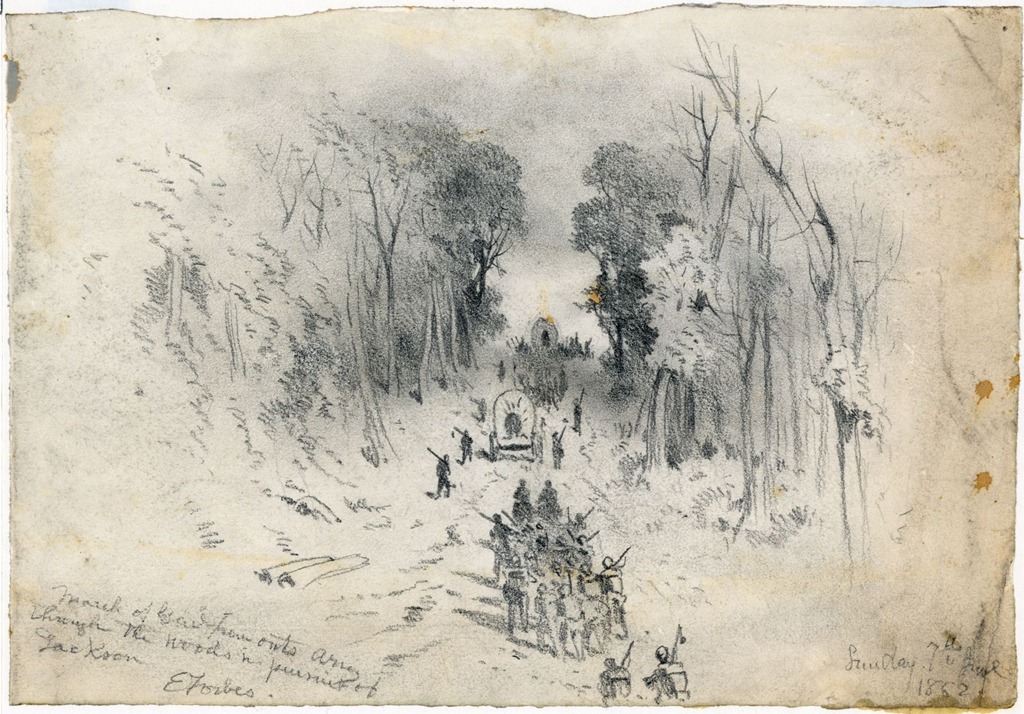
June 7 — This morning we moved about three miles in the direction of Port Republic, then halted and remained in marching order all day, waiting for some war fruit, blooming all about us, to ripen.
Right from where I am writing I saw a signal flag on the summit of Peaked Mountain waving with a jerky fluttering nearly all day, which is generally a sure sign that a battle is getting ripe enough to open. I am not certain, but think that it is a Yank signal, and perhaps it is General Shields — as I heard to-day that he is moving up the Luray Valley — signaling to Fremont to hold the fort. About to-morrow Old Stonewall will show them how it is done.
June 7th. To-day the last of the dead were buried, and the general appearance of things much improved. Our division hospital is in and about a large house on the hill, in rear. The doctors have had more than they could do, and are pretty well used up. I went over there to-day to see McKim, and found him up to his ears in work. Below the house, just outside the door, I saw a heap of arms, feet, legs, hands, etc.; the pile was beastly odoriferous, and most suggestive. The doctor said they had been unable, so far, to get anybody to bury it.
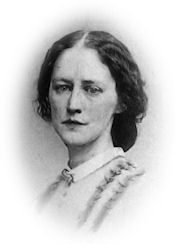
Jane Stuart Woolsey to her sister, Georgeanna.
Charley’s letter to the Post was quite a success and I advise him to continue his communications. The Vanderbilt, Government Hospital Ship, got in last night at six or seven, and will be emptied to-day, I suppose. There has been a great and general muss on the whole subject (of course) between General B— and Satterlee and their underlings, parties of the first part,—and all the State agents and volunteer doctors, parties of the second part, the old fight between regulars and volunteers—conflict of authority and efforts to sustain small personal dignities at the expense of everything else. In the meantime however, the patients, contrary to the usual course, have not suffered very much, as the public have had pretty free access to them and their wants have been supplied. Now, all transports are obliged to anchor in the stream and report to the regular quartermaster. . . . The Vanderbilt is the first arrival under the new regime and we shall see how it works. As much flourish of authority as they like, if it only shows fruit in the comfort of the patients, a subject on which I have misgivings. Fort Hamilton is the new depot; that and Bedloe’s Island. We went to the Island on Friday and found things improving. A few weeks ago Dr. Agnew (I think) or one other of the Commission went down and found the doctor drunk, the stewards on leave given by themselves, and the fever patients dying of neglect. He, whoever he was, cruised about the Island, found ten pounds of beef, cut it up and made broth himself, and spent the night feeding the sick men. They have got a new surgeon now, but I think the steward steals. One reform at a time. We are determined, we “females,” to make the place much too hot for him if we can prove anything. But how many weak-minded sisters there are! I never realized before how few people in the world are really clever and how very few are capable of “taking the responsibility.” I have also discovered that there is nothing like philanthropy to bring out the quarreling propensities. Two young gentlemen called yesterday and asked for Charley, expressing great surprise that he hadn’t got back, as they saw him driving his horse a day or two ago. They might have mistaken the man, but they appeared confident on the subject of the horse. So, Charley, Mr. Coles may be guilty of some black-hearted treachery. My mind always misgave me that Wilson’s men went out o’nights with Nelly Bly. What is the news from Joe and the 16th? We search the papers in vain to find his whereabouts. Yesterday in the Herald, in a chance letter, was this, “General Franklin, in crossing a brook to-day, got mired in the soft earth banks and was thrown, but instantly emerged unhurt, dripping, puffing and laughing.” That is the only public news I have seen of the Division for ten days. Where are they?
June 7. [Okolona, Mississippi]—Colonel Williams, quartermaster for Price’s army, and two young men, his assistants, are boarding here. They have a small room for their stores, for which they are very thankful, as the place is so crowded.
One of the young men who is with the colonel is an Episcopalian. To-day he informed me that Mr. Clute intended having service in the open air, as his church, along with the others, has been taken for a hospital.
June 7th.—Cheves McCord’s battery on the coast has three guns and one hundred men. If this battery should be captured John’s Island and James Island would be open to the enemy, and so Charleston exposed utterly.
Wade Hampton writes to his wife that Chickahominy was not as decided a victory as he could have wished. Fort Pillow and Memphis¹ have been given up. Next! and next!

______
¹ Fort Pillow was on the Mississippi above Memphis. It had been erected by the Confederates, but was occupied by the Federals on June 5, 1862, the Confederates having evacuated and partially destroyed it the day before. On June 6, 1862, the Federal fleet defeated the Confederates near Memphis. The city soon afterward was occupied by the Federals.
June 7.—An enthusiastic Union meeting was held at Shelbyville, Tenn., at which speeches were made by Andrew Johnson, W. H. Wisner and Col. May —On the Chickahominy River the rebels opened fire on the pickets of Gen. Sumner, but without any effect—The rebel steam-tug Mark R. Chesk, was captured near Memphis, Tenn.
—The Paris Constitutionnel, of this day, published an article to show “the impossibility of the South being conquered,” and maintaining that foreign “mediation alone will succeed in putting an end to a war disastrous to the interests of humanity.”
—William Mumford, a citizen of New-Orleans, was hung in that city for an overt act of treason in pulling down the American flag from the United States Mint— (Doc. 65.)
—In the Missouri Convention a bill for the gradual emancipation of slaves was submitted and defeated by a vote of fifty-two to nineteen.
—Memphis, Tenn., was formally taken possession of in the name of the Government of the United States, by Col. G. N. Fitch, commanding Indiana brigade.—The schooner Rowena, formerly the Garibaldi, ran into Stono Inlet, S. C, this evening, not knowing it to be in the possession of the National forces, and was captured by the gunboat Pawnee.—Official Report.
—The rebel batteries at Chattanooga, East Tennessee, were silenced by the artillery of General Negley’s command after a bombardment of three hours.—(Doc. 64.)
Headquarters 1st Brigade Cavalry Division,
Camp near Boonville, Miss., June 6, 1862.
I am leading an inglorious life now, nothing to do but the brigade writing and ride with the colonel when he goes out on business. The only time I am on the fighting list is when the brigade goes out, and that is very rarely, and only when reconnoisances in force are made, and there is seldom any fighting done then. General Hamilton’s whole division marched by our tent to-day and it was a splendid sight; I had thought that I’d never want to see any more troops but his division looked so splendidly, that I really enjoyed the sight of them. I knew that they were only marching into a new camp, but they all had got the idea that they were going into a fight and they were in grand spirits. I never saw the men look as healthy as they do now. One reason is those who were sick have been all left at the river and the weakly ones do not pretend to march in the ranks this hot weather. We are within one hundred yards of General Pope’s headquarters and there are continually a lot of brigadiers passing. They nearly always ride on the gallop, and with the aids and escorts all told, say 60 in number to each general, they make quite a dashing appearance. Rosecrans, Buell, Granger, Smith, Sherman, T. W., Plummer, Paine, Hamilton and Pope all rode by at one time to-day.
All the companies we have had out to-day report skirmishing with the enemy We lost two men prisoners, some wounded and several horses. Got some prisoners. The enemy are in some force six miles from here. They are dodging all around us. Rumor says to-day that Buell with his army is going down through Alabama to Montgomery. Pope will move slowly after the enemy through Mississippi, and Thomas will go across to Memphis and down the river to co-operate with Butler in a movement through Southern Mississippi. ‘Tis probably the plan of some cuss in the ranks. I wish for one day that you could hear all the camp rumors. They would make a remarkable book.
‘London, June 6, 1862
The evening before the Derby, the Chief and I were down at the House of Commons from five o’clock P.m. till one A.m., listening to the great debate of the season. This is one of the sights that I enjoy most. With us debate has gone out, and set speeches and personalities have taken its place. But here, though they no longer speak as they used in the old days of Pitt and Fox, with rhetorical effort and energy, there is still admirable debating. That night we heard Palmerston, Disraeli, Horsman and Cobden. Palmerston is a poor speaker, wants fluency and power, and talks the most miserable sophistry, but he does it so amusingly and plausibly and has such prestige that even Disraeli’s keenness puts no quencher on him. Gladstone is the best speaker in the house, but next to him I should place Disraeli. He looks precisely like the pictures in Punch, and speaks with a power of making hits that is infinitely amusing. He kept me in a roar three quarters of an hour, and the House cheered him steadily. Cobden was very good too. He damaged Horsman dreadfully. But the most striking part of the debate was that not a word as to America or interference was said in it. This was peculiar because the debate was on the subject of retrenchment, and retrenchment was necessary because of the American war. Six months ago such a debate would not have taken place, but in its place we should have had war speeches with no end.
Our position here now, putting aside a few diplomatic questions, is much as it might be at home. The Speaker calls the Chief “The Conqueror,” and it is only now and then, when our armies stop a moment to take breath, and they think here that we are in trouble, that the opposition raises its head a little and barks. Indeed the position we have here is one of a great deal of weight, and of course so long as our armies march forward, so long our hands are elevated higher and higher until we bump the stars. I hear very little about our friend Mason. He is said to be very anxious and to fear a rebellion within the rebellion. He has little or no attention paid him except as a matter of curiosity, though occasionally we are told of his being at dinner somewhere or other. A Southern newspaper called the Index lately started here, contains numbers of southern letters, all of which are so excruciatingly “never conquer” in their tone, that one is forced to the belief that they think themselves very near that last ditch. . . .
JUNE 6TH.—Gen. Winder getting wind of what was going on, had an interview, first with Mr. Benjamin, who instructed him what to say; and then bringing forward the Provost Marshal, they had a rather stormy interview with Mr. Randolph, who, as usual, yielded to their protestations against having two passport offices, while martial law existed.
And so Col. Bledsoe came in and told me to “shut up shop.” The Secretary had revoked his order.