Following the American Civil War Sesquicentennial with day by day writings of the time, currently 1863.

June 2012

Whitsunday, June 8.—This morning I went to church with my Missouri friend, Colonel W.’s assistant, and quite an amusing incident happened. I had seen and spoken to him a number of times, but did not know his name. We see so many persons here that it is impossible to remember their names. I recollected, while walking with this gentleman, that I was ignorant of his name, and asked him what it was. He laughed so heartily that. he could scarcely tell me. Surely these are strange times. We never think of requiring an introduction to a soldier, as we have perfect confidence in them. To be in our army is a passport. The men are all gentlemen—at least I have found them so thus far. The one I was then walking with was not an exception. His name is Curtis. He was a captain in Price’s Missouri State Guard, and was with it at the time it was captured. He is now with Colonel W., on General Price’s staff.

We called on Mr. Clute, who was glad to see me. He kindly inquired after Mrs. Ogden, and all the other ladies. I was introduced to Mrs. Clute, and she and I raised the tunes. The services were held under a large oak-tree, and the scene was quite romantic. Mr. C. preached an excellent sermon on the subject for the day.

June 8.—This day a scouting party under Lieut. Bonse, company A, Tenth Virginia regiment, captured, in Braxton County, Va., Ben. Haymond, Ed. Riffle and Stan. Conrad, three of the most notorious bushwhackers in Western Virginia. Haymond and Riffle had been cutting telegraph wires, robbing Union men, stealing horses, etc.—Cincinnati Gazette, June 11.

—An extension of the following military departments of the United States was made:

1. The Department of the Mississippi is extended so as to include the whole of the States of Tennessee and Kentucky. All officers on duty in those States will report to Major-Gen. Halleck.

2. The Mountain Department is extended eastward to the road running from Williamsport to Martinsburgh, Winchester, Strasburgh, Harrisonburgh, and Staunton, including that place—thence in the same direction southward until it reaches the Blue Ridge chain of mountains; thence with the line of the Blue Ridge to the southern boundary of the State of Virginia.

3. The Department of the Shenandoah is extended eastward to include the Piedmont District and the Bull Mountain range.

—General Prim, commanding the Spanish forces recently sent to Mexico, together with his suite, visited the army of the Potomac to-day.

—General Fremont attacked (Stonewall) Jackson seven miles beyond Harrisonburgh, Va., near Union Church or Cross Keys, at half-past eight this morning, and drove him from a strong position with considerable loss.—(Doc. 18.)

—The obsequies of General Turner Ashby of the rebel cavalry, were celebrated at Charlottesville, Va. “The services were performed by the Rev. Mr. Norton and Rev. Mr. Avery—the latter had been chaplin in the cavalry from the opening of the war. Both spoke of the deceased in terms of high praise as a man, a soldier, and a Christian. The brave soldiers wept as they listened to the pious exhortations of the clergymen. They had lost a host in Gen. Ashby, but they were expected to imitate him in all things, and especially in his veneration and respect for Christianity. The country looked to them for deeds of greater valor than had ever yet been accomplished by them; and there, on the dead body of their late commander, they should swear not to sheathe their swords when a hostile army polluted the soil of Virginia and the South. After the services in the chapel the remains of General Ashby were conveyed to the University cemetery and committed ‘earth to earth, ashes to ashes, and dust to dust,’ Colonel T. G. Randolph and the Professors of the University assisting in the ceremony. They grave was covered by the cavalry, and they fired several volleys over it, and there he will remain in this classic ground until the last trump shall summon all to the general judgment”—Lynchburgh Republican, June 12.

—Judge Swayne, of Memphis, Tenn., refused to open the Criminal Court in that city, after receiving an order from Col. G. N. Fitch, commanding United States forces, instructing him to confine himself to the hearing and adjudication of such cases only as are not based upon the recognition of the right of a State to secede from the Union, or upon the presumption of the establishment or existence of a so-called Southern Confederacy, or recognizing the same.

—A small force of Union troops, commanded by Capt. V. Geary, Third Pennsylvania cavalry, while on a reconnoissance in the vicinity of New Market, Va., captured a rebel spy named Hance. He was the medium by which letters were carried to and fro, giving the rebels much information concerning the movements of the Union army. When captured he had a mail made up, ready to carry into Richmond.

—A reconnoissance was this day made, under cover of eight Union gunboats, by a body of National troops, commanded by Colonel Morrow, on James Island, S. C. The Union forces drove the rebels a distance of two miles, and were at one time within three miles of the city of Charleston, and in full view of Fort Sumter. The object of the reconnoissance was accomplished, and the troops fell back to their former position, losing two killed and seven wounded.
7th.—Sad news from the Valley. The brave, gallant, dashing General Ashby has fallen! He was killed yesterday, in a vigorous attack made by the enemy on our rear-guard, at a point between Harrisonburg and Port Republic. The whole country will be shocked by the calamity, for it had a high appreciation of his noble character and achievements. General Jackson valued him very highly, as did both men and officers. His daring was wonderful, and wonderfully did he succeed in his dashing and heroic efforts. “His sagacity in penetrating into the designs of the enemy seemed almost intuitive.”* It is so hard, in our weakness, to give up such men!

* From General Jackson’s telegram announcing the death of General Ashby.

JUNE 7TH—But business is in a great measure suspended, and so I have another holiday.

Saturday, 7th—I stood out on picket all day. We were relieved from picket this evening about dark. We were posted in a heavy timber about two miles out, on one of the main roads leading to town. Water is very scarce and poor at that. We have to go a mile from camp for our drinking water, and to a branch the same distance to do our washing.

Flat Top Mountain, June 7, 1862. Friday [Saturday] A. M.

— Still cloudy with hopes of clearing off. This has been a bad storm, lasting almost a week. No prospect of moving yet. Read the “Bride of Lammermoor.” — I don’t like the conclusion of it — lame and impotent.

7th. In saddle at 4 A. M. Went into the timber for breakfast. Ate with Co. “E.” Good appetite, having eaten nothing of consequence since the morning before. Reconnoitering party was sent south to learn the position and force of the enemy supposed to be encamped 15 miles south. The command encamped in favorable positions in and near Round Grove, the former camp of Col. Coffee. The women in the grove reported that he moved at sundown. One sick man of Coffee’s left behind, reported that he had 600 and Standwaite 1,000. Raines’ unknown. Variously estimated from 500 to 2000. At night the First Battalion went out on picket. Some Co. H men fired on our patrol. Slept with Delos in No. 3.

Written from the Sea islands of South Carolina.

[Diary] Saturday, June 7, 1862.

An exciting day. This morning Mr. Eustis came over and told Mr. Hooper that we ought to be ready to go at a moment’s notice. For two weeks we have been quite unprotected, and last night an attempt was made to pass the pickets at Port Royal Ferry. A flat was seen coming. Our pickets challenged it, and the negroes exclaimed, “Don’t shoot, massa!” Then fifty men rose up in the boat and fired into the guard, killing four of them. The others fled to Port Royal, I believe, carrying dismay, and this morning all the ladies, cotton agents, and civilians, except our men, embarked on the Ottawa and went down to Hilton Head, Miss Walker among them. Our men, of the Commission, have been bold enough. Little Taylor has shouldered his gun and he this morning went to within four miles of the enemies’ lines. Ashly acted as guide to the scouts and others have gone readily to the aid of the soldiery. Yet Mr. Pierce says the soldiers are swearing at the “nigger lovers,” who have all gone — run away at the first danger. Not a man has gone — not one.

There is quite a panic in Beaufort and several gunboats have gone up to it, apparently to take away the commissary stores. It will then be evacuated, and what will become of the poor negroes if the masters return! It seems to me that this is a causeless panic.

We packed our trunks to-day according to Mr. Hooper’s orders, and we can run at any time, but leaving much behind us. I cannot bear the thought of going while these poor people must stay — Aunt Bess, whose leg is so bad; and some of the babies are ill now — they will suffer so in the woods and marshes if they have to fly. While we were packing this morning, Susannah, then Rina, came and asked anxiously about our going. I told them all we knew — that we might have to go off, but would not if we could help it; that our soldiers had all gone off to take Charleston and that Secesh might come down to attack us, and then the gentlemen would insist upon our going. Mr. Pierce came home about eleven, and he thinks we may remain. So we have composed ourselves as best we can. The gentlemen are going to patrol to-night, but I am more afraid of the exposure than of Secesh for them, and us too.

Mr. Pierce has gone to Beaufort again. Several gentlemen were here to-day, Mr. Horton among them, who wanted to know if we were “going to trust the Lord and keep our powder dry.” I want to have Mr. Pierce secure half a dozen guns for each plantation, and then if Secesh come, call upon the negroes to help us and stay. I am sure we shall be safe. I am entirely opposed to our flying. If Mr. Pierce were not going North, this would be the case, I am pretty sure, but he is determined to have us safe while he is gone. We have a boat in readiness to set out by water, and the horses are kept fresh to take us by land. One of them died to-day of poison plants, or colic, — one of the handsome bays.

I have been in other excitement lately and feel almost ill from it. But first about the alarm at Beaufort. It was so great that the arsenal was open, and anybody wishing it could go in and get a gun. It appears that the Pennsylvania regiment, or a guard of fifty, were stationed at Port Royal Ferry, and on this alarm they ran, after firing, and burned the bridge between themselves and the enemy. Their panic alarmed Beaufort. The ladies fled to the gunboats and to Hilton Head. They will return to-morrow probably. All Beaufort was in confusion. To-night all is safety and quiet there. We have had quite a cosy evening here — Mr. Pierce, Mr. Hooper, Miss Winsor, and I.

Friday, 7th.—Arrived at Camp Kirby Smith very hungry and tired; but some that were at the camp had rations cooked for us.


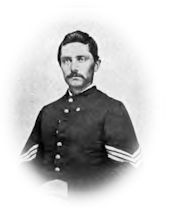
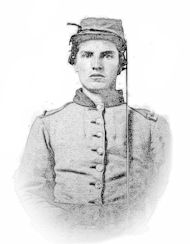
(Note: picture is of an unidentified Confederate soldier.)

June 7—At 11 o’clock to-night we were roused out of our sleep and marched to Weldon Bridge, as the river was so swift that it was thought the bridge would wash away. We went there to knock the sides off, so that the water could run over it, but we got there without tools. When they came the water was receding, so we returned to camp.