2d, 3d, 4th.—Taking my ease and riding about the camps, not having received any further orders as to duty. The army remains in “statu quo,” the large hospital, or rather its patients, in suffering state, though Surgeon Jayne seems to be using every effort to improve the condition of things.
June 2012
June 4—Still raining, and the roads are very muddy.
June 4th. Yesterday and to-day very hot, reminding us forcibly that summer has come. On account of the continued rain it is very unpleasant. The pickets keep up a continuous fire night and day, and do a good deal of execution; it is a very dangerous duty, particularly for officers, who are picked off by sharpshooters, in preference to the men. Towards evening, we received orders to fall in, and hold ourselves ready for action, the enemy having been seen forming columns of attack; nothing, however, materialized, so we stacked arms, and lay down in rear of them. About 7 P.M. it rained hard, flooding the ground we lay on, but we were obliged to remain throughout the night, the general refusing to let us budge.
Some of the hurried notes in the small blank books we carried about with us (G’s tied to her belt) are characteristic, and somewhat mixed at the distance of 36 years.
“78 pillow-cases, and 4 mattresses. Whiskey for 10, brandy for 4. W. T., 49th Ga., Co. D. C.G., both legs; handkerchiefs, arrowroot, bay-rum. V. W., shoulder off, 17 Cedar St. E. D., lowest berth; Waters, top berth.”
And in the midst of it this note:
“To Mrs. I., 3 Milligan Place.
My dear Mother: You must not be anxious about me as I am not wounded, only sick. I was not in the battle because I was not strong enough to hold my gun. The battle began Sunday while I was in bed. We had to jump up and take our arms. I asked the lieutenant to let me fall out; he said I might, and stay there. The rebels came right up to the pits. Our men began to retreat very fast, and one came and told me to get up or I would be taken prisoner. So the doctor sent me down in the woods. Three nights I had nothing to cover me, slept just under the dew. The doctor put me on the cars and I was brought to White House. I am lying now in better condition and being better taken care of.”— Beef essence, tea, oranges” —! Etc., etc. etc.
We used to say :
“In the great history of the land
A lady with a flask shall stand.”
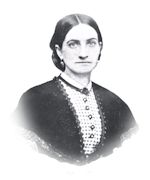
June 4. [Okolona, Mississippi]—This place is filled with strangers; the rear of the army being here— quartermasters, commissaries, etc. Mrs. T.’s house is like a hotel; the men walk into it without asking any questions, sit down at the table, take what they want, and some times they pay. Mrs. T. has not the heart to prevent it, as the men seem to be so hungry.
Dr. H. introduced me to Colonel Hunt, of the Ninth Kentucky Regiment. He is a very handsome man, and is an uncle of John Morgan’s.
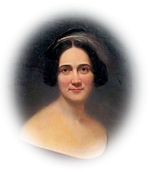
June 4th.—Battles occur near Richmond, with bombardment of Charleston. Beauregard is said to be fighting his way out or in.
Mrs. Gibson is here, at Doctor Gibbes’s. Tears are always in her eyes. Her eldest son is Willie Preston’s lieutenant. They are down on the coast. She owns that she has no hope at all. She was a Miss Ayer, of Philadelphia, and says, “We may look for Burnside now, our troops which held him down to his iron flotilla have been withdrawn. They are three to one against us now, and they have hardly begun to put out their strength—in numbers, I mean. We have come to the end of our tether, except we wait for the yearly crop of boys as they grow up to the requisite age.” She would make despondent the most sanguine person alive. “As a general rule,” says Mrs. Gibson, “government people are sanguine, but the son of one high functionary whispered to Mary G., as he handed her into the car, ‘Richmond is bound to go.'” The idea now is that we are to be starved out. If they shut us in, prolong the agony, it can then have but one end.
Mrs. Preston and I speak in whispers, but Mrs. McCord scorns whispers, and speaks out. She says: “There are our soldiers. Since the world began there never were better, but God does not deign to send us a general worthy of them. I do not mean drill-sergeants or military old maids, who will not fight until everything is just so. The real ammunition of our war is faith in ourselves and enthusiasm in our cause. West Point sits down on enthusiasm, laughs it to scorn. It wants discipline. And now comes a new danger, these blockade-runners. They are filling their pockets and they gibe and sneer at the fools who fight. Don’t you see this Stonewall, how he fires the soldiers’ hearts; he will be our leader, maybe after all. They say he does not care how many are killed. His business is to save the country, not the army. He fights to win, God bless him, and he wins. If they do not want to be killed, they can stay at home. They say he leaves the sick and wounded to be cared for by those whose business it is to do so. His business is war. They say he wants to hoist the black flag, have a short, sharp, decisive war and end it. He is a Christian soldier.”
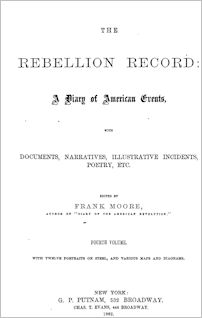
June 4.—Major-General Halleck reported to the Secretary of War that General Pope, with forty thousand men, was thirty miles south of Florence, Alabama, pushing the enemy hard; that he had ten thousand prisoners and deserters from the enemy, and fifteen thousand stand of arms captured. Also that nine locomotives and a number of cars were captured.—(Doc. 131.)
—Fort Pillow, otherwise called Fort Wright, on the Mississippi River, was evacuated by the rebels. After the occupation of the Fort, the Union gunboat fleet steamed directly to Memphis.—(Doc. 54.)
—Jeff Davis threatened retaliation in the case of Major W. Van Benthuysen, who had been arrested by Gen. Butler, at New-Orleans, “for aiding the escape of a scoundrel and spy.”
—Brig.-general J. T. Boyle, headquarters in Louisville, assumed command of the National troops in Kentucky this morning.
—A fight occurred near Jasper, Tenn., between a body of Union troops under the command of Gen. Negley, and a large force of rebel cavalry under Gen. Adams, which resulted in a complete rout of the rebels, with great loss.— (Doc. 55.)
—Sixteen hundred of Gen. Prentiss’s troops, who were taken prisoners at the battle of Pittsburgh Landing, arrived at Nashville, Tenn., they having been paroled by the rebel authorities, “in consequence of their being unable to feed them.” —Nashville Union, June 5.
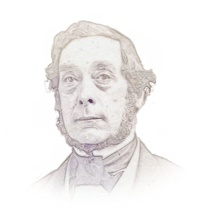
JUNE 3D.—Gen. Lee henceforth assumes command of the army in person. This may be hailed as the harbinger of bright fortune.
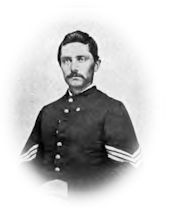
Tuesday, 3d—The weather is very hot. We have no picket duty now, but get plenty of exercise by regular drills, having company drill twice a day. We also get exercise in keeping the camp clean; have to sweep it every morning.
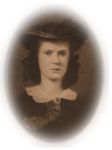
Baton Rouge, June 3d.
Well! Day before yesterday, I almost vowed I would not return, and last evening I reached here. Verily, consistency, thou art a jewel! I determined to get to town to lay both sides of the question before mother; saving home and property, by remaining, thereby cutting ourselves off forever from the boys and dying of yellow fever; or flying to Mississippi, losing all save our lives. So as Mrs. Brunot was panic-stricken and determined to die in town rather than be starved at Greenwell, and was going in on the same wagon that came out the night before, I got up with her and Nettie, and left Greenwell at ten yesterday morning, bringing nothing except this old book, which I would rather not lose, as it has been an old and kind friend during these days of trouble. At first, I avoided all mention of political affairs, but now there is nothing else to be thought of; if it is not burnt for treason, I will like to look it over some day — if I live. I left Greenwell, without ever looking around it, beyond one walk to the hotel, so I may say I hardly know what it looks like. Miriam stayed, much against her will, I fear, to bring in our trunks, if I could send a wagon.
A guerrilla picket stopped us before we had gone a mile, and seemed disposed to turn us back. We said we must pass; our all was at stake. They then entreated us not to enter, saying it was not safe. I asked if they meant to burn it; “We will help try it,” was the answer. I begged them to delay the experiment until we could get away. One waved his hat to me and said he would fight for me. Hope he will — at a distance. They asked if we had no protectors; “None,” we said. “Don’t go, then”; and they all looked so sorry for us. We said we must; starvation, and another panic awaited us out there, our brothers were fighting, our fathers dead; we had only our own judgment to rely on, and that told us home was the best place for us; if the town must burn, let us burn in our houses, rather than be murdered in the woods. They looked still more sorry, but still begged us not to remain. We would, though, and one young boy called out as we drove off, “What’s the name of that young lady who refused the escort?” I told him, and they too expressed the greatest regret that she had not accepted. We met many on the road, nearly all of whom talked to us, and as they were most respectful in their manner (though they saw us in a mule team!), we gave them all the information we could, which was all news to them, though very little. Such a ride in the hot sun, perched up in the air! One of the servants remarked, “Miss Sarah ain’t ashamed to ride in a wagon!” With truth I replied, “No, I was never so high before.”
Two miles from home we met the first Federal pickets, and then they grew more numerous, until we came on a large camp near our graveyard, filled with soldiers and cannon. From first to last none refrained from laughing at us; not aloud, but they would grin and be inwardly convulsed with laughter as we passed. One laughed so comically that I dropped my veil hastily for fear he would see me smile. I could not help it; if any one smiled at me while I was dying, I believe I would return it. We passed crowds, for it was now five o’clock, and all seemed to be promenading. There were several officers standing at the corner, near our house, who were very much amused at our vehicle. I did not feel like smiling then. After reducing us to riding in a mule team, they were heartless enough to laugh! I forgot them presently, and gave my whole attention to getting out respectably. Now getting in a wagon is bad enough; but getting out —! I hardly know how I managed it. I had fully three feet to step down before reaching the wheel; once there, the driver picked me up and set me on the pavement. The net I had gathered my hair in, fell in my descent, and my hair swept down halfway between my knee and ankle in one stream. As I turned to get my little bundle, the officers had moved their position to one directly opposite to me, where they could examine me at leisure. Queens used to ride drawn by oxen hundreds of years ago, so I played this was old times, the mules were oxen, I a queen, and stalked off in a style I am satisfied would have imposed on Juno ,herself. When I saw them as I turned, they were perfectly quiet; but Nettie says up to that moment they had been in convulsions of laughter, with their handkerchiefs to their faces. It was not polite!
I found mother safe, but the house was in the most horrible confusion. Jimmy’s empty cage stood by the door; it had the same effect on me that empty coffins produce on others. Oh, my birdie! At six, I could no longer stand my hunger. I had fasted for twelve hours, with the exception of a mouthful of hoe-cake at eleven; I that never fasted in my life! — except last Ash Wednesday when Lydia and I tried it for breakfast, and got so sick we were glad to atone for it at dinner. So I got a little piece of bread and corn beef from Mrs. Daigre’s servant, for there was not a morsel here, and I did not know where or what to buy. Presently some kind friend sent me a great short-cake, a dish of strawberry preserves, and some butter, which I was grateful for, for the fact that the old negro was giving me part of her supper made me rather sparing, though she cried, “Eat it all, honey! I get plenty more!”
Mother went to Cousin Will’s, and I went to Mrs. Brunot’s to sleep, and so ended my first day’s ride on a mule team. Bah! A lady can make anything respectable by the way she does it! What do I care if I had been driving mules? Better that than walk seventeen miles.
I met Dr. DuChêne and Dr. Castleton twice each, this morning. They were as kind to me as they were to the girls the other day. The latter saved them a disagreeable visit, while here. He and those three were packing some things in the hall, when two officers passed, and prepared to come in, seeing three good-looking girls seemingly alone, for Miriam’s dress hid Dr. Castleton as he leaned over the box. Just then she moved, the Doctor raised his head, and the officers started back with an “Ah!” of surprise. The Doctor called them as they turned away, and asked for a pass for the young ladies. They came back bowing and smiling, said they would write one in the house, but they were told very dryly that there were no writing accommodations there. They tried the fascinating, and were much mortified by the coldness they met. Dear me! “Why was n’t I born old and ugly?” Suppose I should unconsciously entrap some magnificent Yankee! What an awful thing it would be!!
Sentinels are stationed at every corner; Dr. Castleton piloted me safely through one expedition; but on the next, we had to part company, and I passed through a crowd of at least fifty, alone. They were playing cards in the ditch, and swearing dreadfully, these pious Yankees; many were marching up and down, some sleeping on the pavement, others picking odious bugs out of each other’s heads! I thought of the guerrillas, yellow fever, and all, and wished they were all safe at home with their mothers and sisters, and we at peace again.
What a day I have had! Here mother and I are alone, not a servant on the lot. We will sleep here to-night, and I know she will be too nervous to let me sleep. The dirt and confusion were extraordinary in the house. I could not stand it, so I applied myself to making it better. I actually swept two whole rooms! I ruined my hands at gardening, so it made no difference. I replaced piles of books, crockery, china, that Miriam had left packed for Greenwell; I discovered I could empty a dirty hearth, dust, move heavy weights, make myself generally useful and dirty, and all this is thanks to the Yankees! Poor me! This time last year I thought I would never walk again! If I am not laid up forever after the fatigue of this last week, I shall always maintain I have a Constitution. But it all seems nothing in this confusion; everything is almost as bad as ever. Besides that, I have been flying around to get Miriam a wagon. I know she is half distracted at being there alone. Mother chose staying with all its evils. Charlie’s life would pay the penalty of a cotton burner if he returned, so Lilly remains at Greenwell with him. We three will get on as best we can here. I wrote to the country to get a wagon, sent a pass from Headquarters, but I will never know if it reached her until I see her in town. I hope it will; I would be better satisfied with Miriam.


