Following the American Civil War Sesquicentennial with day by day writings of the time, currently 1863.

June 2012

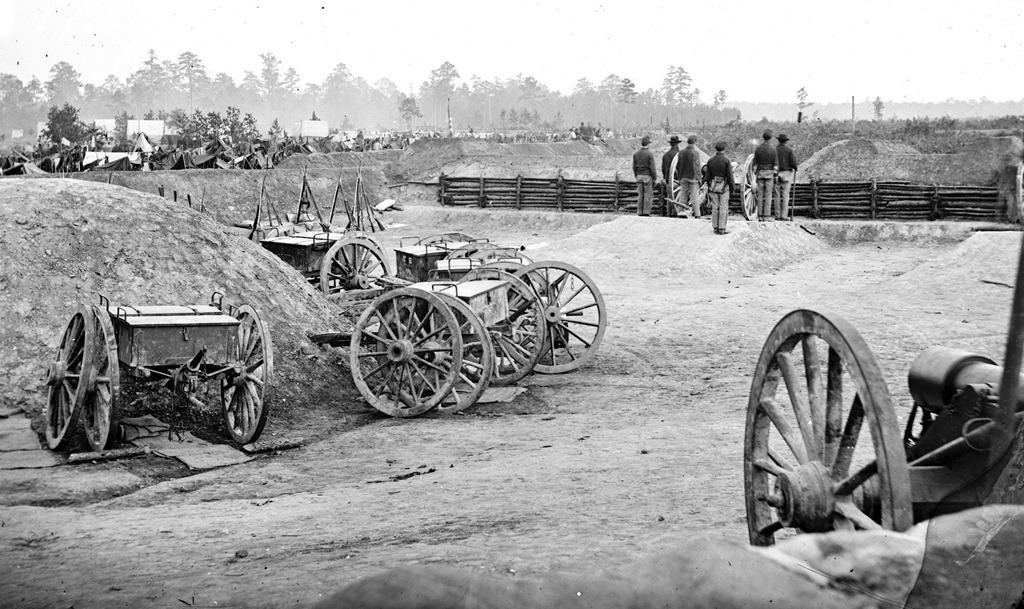
Fair Oaks, Va., vicinity. Fort Richardson and adjacent encampment, Knapp Pa. Battery

Title: Fair Oaks, Va., vicinity. Fort Richardson and adjacent encampment.

[This was a temporary fort.  A more permanent Fort Richardson was part of the defenses of Washington City, with much more impressive weaponry.  A stereograph from this negative, identifies the battery as “Knapp Pa. Battery, Fair Oaks, Va.” along with the name “William Pinkerton”, both written in hand on the back.]

Photographer: George N. Barnard

  • Photograph from the main eastern theater of war, the Peninsular Campaign
  • Civil War photographs, 1861-1865 / compiled by Hirst D. Milhollen and Donald H. Mugridge, Washington, D.C.
  • Title from Milhollen and Mugridge.Civil War glass negative collection.  Library of Congress Prints and Photographs Division Washington, D.C. 20540 USA

    Record page for this image: http://www.loc.gov/pictures/item/cwp2003000072/PP/

Headquarters 5th Prov. Army Corps,

Camp near New Bridge, June 4, 1862.

Dear Father, — Here we are still and here we shall probably stay for a few days, until the rain has exhausted itself, and the banks of the Chickahominy have peeped above the surrounding waters. I begin to think we shall have to get an ark built if the rain continues. Every night regularly we have terrible thunder-storms, which last the whole night, and at morning it clears up again. This has happened for four successive nights, and last night it culminated in an easterly storm, which bids fair to last some time. My tent resembles Fortress Monroe in one respect. It has a deep ditch of water all around it, which has lately been pretty full. In one respect this rain is peculiarly unfortunate. It delays our advance to Richmond, where we should have been two days ago, were it not for this dirty little stream of a Chickahominy which the rain swells up so as to make it impassable. The roads to the river are streams of mud and water which no corduroying can remedy, and which dry weather and the sun can alone make passable. In some places the roads to the bridges are covered with water four or five feet deep, with a nice mud bottom. All we can do is to wait patiently. The general says that it seems almost as if Providence connived at the escape of the rebels, for we should have bagged a good lot of them if we could have crossed the other day.

General McClellan has issued an address which I send to you, and which I want to be kept. It has the true ring to it, and was greeted by many and loud cheers from the soldiers, to whom it was read yesterday on dress-parade.

The roads here are in a shocking condition. I went out yesterday in a light wagon, foraging, and rode some twelve miles. In many places the horses were up to their bellies in mud, and at times down we would go in the quicksand or in some deceptive hole, covered with water. I got, however, some fresh butter, chickens, strawberries, cherries, onions, lettuce, and eggs. We manage to get on very well in the eating line.

That Stanton is a bitter old rascal. He suppressed some dispatches of the Associated Press agent containing an account of the battle of Hanover C. House, and only allowed a meagre telegram to appear. It was meant as a hit at General McClellan and General Porter, who have some personal enemies in Washington. I think that General McClellan has shown his greatness in the way he has borne all his ill-treatment. Not a word of complaint has he uttered. Stanton has prolonged the war by his meddling and interference, and has shown himself a bitter and unfair man. He has prevented McClellan from receiving reinforcements, and delayed him in every way possible. . . .

JUNE 4TH.—Col. Bledsoe sent word to me to-day by my son that he wished to see me. When I met him he groaned as usual, and said the department would have to open another passport office, as the major-generals in the field refused to permit the relatives of the sick and wounded in the camps to pass with orders from Brig.-Gen. Winder or his Provost Marshal.

Wednesday, 4th—Nothing of importance. Some of the troops are returning to Pittsburg Landing, a part of them to go down the Tennessee river and then up the Cumberland to reinforce the army in eastern Tennessee, and the others are to join the forces going down the Mississippi.

June 4th.

Miriam and Mattie drove in, in the little buggy, last evening after sunset, to find out what we were to do. Our condition is desperate. Beauregard is about attacking these Federals. They say he is coming from Corinth, and the fight will be in town. If true, we are lost again. Starvation at Greenwell, fever and bullets here, will put an end to us soon enough. There is no refuge for us, no one to consult. Brother, whose judgment we rely on as implicitly as we did on father’s, we hear has gone to New York; there is no one to advise or direct us, for, if he is gone, there is no man in Louisiana whose decision I would blindly abide by. Let us stay and die. We can only die once; we can suffer a thousand deaths with suspense and uncertainty; the shortest is the best. Do you think the few words here can give an idea of our agony and despair? Nothing can express it. I feel a thousand years old to-day. I have shed the bitterest tears to-day that I have shed since father died. I can’t stand it much longer; I’ll give way presently, and I know my heart will break. Shame! Where is God? A fig for your religion, if it only lasts while the sun shines! “Better days are coming” — I can’t!

Troops are constantly passing and repassing. They have scoured the country for ten miles out, in search of guerrillas. We are here without servants, clothing, or the bare necessaries of life: suppose they should seize them on the way! I procured a pass for the wagon, but it now seems doubtful if I can get the latter — a very faint chance. Well! let them go; our home next; then we can die sure enough. With God’s help, I can stand anything yet in store for me. “I hope to die shouting, the Lord will provide!” Poor Lavinia! if she could only see us! I am glad she does not know our condition.

5 P.M.

What a day of agony, doubt, uncertainty, and despair! Heaven save me from another such! Every hour fresh difficulties arose, until I believe we were almost crazy, every one of us.

As Miriam was about stepping in the buggy, to go to Greenwell to bring in our trunks, mother’s heart misgave her, and she decided to sacrifice her property rather than remain in this state any longer. After a desperate discussion which proved that each argument was death, she decided to go back to Greenwell and give up the keys of the house to General Williams, and let him do as he pleased, rather than have it broken open during her absence. Mattie and Mr. Tunnard were present at the discussion, which ended by the latter stepping in the buggy and driving Miriam to the Garrison. General Williams called her by name, and asked her about Major Drum. It seems all these people, native and foreign, know us, while we know none. Miriam told him our condition, how our brothers were away, father dead, and mother afraid to remain, yet unwilling to lose her property by going away; how we three were alone and unprotected here, but would remain rather than have our home confiscated. He assured her the house should not be touched, that it would be respected in our absence as though we were in it, and he would place a sentinel at the door to guard it against his own men who might be disposed to enter. The latter she declined, but he said he would send his aide to mark the house, that it might be known. A moment after they got back, the aide, Mr. Biddle (I have his name to so many passes that I know it now), came to the door. Mr. Tunnard left him there, uncertain how we would receive a Christian, and I went out and asked him in. He looked uncertain of his reception, too, when we put an end to his doubt by treating him as we invariably treat gentlemen who appear such. He behaved remarkably well under the trying circumstances, and insisted on a sentinel; for, he said, though they would respect the property, there were many bad characters among the soldiers who might attempt to rob it, and the sentinel would protect it. After a visit of ten minutes, devoted exclusively to the affair, he arose and took his leave, leaving me under the impression that he was a gentleman wherever he came from, even if there were a few grammatical errors in the pass he wrote me yesterday; but “thou that judgest another, dost thou sin?”

Well, now we say, fly to Greenwell. Yes! and by to-night, a most exaggerated account of the whole affair will be spread over the whole country, and we will be equally suspected by our own people. Those who spread useless falsehoods about us will gladly have a foundation for a monstrous one. Did n’t Camp Moore ring with the story of our entertaining the Federal officers? Did n’t they spread the report that Miriam danced with one to the tune of “Yankee Doodle” in the State House garden? What will they stop at now? O! if I was only a man, and knew what to do!

Night.

We were so distressed by the false position in which we would be placed by a Federal sentinel, that we did not know what course to pursue. As all our friends shook their heads and said it was dangerous, we knew full well what our enemies would say. If we win Baton Rouge, as I pray we will, they will say we asked protection from Yankees against our own men, are consequently traitors, and our property will be confiscated by our own Government. To decline General Williams’s kind offer exposes the house to being plundered. In our dilemma, we made up our minds to stay, so we could say the sentinel was unnecessary.

Presently a file of six soldiers marched to the gate, an officer came to the steps and introduced himself as Colonel McMillan, of 21st Indiana Volunteers. He asked if this was Mrs. Morgan’s; the General had ordered a guard placed around the house; he would suggest placing them in different parts of the yard. “Madam, the pickets await your orders.” Miriam in a desperate fright undertook to speak for mother, and asked if he thought there was any necessity. No, but it was an additional security, he said. “Then, if no actual necessity, we will relieve you of the disagreeable duty, as we expect to remain in town,” she said. He was very kind, and discussed the whole affair with us, saying when we made up our minds to leave, — we told him after we could not decide, — to write him word, and he would place a guard around to prevent his men and the negroes from breaking in. It was a singular situation: our brothers off fighting them, while these Federal officers leaned over our fence, and an officer standing on our steps offered to protect us. These people are certainly very kind to us. General Williams especially must be a dear old gentleman; he is so good.

How many good, and how many mean people these troubles have shown us! I am beginning to see my true friends, now; there is a large number of them, too. Everybody from whom we least expected attention has agreeably surprised us. . . .

General Williams will believe we are insane from our changing so often.

His guard positively refused.
June 4 — Rained all last night and tc-day. At four o’clock this evening a report reached camp that the Yanks were advancing. We went half a mile below New Market, took a position and remained there till nearly dark, then moved back a mile south of town and camped. The Yankees crossed the river this evening in boats, where we burnt the bridge yesterday.

To Mrs. Lyon.

Booneville, 25 miles south of Corinth, June 4,1862. —We marched until midnight last night. I don’t know what we are here for or where the enemy is. I am very weary. I have not been in camp for over a week, yet I keep well. It is singular that the rebel army has twice as much sickness as we have, and they are accustomed to the climate and we are not. I saw Spud Smith, who told me all about you and the pets. It was a great comfort to me.

4th. Wednesday. Reveille at 3:30 A. M. Breakfast and under way at 6 A. M. After riding ten miles, troops rested. Lieutenant Lisering of Doubleday’s staff met us with the news that Col. Salomon had been made brigadier and Col. Weir of the Tenth Kansas had the command of the expedition. All seemed astonished. Lt. Colonel said, “the news rather surprised him.” Considerable sensation. Crossed the Neosho and encamped near the rest of the troops. A very pretty situation for a camp. A range of hills, overlooking large valley and woods.

Headquarters 2d Brigade,
Nor. Dist. Dept. Of The South,

James Island, June 4th, 1862.

My dear Mother:

I must write a few lines to inform you of my continued welfare, although we are now actually in the field. We have had much skirmishing the past few days and some small losses. I got in a bog yesterday, lost my horse, and had a hot time of it escaping. I will give you the particulars, when I have time to be minute. I cannot say how soon the engagement will become general. We have a young prisoner with us named Henry Walker, who was a Lieutenant in Sam Lord’s Company. He reports Capt. Lord on the island. Alfred Tyler is also here. Tell Cousin Louisa, Lord is still by no means rabid in his secession sentiments. He talks still of some Northern cousin of his, older than himself, and with children now almost old enough for him to marry, but who was an old sweetheart of his, and for her sake he has a kindly feeling toward all the people of the North. He does not think he cares to hang all Yankees, but credits them with virtues not generally admitted by devotees of secession. Lord has lost a cousin lately — a Mrs. Walker, I think — only a short time married. I do not doubt that all this will interest Cousin Louisa and Horace.

This letter is short, but I trust satisfactory, as I have good health and spirits to communicate. I have received Lilly’s letter, and will send no messages to her until I can answer it at length. May she be very happy though, should the chances and perils of war forbid our meeting again. Good-bye, many times good-bye.

Love to all the dear friends who have always been so kind to me.

Next I shall hope to write from Charleston.

Very affec’y;

Will.

“Wilson Small,” June 4.

Dear Mother, — I write a line — only a line — that you may not be anxious: you can’t conceive under what circumstances. I am perfectly well. I have no time to write, no power to withdraw myself from my surroundings enough to write.

Conceive of the Medical Director sending down over four thousand five hundred wounded men without — yes, almost literally without— anything for them: without surgeons; no one authorized to take charge of them; nothing but empty boats to receive them.

Of course the Commission throws itself in and does all. Mr. Olmsted is everything, — wise, authoritative, untiring; but he must break down. You can’t conceive what it is to stem the torrent of this disorder and utter want of organization. We are all well, and can only thank God that we are here, with health, strength, and head. To think or speak of the things we see would be fatal. No one must come here who cannot put away all feeling. Do all you can, and be a machine,—that’s the way to act; the only way.

Good-by! No head to write more: Mr. Olmsted, Mr. Knapp, and I are sitting on the floor, resting, with a pitcher of lemonade between us. My cases have arrived — oh, so thankful! Thank that good Newport for me.