Following the American Civil War Sesquicentennial with day by day writings of the time, currently 1863.

June 2012

To Mrs. Lyon.

Camp Clear Creek, Miss., Sunday, June 28.—The boys are usually well, but I have quite a number sick at the hospital ten miles back, none dangerously. Out of 63 men here, all, except three or four, are fit for duty, and none of them are very sick; yet I notice that when a man gets sick here it takes a long time for him to recover his strength again, but the men have to stay right here and do the best they can. There are but few paroles now granted to either officers or enlisted men, and it has become almost impossible for an enlisted man to get a discharge. An officer can only get his resignation accepted on account of sickness. Many of our regiment have been taken sick and resigned since we came up the Tennessee. I think this climate well adapted to my constitution, and I have no fear of being sick, neither have I the least disposition to leave the service until this rebellion is put down. When that will be, God only knows; but I do not despair of getting home next fall. I see no prospect of any more fighting this summer, if ever.

We are under marching orders to leave in an hour. I do not know to what point we are going, but I hear it is Ripley, a place west of here and south of Grand Junction, on the Miss. Cent. R. R.

28th. Saturday. Got my horse shod. A good many ladies in camp. Straightened the provision returns and wrote letter to Fannie, and sent them by Corp. I., Co. M. Didn’t get to bed till 12 P. M.

“Wilson Small,” Off Fortress Monroe,
Saturday, June 28.

Dear A., — You will see my letter to mother, which gives an account of the removal of the depot at White House. We left last evening at the last moment, and rendezvoused for the night off West Point. Captain Sawtelle sent us off early from there with despatches for Fortress Monroe. This gave us the special fun of being the first to come leisurely into the panic then raging at Yorktown. The “Small” was instantly surrounded by terror-stricken boats; the people of the big “St. Mark” leaned over their bulwarks to question us. Nothing could be more delightful than to be as calm and monosyllabic as we were, — partly from choice, and partly under orders from Colonel Ingalls. They knew nothing, except the fact that the enemy had possession of White House. It seems that General Van Alen, commanding at Yorktown, had telegraphed to Colonel Ingalls after we left White House, and received from our successors a polite request to “go to —”

We find no news here at the Fortress. We hoped to meet some from the James River; but, on the contrary, it is we who have brought all the news as yet. Our eyes are strained towards the James, and every time a black hull shows in that direction we are feverish with anxiety and hope. The universal feeling here is that this movement of McClellan’s is a grand stroke to wring a triumph out of adverse circumstances. I feel it is so. “What profit lies in barren faith?” was the thought I fell asleep with and dreamed of all night.

Meantime we are here in Hampton Roads, breathing life in the salt air. May I never see the pretty poisonous Pamunky again! Keep my room ready for me; I may be home any day. Oh, to sleep in a bed once more! It seems too great a rest ever to be reached. I am writing on the upper deck at 3 A. M., looking out upon the dawn, which slowly shows me, one by one, the places we have read of, — the Rip-Raps, Sewall’s Point, Craney Island, and the ruins of the old church at Hampton.[1]


[1] How well I remember the night when this letter was written, and the feelings which were not expressed in it! Our minds had been strained to the utmost, and the disappointment and uncertainty striking sharply upon them were more than we could bear. I remember well what a dreadful day we passed off Fortress Monroe. At night I could not sleep, but went out and sat on the deck and wrote by the light of my lantern, and wondered if my mind were leaving me, and whether it would right itself again.

28th.—This morning opened brightly and beautifully; the elements calm and peaceful—not so the passions of the parties, for we on the right bank, where the enemy attacked us and were repulsed last night, were again attacked in our little fort by Toombs’ Brigade—Toombs in person leading it on. He was repulsed with considerable loss, whilst we suffered but little.

Our army had now abandoned the field on the left bank, leaving the enemy free access to our base, and we were massing our forces on the Richmond side of the river. But whilst our defeat on the left admitted our enemy to our supplies, their repulse on the right did not, as we had hoped, admit us to Richmond. The necessity of a general retreat is now becoming evident to the men, though nothing is heard on the subject from our officers. At 10 A. M. our right (Hancock’s Brigade) moved its quarters about a mile and a half professedly to get out of the reach of the enemy’s shells, which were falling and exploding in the midst of our camp. My opinion is that the real object of the move is the massing of our men preparatory to a general retreat. Our troops to-night are very much worn out. The rejoicing all night of the 26th, at the report of the “thorough whipping” of Stonewall Jackson, repulse on the north side, and the night fight of the south side on the 27th, the morning fight of this day, with the subsequent marching and moving of camps, being all the time on short allowance, is telling sorely on the energies of the men. The losses of yesterday to the two parties cannot have been less than 25,000 to 30,000 men.

Eliza Woolsey Howland’s Journal.

June 28th. We went as far as West Point, followed by a train of schooners and barges running away like ourselves. There we lay through the evening and night, watching for the flames of burning stores at White House which did not burn, and for booming of guns which did not boom—without news or orders, until after dinner, when we turned and ran up the river again in search of both. Near Cumberland we met the Arrowsmith with Surgeon Vollum on board, who hailed us and told us all we yet know of yesterday’s action at the front. Colonel Vollum then pushed on to Washington for medical supplies and we kept on up here to White House again.


We little knew at the time that “yesterday’s action at the front,” to which E. alludes so quietly, was the desperate battle of Gaines’ Mill, June 27, 1862, the first of the terrible seven days’ battle before Richmond. It was in this action that [Eliza’s husband] J. H. was wounded at the head of his regiment. His commanding officer (General J. J. Bartlett) said, in his official report of the battle: “The enemy were slowly but surely forcing back the right of the entire line of battle. At this juncture I ordered forward the 16th New York Volunteers, Colonel Howland commanding. From the position of the regiment it was necessary to change front forward on first company under the most terrific fire of musketry, with the shells and round shot of two batteries raking over the level plain, making it seemingly impossible for a line to withstand the fire a single instant. But with the calmness and precision of veteran soldiers the movement was executed. . . . To Colonel Joseph Howland I am indebted for maintaining the extreme right of my line, for nobly leading his regiment to the charge and retaking two guns from the enemy. Whatever of noble moral, physical and manly courage has ever been given by God to man, has fallen to his lot. Cheering his men to victory, he early received a painful wound, but with a heroism worthy of the cause he has sacrified so much to maintain, he kept his saddle until the close of the battle.”

Lieutenant-Colonel Marsh of the 16th was mortally wounded in this engagement at Gaines’ Mill, and apart from the Colonel and Lieutenant-Colonel, the loss of the regiment in killed and wounded was 260 men, rank and file, fully one-quarter of its effective force on that day.

It was “for gallantry at the battle of Gaines’ Mill, Virginia,” that the rank of Brigadier-General by brevet was later conferred on J. H. by the President of the United States.

When the battle at Gaines’ Mill was all over and Joe began to realize his own fatigue and wounded condition, he dismounted and lay down under a tree not far from the field, and presently fell asleep. He did not know how long he had slept, but it was dusk when he was waked by something soft touching his cheek, and rousing himself he found it was his war horse, old “Scott,” rubbing his nose against his face. He had got loose from where he was tied and had looked for his master until he found him. Joe was not ashamed to say that he cried like a child as he put his arm round the dear old fellow’s neck.

He brought him home and rode him after the war until he grew to be old and no longer sure-footed. Then his shoes were taken off and he was turned out to grass to have an easy time and nothing to do the rest of his life. After a little, however, he moped and refused to eat and was evidently dissatisfied with life. So Thomson came to Joe and said, “Do you know, Mr. Howland, I believe old Scott would be happier if he had something to do.” And accordingly, although he had never been in harness in his life, he was put before the lawn-mower, and to do active light farm-work. The effect was excellent; he grew happy and contented again, and proved to be one of the best working-horses on the farm for several years.

It was Scott’s last shoes as a saddle-horse, when he was turned out to grass, that we mounted and hung in the office at our Fish-kill home.

The news of J.’s being wounded reached us at White House through a telegram kindly sent the morning after the battle by Dr. McClellan, Staff Surgeon at Army Headquarters, as follows: “The Colonel has a slight flesh wound. He is in my tent, and will be taken good care of until he can be sent down.”

At almost the same moment communication with the front was cut. We telegraphed for more details, in vain. The rebels were upon us. Stoneman sent in word that they were in sight. We stayed as long as they would let us and then went off into the dark, taking what comfort we could in the one word, “slight.”

28th.—The casualties among our friends, so far, not very numerous. My dear R. T. C. is here, slightly wounded; he hopes to return to his command in a few days. Colonel Allen, of the Second Virginia, killed. Major Jones, of the same regiment, desperately wounded. Wood McDonald killed. But what touches me most nearly is the death of my young friend, Clarence Warwick, of this city. Dearly have I loved that warm-hearted, high-minded, brave boy, since his early childhood. To-night I have been indulging sad memories of his earnest manner and affectionate tones, from his boyhood up; and now what must be the shock to his father and brothers, and to those tender sisters, when to-morrow the telegraph shall tell them of their loss! His cousin, Lieutenant-Colonel Warwick, is desperately wounded. Oh, I pray that his life may be spared to his poor father and mother! He is so brave and skilful an officer that we cannot spare him, and how can they? The booming of cannon still heard distinctly, but the sound is more distant.

Saturday, 28th.—Got furlough for thirty days, dated June 24th; was sent to me from Knoxville.


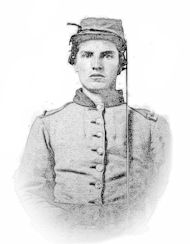
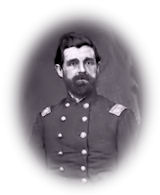
(Note: picture is of an unidentified Confederate soldier.)

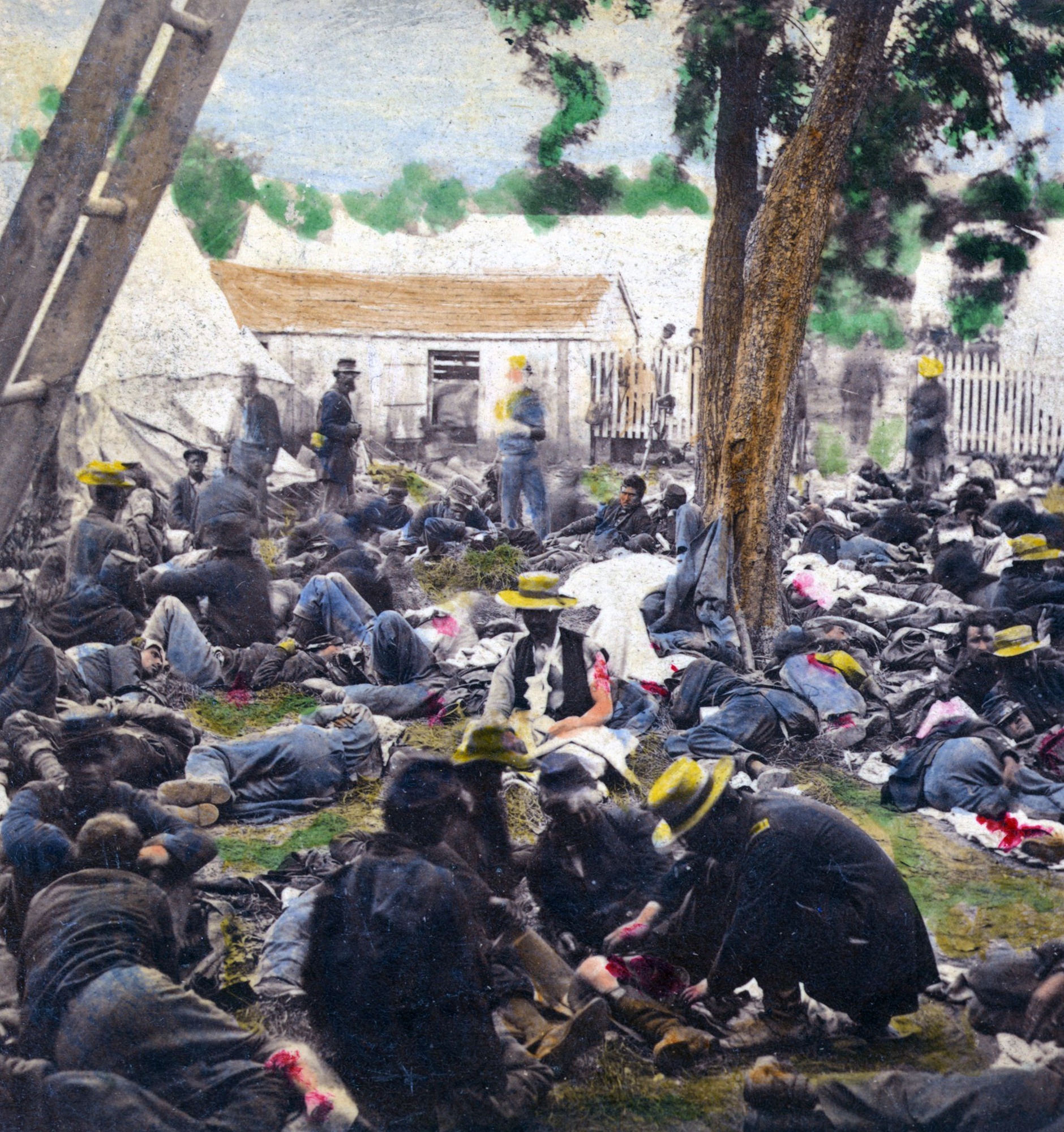
Wounded at Savage’s Station – Hand-colored photo.

From Library of Congress:

Summary: Photo shows a makeshift field hospital with wounded soldiers sitting and lying on the ground while some receive care. Includes the straw-hatted Sixteenth New York Infantry who fought at Gaines’ Mill on June 27. Most were captured when Confederates overtook the area during the battle of Savage’s Station on June 29. (Source: Bob Zeller, Civil War in Depth, v. 1, p. 34)

Photographed by James F. Gibson

Civil War Photograph Collection.  Library of Congress Prints and Photographs Division Washington, D.C.

Record page for this image: http://www.loc.gov/pictures/item/2011646181/

__________

Note: I used a photo editor to correct for fading, crop, and digitally enhance the image.

June 28, 1862.

IT seems almost incredible that this fine army, planted solidly, so near Richmond that the ringing of the bells within the city can be distinctly heard in its camps, should give up the task, surrender its magnificent works, much of its immense supplies, and undertake a difficult and dangerous movement, without making one supreme effort to accomplish its original purpose. Such is the determination of the general commanding however, and our great expectations are frustrated and in the judgment of most of us, without sufficient cause. The whole army is disgusted, and greatly disappointed; much more anxious to fight than retreat, and ready on the instant to make a dash forward at the signal of its commander, however, “Ours not to reason why.” Throughout the 28th there was a complete lull; the enemy apparently loth to follow up his success, probably from his astonishment at our withdrawing from the Gaines’ Mill position. The delay on his part was of the greatest importance to us as it gave the teams and impedimenta time to get well ahead. We remained under arms during the day, and throughout the night, but did not move.

June 28th.—Victory! Victory heads every telegram now;¹ one reads it on the bulletin-board. It is the anniversary of the battle of Fort Moultrie. The enemy went off so quickly, I wonder if it was not a trap laid for us, to lead us away from Richmond, to some place where they can manage to do us more harm. And now comes the list of killed and wounded. Victory does not seem to soothe sore hearts. Mrs. Haskell has five sons before the enemy’s illimitable cannon. Mrs. Preston two. McClellan is routed and we have twelve thousand prisoners. Prisoners! My God! and what are we to do with them? We can’t feed our own people.

For the first time since Joe Johnston was wounded at Seven Pines, we may breathe freely; we were so afraid of another general, or a new one. Stonewall can not be everywhere, though he comes near it.

Magruder did splendidly at Big Bethel. It was a wonderful thing how he played his ten thousand before McClellan like fireflies and utterly deluded him. It was partly due to the Manassas scare that we gave them; they will never be foolhardy again. Now we are throwing up our caps for R. E. Lee. We hope from the Lees what the first sprightly running (at Manassas) could not give. We do hope there will be no “ifs.” “Ifs” have ruined us. ShiIoh was a victory if Albert Sidney Johnston had not been killed; Seven Pines if Joe Johnston had not been wounded. The “ifs” bristle like porcupines. That victory at Manassas did nothing but send us off in a fool’s paradise of conceit, and it roused the manhood of the Northern people. For very shame they had to move up.

A French man-of-war lies at the wharf at Charleston to take off French subjects when the bombardment begins. William Mazyck writes that the enemy’s gunboats are shelling and burning property up and down the Santee River. They raise the white flag and the negroes rush down on them. Planters might as well have let these negroes be taken by the Council to work on the fortifications. A letter from my husband:

Richmond, June 29,1862.

My Dear Mary:

For the last three days I have been a witness of the most stirring events of modern times. On my arrival here, I found the government so absorbed in the great battle pending, that I found it useless to talk of the special business that brought me to this place. As soon as it is over, which will probably be to-morrow, I think that I can easily accomplish all that I was sent for. I have no doubt that we can procure another general and more forces, etc.

The President and General Lee are inclined to listen to me, and to do all they can for us. General Lee is vindicating the high opinion I have ever expressed of him, and his plans and executions of the last great fight will place him high in the roll of really great commanders.

The fight on Friday was the largest and fiercest of the whole war. Some 60,000 or 70,000, with great preponderance on the side of the enemy. Ground, numbers, armament, etc., were all in favor of the enemy. But our men and generals were superior. The higher officers and men behaved with a resolution and dashing heroism that have never been surpassed in any country or in any age.

Our line was three times repulsed by superior numbers and superior artillery impregnably posted. Then Lee, assembling all his generals to the front, told them that victory depended on carrying the batteries and defeating the army before them, ere night should fall. Should night come without victory all was lost, and the work must be done by the bayonet. Our men then made a rapid and irresistible charge, without powder, and carried everything. The enemy melted before them, and ran with the utmost speed, though of the regulars of the Federal army. The fight between the artillery of the opposing forces was terrific and sublime. The field became one dense cloud of smoke, so that nothing could be seen, but the incessant flash of fire. They were within sixteen hundred yards of each other and it rained storms of grape and canister. We took twentythree pieces of their artillery, many small arms, and small ammunition. They burned most of their stores, wagons, etc.

The victory of the second day was full and complete. Yesterday there was little or no fighting, but some splendid maneuvering, which has placed us completely around them. I think the end must be decisive in our favor. We have lost many men and many officers; I hear Alex Haskell and young McMahan are among them, as well as a son of Dr. Trezevant. Very sad, indeed. We are fighting again today ; will let you know the result as soon as possible. Will be at home some time next week. No letter from you yet.

With devotion, yours,

James Chesnut.

A telegram from my husband of June 29th from Richmond: “Was on the field, saw it all. Things satisfying so far. Can hear nothing of John Chesnut. He is in Stuart’s command. Saw Jack Preston; safe so far. No reason why we should not bag McClellan’s army or cut it to pieces. From four to six thousand prisoners already.” Doctor Gibbes rushed in like a whirlwind to say we were driving McClellan into the river.

______

¹ The first battle of the Chickahominy, fought on June 27, 1862. It is better known as the battle of Gaines’s Mill, or Cold Harbor. It was participated in by a part of Lee’s army and a part of McClellan’s, and its scene was about eight miles from Richmond.