Following the American Civil War Sesquicentennial with day by day writings of the time, currently 1863.

June 2012

26th.—The forenoon of to-day passed something as did the afternoon of yesterday. Asked for transportation to bring my tents and baggage from Liberty Hall. Cannot have it till to-morrow; so, having nothing to eat, nor any place to shelter, have lived on the kindness of my friends.

About 2 o’clock P. M., ” Stonewall Jackson” and General Ewell, from the North, and Generals Lee, Longstreet and Hill, from Richmond, having united their forces to the number (reported) of about one hundred thousand, made an attack on General McCall’s division, which was strongly posted and fortified about a mile and a half east of Mechanicsville, on the left bank of the Chickahominy. This is about four miles from where we are encamped on the right of the river. The fight was severe, every musket and artillery shot being distinctly heard at our quarters. Our excitement, during the whole of the afternoon, has been intense. The firing ceased at about 9 o’clock in the evening. A few minutes later, orderlies and aids-de-camp were dashing from regiment to regiment, reading a dispatch from General McClellan, that “Stonewall Jackson is thoroughly whipped.” Great rejoicing and cheering in camps. But, strange—one regiment to whom it was read, never, during the whole excitement, raised a cheer or manifested one symptom of elation. That regiment is the Fifth “Wisconsin Volunteers. It has been under General McClellan’s personal friend and relative, Brigadier General Winnfield Scott Hancock, for whom it has won whatever of reputation that Brigadier General claims to have. Can it be possible that this favorite regiment has so far lost its confidence in the Brigadier as to distrust the statement of his friend, the Commander-in-Chief? However this may be, I have heard several of them remark that “it will be time for us to cheer when we know it is true.” Significant.
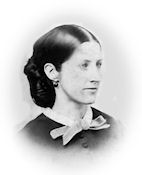
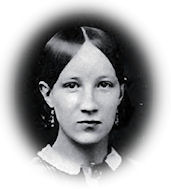
Eliza Woolsey Howland’s Journal.

. . . June 26th. Running away down the Pamunkey again as fast as we can go, escaping from Stonewall Jackson !

All night the wood choppers were at work cutting down the woods at the White House to give the gunboats a chance to command the land beyond, and just now as we passed, the banks were shorn and the pretty little place laid bare. The pickets had been driven in, and Jackson was supposed to be close at hand. Eighty wounded were brought down last night and put on board the Knickerbocker. Twelve more and a few sick came down this morning. The Whilldin follows us, nearly full of sick and wounded.

The rumor to-day is that all communication with the front is stopped, to conceal an advance of our army.

June. — I visited Eureka Lawrence in Syracuse and we attended commencement at Hamilton College, Clinton, and saw there, James Tunnicliff and Stewart Ellsworth of Penn Yan. I also saw Darius Sackett there among the students and also became acquainted with a very interesting young man from Syracuse, with the classic name of Horace Publius Virgilius Bogue. Both of these young men are studying for the ministry. I also saw Henry P. Cook, who used to be one of the Academy boys, and Morris Brown, of Penn Yan. They talk of leaving college and going to the war and so does Darius Sackett.

June 26—We received marching orders this morning. The long roll beat at one in the night. We marched four miles on to Richmond, where we met some wounded of our army that had been injured at same bed that I had the last time—the sidewalk—and the wall for my pillow. Katz, Hugh Sample, “Bat” Harry, Lieutenant Belk and some others were left behind, sick.

June 26th. Magnificent day, with little or nothing doing until towards evening; then came a magnificent display of actual war. If the scene had been expressly prepared for our delectation it could not have been done in a more magnificent manner. Away to the right, the Chickahominy curves southerly, flowing at the foot of high, rolling hills, fringed at their base with heavy masses of dark pines, their slopes and crest open and covered with the white canvas villages of Porter’s corps. From our position, which is on lower ground, we look upwards, and have the entire position in full view, which is certainly at all times picturesquely beautiful. About four o’clock we were attracted by heavy cannonading, which gradually increased until every gun was brought into action. We mounted our horses and rode towards the river, and by the aid of our glasses watched the battle. At first there was little to be seen but by degrees the enemy’s forces came into full view; whole lines of batteries advancing in eschelon and firing with great rapidity; the slopes were soon enveloped in a mass of smoking clouds, through which the flashes from the guns only was visible. For a long time the deep mouthed cannon played its part alone, and we concluded it was nothing more than a great artillery duel. Along towards six o’clock, however, the long, continuous roll of infantry fire told us of a serious attack. We strained our eyes to catch a glimpse between the curling clouds of white-wreathed smoke, but could see nothing except the lightning-like streaks of flame, which issued from the muzzles of the guns, this indicating to us, however, the progress of the fight, and to our chagrin we noted the gradual withdrawal of Porter’s lines and corresponding advance of the enemy’s. Darkness at length suspended operations, and we returned to our quarters. In our own front nothing unusual happened, but we are all convinced the enemy has at last concluded to go for us. If they only would have selected our front, how happy we should be. It is absolutely certain they would be defeated, and nothing would give us more pleasure; we can hold our works against the whole Confederacy combined. At a late hour we turned in, after taking a whiskey sour, fully expecting to be called upon during the night. Last night we were out every half hour.

Sarah Chauncey Woolsey to Georgeanna Muirson Woolsey.

Linen Room, New Haven Hospital,

June 26th, ’62.

My dearest G.: A lull in business gives me a chance to write a few lines to you and tell you how glad I was last night to find your letter waiting for me when I got home from my day here. . . . What wonder that you have not written when I have never found time to write until after ten o’clock at night. . . . One of my pets here among the men is sure that you and Eliza are the ladies who were in a large tent on shore at White House, and brought him some bowls of bread and milk and swigs of strong drink of some kind. He was so interested to make sure of the point that I promised to bring up your picture for him to see and compare with his recollections. . . . The Surgeon-General has written to Dr. Jewett to say that he hears such favorable accounts of the state of affairs here that he is going to send 300 of his worst cases for us to care for. Inspector-General Hammond is coming on Saturday to see with his own eyes, and we are to be swept and garnished for his benefit. Mrs. Hunt (“H. H.”) helps me here often; mends clothes by the hour and comes for three days during the week to write letters for the men. . . . My fortnight’s experience here convinces me that I could soon acquire the art of keeping, not an ” Hotel,” but a small country variety store. There is the same run of customers, the taking of stock, the arranging of the goods, the sweeping-up and closing of the shutters at night. My stock comprises almost everything—shirts and collars, cravats and suspenders, coats and trousers, vests and shoes, handkerchiefs, sheets, pillows and pillow-cases, rags, bandages, soap, thread, needles, tape, buttons, combs, brushes, hats, fans, cotton wadding, water beds (2), stockings, oranges, lemons, bay rum, camphor, stationery, towels, dust-pans, brushes and mosquito netting, and this morning a woman bolted in, saying, “Is it in this room that the corpse is?—they tell me that it is in this end of the passage, and I thought I should like to see him!” I didn’t happen to have one, however, and she seemed quite aggrieved. . . . Jenny is somewhat better, and the baby lovely as can be. . . . She is a dear little puss, and one of the great obstacles to my entire devotion to my country.

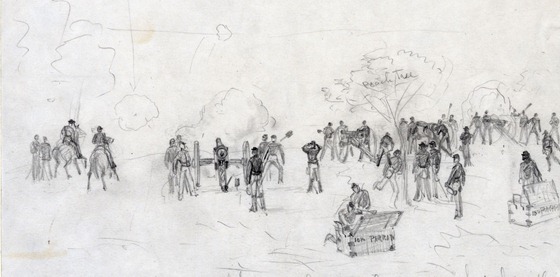
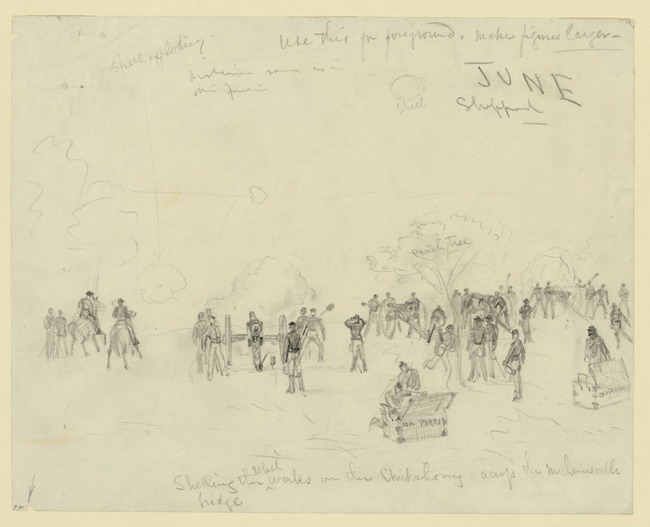
Shelling the rebel works across the Mechanicsville bridge.

(Above image is cropped from the original, on right.)

Shelling the rebel works across the Mechanicsville bridge - originalFrom Library of Congress:

Shelling the rebel works on the Chickahomy [sic] across the Mechanicsville bridge

Artist: Alfred R. Waud.

[1862] June [26]

1 drawing on white paper : pencil ; 20.3 x 25.5 cm. (sheet).

  • Title inscribed below image.
  • Inscribed above image: Shell exploding; Division same as in [ ] Junction; Use this for foreground make figures larger ; shell; June; Sheppard.
  • Inscribed within image: Peach Tree; 10 Pn Parrot.

Part of Morgan collection of Civil War drawings.  Library of Congress Prints and Photographs Division Washington, D.C.

Record page for this image: http://www.loc.gov/pictures/item/2004661049/

June 26.—West H. Humphreys, convicted of having acted as a Judge under the rebel government, was impeached by the Senate of the United States, and sentenced to be removed from his office, and to be forever disqualified from holding any office of profit or honor under the government of the United States.

— The Union mortar-fleet on the Mississippi, under the command of Commodore Porter, commenced to shell the rebel batteries before Vicksburgh. The bombardment lasted for three hours without any result. ,

— The National forces under Majors-General Fremont, Banks, and McDowell were consolidated into one army, called the army of Virginia, and Major-General Pope was assigned by the President to the chief command. The forces under General Fremont constituted the First army corps, to be commanded by General Fremont. The forces under General Banks constituted the Second army corps, to be commanded by him. The forces under Gen. McDowell constituted the Third army corps, to be commanded by him.

—Lieutenant-colonel Alfred W. Ellet, commanding Union ram-flotilla on the Mississippi, went up the Yazoo River with two rams, for the purpose of capturing three rebel gunboats. On his approach the rebels set fire to their boats and started them down on him, compelling him to leave the river to escape the destruction of his vessels. The rebel vessels were entirely consumed.—Lieut.-Colonel Ellet’s Report.

— Nine vessels of the gunboat fleet, under command of Captain Rodgers, entered the Appomattox River, Va., and when about six miles from its mouth, were attacked by the rebels. The squadron opened fire in return, and after shelling him for an hour, the enemy retired. The object of the expedition was to discover the condition of the river, and was entirely successful.

It was ascertained that the rebels had blocked it up, about seven miles from its mouth, with sunken vessels laden with stone, etc. — New Haven Palladium.

— The rebel schooner Zaide, while attempting to run the blockade, was run ashore in the mouth of Cape Fear River, by the blockading fleet off Wilmington, N. C, and burned.

—The battle of Mechanicsville, Va., was fought this day. It commenced at noon and lasted until dark. The Unionists opened with artillery at long-range, but the rebels finding themselves weak in this arm, came into close conflict. The fight increased in fury as it progressed, and it finally became one of the most terrific combats of the war. After losing more than a thousand men, the rebels retreated.—(Doc. 78.)

JUNE 25TH.—The people of Louisiana are protesting strongly against permitting Gen. Lovell to remain in command in that State, since the fall of New Orleans (which I omitted to note in regular order in these chronicles), and they attribute that disgraceful event, some to his incompetency, and others to treason. These remonstrances come from such influential parties, I think the President must listen to them. Yes, a Massachusetts man (they say Gen. L. came froth Boston) was in command of the troops of New Orleans when that great city surrendered without firing a gun. And this is one of the Northern generals who came over to our side after the battle of Manassas.

Wednesday, 25th—The weather is very hot today and our camp is becoming very dry and dusty. Twenty-seven men were detailed this morning to clean up our camp for general inspection.