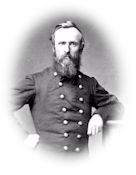
Ditto, Ditto, June 25, 1862. Wednesday. — Dined with General Cox. He has a plan of operations for the Government forces which I like: To hold the railroad from Memphis through Huntsville, Chattanooga, Knoxville [and] southwest Virginia to Richmond; not attempt movements south of this except by water until after the hot and sickly season. This line is distant from the enemy’s base of supplies; can therefore by activity be defended, and gives us a good base.
June 2012
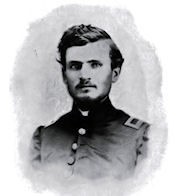
June 25th. Issued the remainder of the ten days’ rations taken along. Received a letter from home.
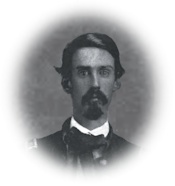
Headquarters ist Division,
Battery Island, June 25th, 1862.
My dear Mother:
I have received your kind letters with their urgent requests from both you and Lilly to be present at the great affair which is to take place in July. How I would like to be there you can well divine, yet the fates never seem to favor my leaving my post. With all quiet in Beaufort I had my hopes; with all in turmoil here my chances seem but small, and yet there are some who have not been half the time in the service I have, who have visited their homes once, twice, and are now going home again. That is a sort of luck some people have, a sort of luck which does not favor me. Yet there will be a time, I suppose, when it will be pleasant to remember I was never absent from duty, though I cannot see that strictness in such respects is held in any special honor now. You must tell Lilly I will think of her with all a brother’s feeling of love when the day comes. I will see that I am properly represented at the table which bears her marriage gifts. I will dream of the orange flowers that bind the brow of the bride and will wish them — the bride and groom— God speed. I will wish them a brave career, and will rejoice that they do not fear to face the future together. I have no patience with that excessive prudence which would barter the blessings of youth and happiness and love for some silly hope of wealth, and the happiness wealth can give to hearts seared with selfishness and avarice. If misfortunes come, will they be heavier when borne together? And are men less likely to prosper when they have something more than themselves for which to toil? And when one man and one woman are brave enough to show they have no fear, but are willing to trust, “Bravo!” say I, “and God grant them all that they deserve.”
My coat and pants have come. All very well, only the coat is about six inches bigger round the waist than I am. There are tailors around the camp, though, who can remedy so excellent though rather ungraceful a fault.
I have had a letter from Hall lately, who seems quite happy. On this island, dear Mother, there are secret, hidden, insidious foes which undermine one’s happiness. We are truly in the midst of enemies which give no quarter, whose ruthless tastes blood alone can satisfy. Now I am not alluding to the human “Seceshers” — they are only mortal — but the insect kingdom. What a taste they have for Union blood! Mosquito bars are useless. They form breaches, and pierce every obstruction imagination can invent, when they once scent Union blood. Flies march over one in heavy Battalions — whole pounds of them at a time. Mosquitoes go skirmishing about and strike at every exposed position. Sandflies make the blood flow copiously. Fleas form in Squadrons which go careering over one’s body leaving all havoc behind. Ticks get into one’s hair. Ants creep into one’s stockings. Grasshoppers jump over one’s face. You turn and brush your face. You writhe in agony. You quit a couch peopled with living horrors. You cry for mercy! — In vain. These critters are “Secesh.” They give no quarter. You rush wildly about. You look for the last ditch. Until utterly exhausted you sink into unrefreshing sleep. Then begins a wild scene of pillage. Millions of thirsty beings, longing for blood, drink out one’s life gluttonously. Enough! Why harass you with these dismal stories?
Benham has been sent home under arrest. The last thing he did on leaving Hilton Head was to lie. He doubtless has not discontinued the practice since.
My love to Mary and Lilly, the little boys (how I would like to see them), and all my dear friends. I have been several times with a flag of truce to the enemy, concerning our prisoners in their hands. In all these interviews I heard of Sam Lord. I wished to see him very much, but permission was not granted. I was allowed, however, to write him concerning Miss Alice Mintzing’s welfare. The Colonel of his Battalion — Lamar — was badly wounded in our late engagement. Genl. Stevens has mentioned me handsomely in his official report of the fight, but he has done the same to all his staff-.
Very affec’y, your Son,
Will.
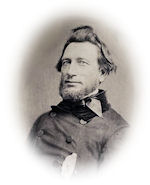
25th.—All in the hospital having been made comfortable, we set to work yesterday to take care of ourselves. Arranged our tents, and to-day find ourselves a band of contented Surgeons, assistants and nurses, willing now to remain where we are. The above lines were written at noon, and before the ink dried, an orderly rode up with a note, the first line of which read: “Surgeon, you will report for duty with your regiment, without delay.” So the fat of my content is all in the fire. I suppose there is another hospital to be organized. This constant change from newly established order and organization, to unorganized, chaotic confusion, is very trying. To establish a large field hospital, provision it and put it in good condition for the comfort of sick and wounded, in the short time allowed and with the disentangling of the red tape, is a big work, which I have been so frequently called on to perform, that I am heartily sick of it. No sooner do I get all comfortable, and become interested in the men under my care, than we must separate, perhaps, never to meet again.
On receipt of order to join my regiment, immediately mounted my horse in obedience, leaving behind me my tent, trunk, books, mess chest—everything but a case of surgical instruments, and reported at headquarters on the Richmond side of the Chickahominy. Found all quiet on the surface, but there was underneath a strange working of the war elements, which I could not comprehend. Officers spoke to each other in whispers—there was a trepidation in everything. There was “something in the wind.” But it blew no definite intelligence to me. I received no order for duty; only to hold myself in readiness for whatever might be assigned me.
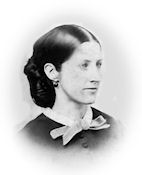
Eliza Woolsey Howland’s Journal.
. . . June 25th. General Van Vliet says that if I want to go to the front at any time and will send him word, he will have his wagon meet me and take me over to J’s camp. This morning Dr. Bigelow came back to our boat from the front.
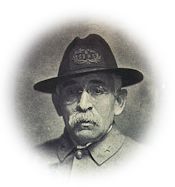
June 25—Reported fighting near Richmond.
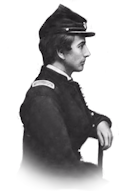
June 25th. The wind blew terrifically all day long. Early detailed six companies for picket duty. Shortly after they left camp the firing along the lines grew fast and furious, and at eight o’clock, we, with the other regiments of the brigade, were ordered to Seven Pines, to man the works in front of Heintzleman’s corps. We took position on the site of the original camp of Casey’s division, now transformed into a formidable fortress. Heintzleman moved forward through a heavy piece of timber to a clearing in front and met with determined opposition. All the forts and redoubts belched forth their murderous fire over the heads of the advancing columns, and thus assisted, they drove the enemy before them and got within four miles of Richmond. If they had remained there, and we had all marched forward, it would have amounted to something, but towards evening the whole force returned, and reoccupied their works, and we returned to our own camp. There was an immense expenditure of powder and shot, but little good resulted from it.
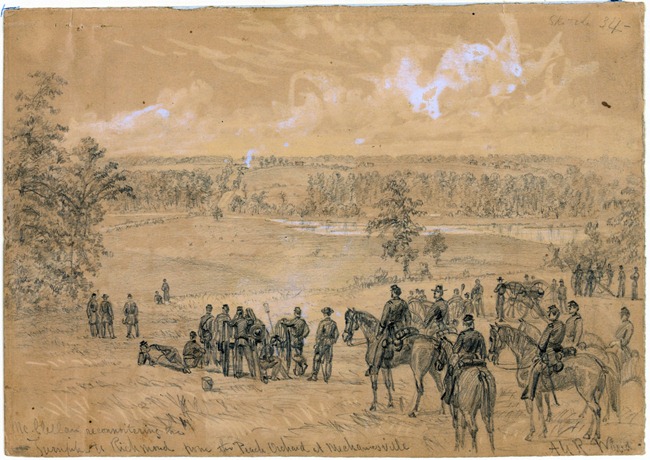
From Library of Congress:
1862 ca. June 25 – July 1
Signed lower right: Alf R. Waud. Title inscribed below image
1 drawing on light brown paper : pencil and Chinese white ; 18.3 x 26.0 cm. (sheet).
Part of Morgan collection of Civil War drawings. Library of Congress Prints and Photographs Division Washington, D.C.
Record page for this image: http://www.loc.gov/pictures/item/2004660821/
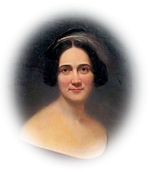
June 25th.—I forgot to tell of Mrs. Pickens’s reception for General Hampton. My Mem dear, described it all. “The Governess” (“Tut, Mem! that is not the right name for her—she is not a teacher.” “Never mind, it is the easier to say than the Governor’s wife.” “Madame la Gouvernante” was suggested. “Why? That is worse than the other!”) ” met him at the door, took his crutch away, putting his hand upon her shoulder instead. “That is the way to greet heroes,” she said. Her blue eyes were aflame, and in response poor Wade smiled, and smiled until his face hardened into a fixed grin of embarrassment and annoyance. He is a simple-mannered man, you know, and does not want to be made much of by women.
The butler was not in plain clothes, but wore, as the other servants did, magnificent livery brought from the Court of St. Petersburg, one mass of gold embroidery, etc. They had champagne and Russian tea, the latter from a samovar made in Russia. Little Moses was there. Now for us they have never put their servants into Russian livery, nor paraded Little Moses under our noses, but I must confess the Russian tea and champagne set before us left nothing to be desired. “How did General Hampton bear his honors?” “Well, to the last he looked as if he wished they would let him alone.”
Met Mr. Ashmore fresh from Richmond. He says Stonewall is coming up behind McClellan. And here comes the tug of war. He thinks we have so many spies in Richmond, they may have found out our strategic movements and so may circumvent them.
Mrs. Bartow’s story of a clever Miss Toombs. So many men were in love with her, and the courtship, while it lasted, of each one was as exciting and bewildering as a fox-chase. She liked the fun of the run, but she wanted something more than to know a man was in mad pursuit of her; that he should love her, she agreed, but she must love him, too. How was she to tell ? Yet she must be certain of it before she said “Yes.” So, as they sat by the lamp she would look at him and inwardly ask herself, “Would I be willing to spend the long winter evenings forever after sitting here darning your old stockings?” Never, echo answered. No, no, a thousand times no. So, each had to make way for another.
June 25.—The division of the army of the Potomac under command of General Hooker, this day advanced in the vicinity of the Chickahominy River, with a view of occupying a new position. The advance was resisted with great determination by the rebels. They fought for seven hours, when they retreated with great loss, leaving the Unionists in the position desired. The loss of the Union army was about two hundred in killed and wounded. This battle was the first of a series of conflicts, lasting over seven days, and resulting in the retreat of the Army of the Potomac, under the command of Major-General McClellan, to the James River, under the protection of the fleet of Union gunboats.—(Docs. 77 and 78.)
—Yesterday the United States steamer Monticello, Lieut. Commanding D. L. Braine, picked up at sea, in an open boat, eight contrabands from Little River Inlet, South-Carolina, from whom information was obtained that two schooners were preparing to run the blockade, laden with cotton and turpentine, and that the cargo was already in the warehouse, near the wharf, ready for shipment. This evening Captain Glisson ordered an expedition to be fitted out, to consist of an armed boat from each vessel, and ordered Lieutenant Braine, of the Monticello, to proceed to the Inlet with the boats and send the expedition in.
The duty was ably performed by Lieutenants Braine and Bunce, with the officers and men under them, the reports of whom show that the town was entirely deserted. The schooners were found at the wharf, and were not considered worth the trouble of bringing away. They found at the wharf and in warehouses two hundred barrels of turpentine, sixty bales of cotton, and fifty-three barrels rosin, the whole of which was destroyed by fire.—Capt. Glisson’s report. .
— General Butler ordered, that “all the property in New-Orleans belonging to General D. E. Twiggs, and of his minor son, the income of which he has received, and under the charge of his agent, H. W. Palfrey, Esq., consisting of real estate, bonds, notes of hand, treasury notes of the United States, slaves, household furniture, etc., is hereby sequestered, to be held to await the action of the United States Government.”
— The Union ram fleet arrived off Vicksburgh, Miss., yesterday, and to-day communicated with Commodore Farragut, commanding fleet of gunboats.
— A large body of rebel cavalry under Jackson, this day visited a number of plantations in the vicinity of Memphis, Tenn., on the line of the Memphis and Charleston Railroad, burning great quantities of cotton and arresting all persons found purchasing that staple. — Memphis Avalanche, June 27.
—A Union force, under the command of Gen. Williams, consisting of four regiments of infantry and nearly two batteries of artillery, left Baton Rouge, La., on the twentieth, and arrived at Vicksburgh, Miss., this day.—(Doc. 142.)
— A train of cars on the Memphis and Ohio Railroad, laden with a company of Union troops, eighty mule-teams with provender, etc., was this day captured by a large force of rebel cavalry, in the vicinity of Germantown, Tennessee. The rebels destroyed the locomotive, burned the cars, and killed ten men.


