Following the American Civil War Sesquicentennial with day by day writings of the time, currently 1863.

September 2012

[September 23d]

From Bolivar Heights, on which our camp is pitched, we have a magnificent view of the Shenandoah valley, limited only by the distant horizon. Immediately across the river are the Loudon Heights, and there, perched up well in the clouds, are several batteries and a large force of infantry. The place is of great strength naturally, but requires a big garrison to hold it. Unless both heights many miles in extent are held, it is untenable, and I suppose Miles with his eleven or twelve thousand men, who surrendered so promptly to General Jackson, concluded it was useless to fight with his small command. It seems Miles retired from the heights on the approach of the enemy, and took shelter in the town, where he was absolutely powerless. As the general was killed, his apparently poor judgment and wretched defense will never be explained. But if the place had held out for twenty-four hours which seems quite possible, Franklin’s corps would have reached it from the Maryland side, and together they could not only have held the fort, but prevented Jackson from joining Lee at Antietam, which would very likely have resulted in Lee’s destruction. Miles probably knew nothing of the measures taken for his relief, but the result shows how imperatively necessary it is for all commanders of detached posts to hold on to the very death. What a chance Miles had for making a hero of himself!

Lee’s army is reported in the neighborhood of Winchester, and is believed to be wholly west of the Blue Ridge. No attempt, apparently, at present is to be made to renew the campaign, and so we are putting up our tents and forming regular camps. The losses have been so great, that few of the old regiments now exceed two hundred men each. The recruiting service is entirely out of joint, and does not furnish in six months as many men as we sometimes lose before breakfast. The total force of the army is maintained by raising new regiments, instead of filling up the old ones, and consequently half the men are inexperienced and useless. It is a wonder to me, that such a vital point should be overlooked by the Government, and no attempt made to keep the force up in quality as well as in numbers.

Another difficulty with the service is the lack of system in promotion. Excepting subaltern commissions, nearly all are obtained through influence at home. There are notable instances in my own regiment, where officers have been commissioned, directly in opposition to the colonel’s recommendation, and the seniority and rights of other officers.
September 23.—Three hundred Sioux Indians, under Little Crow, attacked Colonel Sibley’s command near Yellow Medicine, Minn. The battle lasted two hours, resulting in the repulse of the Indians with the loss of thirty killed and a large number wounded. Four whites were killed and from thirty to forty wounded.—(Doc. 209.)

—This being the last day for taking the oath of allegiance, at New-Orleans, La., in accordance with the order of Gen. Butler, the City Hall and Custom House in that city were besieged by thousands, desirous of availing themselves of the privilege.—The schooner Nellie was captured by the United States steamer Alabama.

—This morning the town of Sutton, Va., was attacked by a body of about one hundred rebel cavalry, but were repulsed by the Union force guarding the post, under Major Withers, Tenth Virginia, and driven nine miles, when, the rebels being reenforced, the Unionists retired, but being in their turn pursued, and being greatly outnumbered, they abandoned their position and fell back to Bulltown.— Wheeling Intelligencer.

—Colonel Switzer, Sixty-second Pennsylvania, in command of his own regiment, with a section of the First New-York artillery, and Griffin’s brigade, crossed the Potomac from Maryland into Virginia at Reynolds’s Ford, below Shepherdstown, Va., and captured over four hundred rifles, mostly marked “London, 1862,” and a twelve-pounder rifled brass cannon of English manufacture. The capture was accomplished without firing a shot; the rebel pickets falling back as the Union men advanced.

—The One Hundred and Forty-ninth (Fourth Onondaga) regiment, nine hundred strong, commanded by Col. Henry A. Barnum, left Syracuse for Washington at nine o’clock this morning. They went by way of Geneva, Elmira and Harrisburgh through Baltimore. Col. Barnum was not able to go with the regiment further than Elmira, not having fully recovered from his wound received on the Virginia Peninsula.

—Major-General Wright, in a special order issued at Cincinnati, Ohio, declared that the daily prohibition of business after four P.M. was rescinded. On every Saturday, after two P.M., business of every kind was to be suspended until five P.M., during which interval all able-bodied men in Cincinnati, Covington, and Newport were to meet for drill. Passes to citizens, except to enter the military lines, and passes issued under the orders regarding the drafting of the enrolled militia, were dispensed with. In dispensing with the daily drills and suspension of business, the General Commanding had in view the relief, as far as was practicable, of the people from burdens to which they had not been accustomed, but would impress upon the minds of all the fact that danger had not passed away; that the present military organization must be rigidly adhered to and carefully preserved. He thanked the citizens for the general alacrity with which they sprung to arms and entered upon the labor for the common defence, and the patience with which they had borne the various restrictions imposed upon them.

—Governor Curtin, of Pennsylvania, issued an order returning thanks to the people of that State for the manner in which they responded to his call for fifty thousand volunteers to resist invasion.—The National War Committee of the city of New-York held a special meeting, at which the sub-committee submitted an addendum to their report of the fifth instant, having relation to their conference with the Governors of the New-England States, concerning the adoption of measures to hasten forward troops to the seat of war.

—Yesterday the steamer Eugene, plying between Cairo and Memphis on the Mississippi River, carrying the United States mail and a large number of passengers and troops, was attacked at Randolph, Tenn., by a band of rebel guerrillas, but she got off. This, on the arrival of the boat at Memphis, being reported to General Sherman, commanding the Union forces there, he despatched, in the steamers Ohio Belle, and Eugene, a force of troops who to-day burned the town.—Cincinnati Commercial.

—The day on which the draft was to take place in Pennsylvania was postponed to the sixteenth October.

—The steamer Emma was boarded at Foster’s Landing, on the Ohio River, by a party of rebel guerrillas, who, after plundering her of all they wanted, allowed her to proceed.

September 22.—I read aloud to Grandfather this evening the Emancipation Proclamation issued as a war measure by President Lincoln, to take effect January 1, liberating over three million slaves. He recommends to all thus set free, to labor faithfully for reasonable wages and to abstain from all violence, unless in necessary self-defense, and he invokes upon this act “the considerate judgment of mankind and the gracious favor of Almighty God.”

Monday, 22nd.—A beautiful morning and all quiet, except that the officers are pitching tents and fixing up tables, as if for a stay. But that is no indication of what is in store for us; even before night we may be ordered to pull up and move again. But this would be very cruel. Our poor, worn out enemy, having fought and been driven for seven days, and now being entirely without provisions, must be exhausted and need rest. How cruel it would be to pursue him, under these circumstances. The kind heart of our Commander can entertain no such idea.

In the afternoon, I rode up to Williamsport and found the town full of soldiers. A little incident occurred, which I shall notice. Walking through the streets I encountered a young lady, fresh, rosy, plump and pretty. Her look told me that she would like to speak to me, but she was hesitating as to the propriety of doing so. I spoke, and she at one commenced a conversation on the war. She said that last night there were three thousand rebels encamped near by, and that we might easily have captured them. She pointed out to me with much military tact, how they might have been surrounded, and then said she could not get any one to come in the night and inform us, though only two miles away; that she got ready to come herself, but (with tears and sobs) that her father would not let her, and only because it was night. Poor child, I did want to kiss her.

Not for the sake of the kiss. Oh, no!

But only for sympathy, you know—you know.

I have suffered some to-day, from a most singular pain in my finger. It is peculiar, and runs up the lymphatics to the arm and shoulder. Ordered to move at 7 tomorrow morning.

Headquarters 5th Army Corps,
Camp near Shepardstown, Sept. 22.

Dear Father, — . . . The enemy are still on the opposite side of the river and I do not know what measures will be taken to drive them off. Meanwhile we are getting a day’s rest, which every one needs badly enough. I am in the saddle almost all the time, and have very few chances to write. I feel so tired after coming in at night, that I go to bed instantly.

We have four guns here at headquarters which were taken the other evening from the other side of the Potomac. One of them is a gun taken from Griffin’s Battery at Bull Run No. 1. Griffin, who is now a general in the corps, is well pleased at getting the gun back, and is going to have it placed with his old battery.

I went over the river this afternoon with a message to Colonel Webb, who was over there with a flag of truce. We sent over some paroled prisoners and also applied for leave to bury our dead, who were killed in the skirmish on that side. I saw Colonel Lee,[1] who was in College with me, being in the class of ’58. He now commands the 9th Virginia Cavalry. He said that their men behaved disgracefully in the fight of September 17 and ran like sheep. He gave as the reason, that they were starved and had nothing to eat. When the 4th Michigan crossed the river the other evening, he said, they drove a whole brigade of rebels, who ran shamefully. These are Colonel Lee’s own words. He also said that the rebels deserted 27 guns that evening, of which we got four, not knowing where the rest were. There is no doubt that the rebels are mighty hard up for food and clothing. There were some forty of our dead there, and all of them had their shoes taken and pockets rifled. The faces of the dead were horrible. Some could hardly be distinguished from negroes, their faces were so black. I had charge of burying a good many of them. There are some 1200 rebels wounded, in the barns and hospitals around here, most of whom will be paroled. . . .

I have every reason to think General Porter is satisfied with me, from the messages he intrusts to me, many of which are very important.


[1] W. H. F. (“Rooney”) Lee

September 22 — Still on picket. From our post we can see the white tents of an extensive camp of Yankees, way up on South Mountain in Maryland, just beyond Maryland Heights.

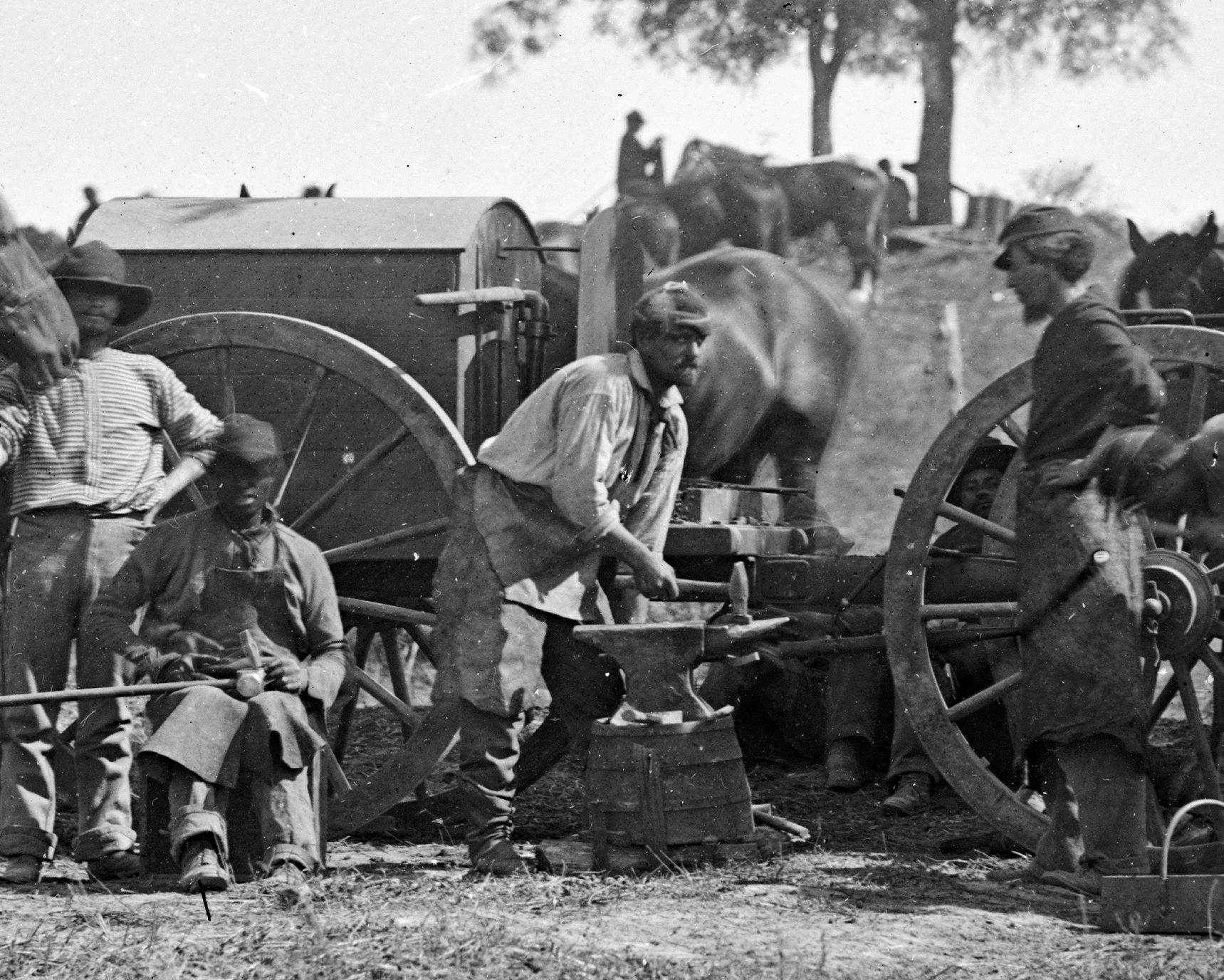
Antietam, Md. Blacksmith at headquarters

Antietam, Md. Blacksmith shoeing horses at headquarters, Army of the Potomac.

Photographed by Alexander Gardner.

Library of Congress image.

Monday Night, September 22d.—Probably the most desperate battle of the war was fought last Wednesday near Sharpsburg, Maryland. Great loss on both sides. The Yankees claim a great victory, while our men do the same. We were left in possession of the field on Wednesday night, and buried our dead on Thursday. Want of food and other stores compelled our generals to remove our forces to the Virginia side of the river, which they did on Thursday night, without molestation. This is all I can gather from the confused and contradictory accounts of the newspapers.

September 22. A special Cabinet-meeting. The subject was the Proclamation for emancipating the slaves after a certain date, in States that shall then be in rebellion. For several weeks the subject has been suspended, but the President says never lost sight of. When it was submitted, and now in taking up the Proclamation, the President stated that the question was finally decided, the act and the consequences were his, but that he felt it due to us to make us acquainted with the fact and to invite criticism on the paper which he had prepared. There were, he had found, not unexpectedly, some differences in the Cabinet, but he had, after ascertaining in his own way the views of each and all, individually and collectively, formed his own conclusions and made his own decisions. In the course of the discussion on this paper, which was long, earnest, and, on the general principle involved, harmonious, he remarked that he had made a vow, a covenant, that if God gave us the victory in the approaching battle, he would consider it an indication of Divine will, and that it was his duty to move forward in the cause of emancipation. It might be thought strange, he said, that he had in this way submitted the disposal of matters when the way was not clear to his mind what he should do. God had decided this question in favor of the slaves. He was satisfied it was right, was confirmed and strengthened in his action by the vow and the results. His mind was fixed, his decision made, but he wished his paper announcing his course as correct in terms as it could be made without any change in his determination. He read the document. One or two unimportant amendments suggested by Seward were approved. It was then handed to the Secretary of State to publish to-morrow. After this, Blair remarked that he considered it proper to say he did not concur in the expediency of the measure at this time, though he approved of the principle, and should therefore wish to file his objections. He stated at some length his views, which were substantially that we ought not to put in greater jeopardy the patriotic element in the Border States, that the results of this Proclamation would be to carry over those States en masse to the Secessionists as soon as it was read, and that there was also a class of partisans in the Free States endeavoring to revive old parties, who would have a club put into their hands of which they would avail themselves to beat the Administration.

The President said he had considered the danger to be apprehended from the first objection, which was undoubtedly serious, but the objection was certainly as great not to act; as regarded the last, it had not much weight with him.

The question of power, authority, in the Government to set free the slaves was not much discussed at this meeting, but had been canvassed by the President in private conversation with the members individually. Some thought legislation advisable before the step was taken, but Congress was clothed with no authority on this subject, nor is the Executive, except under the war power, — military necessity, martial law, when there can be no legislation. This was the view which I took when the President first presented the subject to Seward and myself last summer as we were returning from the funeral of Stanton’s child, — a ride of two or three miles from beyond Georgetown. Seward was at that time not at all communicative, and, I think, not willing to advise, though he did not dissent from, the movement. It is momentous both in its immediate and remote results, and an exercise of extraordinary power which cannot be justified on mere humanitarian principles, and would never have been attempted but to preserve the national existence. The slaves must be with us or against us in the War. Let us have them. These were my convictions and this the drift of the discussion.

The effect which the Proclamation will have on the public mind is a matter of some uncertainty. In some respects it would, I think, have been better to have issued it when formerly first considered.

There is an impression that Seward has opposed, and is opposed to, the measure. I have not been without that impression myself, chiefly from his hesitation to commit nimself, and perhaps because action was suspended on his suggestion. But in the final discussion he has as cordially supported the measure as Chase.

For myself the subject has, from its magnitude and its consequences, oppressed me, aside from the ethical features — of the question. It is a step in the progress of this war which will extend into the distant future. A favorable termination of this terrible conflict seems more remote with every movement, and unless the Rebels hasten to avail themselves of the alternative presented, of which I see little probability, the war can scarcely be other than one of emancipation to the slave, or subjugation, or submission to their Rebel owners. There is in the Free States a very general impression that this measure will insure a speedy peace. I cannot say that I so view it. No one in those States dare advocate peace as a means of prolonging slavery, even if it is his honest opinion, and the pecuniary, industrial, and social sacrifice impending will intensify the struggle before us. While, however, these dark clouds are above and around us, I cannot see how the subject can be avoided. Perhaps it is not desirable it should be. It is, however, an arbitrary and despotic measure in the cause of freedom.

Monday, 22d—No news of importance. Rain last night. Foraging parties are bringing in all the fresh pork that we can use, besides plenty of sweet potatoes. Our crackers, having been kept in storage so long, are musty and full of the weevil web, and there are no trains from Corinth to bring a fresh supply. We often clean them the best we can and bake them again in ashes or in skillets.