Following the American Civil War Sesquicentennial with day by day writings of the time, currently 1863.

September 2012

Middletown, Monday, September 22, 1862.

Dear Uncle : — I am still doing well. I am looking for Lucy. My only anxiety is lest she has trouble in finding me. Indeed, I am surprised that she is not here already. I shall stay here about ten days or two weeks longer, then go to Frederick and a few days afterwards to Washington. About the 15th or 20th October, I can go to Ohio, and if my arm cures as slowly as I suspect it will, I may come via Pittsburgh and Cleveland to Fremont and visit you. I do not see how I can be fit for service under two months.

The Eighth Regiment was in the second battle and suffered badly. You must speak well of “old Frederick” hereafter. These people are nursing some thousands of our men as if they were their own brothers. McClellan has done well here. The Harpers Ferry imbecility or treachery alone prevented a crushing of the Rebels. Love to all. Send me papers, etc., here “care Jacob Rudy.”

Do you remember your Worthington experience in 1842? Well this is it. I don’t suffer as much as you did, but like it.

Middletown is eight miles west of Frederick on the National Road. The nearest telegraph office is at Frederick. Two thirds of the wounded men of my regiment have gone to Frederick. The worst cases are still here. In my regiment, four captains out of eight present were wounded, thirty-nine men killed, one hundred and thirty-seven wounded, and seven missing. I expect about twenty to twenty-five of the wounded to die. The New York Times account gives us the nearest justice of anybody in its details of the Sunday fight but we are all right. Everybody knows that we were the first in and the last out, and that we were victorious all the time. How happy the men are — even the badly wounded ones. One fellow shot through the body has gathered up a banjo and makes the hospital ring with negro songs!

Good-bye,

H.

S. BIRCHARD.

Monday, 22nd. Breakfast at 4:15 A. M. Marched at sunrise, passing through Greenfield, a very pretty little village. One encouraging sign, seldom seen of late months, a comfortable schoolhouse. Stopped two miles out of town, by a spring for dinner. Capt., one or two others and myself explored a cave near by. Found the layers of stone filled with shells and all sorts of stones. Several lizards lying about. Learned afterwards that some bushwhackers were watching us from the bluffs above. Here the country changed from boundless prairie to woodlands and hills. Like the variety better. Encamped for the night after riding 7 miles farther. Slept beneath a clump of trees with Archie.

Headquarters 1st Brig.

1st Div. 9th Army Corps,

Sept. 22d, 1862.

My dear Mother:

Heigh-ho! I do wish I could hear from home. We are promised a mail to-day, but I am not certain if my letters will reach me. I get piles of papers which travel down to South Carolina, make the tour of half the continent, and finally inundate me with news eight or ten weeks old; but the letters — where do they go to? I asked Genl. Burnside’s Postmaster this question the other day. “Why, let me see” was his answer, “there were some letters for you. I remember the name. It’s a queer sort of a name. Now where can they have gone to?” Consolatory, was it not? Here I am full of anxiety, and no relief.

However, most of us here stand on the same footing. We are resting now from past labors, near the mouth of Antietam Creek where it empties into the Potomac. This rest is indeed grateful to us all, for we were pretty well exhausted, ridding Maryland of its invaders. The rest can’t last long, though, I suppose. If possible I am going to abandon the immediate pursuit of arms, and return to medicine. Dr. McDonald, Surgeon of the 79th, urges me very strongly to accept the position as his 2nd assistant, and has well-nigh persuaded me that I could do more good in that position than anyone he would be apt to get elsewhere. I would like this first-rate, but how to accomplish the transfer from Brigade-Adjutant to Asst. Surgeon? The Government is not very obliging in these matters, and it is too difficult a thing to work, for me to hope much. I have a pretty good time now — am not too much pressed with work. The Col. commanding the Brigade treats me with flattering consideration, and I believe myself generally respected and beloved in the Brigade. I am not consequently very unhappy, am rather jolly than otherwise. Still I feel neglected, and have abandoned anything like military aspirations. It is vain to refer to long service, or to the estimation in which I have been held by commanding officers as shown on the records of the Division from the first. I cannot but feel that had I stayed at home until these last levies were raised, I might have held a much more responsible position than my present one. I have abandoned in future all care or thought of promotion, and content myself with doing simply and purely my duty. Now, my precious mother, if I am querulous, don’t let it trouble you. I do not mind it myself. I only write as I do to show you how it is that my feelings have so changed since we parted. You can remember how indignantly I repulsed every suggestion as to my entering the army in connection with the medical service, and yet would very gladly do so to-day were it in my power. As for the rest, not being one of your grand and gloomy geniuses oppressed by a sense of their own merits, and the world’s want of appreciation of them, although occasionally exercising a soldier’s privilege to grumble, I contrive to keep up my spirits, like a Mark Tapley in the township of Eden. Bother! I would like to see you all. Master Turly must wear breeches with pockets in them. Master Will has doubtless grown large enough to bully smaller boys than himself. (Such things are possible, my dear sister Mary, though I grant the improbability in this particular case). Lilly and Tom have grown staid and domestic. Walter can hear the heir-apparent talked about without blushing. Both the Ellens make charming young mothers. The old house, Hunt and Mary, and then my mother thinking of an absent scapegrace who now sits in his shirt-sleeves, having laid aside his shabby war-worn regimentals, and wants to be remembered lovingly by all his friends! Oh bother!

Affec’y.,

Will.
Capt. & A. A. A. G.

Rienzi, Monday, Sept. 22. To-day I felt very weak, there was no local pain, but a general debility.

Abby Howland Woolsey to H. Gilman.

Litchfield, Sept. 22.

Charley is trying for a Lieutenancy in one of the new regiments, and Governor Morgan has promised, as all governors do, to “see about it.” This is going to be a great drain on Mother’s spirits and strength, if the application succeeds, and will bring us all continued personal interest and anxiety.

Georgy was telegraphed ten days ago to come immediately to Newport to a great military barrack hospital.

September 22—We laid here all day. Cars came for us from Petersburg to-night and took us back. Got there at 12 at night, marched one mile and camped for the night.

SEPTEMBER 22ND.—There are rumors that only Jackson’s corps recrossed the Potomac to look after a column of the enemy sent to recapture Harper’s Ferry and take Winchester, our grand depot.

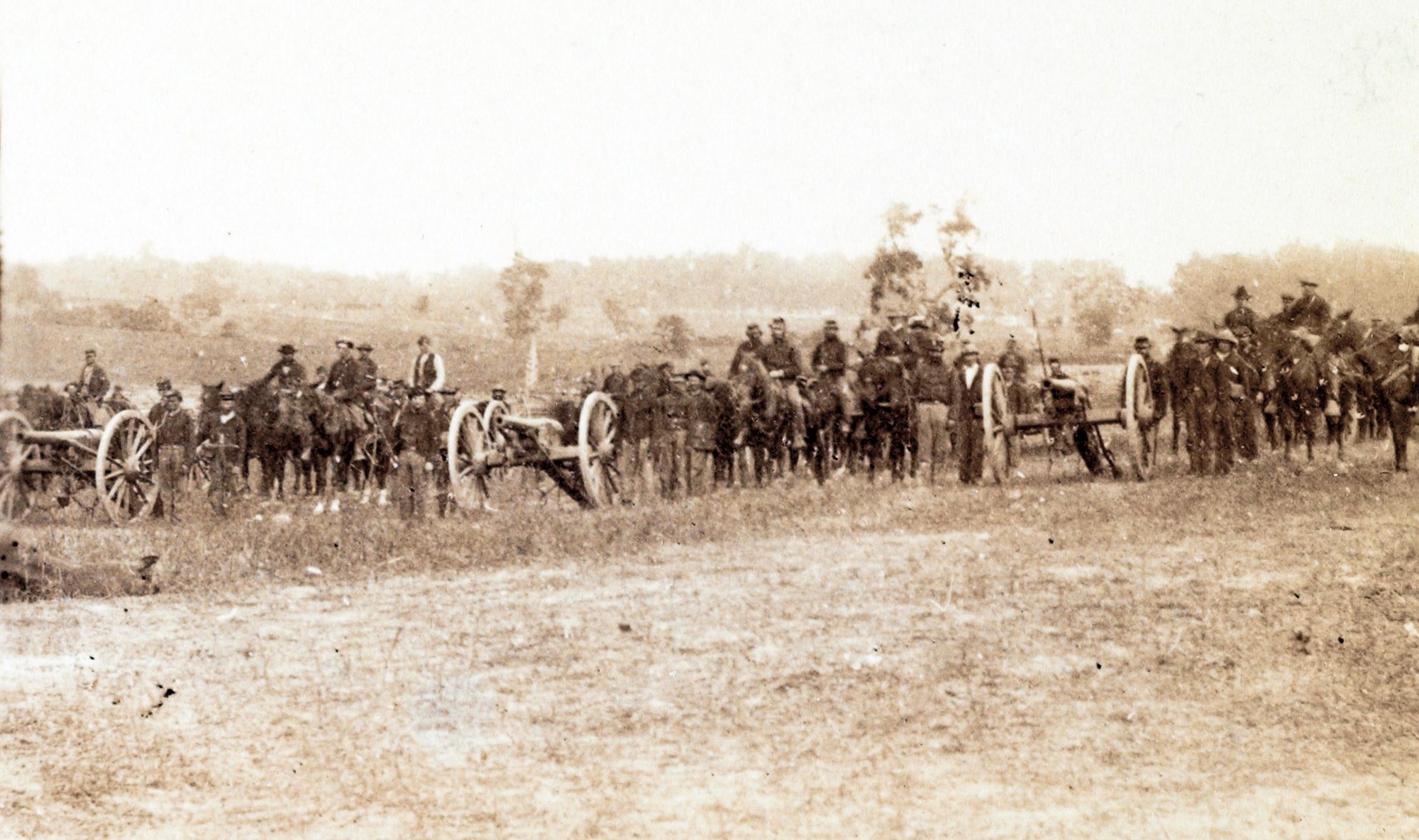
1862-09 Pennsylvania Independent Battery E Light Artillery approaching the battlefield at Antietam

Photograph showing Captain J. M. Knapp’s Pennsylvania Independent Battery “E” Light Artillery approaching the battlefield at Antietam, Maryland after the battle in September 1862. A dead horse lay in the foreground.

Photo by Alexander Gardner.

Given the long exposure times required for early photography, this image was staged at some time after the battle.

Library of Congress image.

September 22.—James F. Robinson, Governor of Kentucky, in view of the near approach of the rebel army under Gen. E. Kirby Smith, for the purpose of attacking Louisville, issued a proclamation calling upon the people of that city to rally for the defence of their homes, and attach themselves with such arms as they had, to the military forces under General Nelson.

—A skirmish took place near Sturgeon, Mo., between a Union force under the command of Major Hunt, and a band of guerrillas under Capt Cunningham, in which the latter were completely routed.—The Tenth regiment of New-Hampshire volunteers, under the command of Col. Michael T. Donahue, left Camp Pillsbury, near Manchester, for the seat of war.

—A fight took place at Ashby’s Gap, Va., between a reconnoitring force of Union troops under the command of Col. R. B. Price, Second Pennsylvania cavalry, and a rebel force under Lieut.-Col. Green, resulting in the defeat of the latter with considerable loss. Among the prisoners taken were Col. Green and two of his lieutenants.

—President Lincoln this day issued a proclamation declaring that hereafter as heretofore, the war would be prosecuted for the object of practically restoring the Union; and “that on the first day of January, in the year of our Lord one thousand eight hundred and sixty-three, all persons held as slaves within any State, or any designated part of a State, the people whereof shall then be in rebellion against the United States, shall be then, thenceforward, and forever, free.” Secretary Seward addressed a circular to all the diplomatic and consular agents of the United States, on the same subject—(Doc. 125.)

Maryland Heights, Va., September 21st, 1862.

Toward evening of the 13th we left Frederic City and marched out on the National Turnpike toward South Mountain, and halted for supper and a few hours rest near Middleton. It was nearly midnight. We had made a rapid march of several miles, and were tired, and hungry as wolves. Hardly had we stacked arms when Lieutenant Rath inquired: “Where’s John Conley?” John could not be found; he was already off on an expedition of his own. “Well, then,” said Rath, “send me the next best thief; I want a chicken for my supper.”

Our foragers soon returned; the Lieutenant got his chicken, and we privates were fairly well supplied with the products of the country. It strikes me as a little strange, the facility with which a soldier learns to steal his grub. It must be the effect of heredity. Perhaps, in the dim past, when our ancestors went on “all fours,” and roamed the forests in search of food; possibly at a more recent date, but before a name was given to the deed; they formed the habit of taking what they wanted wherever it could be found, provided they had the physical power, or mental cunning, to accomplish it, and this habit, thus formed, became instinct, and was transmitted to their descendants. At daylight we were on the move, headed for South Mountain. We had an inkling—how obtained I do not know; mental telepathy, perhaps, that occult, mysterious power that enables us to divine the most secret thoughts of men—that a mass meeting was to be held on that eminence to discuss the pros and cons of secession, and that we, the Seventeenth, had received a pressing invitation to be present. The Pike was in fine condition. Our men stepped off briskly, with long, swinging strides that carried them rapidly over the ground. We marched in four ranks, by companies, and were led by our gallant Colonel Withington. Company G was seventh from the front, which gave me a view of over half the regiment. And it was good to look upon. Only two weeks from home, our uniforms were untarnished. Dress coats buttoned to the chin; upon our heads a high-crowned hat with a feather stuck jauntily on one side. White gloves in our pockets; a wonder we did not put them on, so little know we of the etiquette of war.

As we neared the mountain, about nine o’clock in the morning, I scanned its rugged sides for indications of the presence of our friends, the enemy, and, as I looked, I saw a puff of smoke, and on the instant a shell sped howling above our heads, bursting some half a mile beyond.

Every man of us “bowed his acknowledgments;” then, as by one impulse, every spine became rigid; every head was tossed in air; as if we would say; “My Southern friend, we did the polite thing that time. No more concessions will you get from us and—may God have mercy on your souls.” Of our exploits on South Mountain I will not write. They will be woven into history and will be within the reach of all. About thirty of our brave boys were killed, and over one hundred wounded. Captain Goldsmith was wounded in the shoulder and Lieutenant Somers in the side. A number of Company G boys were wounded, but none were killed in this battle.

Eli Sears, the best, the most universally beloved of the regiment, is dead. He died the second day after the battle. A rifle ball, early in the engagement, struck him in the left breast and passed entirely through him. When I saw him he was so low he could only speak in whispers. He gave me his hand, with a pleasant smile, and told me he had but a few more hours to live. Bitterly do I mourn his loss. So kind, so thoughtful, always preferring another to himself. He died as heroes die, as calm and peaceful as an infant on its mother’s breast. Albert Allen, Carmi Boice and Charlie Goodall were in the thickest of the fight and escaped unhurt.

The Seventeenth has been baptised in blood and christened “Stonewall.” The battle of Antietam was fought on Wednesday, September 17th, three days after South Mountain. The Seventeenth did not lose so many in killed—eighteen or twenty, I think, although the list is not yet made out—and eighty or ninety wounded. Company G lost three killed, among whom was Anson Darling. We crossed the Antietam River about 1 p. m., and about three o’clock charged up the heights, which we carried, and advanced to near Sharpsburg. Here, our ammunition giving out, we fell back behind the hill and quietly sat down ‘mid bursting shells and hurtling balls until relieved. As we sat waiting, a spent ball—a six-pounder—struck a tree in front of us. Not having sufficient momentum to penetrate, it dropped back upon the toe of my comrade on my left. With a fierce oath he sprang to his feet and shouted, “Who the h—1? Oh!”

That night, while on picket, when all my comrades were wrapped in slumber, and silence reigned where, a few hours before, the tumult of battle raged, my willing thought turned to my Northern home. The most vivid pictures arose before me—so real—could they be imagination? And as I gazed upon these fancied visions and pressed them to my soul as a living reality, I asked myself the question, “Can this be homesickness?” The answer came, quick and decisive: No; I have never seen the time—even for one short moment—that I could say to myself, “If I had not enlisted, I would not.” On the contrary, if, after the little experience I have had, and the little knowledge I have gained, I had not enlisted, I would do so within the hour.