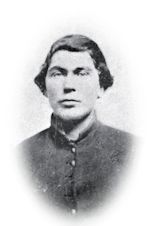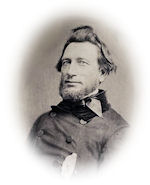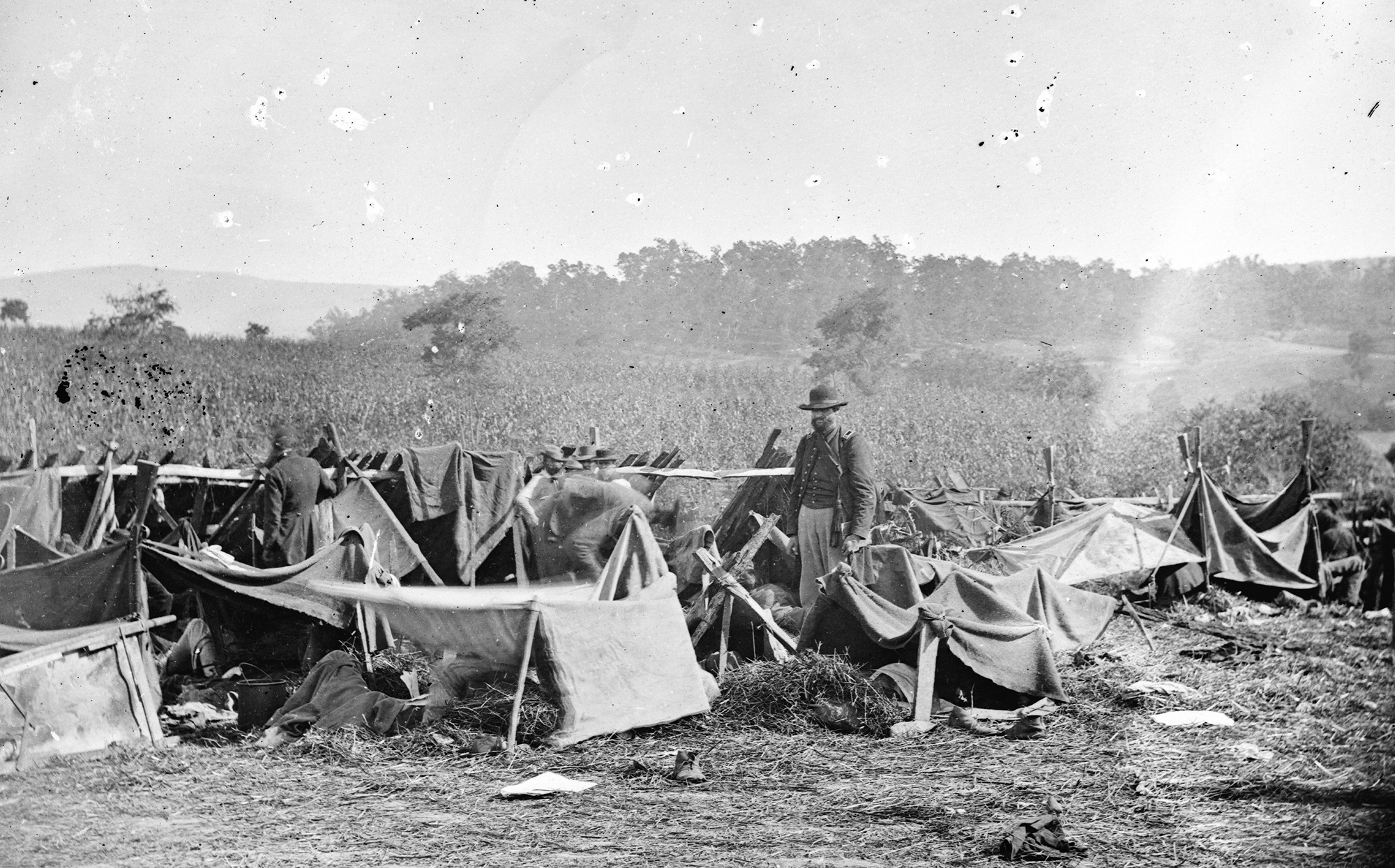
Keedysville, Md., vicinity. Confederate wounded at Smith’s Barn, with Dr. Anson Hurd, 14th Indiana Volunteers, in attendance.
Photo by photographer Alexander Gardner.
Library of Congress image.
Keedysville, Md., vicinity. Confederate wounded at Smith’s Barn, with Dr. Anson Hurd, 14th Indiana Volunteers, in attendance.
Photo by photographer Alexander Gardner.
Library of Congress image.
SEPTEMBER 19TH.—And God has blessed us even more abundantly than we supposed. The rumor that our invincible Stonewall Jackson had been sent by Lee to Harper’s Ferry, and had taken it, is TRUE. Nearly 12,000 men surrendered there on the 15th inst., after the loss of two or three hundred on their side, and only three killed and a few wounded on ours. We got 90 guns, 15,000 stand of small arms, 18,000 fine horses, 200 wagons, and stores of various kinds, worth millions.
 [September 19th]
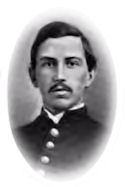
At eight o’clock the next morning, the 19th, the men on the skirmish line, suspecting by the stillness in front that something was up, advanced and found the enemy gone. Immediately the men stood up and all was excitement. The commanding general was notified and promptly ordered Porter’s corps in pursuit, while our corps set to work to succor the wounded and bury the dead. Advancing over the hill we found it covered with dead, mostly our men, but just below in the sunken road over which we originally charged, the rebel dead lay in regular ranks, so close together that it was hard to believe they were not living men in line of battle. Most of them had turned black with the two days’ exposure and it required more than a glance to convince ourselves they were not negro troops. A lot of the gallant Fifty-seventh fellows lay scattered about the hill, the ditch, and cornfield. Amongst them, conspicuous for his neatness and soldierly appearance, was Sergeant Risley, of Co. E, firmly grasping his musket, his features almost as natural as in life, and his appointments perfect in all respects. He was a fine fellow, much above the average in intelligence, and a splendid soldier, and like a soldier died, his face towards the foe. Several men were shot while climbing a rail fence near by, and some of them stuck fast, looking in one or two cases, from a distance, exactly like live men. There were men in every state of mutilation, sans arms, sans legs, heads, and intestines, and in greater number than on any field we have seen before. About noon Colonel Brooke directed me to bury the dead in front of our brigade, and with a strong fatigue party I immediately went to work. In one long grave we buried fifty-three U. S. soldiers gathered on this side of the sunken road, and in two others respectively, one hundred and seventy-three, and eighty-five rebel soldiers; we dug the ditches wide enough to hold two bodies, feet together, heads out, and long enough to hold all those the men had collected. When they were all carefully laid away, we threw over them some army blankets gathered on the field, and then replaced the earth. How many shattered hopes we buried there none of us may ever guess. War is certainly a dreadful thing, and a battlefield an ugly blot on civilization.
The country people flocked to the battlefield like vultures, their curiosity and inquisitiveness most astonishing; while my men were all at work many of them stood around, dazed and awe-stricken by the terrible evidence of the great fight; hundreds were scatered over the field, eagerly searching for souvenirs in the shape of cannon balls, guns, bayonets, swords, canteens, etc. They were all jubilant over the rebel defeat, of course, and claimed for us a mighty victory. I was much amused at the way they stared at me. Had I been the veritable Hector of Troy, I could have scarcely excited more curiosity than while in command of this burial party.
Our brigade moved down to the foot of the hill, immediately after it was known the enemy had decamped, and prepared hot coffee for the first time in three days. We took no immediate part in the pursuit of the rebels, that duty being taken by the cavalry and Porter’s corps.
In the course of the morning, I walked over to the hospital in rear of our lines, located in a house near by, and found General Richardson dangerously wounded, Lieutenant Bell of my regiment with his skull crushed, and Throop shot through the arm, which will probably necessitate its amputation. Bell was left on the battlefield all night, when some of his men discovered him still breathing. They carried him to the hospital, and he is still alive, with a remote possibility of pulling through. While our losses are heavy, they are said to be a mere bagatelle to those of the right wing. Twenty thousand men, it is claimed, were killed and wounded during the battle, which seems too enormous to be true.
General W. S. Hancock arrived on the field about 3 P. M. the evening of the fight, from Smith’s division, and assumed command of the division. He is a fine, soldierly looking officer, and distinguished himself, in a mild way, at the affair of Williamsburg. He brought two aides along with him, Lieutenants Mitchell and Parker. Mitchell is a tall, slim young fellow, who looks every inch a soldier. In this battle the Fifty-seventh and Third brigade came out with flying colors, every one admitting they behaved with exemplary gallantry, and achieved great success. In the charge, besides those killed and wounded, we captured several hundred of the enemy, rushing right over them and sending them to the rear. Two or three flags at least were captured, and so the regiment and brigade in a measure, were compensated for their heavy list of casualties. Our gallant Parisen fell in the cornfield at the head of his regiment. He was the kindest and bravest of men, and perhaps the best loved officer in the regiment. He was very good to me, and together we have spent many hours in search of recreation. He was very handsome, tall, straight and manly, and his death is a veritable loss to the service. Other Fifty-seventh officers killed are Folger of Company I, and Higbee of Company H, Throop, Britt, Jones, and Bell are wounded. The whole loss of the regiment is something over a hundred, which is wonderful, considering the fire they were exposed to.
September 19. [Chattanooga] —I have been kept quite busy ever since I came here; in fact, we all have been. We have a good deal to try us, but our minds were made up to expect that before we came. The stove smokes badly, and we find it almost impossible to do any thing with it; besides it is so small that we scarcely have room to cook on it what little we have. The surgeon, Dr. Hunter, like many other men, is totally ignorant of domestic arrangements, and also, like many others, wholly unaware of his ignorance. The only consolation we get from him is a fabulous tale about a woman (a “Mrs. Harris”) who cooked for five hundred people on the same kind of a stove.
One of our greatest trials is want of proper diet for sick men. We do the best we can with what we have—toast the bread and make beef-tea; and we have a little butter—bad at that.
There are no changes of clothing for the men; but we have cloth, and after our day’s work is done, we each make a shirt, which is a great help. The last, though by no means the least, of our troubles is the steward, who has taken a dislike to us, and annoys us in every little petty way possible. His wife has charge of the wards across the street from us. The assistant surgeon complains of her inattention to her duties in waiting on the sick.
A man, by the name of Watt Jones, died in my ward to-day; another, by the name of Allen Jones, yesterday—both members of the Fourth Florida Regiment.
Our room is in the third story, facing the west; the view from it is really grand, and when worn out physically and mentally, I derive great pleasure from looking out. On the north of us runs the Tennessee River; opposite there is a range of hills—one rising above the other—dotted with beautiful residences, surrounded by prettily laid out gardens. On the southwest, is Lookout Mountain, its peak frowning down on the river, which winds around its base—looking like a lion couchant, ready to spring on its prey.
September 19.—General McClellan, from his headquarters near Antietam, Md., sent the following despatches to the War Department at Washington:
8.30 A.m.—But little occurred yesterday except skirmishing. Last night the enemy abandoned his position, leaving his dead and wounded on the field. We are again in pursuit I do not know whether he is falling back to an interior position or crossing the river. We may safely claim a victory.
10.30 A.m.—General Pleasanton is driving the enemy across the river. Our victory is complete. The enemy is driven back into Virginia. Maryland and Virginia are now safe.
—In the rebel House of Representatives in session at Richmond, Va., Mr. Foote offered the following resolution:
Resolved, by the Congress of the confederate States of America, That the signal success with which Divine Providence has so continuously blessed our arms for several months past, would fully justify the confederate Government in despatching a commissioner or commissioners to the Government at Washington City, empowered to propose the terms of a just and honorable peace. —Richmond, Examiner, September 20.
—General Halleck issued the following circular from his headquarters at Washington:
“Major-General Foster, commanding the Department of North-Carolina, has called attention to an article in the New-York Evening Post of September 4, in which is published the numbers and positions of his troops. He remarks that the New-York papers always reach the enemy in a few days after publication, and that such information from our friends is more injurious than that gained by the rebel spies. The newspaper press is earnestly requested to make no publication in regard to the numbers and movements of our troops.
“No information could be more desirable to the enemy than this. Such publications have done immense injury to our cause.”
—The funeral exercises over the remains of Major-General Reno took place to day in Trinity Church, Boston, Mass. Bishop Eastman officiated. Governor Andrew and other State officials were present
—The battle of Iuka, Mississippi, was fought this day by the National forces under General Rosecrans and the rebels under the command of General Price.—(Doc. 126.)
Rienzi, Thursday, Sept. 18. We awoke in a wet bed, it having rained very hard the latter part of the night. We received orders to march for Jacinto at 3 A. M. but countermanded before doing any harm save the usual harnessing up by the drivers about 9 A. M. The prisoners captured at Danville, twenty-three in number, including two captains, were marched to headquarters.
18th—7 A. M.—All night the litter-bearers were passing by and over me where I lay on the ground They were bearing off the wounded. I had worked from daylight till 11 at night, and was exhausted. Yet I could not but reproach myself for resting whilst these men were at work among the sufferers. I could not help it. My Assistant Surgeon left me on our arrival at the battle-field. I worked without his aid, and was worn out. From the General’s promise last night, we expect to-day the great fight of the war.
9 o’clock.—No fighting yet. I have ridden over the battlefield of yesterday, and what a scene! The dead in rows—in piles—in heaps—the dead of the brute and of the human race mingled in mass. Here lies the boy of fifteen years, hugged in the death embrace of the veteran of fifty—the greasy blouse of the common soldier here pressing the starred shoulder of the Brigadier. The moans of the wounded draw me further on, and whilst I administered to their wants, the bullets of the enemy’s sharpshooters passing in unpleasant proximity admonished me that I was too far in advance. I returned, and what a comfort to be again amongst the dead! With the wounded I must speak consolation, but could feel none, at least in many instances; and whilst I was leaving dying strangers with their kisses on my hands, and their last prayers for me (because of the hopes I had revived) on their lips, I felt that I had deceived them. But I am again amongst the dead, where no moans, no death struggles, no last prayers excite in me the painful consciousness of impotence to relieve, and with a deep feeling of relief I can say of those around me, that
.
“After life’s fitful fever they sleep well.”
.
At 10 A. M. the battle is not renewed. My regiment, though in line all yesterday and till now, has taken no part in the battle. It will probably open the fight to-day, for which we are all growing impatient. I have scarcely a hope that one half of it will ever return from the attack for which it is so impatient. God preserve it. I love this regiment, and I have now good reason to believe that all my affection is reciprocated. For its sake I- am willing to bear much—risk much. I just learn that we had five Generals badly wounded in the fight yesterday—Mansfield and Richardson, mortally; Hook, Max Weber, (the other I have not. learned.)
No fight yet. Little flags of truce, which none acknowledge, but all respect, are on all parts of the field to-day, and the day is being spent in caring for the wounded, and in burying the dead.
Night has come, but the day brought no fight. The army is disappointed and impatient, and here and there can be heard a complaint at the returning tardiness of McClellan. The universal prayer of the army is that we may be permitted to end this war, now and here. At 10 o’clock at night the flags of truce still wave, and are seen by the bright twinkling of the lanterns over the battle-field. The voice of war is still hushed in the solemnities of burying the dead.
Headquarters 5th Army Corps,
Camp near Sharpsburg, Sept. 18
Dear Father, – I just write you a few lines to let you
know that I am all right so far. Yesterday we had a terrible battle[1] in which we drove the enemy along the whole line. The severe fighting was on the right and left. The centre was slightly engaged. We were in the centre and in the reserve and were not actively engaged. From a hill where we were the whole day we had a fine view of the right and most of the centre. I carried several dispatches during the day. To-day we have been getting up ammunition, etc., and also some 10,000 fresh troops. The enemy greatly outnumber us, but the men are confident and in good spirits. To-morrow a great battle will probably come off, and I hope we shall be successful. . . .
Frank Balch was in the fight yesterday, I suppose. I have not been able to see him yet. . . .
We lost 8 generals yesterday, killed and wounded. . .
[1] The battle of Antietam, or Sharpsburg as it is called in the South.
September 18 — Late yesterday afternoon some of the enemy’s shell set some buildings on fire in Sharpsburg and the flames threw a red glare on the sky that reflected a pale ghostly light over the battle plain strewn with the upturned faces of the dead. Early this morning we went about a mile to the right of the Shepherdstown road, or rather down toward the right of our line, on picket. This afternoon there was some firing between the sharpshooters around and near our picket post. We bivouacked near our picket post. The Yankees came over to-day under a white flag and asked permission to bury their dead.
September 18th.—Thanksgiving-day for our victoriesl We went to church this morning and heard Mr. K’s admirable sermon from 1st Sam., chap, vii., v. 12: “Then Samuel took a stone, and set it between Mizpeh and Shen, and called the name of it Ebenezer, saying, Hitherto hath the Lord helped us.” Oh! I trust that this day has been observed throughout the Confederacy. If all our duties were as easily performed, we should be very good Christians; but, alas! our hearts are often heavy, and do not cheerfully respond to the calls of duty. In prosperity, praise and thanksgiving seem to rise spontaneously to our lips, but to humble ourselves, and feel our entire dependence, is a much more difficult duty.
 Follow on facebook
 RSS
RSS email
email