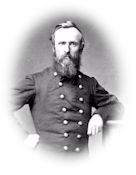
 Thursday, September 18, 1862. — [At] Captain Rudy’s (Jacob Rudy, merchant), Middletown, Maryland. Here I lie nursing my shattered arm, “as snug as a bug in a rug.”
September 12, entered Frederick amidst loud huzzahs and cheering — eight miles. Had a little skirmish getting in; a beautiful scene and a jolly time.
September 13, marched to this town, entered in night — Middletown, Maryland.
September 14, Sunday. Enemy on a spur of Blue Ridge, three and one-half miles west. At 7 A. M. we go out to attack. I am sent with [the] Twenty-third up a mountain path to get around the Rebel right with instructions to attack and take a battery of two guns supposed to be posted there. I asked, “If I find six guns and a strong support?” Colonel Scammon replies, “Take them anyhow.” It is the only safe instruction. General Cox told me General Pleasanton had arranged with Colonel Crook of [the] Second Brigade as to the support of his (General Pleasanton’s) artillery and cavalry, and was vexed that Colonel Scammon was to have the advance; that he, General Cox, wished me to put my energies and wits all to work so that General Pleasanton should have no cause to complain of an inefficient support. The First Brigade had the advance and the Twenty-third was the front of the First Brigade.
Went with a guide by the right flank up the hill, Company A deployed in front as skirmishers. Seeing signs of Rebels [I] sent [Company] F to the left and [Company] I to the right as flankers. Started a Rebel picket about 9 A. M. Soon saw from the opposite hill a strong force coming down towards us; formed hastily in the woods; faced by the rear rank (some companies inverted and some out of place) towards the enemy; pushed through bushes and rocks over broken ground towards the enemy; soon received a heavy volley, wounding and killing some. I feared confusion; exhorted, swore, and threatened. Men did pretty well. Found we could not stand it long, and ordered an advance. Rushed forward with a yell; enemy gave way. Halted to reform line; heavy firing resumed.
I soon began to fear we could not stand it, and again ordered a charge; the enemy broke, and we drove them clear out of the woods. Our men halted at a fence near the edge of the woods and kept up a brisk fire upon the enemy, who were sheltering themselves behind stone walls and fences near the top of the hill, beyond a cornfield in front of our position. Just as I gave the command to charge I felt a stunning blow and found a musket ball had struck my left arm just above the elbow. Fearing that an artery might be cut, I asked a soldier near me to tie my handkerchief above the wound. I soon felt weak, faint, and sick at the stomach. I laid [lay] down and was pretty comfortable. I was perhaps twenty feet behind the line of my men, and could form a pretty accurate notion of the way the fight was going. The enemy’s fire was occasionally very heavy; balls passed near my face and hit the ground all around me. I could see wounded men staggering or carried to the rear; but I felt sure our men were holding their own. I listened anxiously to hear the approach of reinforcements; wondered they did not come.
I was told there was danger of the enemy flanking us on our left, near where I was lying. I called out to Captain Drake, who was on the left, to let his company wheel backward so as to face the threatened attack. His company fell back perhaps twenty yards, and the whole line gradually followed the example, thus leaving me between our line and the enemy. Major Comly came along and asked me if it was my intention the whole line should fall back. I told him no, that I merely wanted one or two of the left companies to wheel backward so as to face an enemy said to be coming on our left. I said if the line was now in good position to let it remain and to face the left companies as I intended. This, I suppose, was done.
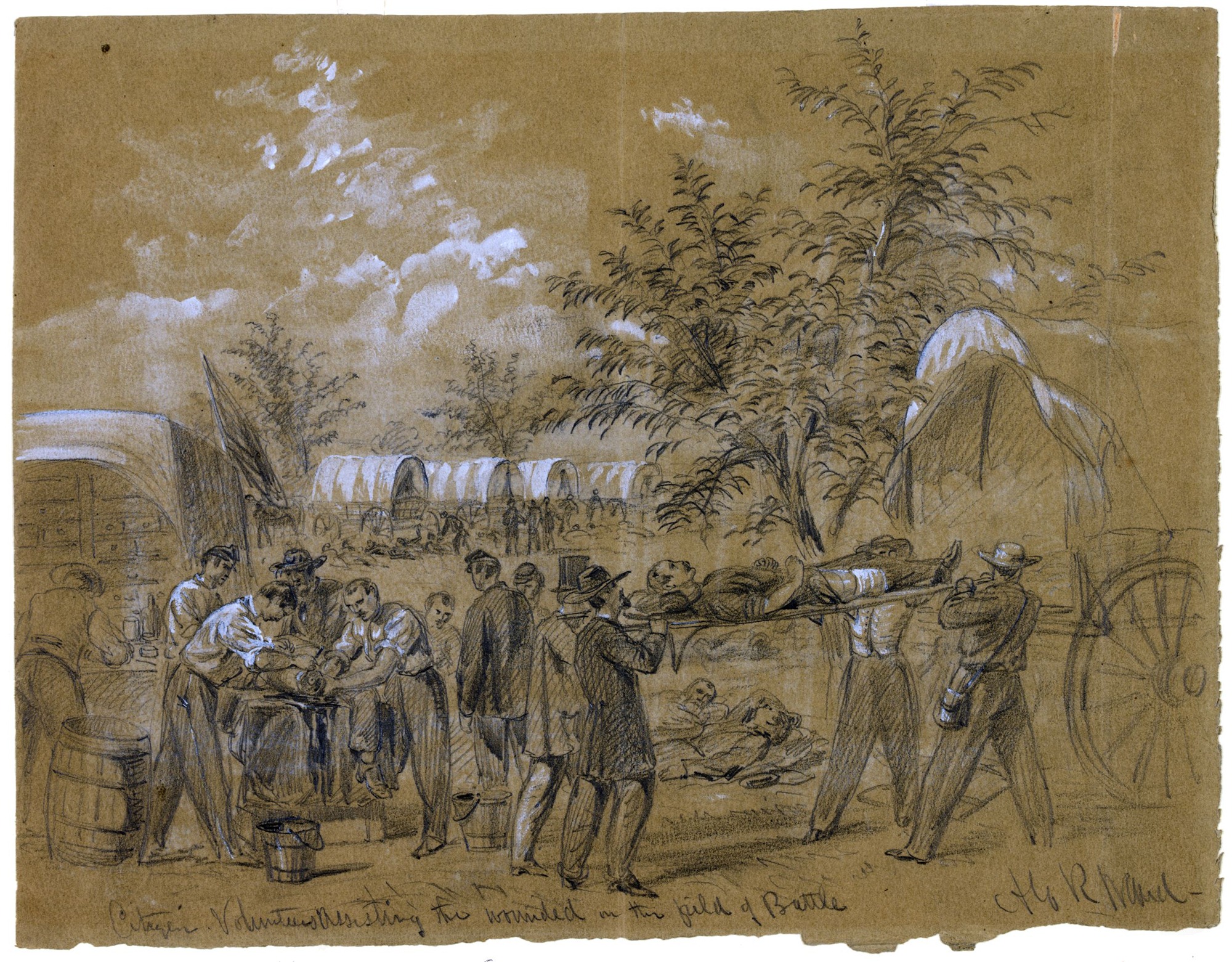
The firing continued pretty warm for perhaps fifteen or twenty minutes, when it gradually died away on both sides. After a few minutes’ silence I began to doubt whether the enemy had disappeared or whether our men had gone farther back. I called out, “Hallo Twenty-third men, are you going to leave your colonel here for the enemy?” In an instant a half dozen or more men sprang forward to me, saying, “Oh no, we will carry you wherever you want us to.” The enemy immediately opened fire on them. Our men replied to them, and soon the battle was raging as hotly as ever. I ordered the men back to cover, telling them they would get me shot and themselves too. They went back and about this time Lieutenant Jackson came and insisted upon taking me out of the range of the enemy’s fire. He took me back to our line and, feeling faint, he laid me down behind a big log and gave me a canteen of water, which tasted so good. Soon after, the fire having again died away, he took me back up the hill, where my wound was dressed by Dr. Joe. I then walked about half a mile to the house of Widow Kugler. I remained there two or three hours when I was taken with Captain Skiles in an ambulance to Middletown — three and a half miles — where I stopped at Mr. Jacob Rudy’s.
I omitted to say that a few moments after I first laid [lay] down, seeing something going wrong and feeling a little easier, I got up and began to give directions about things; but after a few moments, getting very weak, I again laid [lay] down. While I was lying down I had considerable talk with a wounded [Confederate] soldier lying near me. I gave him messages for my wife and friends in case I should not get up. We were right jolly and friendly; it was by no means an unpleasant experience.
Telegraphed Lucy, Uncle, Platt, and John Herron, two or three times each. Very doubtful whether they get the dispatches. My orderly, Harvey Carrington, nurses me with the greatest care. Dr. Joe dresses the wound, and the women feed me sumptuously.
Don’t sleep much these nights; days pretty comfortable.
[Yesterday, the] 17th, listened almost all day to the heavy cannonading of the great battle on the banks of the Antietam, anxiously guessing whether it is with us [or] our foes. [Today, the] 18th, write letters to divers friends.