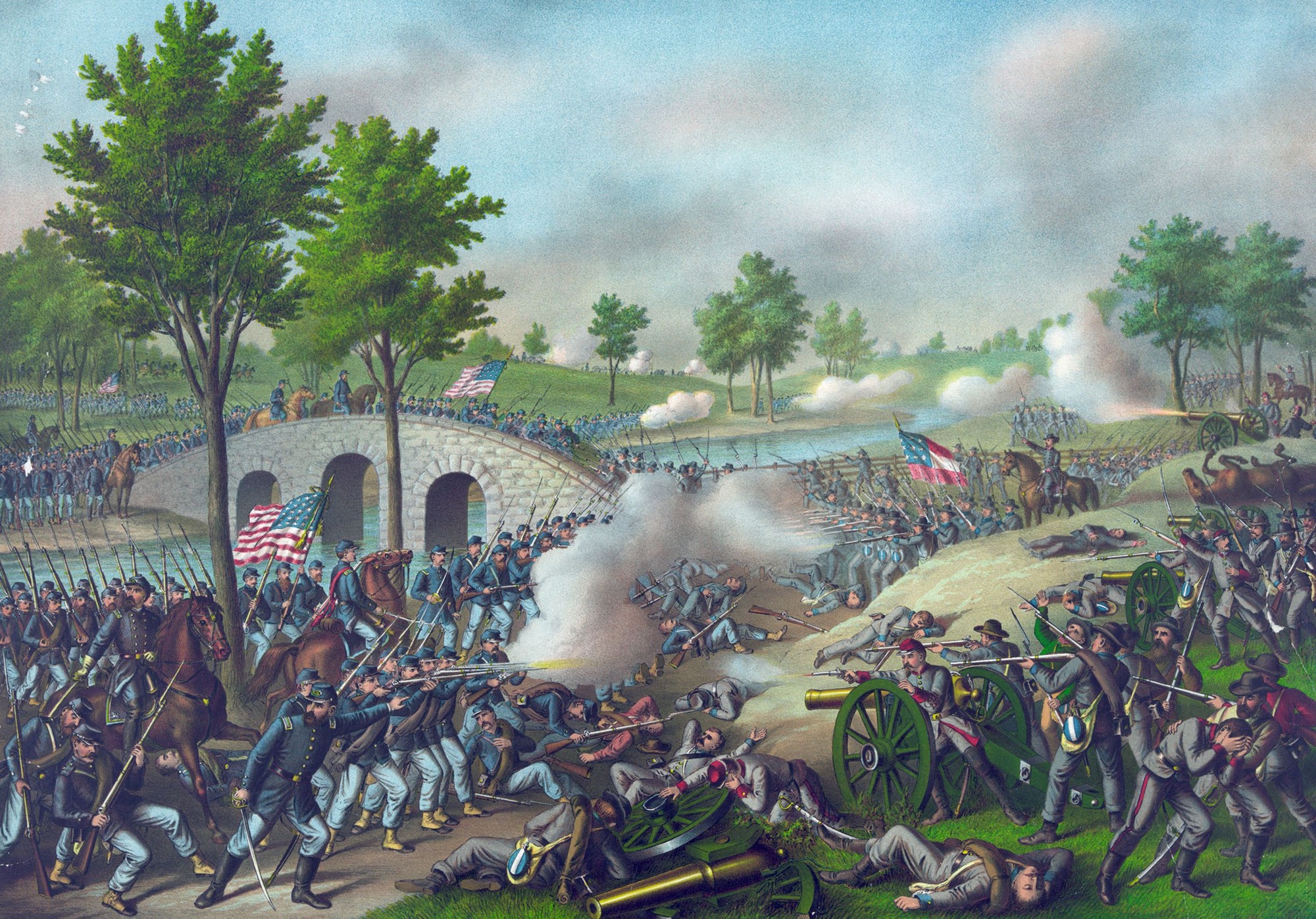
Battle of Antietam – Army of the Potomac: Gen. Geo. B. McClellan, comm., Sept. 17, 1862 …
Kurz & Allison., print : lithograph, color. (© 1888)
Library of Congress image.
Battle of Antietam – Army of the Potomac: Gen. Geo. B. McClellan, comm., Sept. 17, 1862 …
Kurz & Allison., print : lithograph, color. (© 1888)
Library of Congress image.
SEPTEMBER 17TH.—Everything seems to indicate the “breaking up” of the armies of our enemies, as if our prayers had been answered, and the hosts of Lincoln were really to be “brought to confusion.”
[September 17th]
During the night the Eleventh corps, General Mansfield, crossed, and at daylight this morning the combined force commenced an attack which proved to be most sanguinary and without important result. To our astonishment the whole line was not engaged simultaneously, but the old McClellan method of fighting in detail, one corps at a time, the rest of the army looking on. The fight was murderous, the musketry terrific and the number of guns in action almost incredible. About 9 o’clock our division was ordered to follow French, now commanding the Third division across the river, and promptly fell in, marched around the base of the hill into the valley, and crossed at a shallow ford, Caldwell and Meagher in front. We filed off to the left along the stream, and lay down, while Meagher’s brigade supported by Caldwell moved forward to the attack up the hill directly in front. As they approached the summit, they were met by a severe musketry fire, and were shelled by many guns from different directions. The first thing I noticed was General Meagher slip from his horse, and some of the men carrying him to the rear. His brigade, however, marched forward to the crest in beautiful style, but were unable to make further progress. They remained standing in line of battle, loading and firing as fast as they could, their men falling in the ranks every second, and we could see them gradually melting away. Just then Captain Norvell, of General Richardson’s staff, came along, and ordered us forward to relieve them. The order to fall in was given and with nervous force, teeth firmly set and without a word spoken, we marched steadily forward. As we approached the Irish brigade, it opened files and we passed through, immediately coming under a terrific fire of musketry, and artillery. Caldwell, in the meantime, had gone in on our left and gained considerable ground, reaching the crest of the hill. The enemy were in plain sight a very short distance below, and the Fifty-seventh and Sixty-sixth were ordered to charge, which they did, in a most gallant manner, led by Colonel Parisen on horseback. Down the slope, over a sunken road strewn with dead and dying, and into a cornfield pell mell we went, driving the flying rebels before us in splendid shape, bayoneting all who did not promptly surrender. We finally reached a house, since known to be the Piper house, and came under a converging fire or rebel artillery and so were ordered back again, and to the left, taking a position on the slope of the hill overlooking the cornfield. Here the regiment became scattered, and it was some time before it was gotten together under the severe artillery fire. Just at this time Colonel Brooke came up and ordered me to join his staff as aide-de-camp in place of Lieutenant Potts, carried from the field badly wounded. The first thing to do was to reorganize the line. Richardson, on the left, while directing the batteries and infantry as they fell back into new positions, was severely wounded and carried from the field. There was a considerable gap on our right and Colonel Brooke directed me to move up the regiment on the left of Caldwell’s brigade to close it as the enemy were advancing, and there was danger of our line being broken. I walked across the field right on the edge of the cornfield, my ears fairly burning with the singing of the deadly minnie. I could see nothing, but the tips of the cornstalks were constantly toppling over, cut by the rebel infantry fire. When I reached the infantry line, it was lying flat down, and proved to be the Sixty-first New York, commanded by Barlow. The colonel was lying down, too, and I directed him by order of Colonel Brook, to move by the left and close up the gap. To my surprise, he refused to budge, saying he did not recognize Colonel Brooke’s authority. The balls were whistling around me as I stood arguing with him, almost beside myself for chagrin, when Brooke suddenly made his appearance. I told him the colonel refused to recognize his authority, and he, very angry, ordered him instantly to move forward. Barlow got right up, advanced the regiment, and taking the rebels in the flank, gave them a severe drubbing, getting shot himself badly, which I am afraid I thought served him right. Soon afterwards Brooke and I, entirely alone, started for the brigade on the left. As the firing was rather serious, we walked some distance down the side of the hill and then started across. All of a sudden a section of rebel guns appeared on the crest of the hill, unlimbered, and opened fire; they saw us immediately and fired one gun at us exclusively, until we were out of sight, I told the colonel we were certainly in for it now, but he said he did not believe they could hit us anyway, and so we kept right on; the gun plowing up the earth with canister all around us, scattering the dirt and stones everywhere. A piece of shell cut off the colonel’s sword knot, but wonderful to relate, did no further harm. We were not more than seventy-five to one hundred yards distant, on open ground, and could see the operation of loading and firing and the flame of the burning powder bursting out of the cannons’ mouth perfectly. As the colonel seemed to care little for it, and took matters so coolly, I kept up my courage and we talked and walked away until out of range. As soon as the line was re-established we quickly drove these fellows back and so far as we were concerned, the battle was over. While we lay on the ground in position the enemy charged French’s line on our right, but they were so far off when they started, and were in such loose order and small force, that we could easily see they were beaten before they got within range. Cannon everywhere opened upon them, and French’s line, when they came within range, delivered a fire that sent them back much quicker than they advanced. While they were passing our right I took a sergeant’s musket, and fired several long range shots, using the adjustable sight on an Enfield piece. I tried hard, but think it doubtful if I hit any of them.
Burnside commenced an attack on the left in the afternoon which at first seemed successful, ending, however, like most of his undertakings in nothing being accomplished. At sunset, the battle ceased entirely, the victory, although not decisive, undoubtedly being with us. Our men remained throughout the afternoon lying in their ranks, expecting orders every moment for another advance, but none came and we lay in the same position all night. It became very cold during the night, and to keep off the wind we piled up a rampart of dead men and so spent a wretched night. Some of the wounded were brought in during the night by comrades from between the lines, which were very close together. Several times our men hailed the rebel pickets, asking them not to shoot, when the pitious cries of some poor wounded fellow attracted especial notice, and in many cases the friendly Johnnies held their fire, and the victims were brought in.
September 17.—The objects of the invasion of Pennsylvania were thus set forth in the Richmond Dispatch of this day: “The road to Pennsylvania lies invitingly open. There are no regular soldiers on the route, and it would be a task of little difficulty to disperse the rabble of militia that might be brought to oppose them.
“The country is enormously rich. It abounds in fat cattle, cereals, horses, and mules. Our troops would live on the very fat of the land. They would find an opportunity, moreover, to teach the Dutch farmers and graziers, who have been clamorous for this war, what invasion really is. If once compelled to take his own physic, which is a great deal more than he ever bargained for, Mynheer will cry aloud for peace in a very short time. For our own part, we trust the first proclamation of Pope, and the manner in which his army carried it out, will not be forgotten. We hope the troops will turn the whole country into a desert, as the Yankees did the Piedmont country of Virginia.
“Let not a blade of grass, or a stalk of corn, or a barrel of flour, or a bushel of meal, or a sack of salt, or a horse, or a cow, or a hog, or a sheep, be left wherever they move along. Let vengeance be taken for all that has been done, until retribution itself shall stand aghast This is the country of the smooth-spoken, would-be gentleman, McClellan. He has caused a loss to us, in Virginia, of at least thirty thousand negroes, the most valuable property that a Virginian can own. They have no negroes in Pennsylvania. Retaliation must therefore fall upon something else, and let it fall upon every thing that constitutes property. A Dutch farmer has no negroes, but he has horses that can be seized, grain that can be confiscated, cattle that can be killed, and houses that can be burnt. He can be taken prisoner and sent to Libby’s Warehouse, as our friends in Fauquier and Loudon, Culpeper, and the peninsula have been sent to Lincoln’s dungeons in the North. Let retaliation be complete, that the Yankees may learn that two can play at the game they have themselves commenced.
“By advancing into Pennsylvania with rapidity, our army can easily get possession of the Pennsylvania Central Railroad, and break it down so thoroughly that it cannot be repaired in six months. They have already possession of the Baltimore and Ohio Railroad and the York River Railroad. By breaking down these and the railroad from Philadelphia to Baltimore, they will completely isolate both Washington and Baltimore. No reenforcements can reach them from either North or West, except by the Potomac and the bay.”
—Colonel Dunham, in command of the National garrison at Munfordsville, Ky., surrendered to the rebel forces under General Bragg.—(Doc. 121.)
—A fight took place this morning near Durhamville, Tenn., about twenty-five miles southeast of Fort Pillow, between a detachment of one hundred and fifty men, belonging to the Fifty-second regiment of Indiana volunteers, under the command of Lieut. Ross Griffin, and a party of rebels under Lieut.-Col. Faulkner, which resulted in the complete rout of the rebels, with a loss of eight killed and twenty wounded. The National loss was one killed, one missing, and ten wounded.—Surgeon. Martins) Report.
—Colonel George W. Berry, of the Harrison County home guards, left Covington, Ky., with six hundred of Colonel Tevis’s cavalry, for the purpose of reconnoitring up the Kentucky Central Railroad as far as Falmouth. Before reaching Falmouth, the officer in command of the cavalry declined going any further, and started back toward Covington. Colonel Berry was not to be baffled in his enterprise in this way; so he pushed ahead, in company with Greenbury Reed, U. S. Marshal of Bourbon County, and nine other men, and reached Falmouth in a few hours, finding it evacuated by the rebels. The little band had not been there long when twenty-eight Texan Rangers came into the place, and immediately attacked Colonel Berry’s small force. A desperate fight ensued, resulting in the rebels being driven out of the town with a loss of two killed, four wounded, and one prisoner. One of Colonel Berry’s men, named A. McNees, from Harrison County, was badly wounded. This was the only casualty on the National side. The rebels threatened to return soon with a cannon. They burnt the railroad near Falmouth, in their retreat.—Cincinnati Commercial, Sept. 20.
— Brigadier-general L. F. Ross, U.S.A., commanding at Bolivar, Tenn., issued a general order requiring the owners of slaves living within ten miles of that place to send in three fourths of their male slaves, between sixteen and forty-five years of age, to be employed upon the fortifications.—The guerrilla chief Poindexter escaped from the Nationals at Hudson, Mo. — St. Louis Republican, September 18.
—The ship Virginia, of New-Bedford, Mass., was captured and burned by the rebel privateer Alabama, Capt Semmes, in latitude 39° 10′ and longitude 84° 20′. The privateer when first seen displayed English colors, but when a quarter of a mile from the Virginia set the rebel colors and sent an armed boat’s crew aboard. The Captain was informed that he was a prize to the Alabama, and was ordered to take his papers and go on board that steamer. The privateers then stripped the ship of all the valuable articles on board, and at four P.M. set fire to the vessel. On arriving on board the steamer the captain of the Virginia asked Semmes to release him, as he was doing no harm. His answer was: “You Northerners are destroying our property, and New-Bedford people are having their war meetings, offering two hundred dollars’ bounty for volunteers, and send out their stone fleets to block up our harbors, and I am going to retaliate!”—Captain Tilton’s Account.
— This evening, before dusk, a scouting-party of fifty-three of the Tenth Kentucky cavalry, under Major Foley, when near Florence, Kentucky, engaged a party of rebels one hundred and one strong. The rebels, after a short engagement, were routed, with a loss of five killed and seven wounded. Among those killed was one citizen, a rebel sympathizer. The National loss was one killed and one wounded. The enemy sent in a flag of truce, asking permission to bury their dead and take care of their wounded, which was granted.—Cincinnati Commercial, September 18.
— In the rebel House of Representatives, at Richmond, an animated discussion was held on the bill authorizing a suspension of the writ of habeas corpus.
Mr. Conrad, of Louisiana, was in favor of an early opportunity to discuss the bill. If Congress should fail to pass such a law, circumstances might arise in which the President might be compelled to suspend the writ without authority.
The Richmond Examiner in commenting on the debate, strongly denounced the proposition of Mr. Conrad.—Richmond Examiner, Sept. 20.
—The battle of Antietam, Maryland, was fought this day between the National forces under Gen. McClellan and the rebel army commanded by General Robert E. Lee.—(Doc. 122.)
— Lieut.-Colonel Kilpatrick, of the Ira Harris cavalry, made a reconnoissance up the road from Edward’s Ferry to Leesburgh, Va.
At Goose Creek he met a rebel force, and dispersed it with artillery. On arriving at Leesburgh he encountered a regiment of infantry and a battalion of cavalry. A sharp action took place, and the rebels were driven from the town, the Tenth New-York pressing them at the point of the bayonet. A regimental flag, several guns and a number of prisoners were captured.
— Governor Curtin of Pennsylvania announced that seventy-two thousand men had responded to his call for the defence of the State, and that he expected that the number would be increased to one hundred thousand. These men were furnished with equipments, and moved to the State border as rapidly as possible.
— The rebel House of Representatives passed a bill authorizing Jeff Davis to call into the military service, for three years or during the war, all white male citizens of the rebel States, between the ages of eighteen and forty-five years. Such persons to serve their full term; no one being entitled to a discharge because he might have passed the age of forty-five before such term of service expired.
—An expedition consisting of the United States gunboats Paul Jones, Cimerone, and three other steam vessels, left Port Royal, S. C, on the thirteenth instant, and proceeded to the Saint John’s River, Florida, where they arrived to-day. They immediately attacked the rebel batteries, and, after a few hours’ shelling, succeeded in dismounting most of their guns, greatly damaging their breastworks, and completely silencing them.
— Cumberland Gap, Tenn., was evacuated by the National forces under the command of Gen. George W. Morgan.—(See Supplement.)
— In consequence of the reported approach of an the rebel army under General E. Kirby Smith, considerable excitement existed in Louisville, Kentucky. The troops commenced fortifying the city. Negroes were impressed to throw up rifle-pits and dig breastworks.
Rienzi, Tuesday, Sept. 16. We were aroused this morning with the same story of march and ordered to cook three days’ rations and be ready to march at 1 P. M., but did not go and all quieted down again. The 3rd Section went out in the afternoon and stationed itself at bastion No. 5 at 9 P. M. Dispatches were brought around to the effect that McClellan had captured the rebel army of Virginia including General Lee. Nothing could induce us to restrain our joy but the fear of its being false.
September 16— This morning we moved to within a quarter of a mile of Shepherdstown and camped. Shepherdstown is right on the bank of the Potomac in Jefferson County, about ten miles east of Martinsburg. We are camped on the farm near the residence of A. R. Boteler. Morgan Spring, a large and beautiful spring, is near his house.
Tuesday, September 16th.
Yesterday Miriam determined to go to Linwood, and consequently I had a severe task of trunk-packing, one of my greatest delights, however. I hate to see any one pack loosely or in a slovenly manner. Perhaps that is the reason I never let any one do it if I am able to stand. This morning was appointed as our day for leaving, but I persuaded her to wait until to-morrow, in hope that either the General, or news from Virginia, would arrive this evening. Bless this village! It is the meanest place for news that I ever was in. Not a word can be gathered, except what is false or unfounded; and they are even tired of that, in the last few days.
Talk of Baton Rouge turning Yankee, as the report went here! Of the three or four there who took the oath, not one can be compared to some loyal citizens of this small burg. Why, I talked to two gentlemen yesterday who, if it were not for the disgrace and danger incurred by bearing the name, I should style Union men, and talked or rather listened to them, until my spirits were reduced to the lowest ebb. People were shocked at our daring to believe there lived gentlemen and Christians in the North —I mean those wild fanatics, who could only take in one idea at a time, and rarely divested their brains of that one to make room for a newer one, were shocked at our belief; but if they could converse with a few here, that I could point out, our gnat of common sense would be swallowed by this behemoth of heterodoxy.
This morning Mrs. Bar, Miss Bernard, and a Miss Mud came to town and surprised us by a most unexpected visit. They spent the day with us, and have just now driven off on their return home, through this drizzly, misting evening. A while ago a large cavalry company passed, at the corner, on their way from Port Hudson to Camp Moore, the report is. They raised their hats to us, seeing us at the gate, and we waved our handkerchiefs in return, each with a silent “God bless you,” I am sure.
As though to prove my charge unjust, news comes pouring in. Note we a few items, to see how many will prove false. First, we have taken Baltimore without firing a gun; Maryland has risen en masse to join our troops; Longstreet and Lee are marching on Washington from the rear; the Louisiana troops are ordered home to defend their own State — thank God! if it will only bring the boys back! Then comes tidings of nine gunboats at Baton Rouge; Ponchatoula on the railroad taken by Yankees; Camp Moore and three batteries, ditto. Not so cheering! If that is so, Clinton lies within reach, being thirty-five miles off.
Leaving much the most valuable portion of our clothing here, the Yankees will probably appropriate what little they spared us and leave us fairly destitute; for we take only summer clothes to Linwood. I have plenty of underclothes, but the other day, when I unpacked the large trunk from Dr. Enders’s, I found I had just two dresses for winter; a handsome blue silk I bought just two years ago last spring, and one heavy blue merino that does not fit me. What an outfit for winter! Miriam has two poplins and a black silk, and mother a wine-colored merino, only. But each of us is blessed with a warm cloak, and are correspondingly grateful. I was confident I had saved my green, dark blue, and brown silk dresses, but the Yankees saved them instead, for me, or their suffering sweethearts, rather. On the other hand, taking so many necessary articles to Linwood, the risk of losing them is the same. An attack on Port Hudson is apprehended, and if it falls, General Carter’s house will be decidedly unsafe from Yankee vengeance. The probability is that it will burn, as they have been daily expecting ever since the Yankees occupied Baton Rouge. The risk seems equal, either way. Go or stay, the danger seems the same. Shall we go, then, for variety, or die here of stagnation while waiting for the Yankees to make up their minds? I would rather be at neither place, just now; in fact I could hardly name the place I should like to be in now, unless it were Europe or the Sandwich Islands; but I love Linwood and its dear inhabitants, and under other circumstances should be only too happy to be there. I was regretting the other day that our life was now so monotonous; almost longed for the daily alarms we had when under Yankee rule in Baton Rouge. Stirring times are probably ahead.
16th—The mystery is solved. At 8 o’clock yesterday morning, Harper’s Ferry capitulated, (report says, with eight thousand men, forty cannon, and one thousand two hundred horses,) and we have been for two days in sight, and marching less than five miles a day, by a circuitous route. It looks as if the old game is to be re-enacted. Who is there at Harper’s Ferry to be jealous of?
2 P. M.—Tremendous firing along the mountains to our right, some five miles distant. A rider has just arrived from that direction, and reports that Reno’s forces, to the number of ten thousand or fifteen thousand, has surrendered. I do not credit it, but if true, it would indicate a larger force in our front than I supposed, and will explain the necessity of our lying here idle, instead of going to Harper’s Ferry.
But it seems impossible that we could permit two surrenders in one day, in sight of us, and we lie all the while idle. Well, well; we are engaged with the enemy, and shall soon know the worst. Another arrival from Harper’s Ferry. He confirms the story of the surrender there, and says that Colonel Miles capitulated, almost without a fight, and that he was instantly shot by one of his own men. This last story I doubt, though he is certainly shot and mortally wounded. At night, Colonel Miles is dead.
September 16. Chase called on me this morning. Wishes a secret concerted attack on Richmond. Says Stanton will furnish 10,000 men. Told him we would do all that could be expected of the Navy in a sudden movement, but doubted if a military expedition could be improvised as speedily and decisively as he supposed. He thought it could certainly be effected in six days. I told him to try. We would have a naval force ready in that time, though not so large and powerful as I would wish; but we would do our part.
Chase tells me that Harrington, Assistant Secretary of the Treasury, was at Fortress Monroe last Thursday and heard Bankhead, who commands the Minnesota, say that the Government was a poor affair, that the Administration was inefficient, that it is time the politicians were cleared out of Washington and the army in power. Harrington called subsequently and confirmed the statement,—less strong perhaps in words but about as offensive. I requested him to reduce his statement to writing.
At the Executive Mansion, the Secretary of State informed us there was to be no Cabinet-meeting. He was authorized by the President to communicate the fact. Smith said it would be as well, perhaps, to postpone the Cabinet-meetings altogether and indefinitely, — there seemed no use latterly for our coming together. Others expressed corresponding opinions. Seward turned off, a little annoyed.
An unfavorable impression is getting abroad in regard to the President and the Administration, not without reason, perhaps, which prompted Smith and others to express their minds freely. There is really very little of a government here at this time, so far as most of the Cabinet are concerned; certainly but little consultation in this important period. Seward, when in Washington, spends more or less of each day with the President, absorbs his attention, and I fear to an extent influences his action not always wisely. The President has good sense, intelligence, and an excellent heart, but is sadly perplexed and distressed by events. He, to an extent, distrusts his own administrative ability and experience. Seward, instead of strengthening and fortifying him, encourages this self-distrust, but is not backward in giving his own judgment and experience, which are often defective expedients, to guide the Executive. A conviction of this state of things stirred up Smith to make his remarks. The President has, I believe, sincere respect and regard for each and every member of the Cabinet, but Seward seeks, and has at times, influence, which is sometimes harmful. The President would often do better without him, were he to follow his own instincts, or were he to consult all his advisers in council. He would find his own opinions confirmed and be convinced that Seward’s suggestions are frequently unwise and weak and temporizing. No one attempts to obtrude himself, or warn the President, or even to suggest to him that others than S. should be consulted on some of the important measures of the Government. In fact, they are not informed of some of the measures which are of general interest until they see them in operation, or hear of them from others. Chase is much chafed by these things, and endeavors, and to some extent succeeds, in also getting beside the President, and obtaining information of what is going forward. But this only excites and stimulates Seward, who has the inside track and means to keep it. The President is unsuspicious, or apparently so; readily gives his ear to suggestions from any one. Only one of his Cabinet, however, has manifested a disposition to monopolize his attention; but the discussion of important measures is sometimes checked almost as soon as introduced, and, without any consultation, or without being again brought forward, they are disposed of, the Secretary of State alone having had sometimes certainly a view, or car, or eye in the matter. He alone has abbreviated general consultation in many cases. With greater leisure than most of the Cabinet officers, unless it be Smith of the Interior, he runs to the President two or three times a day, gets his ear, gives him his tongue, makes himself interesting by anecdotes, and artfully contrives with Stanton’s aid to dispose of measures without action or give them direction independent of his associates. Under the circumstances, I perhaps am, latterly, as little interfered with as any one, though the duties of the State and Navy Departments run together; yet I am sometimes excessively annoyed and embarrassed by meddlesome intrusions and inconsiderate and unauthorized action by the Secretary of State. The Navy Department has, necessarily, greater intimacy, or connection, with the State Department than any other, for, besides international questions growing out of the blockade, our squadrons and commanders abroad come in contact with our ministers, consuls, and commercial agents, and each has intercourse with the Governments and representatives of other nations. Mutual understanding and cooperation are therefore essential and indispensable. But while I never attempt to direct the agents of the State Department, or think of it, or to meddle with affairs in the appropriate sphere of the Secretary of State, an entirely different course is pursued by him as regards the Navy and naval operations. He is anxious to direct, to be the Premier, the real Executive, and give away national rights as a favor. Since our first conflict, however, when he secretly interfered with the Sumter expedition and got up an enterprise to Pensacola, we have had no similar encounter; yet there has been an itching propensity on his part to have a controlling voice in naval matters with which he has no business, — which he really does not understand, — and he sometimes improperly interferes as in the disposition of mails on captured vessels. The Attorney-General has experienced similar improper interference, more than any other perhaps; none are exempt. But the Secretary of State, while meddlesome with others, is not at all communicative of the affairs of his own Department. Scarcely any important measures or even appointments of that Department are brought before us, except by the President himself or by his express direction. The consequence is that there is reticence by others and the Government is administered in a great measure by Departments. Seward is inquisitive and learns early what is doing by each of his associates, frequently before we meet in council, while the other Cabinet officers limit themselves to their provided duties and are sometimes wholly unadvised of his.
I have administered the Navy Department almost entirely independent of Cabinet consultation, and I may say almost without direction of the President, who not only gives me his confidence but intrusts all naval matters to me. This has not been my wish. Though glad to have his confidence, I should prefer that every important naval movement should pass a Cabinet review. To-day, for instance, Wilkes was given the appointment of Acting Rear Admiral, and I have sent him off with a squadron to cruise in the West Indies. All this has been done without Cabinet consultation, or advice with any one, except Seward and the President. The detail and the reserve are at the instigation of Seward, who wished Wilkes, between whom and himself, since the Trent affair, there seems to be an understanding, to have a command, without specifying where. In due time our associates in the Cabinet will learn the main facts and infer that I withheld from them my orders. My instructions to our naval officers, — commanders of squadrons or single ships, — cruising on our blockade duty, have never been submitted to the Cabinet, though I have communicated them freely to each. I have never read but one of my letters of instructions to the President, and that was to Captain Mercer of the Powhatan in command of the naval expedition to Sumter a few weeks after I entered upon my duties, and those instructions were, covertly, set aside and defeated by Seward.
So in regard to each and all the Departments; if I have known of their regulations and instructions, much of it has not been in Cabinet consultations. Seward beyond any and all others is responsible for this state of things. It has given him individual power, but often at the expense of good administration.
In everything relating to military operations by land, General Scott first, then McClellan, then Halleck, have directed and controlled. The Government was virtually in the hands of the General-in-Chief, so far as armies and military operations were concerned. The Administration had no distinct military policy, was permitted to have none. The President was generally advised and consulted, but Seward was the special confidant of General Scott, was more than any one of McClellan, and, in conjunction with Stanton, of Halleck. With wonderful kindness of heart and deference to others, the President, with little self-esteem and unaffected modesty, has permitted this and in a great measure has surrendered to military officers prerogatives intrusted to himself. The mental qualities of Seward are almost the precise opposite of the President. He is obtrusive and never reserved or diffident of his own powers, is assuming and presuming, meddlesome, and uncertain, ready to exercise authority always, never doubting his right until challenged; then he becomes timid, uncertain, distrustful, and inventive of schemes to extricate himself, or to change his position. He is not particularly scrupulous in accomplishing an end, nor so mindful of what is due to others as would be expected of one who aims to be always courteous towards equals. The President he treats with a familiarity that sometimes borders on disrespect. The President, though he observes this ostentatious presumption, never receives it otherwise than pleasantly, but treats it as a weakness in one to whom he attributes qualities essential to statesmanship, whose pliability is pleasant, and whose ready shrewdness he finds convenient and acceptable.
With temperaments so constituted and so unlike it is not surprising that the obsequious affability and ready assumption of the subordinate presumed on and to an extent influenced the really superior intellect of the principal, and made himself in a degree the centralizing personage. While the President conceded to the Secretary of State almost all that he assumed, not one of his colleagues made that concession. They treated his opinions respectfully, but as no better than the opinions of others, except as they had merit; and his errors they exposed and opposed as they deserved. One or two have always been ready to avail themselves of the opportunity. In the early days of the Administration the Cabinet officers were absorbed by labors and efforts to make themselves familiar with their duties, so as rightly to discharge them. Those duties were more onerous and trying, in consequence of the overthrow of old parties and the advent of new men and new organizations, with the great rupture that was going on in the Government, avowedly to destroy it, than had ever been experienced by any of their predecessors.
Whilst the other members of the Cabinet were absorbed in familiarizing themselves with their duties and in preparing for impending disaster, the Secretary of State, less apprehensive of disaster, spent a considerable portion of every day with the President, patronizing and instructing him, hearing and telling anecdotes, relating interesting details of occurrences in the Senate, and inculcating his political party notions. I think he has no very profound or sincere convictions. Cabinet-meetings, which should, at that exciting and interesting period, have been daily, were infrequent, irregular, and without system. The Secretary of State notified his associates when the President desired a meeting of the heads of Departments. It seemed unadvisable to the Premier — as he liked to be called and considered — that the members should meet often, and they did not. Consequently there was very little concerted action.
At the earlier meetings there was little or no formality; the Cabinet-meetings were a sort of privy council or gathering of equals, much like a Senatorial caucus, where there was no recognized leader and the Secretary of State put himself in advance of the President. No seats were assigned or regularly taken. The Secretary of State was invariably present some little time before the Cabinet assembled and from his former position as the chief executive of the largest State in the Union, as well as from his recent place as a Senator, and from his admitted experience and familiarity with affairs, assumed, and was allowed, as was proper, to take the lead in consultations and also to give tone and direction to the manner and mode of proceedings. The President, if he did not actually wish, readily acquiesced in, this. Mr. Lincoln, having never had experience in administering the Government, State or National, deferred to the suggestions and course of those who had. Mr. Seward was not slow in taking upon himself to prescribe action and doing most of the talking, without much regard to the modest chief, but often to the disgust of his associates, particularly Mr. Bates, who was himself always courteous and respectful, and to the annoyance of Mr. Chase, who had, like Mr. Seward, experience as a chief magistrate. Discussions were desultory and without order or system, but in the summing-up and conclusions the President, who was a patient listener and learner, concentrated results, and often determined questions adverse to the Secretary of State, regarding him and his opinions, as he did those of his other advisers, for what they were worth and generally no more. But the want of system and free communication among all as equals prevented that concert and comity which is really strength to an administration.
Each head of a Department took up and managed the affairs which devolved upon him as he best could, frequently without consulting his associates, and as a consequence without much knowledge of the transactions of other Departments, but as each consulted with the President, the Premier, from daily, almost hourly, intercourse with him, continued, if not present at these interviews, to ascertain the doings of each and all, though himself imparting but little of his own course to any. Great events of a general character began to impel the members to assemble daily, and sometimes General Scott was present, and occasionally Commodore Stringham; at times others were called in. The conduct of affairs during this period was awkward and embarrassing. After a few weeks the members, without preconcert, expressed a wish to be better advised on subjects for which they were all measurably responsible to the country. The Attorney-General expressed his dissatisfaction with these informal proceedings and advised meetings on stated days for general and current affairs, and hoped, when there was occasion, special calls would be made. The Secretary of State alone dissented, hesitated, doubted, objected, thought it inexpedient, said all had so much to do that we could not spare the time; but the President was pleased with the suggestion, if he did not prompt it, and concurred with the rest of the Cabinet.
The form of proceeding was discussed; Mr. Seward thought that would take care of itself. Some suggestions were made in regard to important appointments which had been made by each head of Department, the Secretary of State taking the lead in selecting high officials without general consultation. There seemed an understanding between the Secretaries of State and Treasury, who had charge of the most important appointments, of which understanding the President was perhaps cognizant. Chase had extensive patronage, Seward appointments of high character. The two arranged that each should make his own selection of subordinates. These two men had political aspirations which did not extend to their associates (with perhaps a single exception that troubled neither). Chase thought he was fortifying himself by this arrangement, but he often was overreached, and the arrangement was one of the mistakes of his life.
Without going farther into details, the effect, and probably the intention, of these proceedings in those early days was to dwarf the President and elevate the Secretary of State. The latter also circumscribed the sphere of [the former] so far as he could. Many of the important measures, particularly of his own Department, he managed to dispose of, or contrived to have determined, independent of the Cabinet.
My early collision with him in some complications connected with the Sumter and Pensacola expeditions, when he was so flagrantly wrong as to be overruled by the President, caused us to get along thenceforward without serious difficulties, though, our duties being intimate, we were often brought together and had occasional disagreements. Between Seward and Chase there was perpetual rivalry and mutual but courtly distrust. Each was ambitious. Both had capacity. Seward was supple and dexterous; Chase was clumsy and strong. Seward made constant mistakes, but recovered with a facility that was wonderful and almost always without injury to himself; Chase committed fewer blunders, but persevered in them when made, often to his own serious detriment. In the fevered condition of public opinion, the aims and policies of the [two] were strongly developed. Seward, who had sustained McClellan and came to possess, more than any one else in the Cabinet, his confidence, finally yielded to Stanton’s vehement demands and acquiesced in his sacrifice. Chase, from an original friend and self-constituted patron of McC, became disgusted, alienated, an implacable enemy, denouncing McClellan as a coward and military imbecile. In all this he was stimulated by Stanton, and the victim of Seward, who first supplanted him with McC. and then gave up McC. to appease Stanton and public opinion.
Tuesday, September 16th.—The papers to-day give no account of our army in Maryland. General Loring has been successful in the Kanawha Valley, in driving the enemy, taking prisoners, and 5,000 stand of arms, etc. Our success in the West still continues. Kentucky is represented to be in a flame of excitement. General Kirby Smith asks for 20,000 stand of arms to be sent him to arm Kentuckians, who are rushing to his standard. Cincinnati preparing for defence, etc.
Yesterday I was surprised and delighted to see my nephew, W. B. C. After passing through the bloody fight at Manassas, he found he could not march into Maryland, in consequence of the soreness of his wound received last spring at Kernstown. He gives a graphic account of our army’s trials, tribulations, and successes at Manassas. Our dear ones all passed safely through the fights.
Winchester once more disenthralled. My dear S. B. S. about to return to her home there—but in what state will she find it? When Jackson drove Banks down the Valley, Dr. S., in passing through Winchester, stepped into the open door of his house; found it had been Banks’s headquarters; the floors covered with papers torn up in haste; the remnant of the General’s breakfast on the dining-room table, and other unmistakable signs of a recent and very hurried departure.
 Follow on facebook
 RSS
RSS email
email