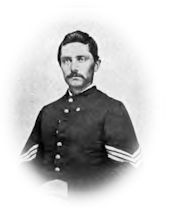
Tuesday, 16th—We drew some clothing today; I got a rubber poncho, which cost $2.50. It is about three by six feet, with eyelets every six inches all around the edges, so by four men going together in bivouac and putting their ponchos over a pole resting on two forks, they will have a roof that will turn rain better than any canvas roof. They are good, heavy rubber cloth.
September 2012
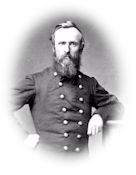
Middletown, September 16, 1862.
Dear Mother: — It would make you very happy about me if you could see how pleasantly and comfortably I am cared for. Imagine Mrs. Wasson and two or three young ladies doing all in their power to keep me well nursed and fed, and you will get a good idea of my situation.
The worst period of my wound is now over. I am, when still, free from pain. A little boy, about Ruddy’s age, (eight or nine) named Charlie Rudy, sits by the window and describes the troops, etc., etc., as they pass. I said to him, “Charlie, you live on a street that is much travelled.” “Oh,” said he, “it isn’t always so, it’s only when the war comes.” Mrs. Rudy’s currant jellies remind me of old times in Delaware.
I hope Lucy will be able to come out to see me. At any rate, I shall probably come home and stay a few weeks when I shall see you. Thus far, the best of the fighting is with us. My regiment has lost largely but has been victorious. — Love to all.
Affectionately,
R.
Mrs. Sophia Hayes.
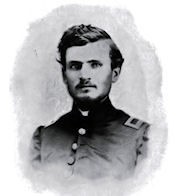
Tuesday, 16th. A rainy, cold and dismal day. Brownell finished a little clamshell ring for me. I polished it up nicely. In the afternoon and evening read “John Brent.” Enjoyed it well. Never read a more thrilling story of a ride. The description of the horse Don Fulano, and his powers was grand. The horse seemed the hero of the tale. Went to town and testified against a prisoner taken while out with Major Burnett. I pitied his poor wife, in tears. Believed the man Union.
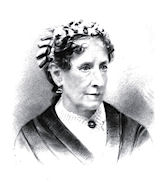
Norwich, Sept 16th, 1862.
My own dear Son:
I have very little reason to believe in the probability of your receiving my many letters, yet I continue to write with the bare possibility that they may some of them reach you. Last night came the news of a glorious victory for us, but alas! also came the sad and sickening news that another of our good and able Generals was killed. In the general rejoicing my heart is heavy, for my dear son was in Reno’s command when I last heard, and I am looking with fear and dread for the terrible list to come from that battlefield. How my God is trying me, and how merciful he has been to preserve my precious son through so many appalling dangers! My heart was so full of sympathy for Mrs. Stevens. I wrote her a letter a few days ago. I saw that her husband was buried at Newport, and an extract from an address delivered on the occasion impressed me wonderfully. We are all occupied by the same train of thought, deepened in intensity of course with some of us by the danger our loved ones are in. I received a very kind letter from Horace a few days since, wherein he dwells upon the birth of your reputation; he says at twenty-four you have won honors enough to suffice for a life time. You are not forgotten, my own son, my heroic boy. Many hearts are watching, eager for every word from you. The extract from your letter in the N. T. Post has attracted the attention of many who know you personally, or have heard of you. They say the account is interesting, and written, too, by one who observes. . . .
17th. To-day our rejoicing is somewhat subdued by the news of the surrender of our forces at Harper’s Ferry. Burnside’s corps is said to have fought splendidly at South Mountain; Reno’s Command is highly complimented, not a man faltered. I am so longing for another letter from you. I see the 79th was in the recent engagements. It seems they are always where work is to be done. I saw, too, that Capt. Pier, of whom I have heard Dr. Elliott speak, was slightly wounded. I trust you have escaped unhurt, that God’s good angels have guarded you, and brought you safely through. I noticed the names of one or two from Co. K, 79th, among the wounded. Uncle John’s faith in Gen. Pope remains firm. Mine is lost, yet I wish all to receive full justice, and am very glad to discover merit among our officers; our men are almost beyond praise.
Miss Abby Bond (Dr. Bond’s daughter) is to be married to-day, to a Mr. Adriance from St. Louis. Nannie Day has come up to attend the wedding. Hunt is in good spirits this morning; he sends love, thinks you are doing great things, and hopes the ball, now in motion, will move until the great end for which it was started is accomplished. He says he sees McClellan has been under a chiropodist, and he is glad to see so glorious a result.
Again, good-bye, my own dear son. I pray that you, so marvellously preserved as a soldier of our country, may likewise always remain a soldier of the Cross. God bless you, guard you, guide you, wherever you may be.
With much love from all, I remain, my precious son,
Always your loving
Mother.
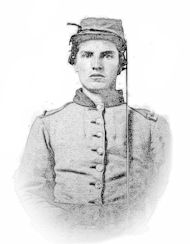
Tuesday, 16th.—Marched twenty-two miles and camped one mile north of Williamstown.
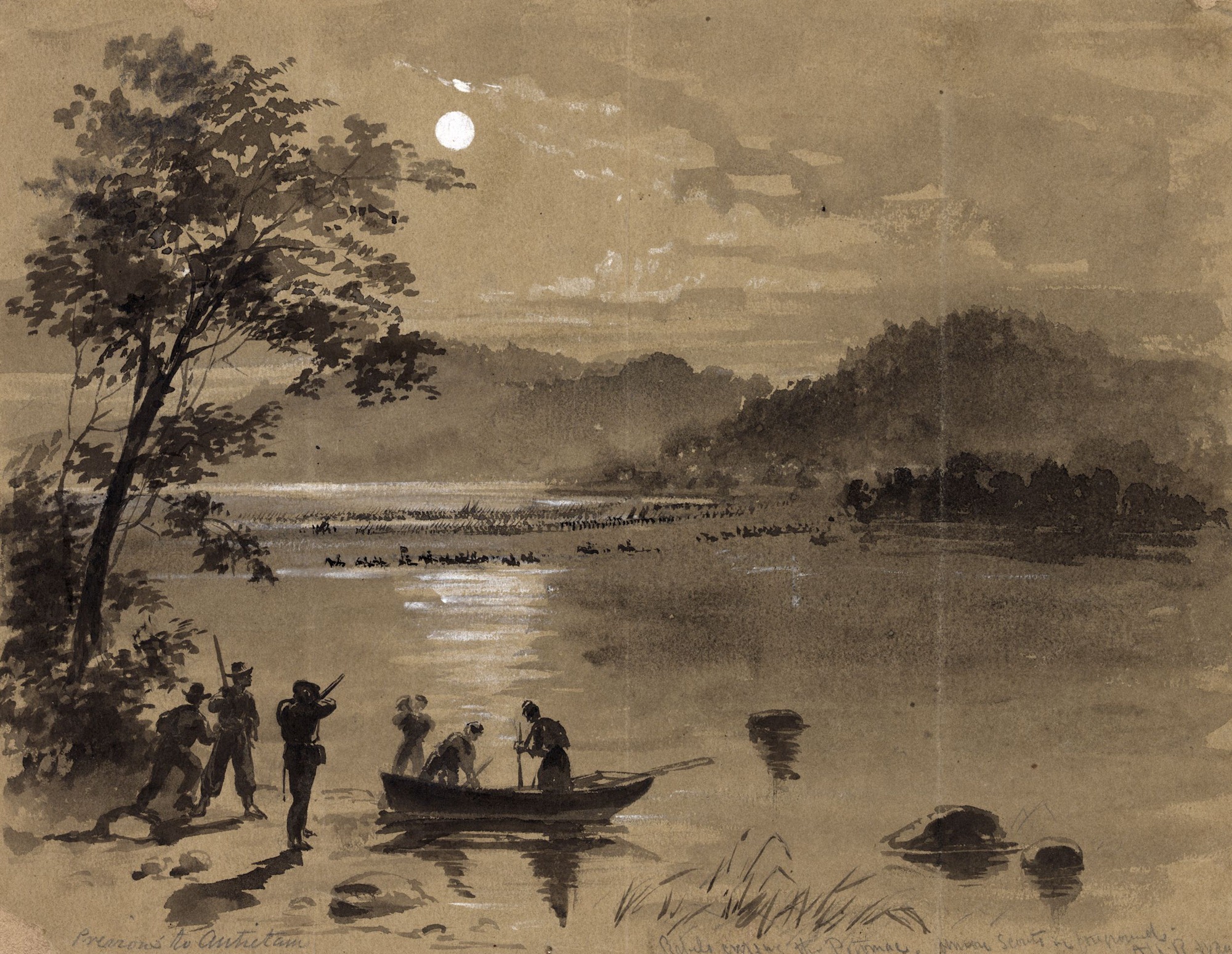
Title: Previous to Antietam. Rebels crossing the Potomac. Union scouts in foreground.
Signed lower right: Alf. R. Waud.
Title inscribed below image.
Library of Congress image.
SEPTEMBER 16TH—Intelligence from Missouri states that the Union militia have rallied on the side of the South.
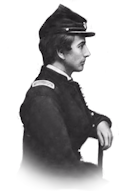
September 16th, Tuesday. Fell in at daylight but remained in position, much to the surprise of everybody. Shortly afterwards an artillery duel commenced, which continued throughout the day. The enemy have an immense number of guns in position, apparently more than we have, and are liberal in the expenditure of ammunition. So far as our own regiment is concerned it had no effect, we simply lay on our backs and speculated as to where certain shells would burst as they went rushing over our heads. But one cannot always attend to one’s own business and the temptation to note the effect of batteries in action is very great. Frequently several of us crept to the top of the hill and there glass in hand, watched the flight of the twenty pounders shell and marked where they struck or exploded. Unluckily these big guns proved almost useless, three of them blowing away their muzzles whilst I was in the battery, of course disabling them. They are made of cast iron with a wrought iron jacket at the breech and are evidently not strong enough for guns of this calibre. The ten pounders of which we have a great many are all right and very popular.
Nothing occurred of interest on our front until towards evening, when Jack Garcon, an O’Malley type of Irish dragoon, aide-de-camp to General Meagher, amused the troops by a display of horsemanship on the top of the hill, in full view of the enemy during the hottest part of the cannonading.
On the right, however, towards evening Hooker crossed and engaged the rebel left, doing a good deal of fighting.
September 16.—I arrived at Chattanooga this morning, about 5 o’clock, having left Dalton on the 15th. Mrs. T. arrived there before I left. Her son was much overcome at the sight of her. Mr. and Mrs. Davis were very kind to me, as was also their niece, an interesting young girl, who had just lost a brother in the service. Mr. D. has two sons in the army. I stopped at Ringgold on the way up. Mrs. M. and Mrs. W. had preceded me, and we are now in the Newsom Hospital. It is a very large one, having been enlarged to double the size it was when we visited it before. The part we occupy is opposite to the wards we formerly visited. We have each a ward assigned us. The house our room is in was a large hotel; Mrs. M. takes charge of it. On the south side is another ward—Mrs. W. in charge—formed of two two-story brick stores; on the north corner is a large brick house three stories high—was a private boarding-house — which is to be under my especial care. It is quite a handsome building. I am much pleased with my portion.
We have a good many patients. One man, by the name of Hughes, died in my ward this morning. He was a member of the Sixteenth Louisiana Regiment. I hope this is not ominous.
We have nothing to cook on but one small stove, and that a smoky one. It cooks for the whole of this side of the hospital. We have nothing to give the men to eat but wheat-bread (very nicely made at the government bakery), fresh beef, rice, tea, and coffee.
We have had no reliable news from the army since it went into Kentucky. A report came a week or two ago that it had reached Covington, and was about to shell Cincinnati. This good news we are almost afraid to believe.
September 16.—Major-Gen. O. M. Mitchel arrived at Port Royal, S. C, and assumed command of the department.—A grand Union demonstration took place at Jefferson City, La.—Paynesville, Stearns County, Minn., was attacked by a party of Indians, who retired after burning one house and committing other depredations.—St. Pau’s Pioneer, September 20.


