
SEPTEMBER 15TH.—Our flag floats over the Capitol at Frankfort! And Gen. Marshall, lately the exile and fugitive, is en-camped with his men on his own farm, near Paris.
September 2012
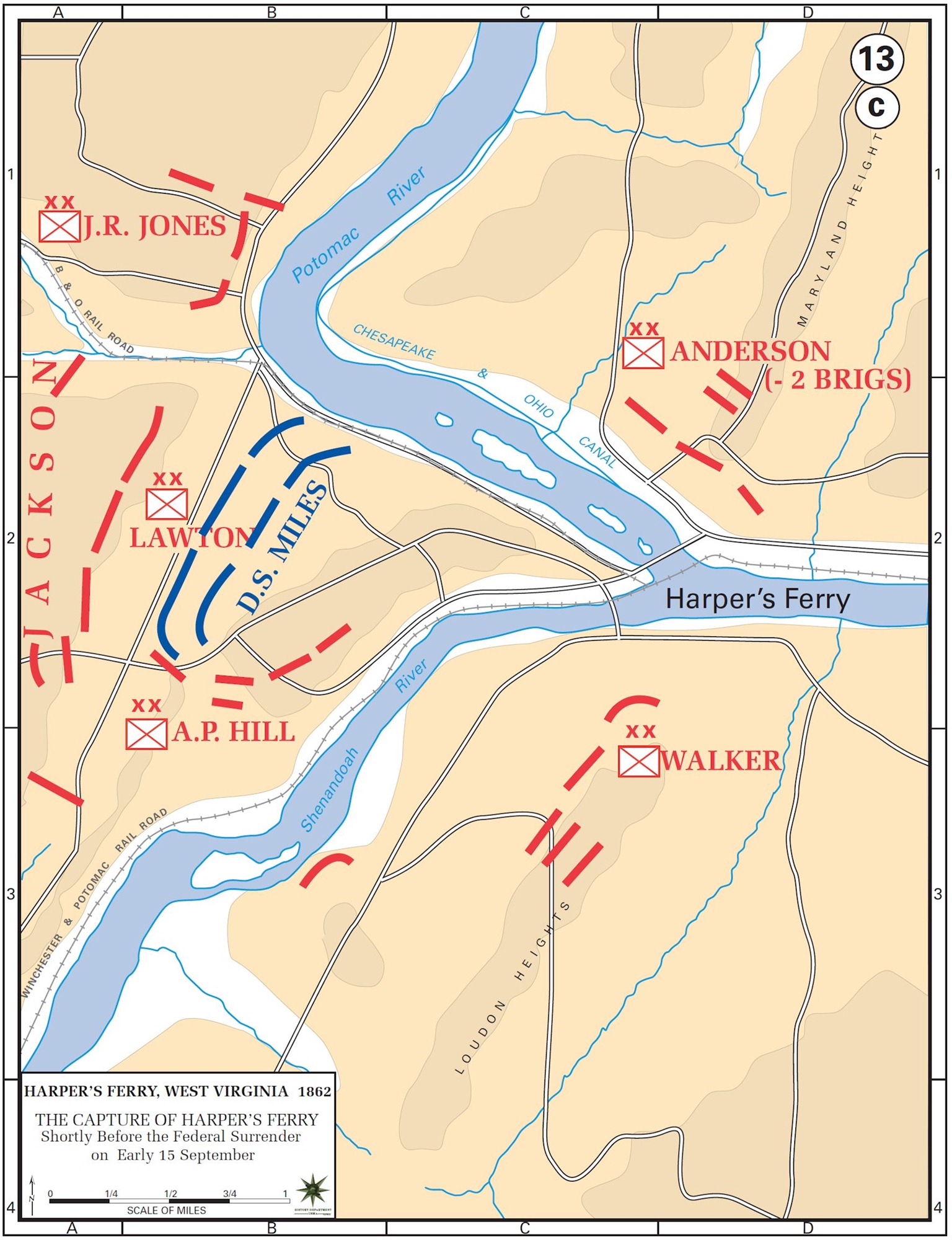
Historical Map of the American Civil War: the Battle of Harpers Ferry – September 15, 1862.
United States Military Academy, Department of History map.
 SEPTEMBER, 1862.
Fellow-citizens,—It is with extreme diffidence and hesitation that I comply with the flattering invitation of your worthy Mayor to address you this evening. I feel, however, that it is the duty of every good citizen, at this moment, to exert what influence he may be able to command, and so I will also raise my feeble and inexperienced voice in the good cause of the Union and the Constitution. We meet here to-night in the midst of the most fearful crisis of our nation’s history. A century has not passed away, and the magnificent edifice raised by the fathers of the Republic to last for all time, and which already spreads its protecting dome from ocean to ocean, is tottering to its very foundations. A deep-laid conspiracy, fanned by sectional passion and reckless leaders into open rebellion, has at last assumed the proportions of a gigantic revolution, against which the immense resources placed by our people at the disposal of the government, have thus far proved powerless.
When the rebellion first broke out, the North, conscious of its strength and the righteousness of its cause, thought that it could, with a slight effort and in a short time, crush it and vindicate the superiority of the law. Our army, hastily collected, full of bravery and patriotism, but badly armed, drilled, and commanded, was, by the insane clamor of meddling politicians, hurled against the fortified stronghold of the rebels, selected and defended by skilful and experienced generals. We suffered a most disastrous defeat—our army was decimated and demoralized, and hardly could claim any longer the name of an army.
The battle of Bull Run was a sad and terrible blow to the Union cause, but we derived one great benefit from it. The government and people awoke to the conviction that political partisans and editors, however meritorious and talented they may be in their sphere, were not the men to lead our brave soldiers to victory. They had to stand aside to make room for the young chieftain called by the President to save the Republic, threatened at the very seat of the Federal government.
George B. McClellan came. Out of chaos and utter confusion he created one of the finest armies of modern days, and that in a space of time not longer than it took military France, with a standing army of five hundred thousand men. to prepare for her last Italian campaign. Then we saw Burnside in the South, and Halleck in the West, drive the rebels like chaff before them; then, under the well-matured plans of our young commander-in-chief, success followed for months our arms, wherever our brave army and gallant navy carried the stars and stripes.
But here again political meddlers and ambitious demagogues step in and arrest our victorious progress. They stop recruiting when men were more than ever wanted to finish up the good work so well begun; they deprive McClellan of the chief command; they interfere with his plans; they reduce his forces, and thus doom our brave Army of the Potomac to defeat and disaster, when months ago Richmond would have been ours had McClellan been left untrammelled. Congress, instead of contenting itself with voting supplies for the vigorous prosecution of the war, and declaring, by an unequivocal attitude, that this war is carried on solely and purely for the Union, the Constitution, and the maintenance of the laws, again throws the apple of discord among us by ill-timed and ill-advised legislation on slavery. Military commanders in Missouri, South Carolina, and Louisiana follow the pernicious example, and instead of attending to their duties as soldiers, issue unauthorized and unconstitutional proclamations calculated to irritate and embitter the South, and estrange it still more from the Union. It is true Mr. Lincoln, whose good and conservative intentions nobody can doubt, disavows these proclamations, but Fremont, Hunter, and Phelps were kept in command by the influence of their Abolition friends, and soon we see the unhappy results of all this.
The South, where, only a few months back, more than one-third of the population was utterly opposed to secession, becomes united as one man; they follow blindly those very leaders against whom so many had battled to the last, but whose predictions that this war was waged by us for abolition and destruction of Southern property, they see now on the eve of being verified.
On the other hand, the North, which, with unexampled unanimity and total oblivion of all party distinctions, had rushed to the defence of our flag, becomes, now, distracted and divided. It was, and is still, ready to fight for the Union and the Constitution, but it is not ready to initiate a war of extermination, and to plunge the South into all the horrors of a servile insurrection. You have seen the fearful consequences of these dissensions and the intermeddling of ignorant politicians and demagogues; our brave soldiers given up to the command of inefficient generals, the flower of our army sacrificed to their ignorance and incapacity, Washington in danger, Maryland invaded, and Pennsylvania threatened.
And now again, as a year ago, the government has to call upon McClellan to save the sinking fortunes of the Republic. For months past he had been traduced and vilified in the halls of Congress and on the floor of the Senate ; his capacity and courage—nay, even his loyalty—questioned by a large portion of the Abolition press; the brave troops, who almost worship him, had been, regiment after regiment, withdrawn from his command, until the man who had created the Army of the Potomac was left with barely a corporal’s guard, while his veteran soldiers were slaughtered by the reckless ignorance of spurious heroes pushed forward by clamorous politicians. He bore all with the fortitude and resignation of a true patriot; he did not issue vaunting proclamations, and he treated the attacks of his enemies with the silent contempt which they merited. Upon the call of his government he quietly and modestly assumed again the high and fearfully responsible position assigned to him. His advent was hailed by the army, and every true lover of the Union, with hopeful joy. Victory, which seemed to have forsaken us forever, perches again upon our glorious banner, and in less than a fortnight from the day on which he assumed command over a beaten and disorganized army, he drives the hungry hordes of Jefferson Davis from the soil of loyal Maryland, upon which they had fallen like a swarm of devastating locusts.
We have now, at the head of our army, Halleck and McClellan, the two men whom the veteran Scott, the hero of a hundred battles, had designated as his worthy successors. Under their leadership our brave army will march on to victory, but if we mean to bring this terrible war to a speedy end, we must furnish more men to fill up our ranks.
My own conviction is, that in order to crush the rebellion we must have one million of men in the field—one-half to be employed in Virginia to beat and disperse the rebel army, the other half to sweep down the Mississippi with an overwhelming force which would make all further resistance hopeless. The rebel Congress has just called out every able-bodied man in the Confederate States between thirty-five and forty-five years old. They expect, thus, to raise three hundred thousand more men, in addition to the three or four hundred thousand whom they have already under arms. This is their last throw in the fearful game in which they are engaged, and you may depend on it they will play it to the bitter end with the recklessness of despair.
The crisis is at hand which is to decide whether we are ever again to be a free and powerful nation, or whether this most wicked and causeless rebellion shall succeed in destroying our liberties and lowering our country to the level of Mexico and Central America. Shall history record that twenty millions, defending the most sacred cause for which nation ever drew the sword, were overcome by one-third their number who had raised their fratricidal hands against the best of governments ? No, it cannot, it must not be!
Men of Rhode Island, the Republic is in danger! Our free institutions, the memory of the past, the hopes of the future, all call upon you to march forth in your country’s cause. Leave your wives and children trustingly behind— a grateful people will protect and care for them. Do not allow demagogues and fanatics to distract you from the legitimate and holy purpose for which alone this war is to be carried on. Inscribe on your banner that you fight for the “Union as it was, and the Constitution as it is,” and God will bless your arms and give you the victory.
And to you who, like me, are deprived by age or physical incapacity of the privilege of drawing your swords in the defence of our liberties, to you I appeal to contribute your money liberally to the good cause which we have all so much at heart. Many a brave and loyal man is only deterred from joining our army by the fear that in his absence his family might suffer want. I have already, on a former occasion, suggested the raising of funds by subscriptions for the purpose of providing for the families of soldiers in this city. I now again renew my suggestions and my offer to subscribe for such a fund. If carried into effect in a judicious and energetic manner, it will do much toward swelling the ranks of the Union defenders.
September 15.—The rebels advanced again towards Cincinnati, Ohio, as far as Florence, and drove in the Union pickets.
—Colonel McNeill had a two hours’ fight with Porter’s gang of guerrillas, near Shelburne, resulting in the complete rout of the latter, with a loss of two killed and a number wounded. Col. McNeill captured twenty wagons and a number of horses and guns.—Ponchatoula, La., was occupied by the National forces under Major George C. Strong, of Gen. Butler’s staff.—(Doc. 208.)
—Harper’s Ferry, Md., surrendered to the rebels under the command of Gen. Jackson, after a contest of three days’ duration.—(Doc. 120.)
Rienzi, Sunday, Sept. 14. Was begun with another of the “strategic moves”. We were told to hitch up with the greatest speed—all our baggage, knapsacks, etc. were put in a wagon, nothing was left to encumber us from a rapid and a desperate fight [in] which we were expected to share. The 3d Section, two regiments of infantry, one of cavalry, started at 3. A. M. But all rumors of the enemy’s presence proved false,, and after lying in the shade, horses hitched, for an hour, we returned, unharnessed and lay quiet all day. The 3rd Section returned at 4 P. M. without seeing any enemy.
September 14 — This morning the shades of night were still lingering over the landscape when we left camp, and early dawn found us on top of South Mountain, looking over the beautiful Middletown Valley that was lying before us like a diversified illuminated map, with its wooded hills, pleasant fields, hamlets, and towns reposing in the quiet calm of a peaceful Sabbath morning. But before the sun shot its first golden lance across the Catoctin range to kiss away the early dew, the booming of Yankee cannon came rolling across from the Catoctin hills, announcing in ominous thunder tones that the Yankee hosts were advancing, and that there would be but little Sunday for soldiers to-day in this part of Uncle Sam’s domain. As soon as we found that the whole Yankee army was on the advance we moved about halfway down the mountain and went in battery ready to work on the first bluecoats that ventured within range of our guns. The cannon we heard so early this morning were at Jefferson, where the Yanks were shelling the woods searching, I suppose, for masked batteries, of which they are most awfully afraid.
There are two principal gaps in South Mountain through which main roads pass that lead west through the Middletown Valley. Turner’s Gap is the most important one, as the National Road which passes through Frederick City, Middletown, Boonsboro, and Hagerstown leads through Turner’s Gap, consequently the heaviest portion of the Yankee forces was hurled against the defenders of that pass to-day. We were at Crampton’s Gap, which is some four or five miles south of Turner’s and, judging from the small force we had there for its defense, it was not considered of much importance from a Confederate point of view. However, the Yankees did not so consider it, from the heavy force of cavalry, artillery, and infantry they brought to bear against it before the day was over. We had only three companies of infantry, Munford’s brigade of cavalry, and six pieces of artillery to defend the pass against at least two, perhaps three, divisions of Yankee infantry, with accompanying artillery and a big bunch of cavalry. At about ten o’clock we saw the first of the Yankee host, about three miles away, approaching our gap cautiously and slowly. As they drew nearer the whole country seemed to be full of bluecoats. They were so numerous that it looked as if they were creeping up out of the ground — and what would or could our little force of some three or four hundred available men standing halfway up a bushy, stony mountain side do with such a mighty host that was advancing on us with flying banners? As they came nearer to the mountain they threw out a heavy skirmish line of infantry on both sides of the road, and were still advancing very slowly when their skirmish line came to within about a mile of our position, so we opened on it with our rifled guns. Our line of fire was right over the village of Burkettsville, and completely checked their skirmishers about half a mile from Burkettsville. The Yanks now brought up a battery and opened fire on us, but they were about two miles off and all their shell fell short. I fired at them in return, but in so doing I disabled my gun. The mountain where we were in battery was a little steep and my gun is a vicious little recoiler, and the recoil space of our position was too sloping, rough, and limited for a free kick, consequently with the second shot that I fired—with a two-mile range—at the Yankees my piece snapped a couple of bolts of its mounting, entirely disabling it for the day. After my gun was damaged there was nothing for me to do but leave the field of action, but before I left I stood for a while and gazed at the magnificent splendor of the martial array that was slowly and steadily moving toward us across the plain below like a living panorama, the sheen of the glittering side-arms and thousands of bright, shiny musket barrels looking like a silver spangled sea rippling and flashing in the light of a midday sun.
The remainder of the battery held its position, and when the enemy advanced to a closer range opened fire and kept it up until nearly night; but late this evening the enemy forced the pass by flanking and fighting, with overwhelming numbers, and compelled our little force to retire. To observe the caution with which the Yankees, with their vast superior numbers, approached the mountain, it put one very much in mind of a lion, king of the forest, making exceeding careful preparations to spring on a plucky little mouse. For we had only about three hundred men actually engaged, and they were mostly cavalry, which is of very little use in defending a mountain pass like Crampton’s Gap, where there is one narrow road leading up the mountain and all the remainder of the immediate surroundings heavily timbered and thickly covered with regular mountain undergrowth and large, loose rocks and boulders.
Crampton’s Gap is really neither gorge nor gap, only a little notch in the crest of South Mountain, and nearly all the fighting to-day in trying to defend it was done on the eastern face of the mountain. It is marvelous how a few hundred of our men held in check nearly all day two divisions of Yankees, besides their artillery and cavalry, and I will venture the assertion that, as usual, correspondents of Northern newspapers will say that a little band of heroic Union patriots gallantly cleaned out Crampton’s Gap, that was defended by an overwhelming force of Rebels strongly posted all over the mountain and standing so thick that they had to crawl over each other to get away.
In retiring our disabled gun from Crampton’s Gap we went to Boonsboro and moved in a southwest direction about four miles on the Shepherdstown road to our wagons, where we arrived at ten o’clock to-night, and camped. In going from Crampton’s Gap to Boonsboro we passed within about half mile of Turner’s Gap, where a portion of General Longstreet’s forces were engaged, fighting desperately right in the gap, which the enemy was assaulting vigorously with a heavy force. The artillery fire was very heavy and the deep-toned thunder of Longstreet’s guns, mingled with the crash of fierce and incessant musketry, raged and roared and rolled along the mountain slopes and made the craggy battlements of South Mountain tremble from base to crest.
Boonsboro is a pretty little town at the western base of South Mountain, on the National Road. The houses are nearly all built of brick and kept in good condition all through the town. Before we got to Boonsboro we passed through Rohrersville, a small hamlet in a pleasant valley, three miles south of Boonsboro. We also passed through Keedysville, a small village three miles southwest of Boonsboro.
Pleasant Valley is a beautiful little mountain vale a mile wide, extending toward Harper’s Ferry along the western foothills of South Mountain.
Sunday, September 14th, 1862.
I have been so busy making Lieutenant Bourge’s shirt that I have not had time to write, besides having very little to write about. So my industry saved my paper and spared these pages a vast amount of trash. I would not let any one touch Lieutenant Bourge’s shirt except myself; and last evening, when I held it up completed, the loud praises it received satisfied me it would answer. Miriam and Miss Ripley declared it the prettiest ever made. It is dark purple merino. The bosom I tucked with pleats a quarter of an inch deep, all the way up to the collar, and stitched a narrow crimson silk braid up the centre to hold it in its place. Around the collar, cuffs, pockets, and band down the front, the red cord runs, forming a charming contrast to the dark foundation. Indeed, I devoted the sole article the Yankees let fall from my two workboxes — a bunch of soutache — to the work. Large white pearl buttons completed the description, and my shirt is really as quiet, subdued, and pretty a one as I ever saw. I should first hear the opinion of the owner, though. If he does not agree with all the others, I shall say he has no taste.
I got a long sweet letter from Sophie on Friday that made me happy for the whole day. They were about leaving for Alexandria. I was glad to hear they would be out of danger, but still I was sorry they were going so far away. I have been laying a hundred wild schemes to reach Baton Rouge and spend a day or two with them, which is impossible now. Sophie writes just as she talks — and that means remarkably well, so I can at least have the pleasure of corresponding. At Dr. Carnal’s they will be out of the reach of all harm and danger; so I ought to rejoice. There is one thing in which Sophie and I agree, and that is in making Stonewall Jackson our hero. Talk of Beauregard! he never had my adoration; but Stonewall is the greatest man of the age, decidedly.
Still no authentic reports of the late battles in Virginia. I say late, referring to those fought two weeks ago. From the Federal accounts, glowing as they usually are, I should gather the idea that their rout was complete. I cannot imagine why we can hear nothing more from our own side. . . .
I think my first act on my return home will be to take a cup of coffee and a piece of bread, two luxuries of which I have been deprived for a long while. Miriam vows to devour an unheard-of number of biscuits, too. How many articles we considered as absolutely necessary, before, have we now been obliged to dispense with! Nine months of the year I reveled in ice, thought it impossible to drink water without it. Since last November, I have tasted it but once, and that once by accident. And oh, yes! I caught some hail-stones one day at Linwood! Ice-cream, lemonade, and sponge cake was my chief diet; it was a year last July since I tasted the two first, and one since I have seen the last. Bread I believed necessary to life; vegetables, senseless. The former I never see, and I have been forced into cultivating at least a toleration of the latter. Snap beans I can actually swallow, sweet potatoes I really like, and one day at Dr. Nolan’s I “bolted” a mouthful of tomatoes, and afterwards kept my seat with the heroism of a martyr. These are the minor trials of war. If that were all — if coarse, distasteful food were the only inconvenience!
When I think of what Lavinia must suffer so far from us, and in such ignorance of our condition, our trials seem nothing in comparison to hers. And think how uneasy Brother must be, hearing of the battle, and not knowing where we fled to! For he has not heard of us for almost two months. In return we are uneasy about him and Sister. If New Orleans is attacked, what will become of them with all those children?
14th.—At 9 o’clock last night we took up our march across Catochtin Mountain. At 9 1-2, as we climbed the mountain side, the moon rose beautifully lighting up hill and valley, and shrub, and tree. ‘Twas all beautiful. The mountain air was brisk and cool. A march of four miles carried us over the mountain, and we bivouaced in Middletown Valley, one of the prettiest countries I ever saw, in the suburbs of the pleasant and flourishing little village of Jefferson. Here we got varied and various estimates of the strength of the enemy, who had passed through. We found here much evidence of loyalty, and were confirmed in the belief that Lee would be disappointed in his expectation of receiving fifty thousand recruits by his raid into Maryland.
Of all the States I have yet seen, Maryland bears off the palm. Its people, its hills, its valleys, its soil, its climate— all bespeak it one of the most favored States of the Union. The loyalty of its people, too, is intense, for whilst the sympathies of nine-tenths of them are with the people of the South, and opposed to our Administration, they positively refuse to join the insurgents in any illegal step. They would like to go out legally, but will fight for execution of the laws which confine them to the Union. The very limited success of Lee, in adding to his already large army in Maryland, is the strongest evidence of their sincerity. May God preserve this beautiful and loyal State from the ravages of actual war, and its people in their horror of treason and rebellion.
‘Tis again Sunday, and again we are fighting all around. How strange that so many of our big fights should occur on Sunday. Six miles to our right, and in full view, Generals Burnside and Sumner are fighting, in an attempt to force a strongly defended mountain pass, one mile and a half in our front, the advance of our own corps are trying to force another pass, (Crampton’s,) whilst seven miles to our left, the fight at Harper’s Ferry is raging. How much hangs on this day.
4 P. M.—Hurrah! Burnside has forced the pass at South Mountain, has crossed and is following up the retreating enemy. He has had a severe fight, with heavy loss on both sides. General Reno, I hear, is killed; another of our best men gone. Some are so uncharitable as to accuse General McClellan of wilfully and unnecessarily ordering him to a position from which escape from death was almost impossible. I will not believe it.
7 P. M.—Hurrah again! General Slocum, from our corps, has forced Crampton’s pass in our front, and is in pursuit. The enemy’s loss is heavy; ours comparatively slight. This is a terrible pass, and it seems wonderful that any army could force it against an opposing foe. It is in the shape of a triangle, the base being at the top of the mountain, the apex at the bottom. Into this narrow point our army had to crowd its way, up a mountain almost perpendicular, whilst musketry and artillery enfiladed our advancing lines at every point. Yet our men, with the cool determination of veterans, forced their way steadily through the Gap, up the precipitous sides of the mountain, and drove the enemy from his stronghold.
Again am I separated from my regiment. Sent for at 8 o’clock, to organize and take charge of another hospital for the wounded; but this time I do not complain. My regiment was not in the fight, and will not suffer by my absence, although I leave it without an Assistant Surgeon. How strange, that in no instance, since the battle of Williamsburg, have I had an assistant in the time of battle. Always sick or out of the way. Could I thus be absent without reproach? Not without self-reproach, at least.

Sunday, 14th—We started early this morning with General Crocker in command and marched fifteen miles without stopping to get a drink. But several of the men became overheated, for it was a dreadfully hot day and the roads were dusty. We reached Corinth at 1 p. m., and going out a mile south of town, stacked arms and remained there the rest of the day. We were nearly famished when we reached Corinth. Our road was on a pine ridge, hot and dusty, with a mile to water on either side, and it was utterly impossible for one to fall out of rank, get water, catch up and get back to his place in line. It was one of the hardest marches I have ever been on.[1] On passing through the town, by the college grounds, the young lady students worked hard at drawing water from the well and giving it to the men to quench their thirst. We bivouacked in a large cotton field, as our teams had not yet arrived with our tents. It commenced to rain about sundown and we lay on the ground without any protection.
[1] The fast march and doing without water so long was all uncalled for, as after we got to Corinth we did nothing but lie around.—A. O. D.

Sunday, 14th. In the morning washed out some shirts, went to the creek and bathed and cleaned up generally. Mac Murray came up and spent the afternoon. He is a good boy. In the evening borrowed “Agnes of Sorrento” from Q. M. S. Mason and read till about 11 o’clock, by Capt. Welch’s permission. The boys were awake late, talking and making a noise. Col. complained about so much noise being made.


