Sunday.—Just returned from church. Mr. K. gave us a delightful sermon on our dependence on God as a people. “When Moses held up his hand, then Israel prevailed; and when he let down his hand, then Amalek prevailed.” Oh, that our hands may always be “held up” for our cause and armies! Next Thursday (18th) is the day appointed by our President as a day of thanksgiving for our successes. His proclamation is so beautiful that I will copy it:
“To the People of the Confederate States:
“Once more upon the plains of Manassas have our armies been blessed by the Lord of Hosts with a triumph over our enemies. It is my privilege to invite you once more to His footstool, not now in the garb of fasting and sorrow, but with joy and gladness, to render thanks for the great mercies received at His hands. A few months since our enemies poured forth their invading legions upon our soil. They laid waste our fields, polluted our altars, and violated the sanctity of our homes. Around our capital they gathered their forces, and with boastful threats claimed it as already their prize. The brave troops which rallied to its defence have extinguished their vain hopes, and under the guidance of the same Almighty hand, have scattered our enemies and driven them back in dismay. Uniting those defeated forces and the various armies which had been ravaging our coasts with the army of invasion in Northern Virginia, our enemies have renewed their attempt to subjugate us at the very place where their first effort was defeated, and the vengeance of retributive justice has overtaken their entire host in a second and complete overthrow. To this signal success accorded to our arms in the East has been graciously added another, equally brilliant, in the West. On the very day on which our forces were led to victory on the plains of Manassas, in Virginia, the same Almighty arm assisted us to overcome our enemies at Richmond, in Kentucky. Thus, at one and the same time, have two great hostile armies been stricken down, and the wicked designs of our enemies set at naught. In such circumstances it is meet and right that, as a people, we should bow down in adoring thankfulness to that gracious God who has been our bulwark and defence, and to offer unto Him the tribute of thanksgiving and praise. In His hand is the issue of all events, and to Him should we in a special manner ascribe the honour of this great deliverance. Now, therefore, I, Jefferson Davis, President of the Confederate States, do issue this, my proclamation setting apart Thursday, the 18th day of September, as a day of thanksgiving and prayer to Almighty God, for the great mercies vouchsafed to our people, and more especially for the triumph of our arms at Richmond and Manassas, in Virginia, and at Richmond in Kentucky; and I do hereby invite the people of the Confederate States to meet on that day, at their respective places of public worship, and to unite in rendering thanks and praise to God for these great mercies, and to implore Him to conduct our country safely through the perils which surround us, to the final attainment of the blessings of peace and security.
“Given under my hand and the seal of the Confederate States, at Richmond, this fourth day of September, A. D: 1862.
“JEFF. DAVIS, Pres. of the C.S.
J. P. BENJAMIN, Sec. of State.”
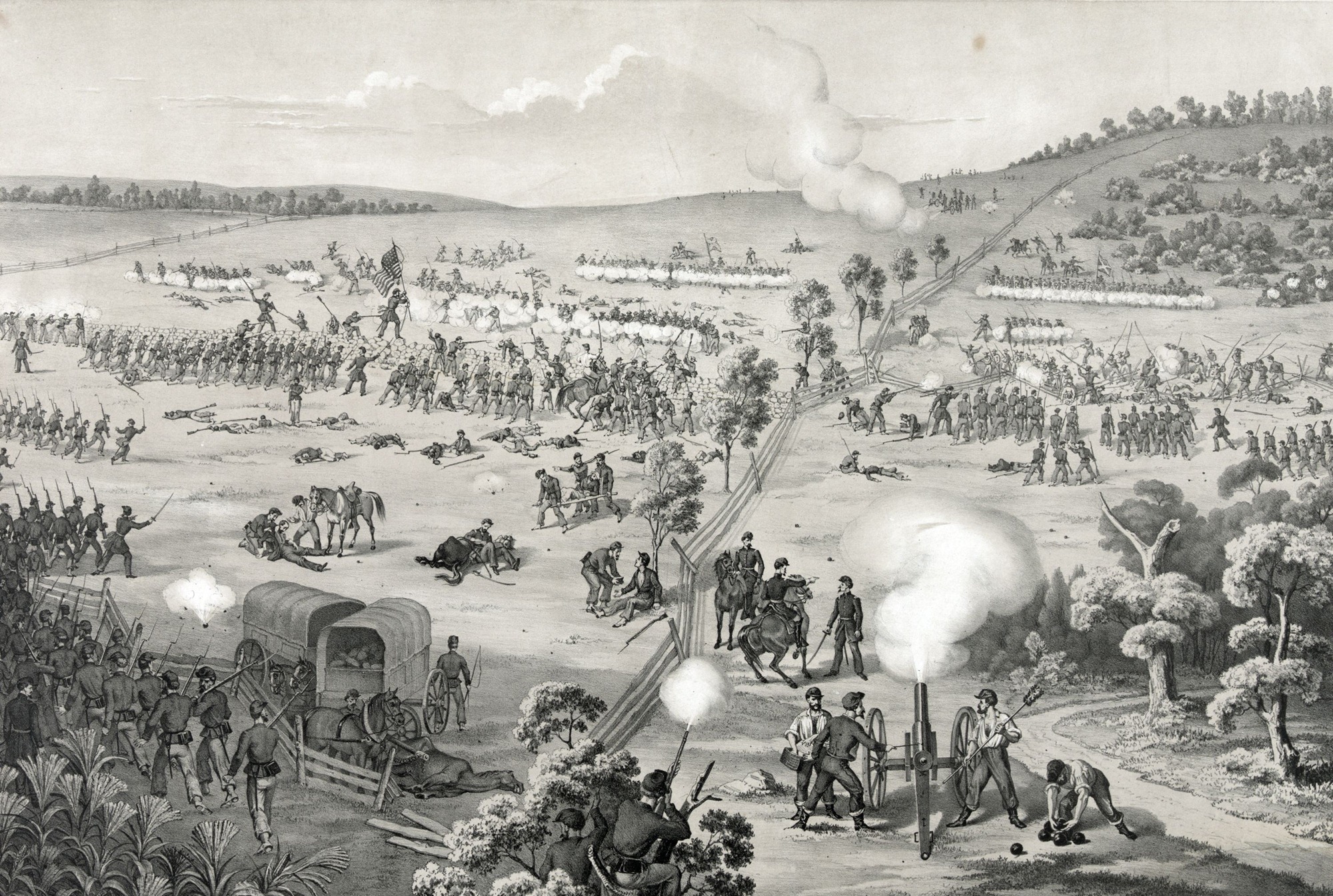
 September 14th, Sunday morning. Early this morning we marched out towards the South Mountains in which direction we heard the sullen sound of an occasional gun. We passed through Boonsboro, and began the ascent of the mountain, forming line of battle as we neared the gap, expecting to find the enemy in possession. Moving slowly, and carefully forward, we soon came upon several dead rebels, and as we aproached the gap the ground was liberally strewn with them, lying behind rocks and boulders, which covered the ascent near the gap. There was a sharp action here yesterday it seems, between Pleasanton’s cavalry, and the First and Ninth corps, and the enemy’s advance guard, the latter being driven back with considerable loss. We met with no opposition and rapidly descended the western slope, marching through Keedysville. As in Frederick City, here too, we were received with tumultuous cheering. All the inhabitants apparently, being in the streets, who showed their patriotism by serving out water, waving their handkerchiefs, etc. They told us the rebels had been there and taken all their provisions and horses and were now only a short distance in front of us. Passing through Keedysville we marched along the Sharpsburg pike towards the Antietam, our brigade leading the corps and the Fifty-seventh the brigade; we were marching at the route step in column of fours, taking it leisurely, Colonel Parisen and I some distance in advance, when all at once we noticed the dust flying suspiciously in many places around us. We halted the column, took out our glasses, and there, directly in front of us, saw the rebel army drawn up in battle array about half a mile in front. To get a better view, I rode up to a fence a short distance ahead, and standing on the top rail, easily made out the long gray lines, extending from left to right, as far as I could see. My further observation from this position was interrupted by a round shot which struck the fence and sent some of the rails spinning out of sight and me to the ground, sans ceremonie; after some delay, General Richardson came up and ordered line of battle formed parallel to the river, which brought our regiment just under the crest of a considerable hill, overlooking the whole country, and from which we subsequently examined the enemy’s lines at leisure. They were admirably posted in rear of the Antietam upon a long line of low hills, commanding the entire valley. The left of our division rested on the Sharpsburg road; Sykes’s division formed on the other side of it as soon as it came up, extending the line well towards the left. During the formation the enemy, who could distinctly see us, shelled us and for a while made things lively. One of our batteries of three inch guns in position on the hill in front of our brigade, replied, but was immediately stopped by General Hooker, who just then came along and directed all offensive operations to cease until more troops came up, as the whole rebel army was in front of us, he said, while the greater part of ours was yet many miles in rear. Fresh columns of troops arrived on the ground continuously, and went into position on either side of us, the reserve artillery as it came up occupying all the commanding positions with heavy guns. A battery of twenty pounder Parrots replaced the three inch guns on the hill, just in front of the Fifty-seventh. During the evening, many of the natives came from the other side and told us what they knew of the enemy’s movements. It seems they only came on the ground about an hour before our division, and were in fact selecting their positions, when the head of our column came in sight. These countrymen say only a part of the rebel army is in front, a considerable force having been detached to capture Harper’s Ferry, which is held by a garrison of ten thousand men under Colonel Miles. We understood this however, several days since, and also that Franklin corps had been detached to try and cut them off, or at least detain them long enough for us to thrash these fellows now in front of us. We slept on the side of the hill, rolled in our blankets, expecting to open the ball at daylight.