September 13. The country is very desponding and much disheartened. There is a perceptibly growing distrust of the Administration and of its ability and power to conduct the war. Military doubts were whispered on the Peninsula by McClellan’s favorites before his recall, and when he was reinstated public confidence in the Administration throughout the country was impaired. Citizens and military, though from different causes, were distrustful. It is evident, however, that the reinstatement of McC. has inspired strength, vigor, and hope in the army. Officers and soldiers appear to be united in his favor and willing to follow his lead. It has now been almost a week since he left Washington, yet he has not overtaken the enemy, who are not distant. There is doubt whether he is thirty miles from Washington. Perhaps he ought not to be, until he has gathered up and massed the dispersed elements of his command. I shall not criticize in ignorance, but insist it is the duty of all to sustain him. I am not without hopes that his late experience and the strong pressure of public opinion will overcome his hesitancy and rouse him to thorough work. He is never rash. I fear he is not a fighting general. Stanton is cross and grouty. A victory for McClellan will bring no joy to him, though it would gladden the whole country.
Rev. Dr. Patton of Chicago, chairman of a committee appointed in northern Illinois, desired an introduction with his associates to the President, to advise with him on the subject of slavery and emancipation. The President assented cheerfully.
Saturday, 13th—We started at 7 o’clock and marched fifteen miles. Bivouacked for the night on the banks of the Tuscumbie river. It was very warm and dusty marching, but all held their places in the ranks. It is said that the rebels’ cavalry which kept up close to our rear guard, had something to do with keeping the men in line, for anyone falling out behind would surely have been taken prisoner.
Frederick, Maryland, September 13, 1862, A. M.
Dearest : — Yesterday was an exciting but very happy day. We retook this fine town about 5:30 P. M. after a march of fourteen miles and a good deal of skirmishing, cannon firing and uproar, and with but little fighting. We marched in just at sundown, the Twenty-third a good deal of the way in front. There was no mistaking the Union feeling and joy of the people — fine ladies, pretty girls, and children were in all the doors and windows waving flags and clapping hands. Some “jumped up and down” with happiness. Joe enjoyed it and rode up the streets bowing most gracefully. The scene as we approached across the broad bottom-lands in line of battle, with occasional cannon firing and musketry, the beautiful Blue Ridge Mountains in view, the fine town in front, was very magnificent. It is pleasant to be so greeted. The enemy had held the city just a week. “The longest week of our lives,” “We thought you were never coming,” “This is the happiest hour of our lives,” were the common expressions.
It was a most fatiguing day to the men. When we got the town, before the formal entry, men laid [lay] down in the road, saying they couldn’t stir again. Some were pale, some red as if apoplectic. Half an hour after, they were marching erect and proud hurrahing the ladies!
Colonel Moor, Twenty-eighth, of Cincinnati, was wounded and taken prisoner in one of the skirmishes yesterday. The enemy treat our men well — very well. We have of sick and wounded five hundred or six hundred prisoners taken here.
Well, Lucy dearest, good-bye. Love to all. Kiss the boys.
Affectionately, ever,
R.
Mrs. Hayes.
Saturday, 13th. In the afternoon a brigade left under General Salomon for Carthage. Dispatches from Col. Weir came, stating a fight was soon expected. I went down and got provisions for 88 men going from our regiment under Capt. Welch. No mail again. Read the latest papers.
Saturday, 13th.—Skirmishing this evening on our right, between a squad of Federal cavalry and General Heth’s bodyguard; four Federals killed; nobody hurt on our side.
September 13.—Darius Sackett was wounded by a musket shot in the leg, at Maryland Heights, Va., and in consequence is discharged from the service.
SEPTEMBER 13TH—Buell has impressed 10,000 slaves, and is fortifying Nashville.
September 13. Remained in bivouac yesterday near Clarksburg, and this morning marched for Frederick City, arriving in the afternoon. As we entered the main street the drums sounded attention, and the troops marched in regular order, with bands playing and colors flying. We were received with open arms by the inhabitants, who crowded the streets and sidewalks, waving handkerchiefs, and showing every manifestation of delight. Women and girls ran into the ranks handing out water, pies, bouquets and handkerchiefs, and were beside themselves with joy. The crowd, indeed, was so great; that we had all we could do to keep our horses from stepping on them. When the Fifty-second regiment reached the principal part of the town, it broke out into one of its sonorous and magnificent war songs, producing a wonderful effect. This is the first real opportunity we have had of showing off to our grateful countrywomen, and we made the most of it, displaying our horsemanship to the best advantage. We passed through the town, going into bivouac on the western side. As soon as the troops were established in bivouac, Colonel Parisen and I rode back to town, ant spent the evening there, meeting a lot of army fellows we had long lost sight of. Frederick City is nearly fifty miles northwest of Washington and is close to the South Mountain range. The whole of the army is near by and the enemy between us and the Potomac.
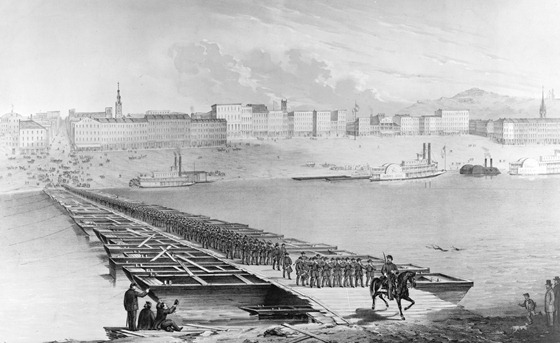
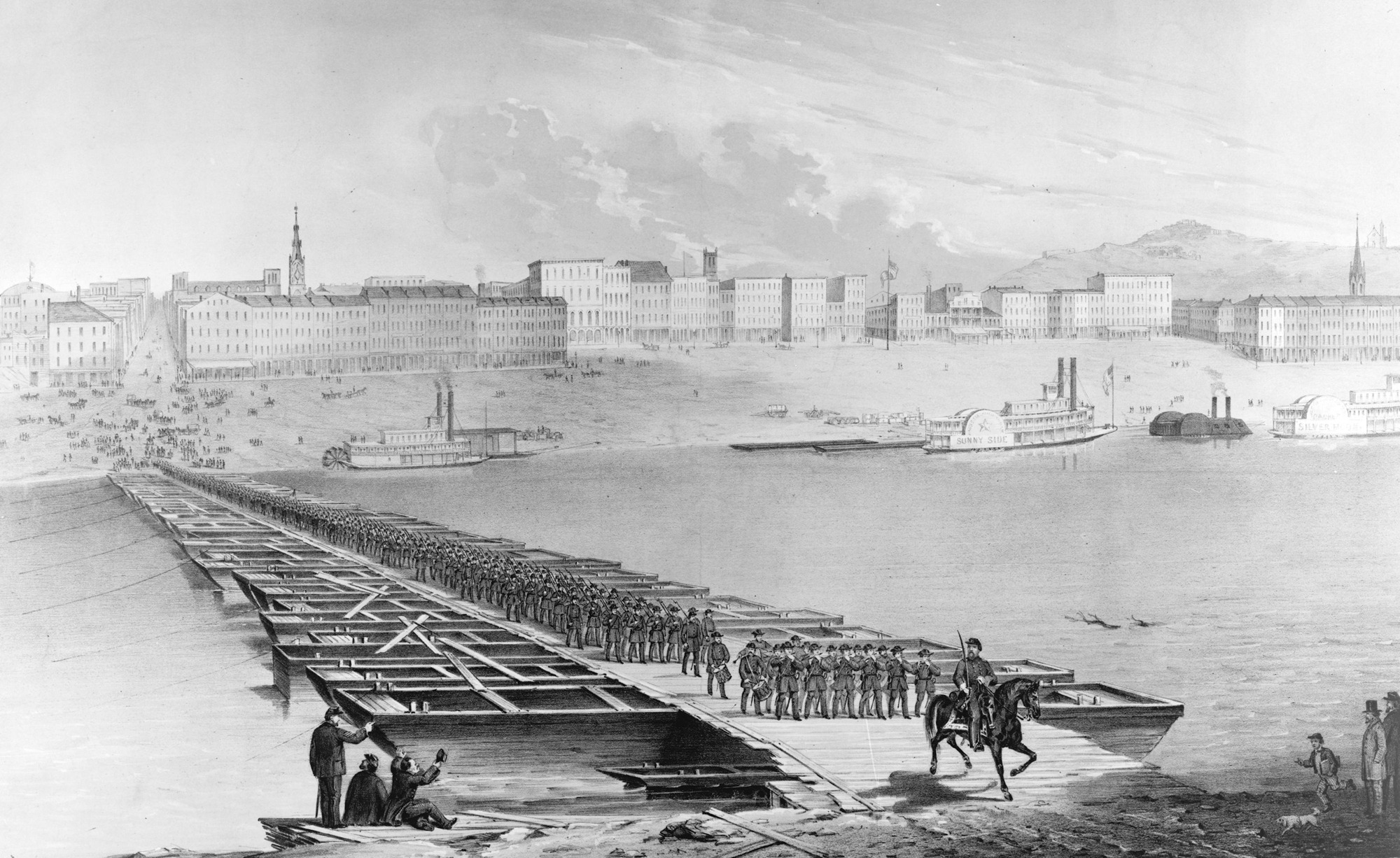
Sketched by A.E. Mathews, 31st Reg’t. O.V.; Print showing Union soldiers of the 21st Regiment of Wisconsin Volunteers marching across a pontoon bridge in Cincinnati, Ohio. (Uncropped image file lists field and staff officers, as well as officers of the line.) Library of Congress image.
September 13.—The military excitement in Philadelphia, Pa., continued. A large number of armed citizens were leaving for Harrisburgh.— The Mayor of Harrisburgh issued a proclamation, forbidding the citizens to leave town under penalty of arrest.
—The rebel chief Porter, with about five hundred guerrillas, made a descent on Palmyra, Mo., this morning and released forty rebel prisoners. He held the town for awhile, but withdrew when he heard an engine from Hannibal whistle. He did no damage whatever.—A force of rebel troops, under the command of Gen. Loring, took possession of the Kanawha salt-works, near Charleston, Va—Richmond Dispatch, Sept. 20.
—The rebels continued the attack upon the Union forces on Maryland Heights, who held the place until three o’clock, when an order was received to spike the guns and remove down the valley to Harper’s Ferry.