SEPTEMBER 12TH.—The ranks of the enemy are broken everywhere in the West. Buell is flying to Nashville as a city of refuge, but we have invincible columns interposed between him and his country.
September 2012
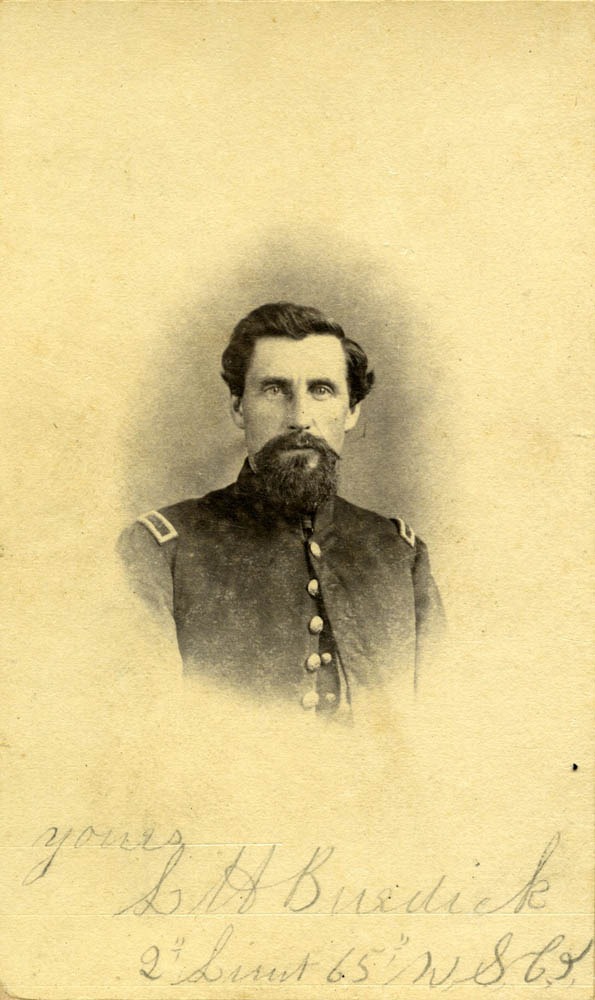
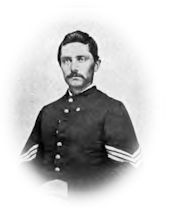
Lucius Burdick enlisted as a private in Company E, 11th Kansas Volunteers, at Emporia, Kansas, on August 25, 1862, and was mustered into service on September 12, 1862. He was promoted to second lieutenant on January 19, 1864, at Benton Barracks, Missouri, and assigned to Company H, 65th U. S. Colored Infantry. Burdick transferred to Company B on November 4, 1864. He was then transferred to Company F on August 15, 1865, and promoted to first lieutenant.
Burdick and the other members of the 65th U. S. Colored Infantry were mustered out of service on January 8, 1867, at Baton Rouge, Louisiana.
Carte-de-Visite by A.D. Lytle, Baton Rouge, La.
_______
The Trans-Mississippi Theater Photo Archive image and information.
Civil War Portrait 009
September 12.—To-day one hundred and eleven rebel prisoners were sent from Fortress Monroe to Aiken’s Landing, Va., for exchange.
—This morning the rebel army under Gen. E. Kirby Smith in full retreat from their position before Cincinnati, Ohio, were pursued by a portion of the Union forces under Gen. Wallace, as far as Florence, Ky.—In view of the invasion of Pennsylvania by the rebel army under General Lee, the City Council of Philadelphia appropriated five hundred thousand dollars for the defence of the city and State, and gave the Mayor of the city full power to act as he might sec fit. The public archives, bonds, and treasure of the State of Pennsylvania and cities of Harrisburgh and Philadelphia were sent to New-York for safe keeping. Many of the capitalists of the State also sent their bonds and treasure.
—A fight took place on the southern bank of Elk River, near Charleston, Va., between a Union force under Col. Lightburn and a large body of rebels, which lasted all day, both parties bivouackng on the field. The Union forces shelled and burned Charleston.
—Capt. Harry Gilmer, of Stuart’s rebel cavalry, with seven other rebel sympathizers, while being “feted by their friends,” were arrested at the house of Dr. T. L. Williamson, seven miles distant from Baltimore, Md., on the Hookerstown road, and carried to Fort McHenry.—The Twenty-first Connecticut, and Eleventh New-Hampshire regiments, under the command of Cols. A . A. Dalton and Walter Harriman, passed through New-York, en route for the seat of war.
—A war meeting of the wholesale grocers was held at New-York City this afternoon, for the purpose of raising an enlistment fund. Mr. Wm. McKenzie called the meeting to order, and nominated G. W. Lane, Esq., for chairman. Dwight Townsend was appointed secretary. Mr. Lane, on taking the chair, made a few appropriate and introductory remarks, after which the following resolution, presented by Mr. Wm. McKenzie, was offered and unanimously adopted: “Whereas, the grocers and the trades connected therewith in the city of New-York desire to aid the Government in suppressing the present rebellion against our Union and Constitution; we do therefore Resolve, that a committee be appointed by the chairman, who shall have full powers to collect money and expend the same in procuring men to enlist as soldiers in the army of the United States, in such a way as shall seem to them most suited to attain the object for which the meeting has been called.” A committee of fourteen was appointed to carry out the object of the resolution.—Bloomfield, Mo., was recaptured by a force of Union troops under the command of Col. Boyd.
—As important debate took place in the rebel House of Representatives at Richmond, Va., upon the propriety of an invasion of the Northern States.—See Supplement.
—The following commands in the army of Virginia were designated by the War Department: First corps, Major-Gen. Hooker; Second corps, Major-Gen. Sumner; Third corps, Major-General Heintzelman; Fourth corps, Major-Gen. Keyes; Fifth corps, Major-Gen. Fitz-John Porter; Sixth corps, Major-Gen. Franklin; Seventh corps, Major-Gen. Dix; Eighth corps, Major-Gen. Wool; Ninth corps, Major-Gen. Burnside; Tenth corps, Major-Gen. Mitchel; Eleventh corps, Major-Gen. Sedgwick; Twelfth corps, Major-Gen. Sigel.
—John Ross, chief of the Cherokee Indians, had an interview with President Lincoln, at Washington, this morning, with regard to the rescue of his nation from the rebels.
—The Union army under General Burnside entered Frederick, Md. A slight skirmish occurred between the Union advance-guard and the rear-guard of the rebel army, in which there were several men killed and wounded on both sides. Great enthusiasm was manifested by the inhabitants, on the appearance of Gen. Burnside and his army.—(Doc. 202.)
—Frankfort, the capital of Kentucky, was occupied by a large force of rebel cavalry under Gen. E. Kirby Smith. He issued a proclamation, informing the citizens that they must fight for him or against him. He also organized a city government and appointed a mayor.—N.Y. Times.
—The attack upon Harper’s Ferry, that position being completely invested by the rebel army, commenced this afternoon in a skirmish with the Union troops upon Maryland Heights, under command of Colonel Ford, lasting until sundown. —(Doc. 120.)
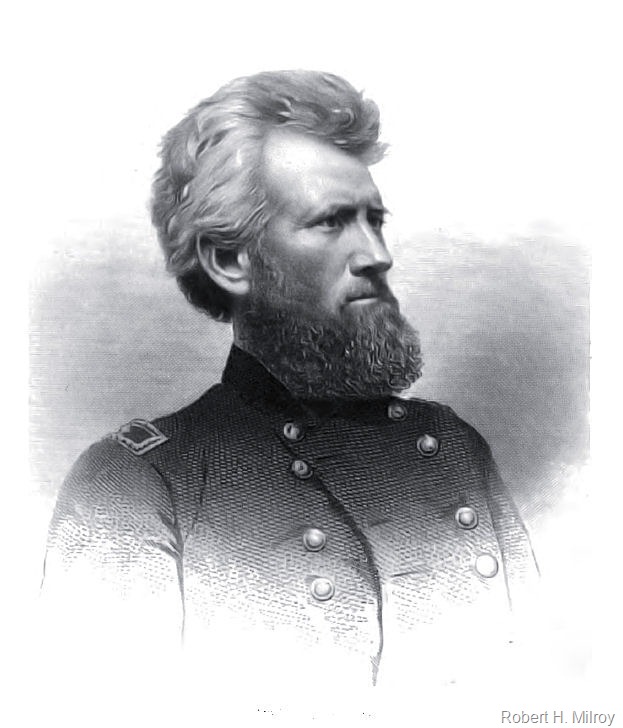
Robert Huston Milroy (June 11, 1816 – March 29, 1890) was a lawyer, judge, and a Union Army general in the American Civil War, most noted for his defeat at the Second Battle of Winchester in 1863. (Wikipedia)
September 12.—No news from the army, except a letter in the morning’s paper speaking of General Lee’s being pleased with his reception in Maryland, and that our troops are foraging in Pennsylvania. I hope so; I like the idea of our army subsisting on the enemy; they certainly have subsisted on us enough to be willing that we should return the compliment. Took leave of our nephew, B. H. M., this morning; he has been here on sick-leave, and has gone in pursuit of his regiment, which is now across the Potomac. Poor child! it was hard to see him go off alone, with his child-like countenance and slender figure; but he is already a veteran in the service, and has a most unflinching, undaunted spirit.
Took a ride this evening with Mrs. D. through the beautiful environs of this city. After getting beyond the hospitals, there was nothing to remind us of war; all was peaceful loveliness ; we talked of days long passed, and almost forgot that our land was the scene of bitter strife. Sometimes I almost fancy that we are taking one of our usual summer trips, with power to return when it terminates ; and then I am aroused, as from a sweet dream, to find myself a homeless wanderer, surrounded by horrors of which my wildest fancy had never conceived a possibility, in this Christian land and enlightened day.
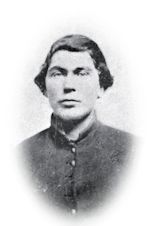
Rienzi, Thursday, Sept. 11. I answered the summons of the reveille, but I did not feel very well; had an attack of the ague but got over it by dinner. Nothing to break the monotony of camp life. Reinforced by one regiment of infantry.
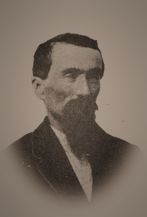
September 11 — This morning we went on picket again on the same road, but did not go to the same place we were yesterday on account of an advance the Yanks made early this morning. We put our guns in position at a schoolhouse about five miles from where we picketed yesterday and about three miles from Urbana. The country around Urbana is full of roads, and to-day the Yanks advanced on several of them at once, but not on the one we were on. They attempted the cutting-off business on us again, but this time we played the fall-back game in due season, before the Yanks had a chance to close in on our rear, like they did the other day at Poolesville. We fell back from our picket post to Urbana and from there to the Monocacy bridge, without firing a shot. We put the battery in position on the bridge,— where the pike crosses the Baltimore and Ohio Railroad,— which thoroughly commands the bridge where the pike crosses the Monocacy and only about three hundred yards distant, which is a first-class range for canister. We are camped this evening on the Monocacy, two miles from Frederick City.
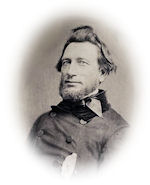
11th.—Generals Hancock’s and Brook’s brigades started this morning, on a reconnoisance towards Sugar Loaf Mountain. There is no longer a doubt that the enemy is in possession of Frederick, and has been for some days. Reconnoitering party discovered no enemy in force. It has rained to-day, and I now prepare to lie down, sick and tired at the foot of the mountain.
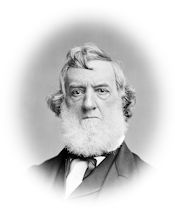
September 11, Thursday. I find it difficult to hurry Wilkes off with his command. The public, especially the commercial community, are impatient; but Wilkes, like many officers, having got position, likes to exhibit himself and snuff incense. He assumed great credit for promptness, and has sometimes shown it, but not on this occasion. Has been fussing about his vessel until I had, to-day, to give him a pretty peremptory order.
Men in New York, men who are sensible in most things, are the most easily terrified and panic-stricken of any community. They are just now alarmed lest an ironclad steamer may rush in upon them some fine morning while they are asleep and destroy their city. In their imagination, under the teachings of mischievous persons and papers, they suppose every Rebel cruiser is ironclad, while in fact the Rebels have not one ironclad afloat. It only requires a sensation paragraph in the Times to create alarm. The Times is controlled by Seward through Thurlow Weed, and used through him by Stanton. Whenever the army is in trouble and public opinion sets against its management, the Times immediately sets up a howl against the Navy.
Senator Pomeroy of Kansas called yesterday in relation to a scheme, or job, for deporting slaves and colored people to Chiriqui. I cautioned him against committing himself or the Government to Thompson, or any corporation or association. Let him know my opinion of Thompson’s project and my opposition to it. Advised him, if anything was seriously and earnestly designed, to go to the Government of New Granada or any of the Spanish-American States and treat with them direct, and not through scheming jobbers. Should suspect P. to have a personal interest in the matter but for the fact that the President, the Blairs, and one or two men of integrity and character favor it.
Thursday, 11th—The brigade received marching orders to leave in the morning at daylight and we packed our knapsacks today. The talk is that we are to go to Corinth. A small force is to be left here to hold the fort, and it will require a large number to take it. Bolivar has some loyal citizens who will be protected in this way, but we are sorry to bid these people good-bye, perhaps for all time to come. We have been in camp here forty-two days and all the time engaged in hard service—on picket, fatigue and patrol duty, besides often in line of battle.
Thursday, 11th. Went down to the post commissary to get provisions. Saw Delos and went down with him to see Charlie. He agreed upon proposal to fill out a program Fred had sent on for the celebration of the 10th, Charlie’s birthday, and anniversary of our enlistment. Issued rations during the day. Charlie came up in the evening and read what he had written. Liked it well. A complete farce to fool the boys. No mail for me in the evening.


