SEPTEMBER 7TH.—We see by the Northern papers that Pope claimed a great victory over Lee and Jackson! It was too much even for the lying editors themselves! The Federal army being hurled back on the Potomac, and then compelled to cross it, it was too transparently ridiculous for the press to contend for the victory. And now they confess to a series of defeats from the 26th June to the culminating calamity of the 30th August. They acknowledge they have been beaten—badly beaten—but they will not admit that our army has crossed into Maryland. Well, Lee’s dispatch to the President is dated “Headquarters, Frederick City.” We believe him.
September 2012
Frederick, Md., Sunday, September 7,1862.
Your two last letters came to hand yesterday, and I was indeed very happy to hear from you. The date of my letter will surprise you. You would have thought it hardly possible that the fortunes of war should have so turned in our favor that this quiet Sabbath would find us here quietly encamped beyond the limits of our own Confederacy. It has cost us much of our best blood and much hardship, but it is a magnificent result, which, I trust, will secure our recognition in Europe, and be a step at least towards peace with our enemies. We left the Rappahannock two weeks ago to-morrow, and such a week as the first was has no parallel in the war. Two days’ severe march brought us about fifty miles to Manassas. That night we had an engagement with the enemy, in which the place was captured and some prisoners. The next day there was another battle, in which Mr. Newman was wounded. That night—Wednesday—we evacuated the place and took up our position adjoining the old battle-ground, and that evening we had another severe engagement, in which Maj .-Gen. Ewell was severely wounded and our loss very heavy. The next day—Friday —we were attacked by the enemy in much larger force, but we repulsed the enemy and at night both armies occupied about the same ground. We expected the battle to be renewed the next morning. The enemy had time to collect his whole force, Pope and McClellan combined, and we had brought up all we had on this side of the Rappahannock. For a while, the lines were unusually quiet, but after a while the picket-firing began to increase, and soon the whole line was engaged. The assault upon our line was very severe, and for a while the tide of battle seemed to turn against us; but our men stubbornly resisted the assault, and soon the enemy’s line gave way, flying in confusion, our artillery playing upon them as they retreated. Our lines were then pushed forward, and by night the enemy was driven from every position. It was a splendid victory, partly fought on the same ground with the battle of Manassas last year. We sustained a very heavy loss, but how much I have no idea. The next day we moved towards Fairfax C. H. The next day—Monday—we had another severe engagement. Tuesday we spent at rest and in cooking. Wednesday we started in this direction, and reached here early on yesterday, without meeting any further obstruction. What next—where do we go—and what is to be done? We will probably know by the end of next week what our General means to do with us. I think it likely we will not stay here, and that this time next week will find us either in Pennsylvania or Baltimore.
I heartily wish with you that the war was over and we were all at home again. But our success depends upon the pertinacity with which we stick to the fight. I think it may not last through another winter. I spend but little time now thinking about business on the farm. I trust it all to you. My duties here are onerous and responsible, occupying my time and mind so completely that I have but little opportunity to think of much else. Not enough, however, to keep me from thinking of dear wife and little ones left at home, and fondly hoping that the day may soon come when I will be with them. It may never come. My fate may be that of many others. Whatever the future may have in store for me, I trust that I am prepared to meet it with becoming resignation.
And now, darling, I will take leave of you. Think of me often, and believe me, with much love, ever yours.
 Sunday, Sept. 7., (Vicksburg, Washington Hotel)—H. did not return for three weeks. An epidemic disease broke out in his uncle’s family and two children died. He staid to assist them in their trouble. Tuesday evening he returned for me and we reached Vicksburg yesterday. It was my first sight of the “Gibraltar of the South.” Looking at it from a slight elevation suggests the idea that the fragments left from world-building had tumbled into a confused mass of hills, hollows, hillocks, banks, ditches, and ravines, and that the houses had rained down afterwards. Over all there was dust impossible to conceive. The bombardment has done little injury. People have returned and resumed business. A gentleman asked H. if he knew of a nice girl for sale. I asked if he did not think it impolitic to buy slaves now.
“Oh, not young ones. Old ones might run off when the enemy’s lines approach ours, but with young ones there is no danger.”
We had not been many hours in town before a position was offered to H. which seemed providential. The chief of a certain department was in ill-health and wanted a deputy. It secures him from conscription, requires no oath, and pays a good salary. A mountain seemed lifted off my heart.

______
Note: To protect Mrs. Miller’s job as a teacher in New Orleans, the diary was published anonymously, edited by G. W. Cable, names were changed and initials were often used instead of full names — and even the initials differed from the real person’s initials.
Sunday, September 7.—Went to the Methodist Church this morning; heard a very good sermon.
There are two hospitals here, called the Buckner and the Bragg, in honor of those generals. Mrs. W. and I visited them in the afternoon. The Buckner is in a large brick building. Every thing about it is in perfect order. The surgeon in charge, Dr. McAllister, is from Alabama. The matron, Mrs. Beers, is from Louisiana. We saw some very sick men there. One poor fellow the nurses were forcing to eat some very thick arrow-root mixed with wine, but he could not be induced to take it. I fixed some for him, as I had done before in Corinth, which he drank and said was delightful. We then visited the Bragg, which is being fixed up. Dr. Redwood of Alabama is surgeon; Mrs. Glassburn is matron of it. She and the ladies with her are doing much for the benefit of the soldiers.
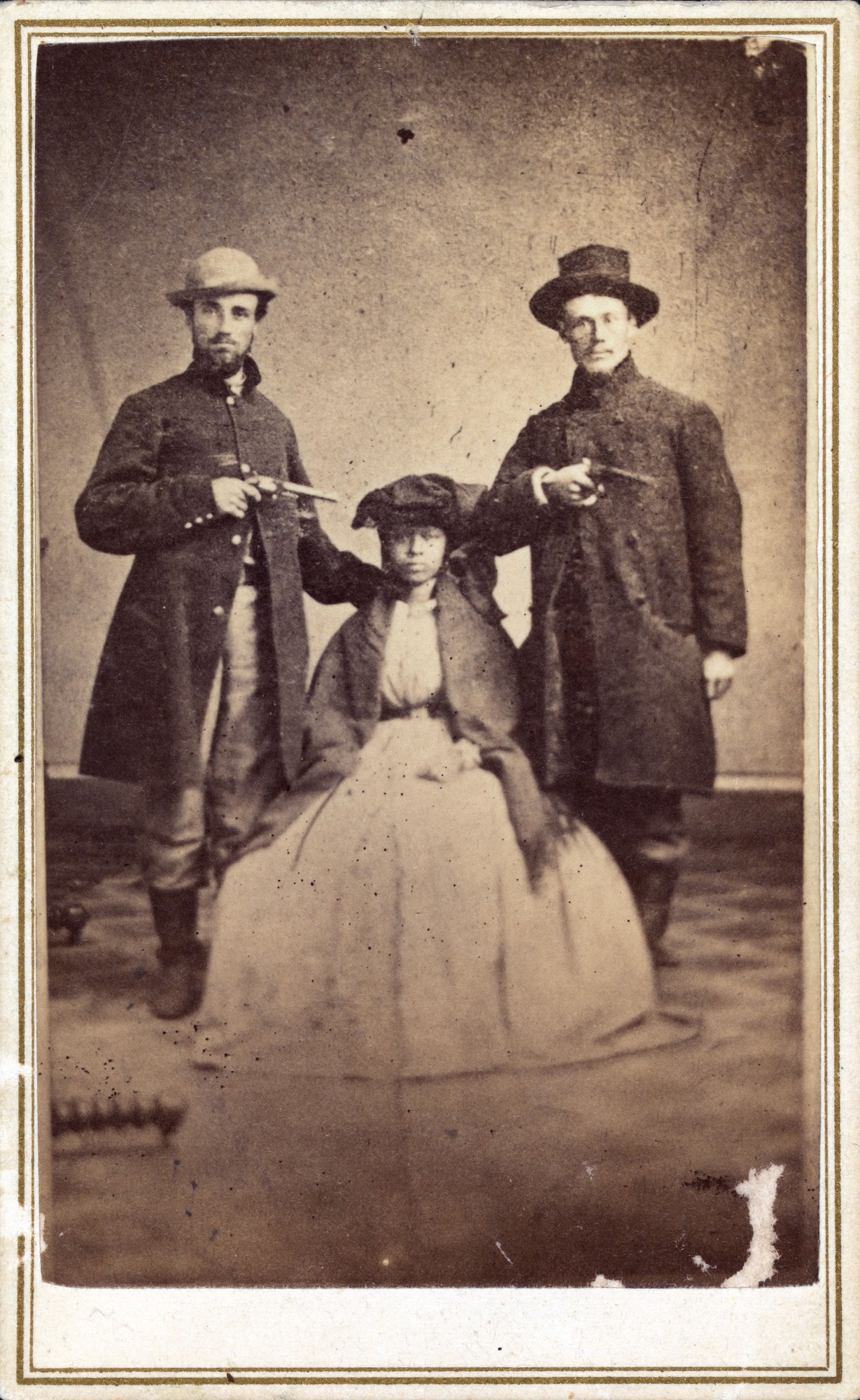 Update: 8/16/2013 — The photo is more fully described at Oxford African American Studies Center. Berch and Rockwell had escorted an escaped teenage slave to the home of Underground Railroad operator Levi Coffin in Cincinnati. They spent a couple of days at the Coffin home and, before sending the girl off to Racine, where some of the soldiers’ friends were ready to take the girl in, the trio posed for the photo. (Thanks to ‘Also Curious’ in comment below.)
__________
This image is indexed on the Library of Congress website under “Fugitive slaves – Wisconsin.”
Jesse L. Berch, quartermaster sergeant, 25 Wisconsin Regiment of Racine, Wis. [and] Frank M. Rockwell, postmaster 22 Wisconsin of Geneva, Wis.
J. P. Ball’s Photographic Gallery, No. 30 West 4th St., betw. Main and Walnut Sts. Cincinnati, O.
Photographer: James Presley Ball
1 photographic print on carte de visite mount : albumen ; 10 x 6 cm.
Photograph showing two men standing, with their guns drawn, and an African American woman sitting between them, full-length portrait, facing front (Rockwell standing on the woman’s right).
From Gladstone Collection of African American Photographs
Library of Congress image.
Civil War Portrait 004
September 7.—Harrisburgh, the capital of Pennsylvania, was the scene of tremendous excitement. The streets were thronged all the evening with excited citizens; and the women were excessively alarmed. The report had been scattered that the women and children were to be sent away on Wednesday; and preparations were actually made for departure. It was also rumored that the money and archives of the State had been packed, ready to be sent away in case of an emergency.
The arrival of a special train from Hagerstown, Maryland, added fuel to the excitement The passengers stated that the rebels were at Frederick, Maryland; that rebel scouts were in and about Hagerstown, and that an advance on that place by the rebels was regarded as imminent There was also a report from Chambersburgh that a rebel spy had been arrested there, with maps and plans of the Cumberland valley in his possession. Men then began earnestly to discuss means of defence for Harrisburgh.— The Thirty-seventh regiment of Massachusetts volunteers, under the command of Colonel Oliver Edwards, left Pittsfield for the seat of war.
— A party of rebels under the command of Captain Bowles, a son of J. B. Bowles, President of the Bank of Louisville, Ky., made a raid upon Shepherdsville, Ky., and burned the bridge over Salt River. A guard of eighty-five of the Fifty-fourth regiment, stationed at that place, were compelled to surrender, but were soon after paroled.—Louisville Democrat, September. 8.
— Major-general Pope, at his own request, was relieved from the command of the army of Virginia, and was assigned to the command of the Department of the North-West— The Tenth regiment of Vermont volunteers, under the command of Colonel A. B. Jewett, passed through New-York, en route for the seat of war.
— Clarksville, Tenn., was recaptured by the National forces under Colonel W. W. Lowe, composed of the Seventy-first Ohio, Eleventh Illinois infantry, and the Fifth Iowa cavalry.—(Doc. 204.)
— Governor Robinson, of Kansas, in view of the threatening attitude of the Indians on the western, north-western, and southern borders of the State, and the numerous bands of rebel guerrillas liable at any time to invade the State on the east, issued a proclamation calling upon all able-bodied citizens not connected with a volunteer company, to organize immediately in accordance with the militia law, and report to the Adjutant-General of the State without delay.
— General George W. Morgan sent the following, from his headquarters at Cumberland Gap, to the editors of Kentucky and the neighboring States. “Gentlemen: Please to say to the relatives and friends of the soldiers of this command that we have good health and good spirits, and that our condition in every respect is better than that of the enemy who surround us. Let our friends do their duty to our country, and we will try and take care of ourselves.”
Rienzi, Saturday, Sept. 6. Went through the usual routine of drill and camp life. Received my first mail since my arrival, consisting of two letters and a [Milwaukee] Sentinel. Changed mess. The 2nd Missouri Infantry left. Wagons moving, fires burning all night.
Headquarters 5th Army Corps,
Camp at Hall’s Hill, Sept. 6, 1862.
Dear Father, — The report is that Generals Porter and Franklin are relieved of the command of their respective corps, until charges are tried which are preferred against them by General Pope. Pope will probably try to blame Porter, and lay the blame of the whole matter on him, on the ground of disobedience of orders. General Porter disobeyed no orders, and if these stories are true, in regard to his being relieved of command, why I have no fear of the result of any court-martial. It will only turn out to the disadvantage of Pope. You cannot conceive of the intense feeling against Pope, McDowell and Stanton.
Meanwhile the enemy are advancing into Maryland, and there will soon be a bloody struggle there, I suppose.
They annoy us very little in front, and are waiting, I suppose, for the force in Maryland to operate.
I am in perfectly good health, and find that out-door life agrees with me.
September 6 — To-day we remained in camp at Leesburg until we had our guns repaired; then we moved to the Potomac, where we arrived a little before sunset; but it was impossible for us to ford the river immediately after our arrival in consequence of the vast number of wagons and artillery there waiting for an opportunity to ford.
The road between Leesburg and the river was so dusty to-day as to make it impossible to discern a man three rods distant.
Beech Grove,
September 6th, Saturday.
Another perch for Noah’s duck! Where will I be in a week or two from this? I shall make a mark, twenty pages from here, and see where I shall be when I reach it. Here, most probably; but oh, if I could then be at home! General Carter, who spent the evening with us day before yesterday, remarked that the first thing he heard as he reached town was that all the gentlemen and ladies of Clinton were hunting for country lodgings for us. It was pretty much the case. The General was as kind as ever, bless his gray head! and made us promise to go back to Linwood with him when he passes back next week. This is the way we keep the promise — coming out here.
Early yesterday morning we received a note from Eliza Haynes, one of our indefatigable agents, saying her grandmother, Mrs. McCay, had consented to receive us, and would come for us in the evening. Immediately my packing task was begun. But imagine my disappointment, just as I had finished one trunk, to hear mother announce her determination to let us go alone, while she remained with Lilly! Prayers, entreaties, tears, arguments, all failed; and we were forced to submit. So with a heart fuller than I can express, I repacked the trunk with Miriam’s and my clothing, and got ready to depart. In the evening the carriage drove up to the door with Eliza and her grandmother, and with a hasty and rather choky good-bye to Lilly and mother, we were hurried in, and in another moment were off.
I fancied the house would be north of Clinton, so of course the horses took the road south. Then I decided on a white cottage to the left of the mad, and about two miles out, found that it was to the right, not painted, and no cottage at all, but a nondescript building, besides. “’T was ever thus from childhood’s hour!” When did I ever fancy anything exactly as it was? But the appearance does not affect the house, which is really very comfortable, though apparently unfinished. The same objection might be made to it that I made to Mrs. Moore’s, for there is not a shutter on the place. But fine shade trees take their place, and here I do not feel the want of them so much, as our room is in the back of the house, to the west, where the rising sun cannot salute my nose as it did at Mrs. Moore’s. As to what effect the setting sun has, I must wait for the evening to decide, though I always enjoy that. At Greenwell, we used to walk a mile away from home to see the sun set in an open field.
I find Mrs. McCay an excellent, plain old lady, with neither airs nor pretentions, and very kindhearted. Here she lives alone, with the exception of an orphan girl called Jane, whose position, half-menial, half-equal, it would be hard to define. Poor girl! the name of orphan alone was enough to make me sorry for her. She must be “Friday’s child”! she is so “ready and willing.” Eliza, who it seems stays a great deal with her grandmother, is one of the brightest little girls I have seen for a long while. She sings and plays on the piano with a style and assurance that I can only mutely covet. Why cannot I have the confidence I see all others possess? She took me to the gin-house last evening, though I could not see much, as it was almost sunset when we arrived. An early tea, and singing, and music after, completed our evening, and then we were shown to our room.
Mrs. McCay has only room for us two, so it is fortunate that mother would not come. She says she wants us to spend a few days with her, to see if we like it, or if we will be willing to be separated from mother. In the mean time, we can look around for lodgings in a larger and more comfortable place where we can be together. She tells such stories about the house Lilly lives in, of its age, and unhealthiness, that I am frightened about mother. She says she will die if she stays there this month. Miriam and Eliza have gone to town to see them, and are then going to Mrs. George’s to see if she can accommodate us.
I wanted to have a splendid dream last night, but failed. It was pleasant, though, to dream of welcoming George and Gibbes back. Jimmy I could not see; and George was in deep mourning. I dreamed of fainting when I saw him (a novel sensation, since I never experienced it awake), but I speedily came to, and insisted on his “pulling Henry Walsh’s red hair for his insolence,” which he promised to do instantly. How absurd! Dreams! dreams! That pathetic “Miss Sarah, do you ever dream?” comes vividly back to me sometimes. Dream? Don’t I! not the dreams that he meant; but royal, purple dreams, that De Quincey could not purchase with his opium; dreams that I would not forego for all the inducements that could be offered. I go to sleep, and pay a visit to heaven or fairyland. I have white wings, and with another, float in rosy clouds, and look down on the moving world; or I have the power to raise myself in the air without wings, and silently float wherever I will, loving all things and feeling that God loves me. I have heard Paul preach to the people, while I stood on a fearful rock above. I have been to strange lands and great, cities; I have talked with people I have never beheld. Charlotte Brontë has spent a week with me — in my dreams — and together we have talked of her sad life. Shakespeare and I have discussed his works, seated tête-â-tête over a small table. He pointed out the character of each of his heroines, explaining what I could not understand when awake; and closed the lecture with “You have the tenderest heart I have ever read, or sung of” — which compliment, considering it as original with him, rather than myself, waked me up with surprise.


