Following the American Civil War Sesquicentennial with day by day writings of the time, currently 1863.

September 2012

Written from the Sea islands of South Carolina.

[Diary] September 2.

I think the last three days have been the darkest hours of the summer, for we have been so sure of evacuation. To-day it brightens a little. General Saxton was to have sailed, but Mr. French came with despatches that have prevented the General leaving at present. Captain Hooper is light-hearted again and ate some supper. The cavalry, which were all ordered North, had embarked when the counter-order came. They have disembarked and that does not look like evacuation.

News from the North that McClellan’s army is in confusion and Pope in retreat.

Chaplain Henry Hopkins to Georgeanna Woolsey.

Alexandria Hospital, Sept., 1862.

My dear Miss Woolsey: In great haste I write to say that to dispense anything which will do the bodies of these poor sufferers good will be a most welcome task. . . . Outside of the house, at the Mansion Hospital, we fed 1,500, 1,900, 2,500, and 1,600 patients passing North on successive days, so that those inside suffer some lack of care and of good food. Last night 75 came in from beyond the lines by flag of truce. I thought I had seen weary and worn-out human beings before, but these bloody, dirty, mangled men, who had lain on the battlefield, some of them two and three days, with wounds untouched since the first rude dressing, and had ridden from near Centreville in ambulances, were a new revelation. We cut their clothes from them, torn and stiff with their own blood and Virginia clay, and moved them inch by inch onto the rough straw beds; the poor haggard men seemed the personification of utmost misery. But some of them were happy. One nobleman who attracted me by the manliness of his very look in the midst of his sufferings, when I spoke to him of the strong consolations of a trust in the Saviour, threw his arms about my neck and told me, weeping, that for him they were more than sufficient. Some of these fellows I love like brothers and stand beside their graves for other reasons than that it is an official duty. . .

It was for such heroic sufferers as the “nobleman” described by Chaplain Hopkins that Mary wrote these verses:

.

“Mortally Wounded.”

.

I lay me down to sleep,
With little thought or care
Whether my waking find
Me here—or THERE!

.

A bowing, burdened head,
Only too glad to rest,
Unquestioning, upon
A Loving breast.

.

My good right hand forgets
Her cunning now;
To march the weary march
I know not how.

.

I am not eager, bold,
Nor strong,—all that is past!
I am willing not to do,
At last, at last !

.

My half-day’s work is done,
And this is all my part:
I give a patient God
My patient heart;

.

And grasp His banner still,
Though all its blue be dim;
These stripes, no less than stars,
Lead after Him.

.

Weak, weary and uncrowned,
I yet to bear am strong;
Content not even to cry,
“How long ! How long!”

September 2.—Passed through Richmond at 7 A. M. Very nice little city. Saw quite a number of prisoners. Crossed Kentucky River at 12 o’clock; camped in a beautiful country, nine miles from Lexington.

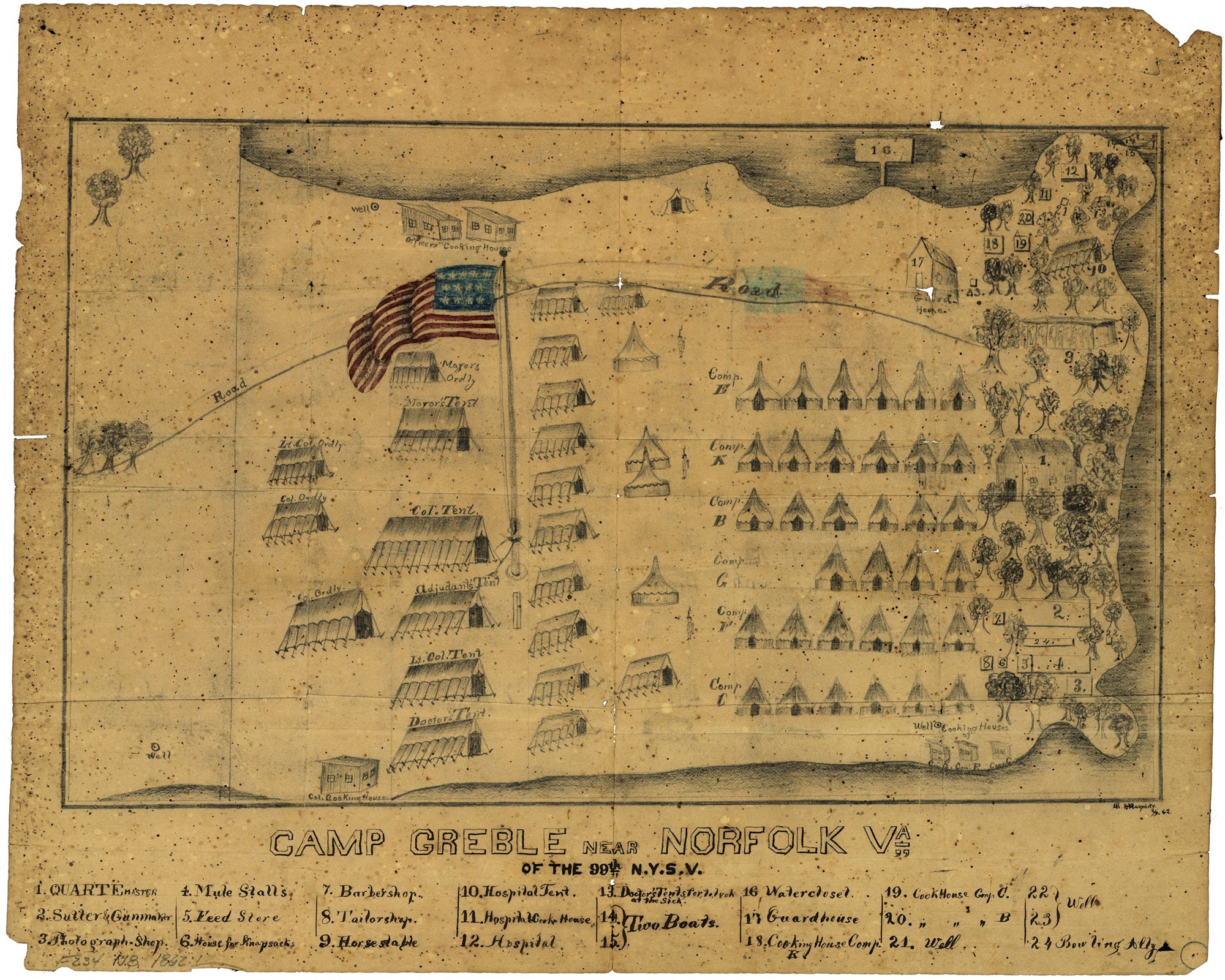
Camp Greble, near Norfolk, was named in honor of Lieutenant John Trout Greble killed at the Battle of Big Bethel, Virginia (June 10, 1861) and the first Union Army officer to die in the Civil War.

September 2, 1862

Drawn by Frank. Maynicke.

Camp Greble was named in honor of Lieutenant John Trout Greble killed at the Battle of Big Bethel, Virginia (June 10, 1861) and the first Union Army officer to die in the Civil War. In 1861, Frank Maynicke, a native-born Prussian, enlisted as a private in the New York State Volunteers (N.Y.S.V.). He was eventually transferred to Company F of the 99th N.Y.S.V., serving in the Union Coast Guard. In January 1864, he was captured near Smithfield, Va., and was a prisoner of war in Richmond, Va., and Andersonville, Ga.

Twenty-four locations are indexed including “Sutter & Gunmaker, “Photograph Shop,” “House for Knapsacks,” and “Bowling Alley.” Tents of officers and various companies are identified as are cooking houses.

___________

Virginia Historical Society image hosted on line at Library of Congress.

SEPTEMBER 2D.—Winchester is evacuated! The enemy fled, and left enough ordnance stores for a campaign! It was one of their principal depots.

Lynchburg, September 2.—The papers to-day give glorious news of a victory to our arms on the plains of Manassas, on the 28th, 29th, and 30th. I will give General Lee’s telegram:

Army of Northern Virginia,
Groveton, August 30 – 10 P.M.
Via Rapidan

“To President Davis:—This army achieved to-day, on the plains of Manassas, a signal victory over the combined forces of McClellan and Pope. On the 28th and 29th, each wing, under Generals Longstreet and Jackson, repulsed with valour attacks made on them separately. We mourn the loss of our gallant dead in every conflict, yet our gratitude to Almighty God for his mercies rises higher each day. To Him and to the valour of our troops a nation’s gratitude is due.

(Signed) “R.E. Lee”

Nothing more to-day—my heart is full. The papers give no news of the dead and wounded. The dreaded black-list yet to come. In the mean time we must let no evil forebodings mar our joy and thankfulness.

September 2.—The following order was issued from the War Department at Washington:

“By direction of the President, Major-General McClellan will have command of the fortifications at Washington, and of all the troops for the defence of the capital.”—Gen. Wright, commanding Department of the Ohio, issued an order from his headquarters at Louisville, Ky., proclaiming Jefferson County in that State, to be under martial law.

—The greatest excitement existed in the cities of Cincinnati, Ohio, Covington and Newport, Ky., in consequence of the reported approach of the rebel army under Gen. E. Kirby Smith. General Wallace assumed command, and issued a proclamation declaring those cities to be under martial law. All business was suspended. Saloons were closed and liquor of all kinds was forbidden to be sold. The ferry-boats were stopped. The inhabitants, including judges and clergymen, met in public places, formed themselves into companies, and began to drill in readiness for military duty. A large force was being gathered together by Gen. Wallace with which to meet the enemy should he make his appearance.

—The Thirty-sixth regiment of Massachusetts volunteers, under the command of Colonel Henry Bowman, left Worcester for the seat of war.—The rebel sloop John Thompson, was captured by the United States bark Restless, Lieut. Edward Conroy commanding.

—This morning at four o’clock a train of one hundred wagons, with commissary stores, was intercepted by the rebels between Fairfax and Centreville, Va., and driven off toward Manassas before the party could be overtaken. They secured the entire train. So soon as this raid in the rear of the National army at Centreville was known, the necessity of guarding that direction became apparent, and at noon the whole army of Virginia abandoned Centreville, and massed northeast of Fairfax Court-IIouse. At noon they again took up the line of march, and this evening the advance was in sight of Munson’s Hill. The enemy’s cavalry followed them in the distance, but made no attack, and the entire movement was being accomplished in excellent order. (Doc. 104.)

—A large force of rebel cavalry under General Scott, entered and occupied Versailles, Ky.— Louisville Journal, September 1.

—A fight took place at Morganfield, Ky., between a force of Union troops under command of Col. Shackleford, Eighth Kentucky cavalry, and a body of rebel guerrillas under Col. A. R. Johnson, resulting in a rout of the latter with considerable loss.

—A. S. Paddock, Acting Governor of the Territory of Nebraska, apprehending an attack by the hostile Indians on the frontier settlements of that territory, issued a proclamation calling upon the citizens of the organized counties of the territory to enroll themselves in accordance with previous instructions, and that all organized companies should meet as often as practicable to perfect themselves in drill, that they might be prepared for any emergency.

—The chiefs of the Wisconsin Chippewa Indians, Naw-gaw-nub and Shin-gwack, sent a letter to Gov. Ramsey of Minnesota, offering their services in putting down the hostile Sioux Indians, who had risen against the whites in the frontier settlements of the latter State.

—A fight took place near Plymouth, N. C, between a force of Union troops under Orderly Sergeant Green of Hawkins’s Zouaves, aided by a portion of the inhabitants of Plymouth, and a large force of rebels under the command of Col. Garrett, resulting in a rout of the latter with a loss of thirty killed and forty taken prisoners, among whom were Colonel Garrett and several of his officers.—(Doc. 201.)
September 1st. The fort was historic ground. The flag flying over it caused Mr. Key to write the song “The Star-spangled Banner,” in 1814. Many British shells and solid shot were piled up in the fort as relics. After the battle of Antietam many rebel prisoners were brought to the fort to remain as prisoners of war until exchanged. Sympathetic friends from Baltimore were allowed to visit them giving them supplies and encouragement.

A camp for sick and wounded Union soldiers was located in the enclosure. No notice was taken of them. That was more than the Connecticut boys could stand for. A raid was made on the Baltimoreans, they were run out of the fort, the supplies confiscated and given to the disabled Union soldiers who were in need of some comforts. Fort McHenry was like being in prison. We were not allowed outside of the walls. We had quite a number of callers from Connecticut. They were always welcome. Citizens were allowed passes to enter the grounds.

September 1 — We renewed our march early this morning, passing through Salem on the Manassas Gap Railroad, in an eastern course, frequently touching the railroad, and passed the Plains, a station on the Manassas road. We came through Thoroughfare Gap, which is a rugged gorge in Bull Run Mountain and the western gate to the plains of Manassas, through which the Manassas Gap Railroad passes. At Thoroughfare Gap the Yanks had the pass blockaded a few days ago, attempting to prevent General Longstreet from reenforcing General Jackson, who, playing a bold game with a good hand in General Pope’s rear, executed smashing havoc to his haversack ammunition and general supplies at Manassas Junction.

The gorge in the mountain is very narrow and abrupt and looks as if it could be successfully defended by a few hundred determined riflemen against almost any force that would assail it. The enemy had barricaded the main road that leads through the pass with felled trees and large rocks which they had rolled from the almost perpendicular side of the gap into the narrow road; behind the barricade they had a line of infantry, and behind the rocks and trees on the mountain side sharpshooters with long-range rifles were ready to pour a deadly fire into any assaulting party that would dare to approach the dangerous gate from the west or south side. On the east side of the mountain, or rather in rear of the Gap, they had another line of infantry, ready to support and protect the men immediately behind the barricade. When Longstreet’s column, hastening to the urgent relief of Jackson, dashed like a storm-driven wave against the blockaded mountain gorge and demanded a pass with the thunder tones of artillery and the crash of musketry, his victorious column swept everything before it like a flood of rushing water and passed through the Gap and over the plains of Prince William County like a mighty stream that has overcome and swept away some opposing barrier. Directed by the deep thunder of booming cannon that came rolling from the east, Longstreet pressed on his onward way to where old Stonewall was unfolding the science of strategic war and still successfully baying the hosts of the mighty Pope. Toward evening we struck the plains of Manassas, and soon after arrived on the field where a few days ago General Jackson fought one of his hardest battles.

The first indications that I observed of a recently fought battle were hundreds and hundreds of small arms of all descriptions that had been gathered on the battle-field and piled up along the road. When we got to the part of the field where the struggle had been the most desperate and destructive the Federal dead still lay there by the hundreds. At one place I could distinguish where the enemy’s line of battle had been, by the many dead lying in line where they fell. Where their batteries had been in position dead horses lay thickly strewn around. A disabled gun and the wreck of blown-up caisson marked the spot where the fire of the Confederate batteries did its destructive work.

At one place I saw the guns of a Yankee battery that had been charged and taken by the Confederates, still in position. White flags were flying all over the field to-day, and the Citizens’ Relief Committee of Washington, with two hundred ambulances, were on the field burying the dead and gathering the wounded. I saw at one place where they were burying eighty men in one trench. Some have lain on the field four days and their upturned faces were as black as African negroes.

I saw one wounded Federal lying under a little white oak bush out in the open field. I suppose he had been there for at least forty-eight hours. He was nearly perished with thirst and begged me for a drink of water. I did not have a drop and did not know where to get any. I did not see any farmhouse near nor far, and we were under marching orders, liable to move at any moment. I told him that water was scarce in his present neighborhood, but that was sad news, poor consolation, and poverty-stricken comfort to a man who is dying for water. It was enough to cruelly crush his last hope. I told him that the Citizens’ Committee from Washington was on the field and I would tell the first man I met where to find him, and he would administer to his pressing wants. The poor wounded man exclaimed: “Oh, I have heard that for the last twenty-four hours, and they have not found me yet.” Ah, what a striking object lesson on the horrors and probable vicissitudes of cruel war! One moment a strong robust man may be wielding the saber or bayonet like a Hercules and the next instant he may be lying on the field as helpless as a babe and begging his antagonist for a drink of water.

Soon after I left the helpless soldier I met some of the Washington Relief men and told them of his critical condition and exactly where to find him. As a couple of us were passing over the battle-field we met a well dressed, fine-looking man, probably he was a surgeon belonging to the Relief Corps. He stopped and in a snappish manner, remarked, “Well, you have defeated us again, and this is the second time on this field, but it will have to be tried over.” We replied, “All right, give us a fair shake and we will thrash you again.” That shot was a surpriser and silenced his mouth-piece.

He drove on then, looking as sour as if his mother-in-law had drenched him with double-proof crab apple vinegar for a month.

Late this evening we were ordered to move toward Fairfax Court House. When we had marched about four miles in that direction it grew pitchy dark and we dropped by the roadside and camped.

September 1st, Monday.

I woke up this morning and, to my great surprise, find that summer has already passed away, and that we have already entered the first month of fall. Where has the summer gone to? Since the taking of Fort Jackson, the days have gone by like a dream. I had hardly realized spring, when now I find it is autumn. I am content to let the time fly, though, as every day brings us nearer Peace — or something else.

How shockingly I write! Will I ever again have a desk or a table to write on? At present, my seat is a mattress, and my knee my desk; and that is about the only one I have had since the 2d of August. This is the dreariest day I have seen for some time. Outside, it has been raining since daybreak, and inside, no one feels especially bright or cheerful. I sometimes wish mother would carry out her threat and brave the occasional shellings at Baton Rouge. I would dare anything, to be at home again. I know that the Yankees have left us little besides the bare house; but I would be grateful for the mere shelter of the roof. I often fancy how we will miss little articles that we thought necessary to our comfort before, when we return. . . . And the shoes I paid five dollars for, and wore a single time? I am wishing I had them now that I am almost barefooted, and cannot find a pair in the whole country. . . . Would it not be curious, if one of these days while traveling in the North (if I ever travel again), I should find some well-loved object figuring in a strange house as a “trophy of the battle of Baton Rouge”? I should have to seek for them in some very low house, perhaps; respectable people had very little to do with such disgraceful work, I fancy. Suppose I should see father’s cigar-stand, for instance, or Miriam’s little statues? I wonder if the people would have the conscience to offer to return them? A young lady, passing by one of the pillaged houses, expressed her surprise at seeing an armoir full of women’s and children’s clothes being emptied, and the contents tied up in sheets. “What can you do with such things?” she asked a soldier who seemed more zealous than the rest. “Ain’t I got a wife and four children in the North?” was the answer. So we, who have hardly clothes enough for our own use, are stripped to supply Northerners!

One would think that I had no theme save the wreck of our house, if they read this. But I take it all out in here. I believe I must be made of wood, or some other tough material, not to feel it more. I sometimes ask myself if it is because I did not care for home, that I take it so quietly now. But I know that is not it. I was wild about it before I knew what had happened; since I learned all, few are the words that have escaped my lips concerning it. Perhaps it is because I have the satisfaction of knowing what all women crave for — the Worst. Indeed it is a consolation in such days as these when truth concerning either side is difficult to discover. The certainty of anything, fortune or misfortune, is comfort to me. I really feel sorry for the others who suffered; but it does not strike me that sympathy is necessary in our case.

Mrs. Flynn came to Lilly’s room, when she heard of it, well prepared for sympathy, with a large handkerchief and a profusion of tears, when she was horrified to find both her and Miriam laughing over the latter’s description of some comical scene that met her sight in one of the rooms. Seems to me that tears on all occasions come in as the fortieth article, to the articles of belief of some people.