June 21—We reached Petersburg, Va., this morning at half-past two, and had barely laid down with a brick wall for my pillow when breakfast was announced in the shape of Mack Sample, who told us where we could get it. I ran the blockade with Katz, and went to see Mike Etlinger. He was not at home. Afterward we met Wortheim, and we all went again and got something good to eat. We then returned to our regiment, which is the 53d North Carolina Regiment, infantry, Col. William Owens, commander. We are enlisted for three years, or the war. We fell in line and marched to our camp, which is on Dunn’s Hill, just outside of the city.
June 2012
June 21st. Weather broiling hot, and water as poor as can be; the sick list growing longer all the time, whole regiments of men going to the hospitals. At 4 P. M. fell in for a brigade drill, the first drill we have had this side of the Chickahominy; made a good appearance and performed promptly and correctly several complicated movements; we all enjoyed the excitement and display. Drill dismissed at 6:30 p. M. In the evening rode from one end to the other of the corps line; turned in early.
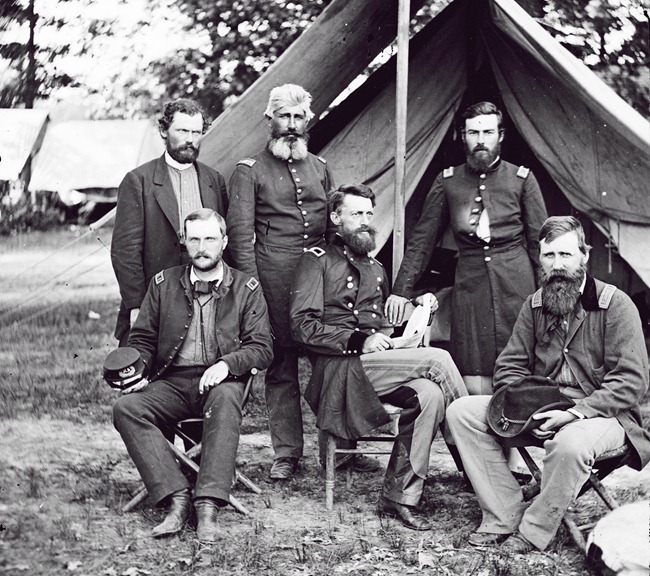
From Library of Congress:
Fair Oaks, Va., vicinity. Gen. George Stoneman and staff
June 1862
Photographed by James F. Gibson
Photograph from the main eastern theater of war, the Peninsular Campaign
Civil War glass negative collection. Library of Congress Prints and Photographs Division Washington, D.C. 20540 USA
Record page for this image: http://www.loc.gov/pictures/item/cwp2003000075/PP/
June 21.—At New-Orleans, La., a large and enthusiastic Union meeting was held at Union Hall, in the Fourth district. The meeting was called to order by D. S. Dewees, Esq., who nominated Edwin White, Esq., as Chairman of the meeting. The following named gentlemen were appointed Vice-Presidents: Robert Watson, C. Auch, W. A. Bills, and Win. McDuff. L. M. Day, Esq., was appointed Secretary. Able and eloquent addresses were made by the President, Judge Hiestand, and D. S. Dewees, Esq. The meeting was characterized by great unanimity of feeling, and the addresses of the several gentlemen were received with universal demonstrations of appreciation. In the evening a festival took place at the Planter’s Hotel, the patriotic hostess of which is Madame De Bare. A grand Union ball was given, which was numerously attended.
—A series of skirmishes took place between a force of Union troops, under the command of Col. Sill, and a considerable body of rebel infantry and artillery, at the mouth of Battle Creek, Tennessee.—(Doc. 138.)
—Colonel Charles Ellett, commander of the ram squadron of the United States, on the Mississippi River, died at Cairo, Ill., while on his way to New-Albany, Ind.—The Seventh, Twenty-second, Thirty-seventh, and Forty-seventh regiments New-York State militia were mustered into the service of the United States Government for three months.
—A Fight took place near Fair Oaks, Va., between the pickets of the Union army, supported by a redoubt, and a large attacking force of rebels, in which the rebels were repulsed with great loss in killed and wounded. The Unionists lost two killed and seven wounded.
—General Butler, commanding Department of the Gulf, issued the following order at New Orleans:
“Any vessel attempting to leave this port and take away any person of color who did not come here on board of her, and has not a pass from these headquarters, will be liable to confiscation, and her master punished by imprisonment.
“No vessel shall so leave the port until the master shall take an oath that he has not any such person on board, and will not allow any such to come on board.”
—The rebels kept up a continuous shower of shells along the lines of the Union army before Richmond. They opened upon Gen. Hooker’s advance, but did no damage. Gen. Hooker replied from his batteries, by throwing heavy shells among their artillerymen, which caused them to retire.
—A reconnoissance was made by Captain Keenan, with two companies of the Pennsylvania cavalry, to the James River, Va. He successfully passed the rebel pickets and communicated with the Union gunboat Galena.
—An engagement took place at Simon’s Bluff, Wadmelaw Sound, S. C, between the United States gunboats Crusader and Planter, and a body of rebels stationed at that place.—(Doc. 139.)
JUNE 20TH.—Moved once more into the old office.
Friday, 20th—Our regiment went out on picket this evening. Water is very scarce out on the picket line and so we have our canteens filled in the evening before we go out.
June 20— To-day we moved camp two miles below Harrisonburg, then started down the pike to do picket duty. When we had proceeded a few miles on our way the order was countermanded, and we returned to camp.
To Mrs. Lyon.
June 20, 1862.—Last night it was quite cold. We were out on grand guard duty. I slept on the ground out of doors, with nothing but a rubber blanket under me and an elevation of ground for a pillow. I had a little cold yesterday, but today I am nearly well. I live quite luxuriously in camp. Our mess consists of Lieut. Smith, Henry Bull, A. S. Henderson, of Bloomfield, and myself. We have a large Secesh tent with an awning in front, and live principally on biscuit, ham, black tea, and pork and beans. The boys make excellent biscuit.
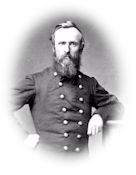
Ditto, Ditto, June 20, 1862. Friday. — Cold and wet. We wear overcoats, sit by fires in front of tents, and sleep under blankets! Had a very satisfactory drill. Am reading “St. Ronan’s Well.” Rode down the mountain towards New River On returning found R. S. Gardner giving a blow-out on receiving news of his appointment as captain and quartermaster. Lieutenant-Colonel Paxton, Bottsford, and Lieutenant Christie, of General Cox’s staff, all a little “how-come-ye-so.” . . .
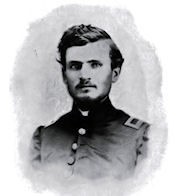
20th. Friday. Attended to my usual duties. Read papers.


