Following the American Civil War Sesquicentennial with day by day writings of the time, currently 1863.

June 2012

In Our Tent, June 20.

Dear Mother, — For the first time I have neglected you, — and not from hard work either, but from a scattering sort of work, which has left us no time of absolutely needed rest in which to write. All your Newport cases have arrived; also four cases of brandy and one of beef stock, marked “F. Gordon Dexter;” four of sherry, from Mrs. J. Howland Shaw; one of lemons, marked “Mrs. Kuhn;” also a case of assorted liquors, and a box of lemon-squeezers, from the Honorable Ezra (can’t make out the name), of Walpole, Mass., who says he had seen a letter of mine somewhere, in which I told that I had squeezed eight hundred lemons on one occasion. The cases sent by the “St. Mark” are also in my possession; but for the last three days I have had no time to open them, and I won’t sacrifice my present hour of writing to do it now.

The Fourth Connecticut came down to-day for its siege-guns. We, who have seen the blackness of battles, rejoice, and trust it is a sign that there may be no more. God grant it may be so! How deluded the body of the Southern troops and people have been by their leaders! I go as much as I can among the prisoners, that I may judge for myself how they feel. I find surprise their chief emotion. “I never thought of this.” “I could change the feelings of half my county if I told them what I know now.” One man told me he had never fired his gun. They look shy, and are unwilling to meet your eye; but if you make any way with them, you are almost sure to see tears in theirs. I have written letters for several of them, which General Wool and General Dix have been very kind in forwarding from Fortress Monroe on the flag-of-truce boat. The men are eager to write, “because their friends are thinking them so badly treated, and they want to tell them how it is.” Of course there may be exceptions to this spirit; but I have, so far, met with none. Just now I asked a handsome young fellow, with a clear eye which at first he rather veiled, if he had all he wanted, — “All” he said; “more than I deserve to have.”

Wednesday, the ” Small” went down to coal, and Georgy and Dr. Ware and I spent the day in the tent, and dined with our old black aunty on the “Elizabeth,” — or the “Fiend,” as she is commonly called, from her habit of rushing up at all hours of the day and night, making unearthly noises with her steam-pipe. The usual number of men, about a hundred, came down. The process is this: I will describe it, and you can imagine it, once for all.

We have thirty-three Sibley tents along the line of the railroad on the other side of the track. On this side, and just at the head of the wharf, —an old scow and a few planks which we dignify by that name,—stands the tent, filled with stores, and the kitchen behind it. The “kitchen” is al fresco, and consists solely of two long trenches about a foot deep, with forked upright stakes at each end and a pole across, on which the camp-kettles are hooked over the fire built in the trench below. Alongside the tent we have two large wall-tents, where we put the worst cases, so as to have them close at hand; the others, which are mostly waiting for the hospital ambulances, are put in the Sibley tents. We take great pride and satisfaction in these arrangements. It is true that the tent is smoky and hot, not pleasantly odoriferous, and filled with flies; but when the smoke is very bad we make believe it kills the flies. In short, we admit nothing evil of our tent; and when Dr. Agnew, peeping round in the smoke, said in the kindness of his heart: “Oh, how uncomfortable for you!” we were seriously angry with him.[1]

A train arrives, and the principle on which we proceed is as follows: The wounded men are sent at once on board whichever transport lies at the wharf (the “Small,” the “Elizabeth,” and the “”Wicked Chicken ” always lie outside of the large vessel). As they pass our tent, we give them something refreshing or stimulating, as the case may need. The sick men are put into the tents, and we give them a meal. They ought to be moved promptly to the Shore hospital; but the surgeon-in-charge is not prompt, so they are often a day or a night in our hands. This gives us an average of a hundred men to feed and attend to daily; but they are constantly changing. Dr. Ware has the entire charge and responsibility of them and of the shipments upon our boats. As soon as a train comes in he selects the cases. Meantime we despatch, by our four orderlies, buckets of soup, or tea, or milk-porridge, and other food; then we follow Dr. Ware into the train with the inevitable brandy and beef-tea. The cars are large, double freight-cars. The worst cases lie upon the floor inside; the slight cases sit upon the roof. Dr. Ware is everything to us,—so sensible, so self-sacrificing, so prompt, so careful. We owe all the comfort of this tent to him, for he takes pains to keep it well supplied, and thus efficient. His fault is that he thinks too little of himself; and I fear it will always keep him back in life.

On Thursday we went down in the “Small” to Yorktown. Mr. Olmsted wished to inspect the “St. Mark” (it ought to be “St.Luke”),— a large clipper-ship sent down by the Sanitary Commission. The surgeons and ladies were ashore when we arrived, so we could go over the ship with an eye to her real merits. She is magnificent; but so wholly out of the pale of the necessities of our work that, though we heartily admired, we could not feel the intense pleasure and sympathy with which we hail some lesser good on the other vessels. She is not fit for transport service, drawing too much water to get up the rivers, and having no steam. She should be kept as a floating-hospital off Fortress Monroe; for that she is perfect, — giving noble accommodation for a few, say two hundred, men. Our work, on the other hand, requires us to give life and some comfort to the many.

The Quartermaster, an old friend, gave us many valuable things. Case after case rattled on to the “Small,” and tin pails almost in abundance. We dined on board. Dr. Draper is in charge, — his wife and Mrs. George T. Strong among the ladies. Soon after dinner a telegram arrived, recalling Mr. Olmsted to White House; and we had the sweetest run up the river by every light imaginable, — sunlight, sunset, twilight, moonlight.

Orders had come to send the “Webster” and the “Spaulding” to Fortress Monroe immediately, and empty the hospitals there as fast as possible. Mrs. Griffin went in the “Webster,” which sailed at eleven o’clock last night; so one of our four fingers is missing.

To-day the Chief and the “Small” have gone to Yorktown on “special business.” Mrs. H., Georgy, Dr. Ware, and I are waiting in the tent for one hundred and fifty men now due. Tomorrow, I fear, we shall have many wounded; heavy firing on our right has been going on all the afternoon, and a good deal of musketry.

This is a very rambling letter; but it is hard to keep any ideas in one’s head, being interrupted every tenth word by cooks, Zouaves, and obnoxious persons of many kinds, who persist in looking into the tent and asking questions. This afternoon, as I was attending to some men in the Sibley tents, I came upon one of the exhortative kind, who often afford us much amusement. He made a rapid survey of the history of the world, to prove that no women had ever done as we were doing, no men had ever been succored as they were succored. Whether he was out of his mind, or simply one of the irrepressible, I could not tell; but he looked so funny, declaiming in his hospital rig, that I slipped out of the tent, convulsed with laughter, — for which I felt sorry, and rather ashamed, a moment later, when I saw the tears in the eyes of a gentleman, new to the work, who was with me. But we must either laugh or cry; and this work teaches us that we had better laugh, if we mean to be good for anything. I hope I have not seemed to you heartless in the tone which I have taken; it is that which we all adopt, and, though perfectly genuine, it answers as a mental prophylactic.

Good-by! I mean to go to sleep. The train is not in, and may not be till morning. I have learned to sleep on my arm, and it is very “comfy.” As for Georgy, she curls herself up anywhere, like a little gray kitten, and is asleep in a minute.


[1] “It was not the vale of Cashmere,” as Dr. Ware wrote me in his last letter, just before his death, “but many dear associations cluster round it.”
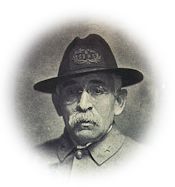
Friday, 20th.—No nurse in my room. Some very rough looking fellows in my room. Remained very sick all day.


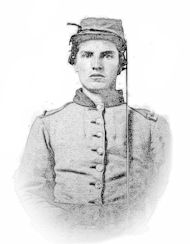
(Note: picture is of an unidentified Confederate soldier.)

June 20—Up until this date there has been nothing worth recording, but to-day got orders to fall in line with two days’ rations cooked. Left at 12 M. in box cars. We knocked holes in them to get fresh air. We laid over six hours eight miles from Gerresburg in order to let the passenger cars pass us. Several of our company left the train in quest of supper. We found a house where a lady promised to give us supper for fifty cents each. As we were doing full justice to her supper the train started, we left in a hurry, and did not have time to pay for our meal. I don’t suppose she gave us her blessing.

June 20, 1862.—As soon as our intended departure was announced, we were besieged by requests for all sorts of things wanted in every family—pins, matches, gunpowder, and ink. One of the last cases H. and Max had before the stay-law stopped legal business was the settlement of an estate that included a country store. The heirs had paid in chattels of the store. These had remained packed in the office. The main contents of the cases were hardware; but we found treasure indeed—a keg of powder, a case of matches, a paper of pins, a bottle of ink. Red ink is now made out of poke-berries. Pins are made by capping thorns with sealing-wax, or using them as nature made them. These were articles money could not get for us. We would give our friends a few matches to save for the hour of tribulation. The paper of pins we divided evenly, and filled a bank-box each with the matches. H. filled a tight tin case apiece with powder for Max and himself and sold the rest, as we could not carry any more on such a trip. Those who did not hear of this in time offered fabulous prices afterwards for a single pound. But money has not its old attractions. Our preparations were delayed by Aunt Judy falling sick of swamp fever.

______

Note: To protect Mrs. Miller’s job as a teacher in New Orleans, the diary was published anonymously, edited by G. W. Cable, names were changed and initials were often used instead of full names — and even the initials differed from the real person’s initials.

June 20th. For the first time since the battle we slept all night without being turned out; what a pleasant thing it is to be able to sleep enough; want of sleep uses one up more than anything else. It is twenty-two days now since we slept without removing our clothes or accoutrements; if we don’t get enough of full regimentals, it will be because we are insatiable. Notwithstanding the severe duty the men look well and are spruce and outwardly, at least, clean; boots are blacked and accoutrements kept perfectly clean, but our clothes are getting shabby and have changed color sadly; these blues are very uncertain. Rode over to Sumner’s headquarters this evening and heard various accounts of the late battle. Much fine writing, with gross exaggeration of trifles, and general disregard for accuracy. The little movement of our two flank companies has blossomed out into a splendid charge, led by General French in person, and his example is highly spoken of. “Vitian regit fortuna, non sapientia.” How much many of our generals owe to the ubiquitous reporter. May their shadow never grow less. If the history of past ages is as much tainted as the history we are now making, then, alas, poor Yorick!

From Edward Mitchell.

White House, June 20, 1862.

My dear Father: Heavy firing in the advance this A. M. Since writing to Fred. I have had no time to write another word. Sitting up late that night, I was waked up, with Drs. Jenkins and Haight, to go ashore for 24 hours at 3 A. M. In consequence of being routed out at this unusual hour, yesterday was spent, so far as leisure hours were concerned, in deep sleep. . . . I now write to thank you for your kind expressions of regard for my health, and of love for me; and for your desire to see me with you once more. . . .

My health—it is excellent. . . . And so far it has been possible to find an assistant, who though stupid to an extent and lazy, is willing to go twice a day to wait an hour or more for commissary stores;—it would be perfectly disgusting to me. . . . I doubt much if Mr. Olmsted will be willing to let me go home for some months at least. The staff is now well organized, and the departure of one would throw very much labor on another who would not understand it at all. This is especially so in my case. The drawing of rations requires much care, and to know what stores the Commission has, and where they are, one must be continually among them. . . . You were right about the rebel cavalry, not I. It was very bold. Gen. Stuart commanded. In case we had been called out, I had intended to use only the bayonet and to creep round if possible on the flank of the enemy and charge at my own time—have lain in ambush, in other words. I think Sawtelle would have been willing to allow me my own way, for as he was a regular, he of course placed not much reliance, if any, on such a Falstaff army. . . .

Olmsted has a deal of tact; as much as a woman. Also much shrewdness and a very quiet manner. In some characteristics he reminds me a little of you, or rather what you would have been if you had been called more actively into public life. . . .

A battle is predicted to take place in three days, by Capt. Sawtelle; time will show.

The Webster and Spaulding go to New York. Dr. —— goes in charge of the latter. In my capacity of aide I delivered his sailing orders to him. He may be a very nice man and an excellent physician, but he has an unquenchable and unalterable desire to spread himself and his authority. I received instructions to bully him into staying on board in case he should attempt to come back to the White House! Some funny things occur here!

I regret immensely that I will be unable to be present at Neil’s commencement. I would rather loose $50 than not to be there. . . .

June 20th, 1862.—The tannery, under Mr. James, is a complete success. Father sent to Gadsden County for a shoemaker, and three of the black boys are working under him, learning the trade; he has three sons and they are motherless. John, the eldest, is fourteen years old, but is very small for his age; David is twelve and Nathan is nine; they have never been to school in their lives and Father wants me to teach them two hours every morning. I have taught Frances right along, since Grandpa gave her to me but I do not know if I can “instill knowledge,” as Dr. Cleveland says, into such unpromising specimens. However, I will try.

June 20.—A force from Gen. Sherman’s command occupied Holly Springs to-day, and destroyed several pieces of trestle-work on the Mississippi Central Railroad. The machinery for repairing and manufacturing arms was removed from Holly Springs to Atlanta, Ga., previous to the evacuation of the place by the rebels.

—The Paris Constitutionnel, of this date, expressed the opinion that mediation was but a question of time. The cause had gained. More than one hundred provincial journals in France had given in their adhesion to it. The idea had gained ground in England. Such an expression of public opinion in two great countries could not remain without effect, but mediation could not be proposed with the certainty of rejection. It was for the government to seize upon a favorable opportunity.

—A delegation from the religious society of Progressive Friends appeared before the President, at Washington, for the purpose of presenting a memorial praying him to decree the emancipation of the slaves.

—The United States gunboat Jacob Bell, commanded by Lieut. E. P. McCrea, proceeded up the James River, Va., with despatches for the commander of the Monitor. She succeeded in her mission, but was considerably damaged by the rebel batteries on shore.—(Doc. 137.)

—Lieut.-Col. William B. Cassilly, Sixty-ninth Ohio volunteers, assumed command of the military district of Franklin, Williamson County, Tenn.

—The brig Yankee Blade arrived in New-York from New-Orleans, laden with sugar, molasses, and cotton—the first arrival since the remission of the blockade.

June 19.—Our cousin, Ann Eliza Field, was married to-day to George B. Bates at her home on Gibson Street. We went and had an elegant time. Charlie Wheeler made great fun and threw the final shower of rice as they drove away.

JUNE 19TH.—To-day so many applications were made to the Secretary himself for passports to the armies, and beyond the lines of the Confederate States, that, forgetting the revocation of his former order, he sent a note into the Assistant Secretary, saying he thought a passport agent had been appointed to attend to such cases; and he now directed that it be done. Bledsoe came to me immediately, and said: “Jones, you’ll have to open a passport office again—I shall sign no more.”