Following the American Civil War Sesquicentennial with day by day writings of the time, currently 1863.

June 2012

June 19th.

Miriam and I have disgraced ourselves! This morning I was quietly hearing Dellie’s lessons, when I was startled by mother’s shrieks of “Send for a guard — they’ve murdered him!” I saw through the window a soldier sitting in the road just opposite, with blood streaming from his hand in a great pool in the dust. I was downstairs in three bounds, and, snatching up some water, ran to where he sat alone, not a creature near, though all the inhabitants of our side of the street were looking on from the balconies, all crying “Murder!” and “Help!” without moving themselves. I poured some water on the man’s bloody hand, as he held it streaming with gore up to me, saying, “The man in there did it,” meaning the one who keeps the little grog-shop, though it puzzled me at the time to see that all the doors were closed and not a face visible. I had hardly time to speak when Tiche called loudly to me to come away, —she was safe at the front gate, — and looking up, I found myself in a knot of a dozen soldiers, and took her advice and retreated home. It proved to be the guard Miriam had roused. She ran out as I did, and seeing a gentleman, begged him to call the guard for that murdered man. The individual — he must have been a “patriot” — said he didn’t know where to find one. She cried out they were at Heroman’s; he said he did n’t believe they were. “Go! I tell you!” she screamed at last; but the brave man said he did n’t like to, so she ran to the corner and called the soldiers herself. O most brave man! Before we got back from our several expeditions, we heard mother, Lilly, Mrs. Day, all shouting, “Bring in the children! lock the doors!” etc. All for a poor wounded soldier!

We after discovered that the man was drunk, and had cursed the woman of the grog-shop, whereupon her husband had pitched him out in the street, where they found him. They say he hurt his hand against a post; but wood could never have cut deep enough to shed all that gore. I don’t care if he was drunk or sober, soldier or officer, Federal or Confederate! If he had been Satan himself lying helpless and bleeding in the street, I would have gone to him! I can’t believe it was as criminal as though I had watched quietly from a distance, believing him dying and contenting myself with looking on. Yet it seems it was dreadfully indecorous; Miriam and I did very wrong; we should have shouted murder with the rest of the women and servants. Whereas the man who declined committing himself by calling one soldier to the rescue of another, supposed to be dying, acted most discreetly, and showed his wisdom in the most striking manner.

May I never be discreet, or wise, if this is Christian conduct, or a sample of either! I would rather be a rash, impetuous fool! Charlie says he would not open his mouth to save a dozen from being murdered. I say I am not Stoic enough for that. Lilly agrees with him, Miriam with me; so here we two culprits stand alone before the tribunal of “patriotism.” Madame Roland, I take the liberty of altering your words and cry, “O Patriotism! How many base deeds are sanctioned by your name!” Don’t I wish I was a heathen! In twenty-four hours the whole country will be down on us.

       O for a pen to paint the slaves
Whose “country” like a deadly blight
Closes all hearts when Pity craves
And turns God’s spirit to darkest night!
May life’s patriotic cup for such
Be filled with glory overmuch;
And when their spirits go above in pride,
Spirit of Patriotism, let these valiant abide
Full in the sight of grand mass-meeting — I don’t
Want you to cuss them,
But put them where they can hear politics,
And yet can’t discuss them!

(I can’t say worse than that!)
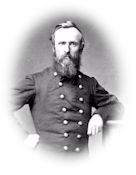
Thursday, 19th—Drill is now all dispensed with on account of the hot weather. But the men are kept busy at fatigue and picket duty.

Camp Jones, Flat Top Mountain, June 19, 1862. Thursday. — Cold, dull, and P. M., rainy. Drilled A. M. Rode with Adjutant Avery and practiced pistol firing in the P. M.

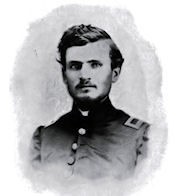
Lieutenant-Colonel Paxton of the cavalry called to see me about Lieutenant Fordyce. Would he do for captain? Is he not too fond of liquor? My reply was favorable. He says he has three vacancies in the regiment. Captain Waller seduced Colonel Burgess’ daughter; had to resign in consequence. I recommended both Avery and Bottsford for captains of cavalry; both would make good captains. Only one will probably be commissioned. While I dislike to lose either, I feel they are entitled to promotion and are not likely to get it here.

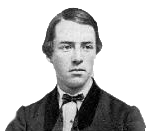
19th. Thursday. Went to the Commissary as usual at 9 A. M. Archie got thrown from his horse. Wrote to Fannie. Went bathing with Nettleton and Brownell. Talked Minnie and Professor. Two letters. Home and Fannie.

Thursday, 19th.—Came orders for regimental baggage to be sent to Loudon. Not being able to go, was sent to hospital on College Hill.


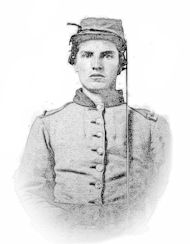
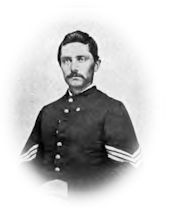
(Note: picture is of an unidentified Confederate soldier.)

Headquarters 5th Prov. Army Corps,
Camp near New Bridge, June 19, 1862.

Dear Father, — . . . I do not have as much to do as I did before the two new aides came, but still General Porter gives me things to do. Yesterday he heard that the enemy had left the vicinity of New Bridge, and sent me down with an order to the battery there to fire 12 rounds at a work the enemy had erected in the woods opposite the bridge, and to see if they could not wake them (the enemy) up. We had erected a small earthwork there to protect our guns, and there I went. We fired about three rounds, when bang went one of their guns, and a shot flew whizzing over our heads. The officers told us to lie down in the trench, whenever we saw a gun fired, and kept a man on the watch, who called out “fire” when he saw a gun go off, and down we would all go. They fired splendidly at us, planting the shell in the battery and all around it. My horse was tied to a tree behind the battery, and I thought his chance of escaping was pretty small. I had to stay till the 12 shots were fired, to tell the general the result, and was glad when they were all fired. Our firing was indifferent. I waited till the enemy had fired two shots in succession, and then made a rush for my horse with a lieutenant from Weeden’s Battery whom I met there. It did not take us long to get out of range. The enemy were 1000 yards distant.

I had a narrower escape the other day than I thought for. The enemy’s infantry were near Mrs. Brockenborough’s house, and a body of their cavalry followed down soon after I went down that road, by Mrs. B.’s house. Then, too, I should have been shot by our own cavalry had they seen me in the woods, for they had orders to shoot any one they saw in the woods, no matter who he was. This was necessary as they were the outpost picket. I refer to the party I mistook for rebels.

Captain Mason is a very pleasant fellow, and I like him very much. He is always kind and polite to me.

I hope General McClellan will receive all the troops he wants. General McCall’s division has arrived, and is on this side of the river. It is under General Porter for the present. He and all his staff came near being captured by the rebel raid the other day.

General Franklin’s corps has passed over the river, and now we are the only corps on this side. . . .

All reports confirm the scarcity of food at Richmond. A darkey who came in this evening said that the rebels were conveying all their specie to Danville, N. C. They seem, however, afraid to trust it all in one place, and are pretty anxious about it.

Don’t place any confidence in newspaper reporters. They are all rascals.

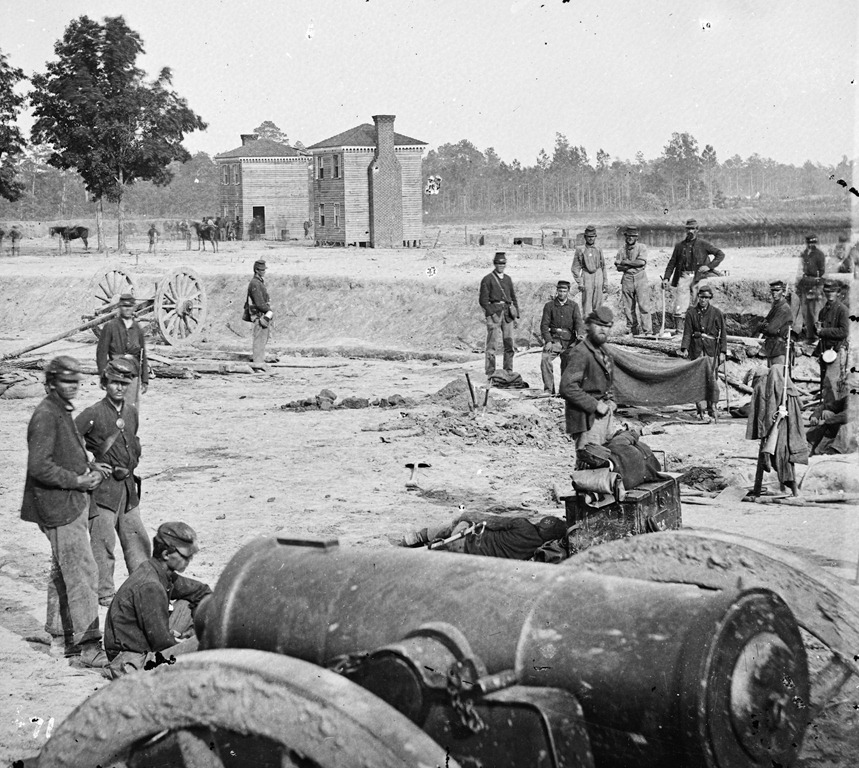
Seven Pines, Va. Twin houses on battlefield, with 32-pdr. field howitzer in foreground

From Library of Congress:

Title: Seven Pines, Va. Twin houses on battlefield, with 32-pdr. field howitzer in foreground.

(Note — the title description of the artillery piece is likely wrong.  Please see first comment below.)

June 1862

Photographer: George N. Barnard

Photograph from the main eastern theater of war, the Peninsular Campaign

Civil War glass negative collection.  Library of Congress Prints and Photographs Division Washington, D.C. 20540 USA

Record page for this image: http://www.loc.gov/pictures/item/cwp2003000069/PP/

June 19th. Returned from the works at 8 A. M. this morning, tired out, but in good spirits, as we indulged in a good deal of sport when the firing slacked. Had a good dinner, the sutler having finally found his way to camp. Lieutenant-Colonel Parisen returned from sick leave to-day, looking very well. We were all pleased to have him back with us.

McCall’s division, of Pennsylvania reserves, from McDowell’s army, joined to-day, and were placed in position near Mechanicsville.

Sarah C. Woolsey to Georgeanna Muirson Woolsey.

New Haven Hospital, June.

I have been so very busy that my conscience does not reproach me at all for not writing. . . . A fortnight ago our wounded came—240 of them, all dreadfully neglected and needing attention of every kind. I cannot just this moment recollect the name of the ship which brought them, but there was only one surgeon on board to care for them, no nurses and hardly any provisions; the wounds of many had not been dressed for nearly a week when they got here, and seven or eight died on the passage. For the first few days most of them were placed in tents on the hospital grounds, but since then the new Barrack Hospital has been finished, and all except about twenty very bad cases are quartered there and doing very well. They would not let any young ladies enter for the first three or four days, the sights and sounds were too bad for them. Such was the enlightened decision of the excellent incapable in charge, but Friday I worked my way in, and since then have been there nearly every day, taking charge of the linen room and giving out clothes, etc. to the men. At first everything was in dreadful confusion, but gradually our department is getting into order, and in the course of three or four days will be thoroughly systematized. A good old lady and myself are to take turns in presiding over the clothing supplies, and as she is rather inefficient and feeble, I hope to take a very big half of the time. The small corner they give us as a store-room was yesterday all shelved and cupboarded under my direction, and will be capable of holding three times the supply it did before. . . . I go up at nine and stay till seven, and all day long the nurses are coming after sheets, and shirts, and bandages, and rags, and towels, and soap, and the men stopping at the door to ask for trousers or coats, and in time I hope to get the true tailor’s measure in my eyes. Such fine, manly, patient fellows as they are. Many of them, almost all, from Michigan and Pennsylvania and New York; not one Connecticut man among them. From the linen room one can organize little rushes into the wards to see special cases, etc., so it is not to be despised even though not as satisfactory as the actual nursing would be. Just outside of our long wooden barrack is a small wooden kitchen, and there Harriet Terry and Rebecca Bacon preside over the diet for the special cases who cannot eat the hospital rations, and if one looks in there about twelve, such a smell of good things greets the nose as it does one good to experience; and arranged on the table are such nice little messes all labelled and numbered—such brown crisp toast and savory chops, and smoking beef-tea, and little messes of this and that; and later the great trays come in and carry them off down the long entry, and so, many poor fellows are made comfortable. One building, which holds eight wards, and comprises four tents full of sick, is all well managed, orderly and thriving, with good paid and excellent unpaid nursing; but in the main hospital where the housekeeper has control, it is all mismanagement, confusion and waste; really sickening to see. The men are doing pretty well though, and all of them are so happy and grateful for the care taken of them. A very nice man from the 105th Pennsylvania, for whom I was writing a letter yesterday, told me to tell his mother not to feel anxious about him, for he was cared for just as if he was at home, and had everything he desired.

Engagement at Charles City–Explosion of the Boiler of the Mound City–Terrible Loss of Life–Total Defeat of the Rebels.

USS_Mound_City_01Memphis, June 19.–An expedition, composed of the gun-boats St. Louis, Lexington, Conestoga and Mound City, with transports carrying the Forty-third and Forty-sixth Indiana Regiments, under Colonel Fitch, was sent hence some days since to remove the obstructions from the White River. On the 17th the expedition reached St. Charles, 85 miles from the mouth of the river, where the Rebels had erected a battery.
An engagement ensued, lasting an hour and a half. While the gun boats engaged the batteries, the troops under Colonel Fitch landed a short distance below and proceeded to storm the place. During the cannonading, a ball entered the boiler of the gun-boat Mound City, causing a fearful explosion and loss of life. The crew consisted of one hundred and seventy-five, of whom one hundred and twenty-five were killed and wounded. The following officers are among the killed:–John Kenzie, Jan Scoville, John Green, Henry R. Brown, Jos. Nixon and John Cox. Captain Kelty, the Flag Officer, was badly scalded, but it is thought will recover.
Colonel Fitch’s charge on the battery was a perfect success, driving the enemy out at the point of the bayonet. The Rebel loss is 125 killed and wounded, and 30 prisoners. General Halleck has occupied Holly Springs.
Chicago, June 21.–The following fuller account of the fight with the Rebel batteries on White River has just been received.


Memphis, June 19.–The gun-boat Conestoga has arrived with despatches containing the particulars of the engagement at the Rebel fortifications below St. Charles.
On the 17th, the gun-boats St. Louis, Mound City, Lexington, and Conestoga, and transport New National, having on board the Forty-sixth Indiana Regiment, Col. Fitch, which left here a week ago to open communication with Gen. Curtis’ army, and remove the obstructions from White River, ascended that stream. The gun-boat Mound City, Captain Kelty commanding, was about a mile and a half in advance. In a bend of the river near St. Charles, two concealed batteries opened on the Mound City. Her decks were immediately cleared for action, and as soon as the range of the works was obtained, the guns opened fire.
Capt. Kelty signaled to Col. Fitch to land his force below the fort, which was successfully accomplished. The Lexington and St. Louis shelled the woods, under cover of which Col. Fitch gained the rear of the Rebel position.
At this juncture a ball from a siege gun on the bluff struck the forward and port side of the Mound City, penetrating the casements and passing through the steam drum. The vessel was filled with the escaping vapor, and nearly every one on board was scalded; only twenty-three of the officers and crew, out of one hundred and seventy-five, escaped from injuries. The scene which ensued was horrible. Many of the crew, frantic with pain, jumped overboard, and some of them were drowned. Boats from the Conestoga, which was coming up at the time to support the Mound City, were sent to their relief; but the Rebels fired on the men in the water with grape and canister from their field pieces, murdering most of those who were attempting to escape.
Being apprised of the state of affairs in the river, Colonel Fitch’s regiment pushed forward and carried the fort by storm at the point of the bayonet. The Rebel works consisted of two batteries, the lower one mounting six field pieces, and the upper one three heavy siege guns, manned by from 400 to 500 men, under command of Colonel Frye, late of the United States Navy. About 200 Rebels are said to have escaped, over 150 are reported killed and wounded, and thirty taken prisoners.
Among the prisoners is Colonel Frye, who was wounded in the shoulder. He has been brought to Memphis by the Conestoga.
Captain Kelly, of the Mound City, was severely scalded about the face and hands. He will recover. Second Master Hearth, Third Master Kinzie, Fourth Master Scoville, Master’s Mate H. R. Browne, Paymaster —–, Chief Engineer John Cox, and Assistant Engineers John McAffee and Hollingsworth were killed. Pilot Chas. Young was severely scalded, and is reported to have since died. Surgeon Jones and Carpenter Manning were slightly scalded. From eighty to one hundred of our sailors have already been buried, and over twenty are missing.
Colonel Fitch, report[ed that] but few of his men were wounded and none [died], and but for the unfortunate accident on the Mound City, the Rebel works would have been carried without loss on our side. She can easily be repaired. The Flag Officer has sent to Cairo for another crew. The Rebels have obstructed the channel above, by sinking two large steamboats and a gun-boat, believed to be the Maypol.

Philadelphia Inquirer
Monday, June 23, 1862