Following the American Civil War Sesquicentennial with day by day writings of the time, currently 1863.

June 2012

June 19.—A skirmish took place between the Twentieth Indiana regiment, in General Kearny’s division of the army of the Potomac, and a body of rebel troops, which lasted for more than an hour. The Union troops held their position with slight loss, having had only three men wounded. In the afternoon, Gen. Kearny complimented the regiment for its bravery and discipline.

—The confederate schooner Louisa, laden with cotton, two flatboats, laden with rice, and a steam tug-boat, were captured about twelve miles up the Santee River, by a boat’s crew of the United States steamer Albatross, blockading off the North-Santee River, S. C.

Note: This letter—a document written in 1862—includes terms and topics that may be offensive to many today.  No attempt will be made to censor or edit 19th century material to today’s standards.

Rienzi, Tishomingo Co., Miss., June 19, 1862.

This is one of the few days that remind one of Illinois, although there are very few nights that might not remind a Greenlander of his home. I think there has not been a night yet that I have not slept under three blankets, and there have been many nights that I would have used a dozen if I had had them. The natives say that ’tis the Gulf breeze that makes the air so cool after about 7 or 8 p.m. I wish that it would get along about eight hours earlier daily; but to-day there are clouds kiting about so o’erhead that the sun don’t amount to much only for light, and ’tis cool enough to make underclothing comfortable. The colonel, A. D. C. and myself visited the camp of the 7th Illinois yesterday at Jacinto. We found them surrounded with a brush parapet, felled trees, etc., ready as they said for a twelve-hour’s fight. They’d been visited by a scare. There is no enemy within 15 miles of them and hasn’t been. They are camped in the suburbs of a beautiful little town that fell in among the hills in a very tasty manner (for a Mississippi town). In one little valley near a fine residence there are three springs bubbling up in line and within a foot of each other, which are so independent that each furnishes a different kind of water. The first pure, cold, soft water without taste, another chalybeate, and the third, strong sulphur. The waters of the three fall into one little basin and run thence into a bathhouse twenty steps distant. There is a neat vine covered arbor over the springs with seats arranged within, and altogether ’tis a neat little place—good to water Yankee horses at. There were several gangs of negroes at work in the corn and cotton fields along the road yesterday, and I thanked God they were not in Illinois. Candidly, I’d rather see them and a whole crop of grindstones dumped into the Gulf, than have so many of them in our State, as there are even here. Yet, it don’t look square to see the women, if they are niggers, plowing. I have no reason for the last sentence, only it isn’t in my opinion what petticoats were designed for. Talking about niggers, these headquarters are fully up with anything in that Potomac mob on the colored question. They got Jeff Davis’ coachman. What of it? J. D. isn’t anybody but a broken-backed-politician-of-a-civilian, and of course his coachman is no better than a white man. But we, we have, listen, General Beauregard’s nigger “toddy mixer,” and my experience fully proves to the satisfaction of your brother that the general’s taste in selecting a toddy artist is fine. He is a sharp cuss (the nigger). He left them at Tupelo day before yesterday, p.m., slipped by the pickets while ’twas light without their seeing him, but after dark he was suddenly halted by their videttes when within ten feet of them. He ran by them and they fired, but as usual missed. He is really the servant of Colonel Clough, of Memphis, but the colonel is now on Beauregard’s staff, and John (the boy) was selected as drink mixer for the general-pro tem. He reports that Price started with the flower of the flock, only some 3,000 posies, to Virginia, but said posies, like their vegetable brethren, wilt and droop by the wayside, and unlike them, scoot off through the brush at every chance, and that is the last of them as far as soldiering is concerned. Hundreds of the dissatisfied Rebels pretended sickness and lay by the roadside until the army passed and then heeled it for home. All the prisoners and deserters that we get concur in saying that at least 10,000 have deserted since the evacuation. A couple of very fine-looking young fellows, Kentuckians, came in this p.m. Their regiment with two others are the outpost guard between the Rebel Army and ours. They were in a skirmish the other day at Baldwin, where two of our companies were surprised and lost six men, taken prisoners. There were 60 of our boys and they reported 400 Rebels. These deserters say there were only 42 Rebels; but the next day 700 Rebels came onto 75 of our men and the chivalry were put to flight in a perfect rout. So it goes. There was a flag of truce came in last night to our picket. Brought a dozen packages for Halleck and company, with a number of letters for Northern friends, all unsealed. Several of the envelopes were of common brown wrapping paper. There are a good many things about this advance of an army that are more interesting than the main army the infants know of. We cavalry feel as safe here as in Illinois, but General Ashboth keeps calling on Pope for more men all the time.

What do you think we’ll have to eat to-morrow? Answer: Lamb, roast goose and liver (beef), blackberry pies, plum pudding, new peas, string beans, onions, beets, fresh apple sauce, etc. That’s a fact, and we have a cow that furnishes us milk, too, and a coop full of chickens, maccaroni for our soup, and we get all the beef brains.

Tell Colonel Kellogg that the boys are talking about him yet, like a lot of chickens for their lost “Mar.” The 7th has plenty to do now, if I wasn’t so tired I’d write you a copy of the orders I sent them to-day.

The enemy keeps annoying our outposts, and rumors come to-day of their being on the way for this place to surprise us. All bosh, I suppose. I hope they are too gentlemanly to disturb us while we are doing as well as we are here. It would be worse than the old lady where I stayed night before last. I went to bed at 12:30, and about 5 she sent a servant up for the sheets to wash. The joke was on our family, but I told her that she had better let me roll over the whole house if she had to wash up after me, for it would improve the health of her family to scrub the premises and them. Fine people here. They’ve commenced bushwhacking. One of my orderlies was shot through the thigh night before last while carrying some dispatches. “Concilate,” “noble people,” “high spirited.” Oh! Strangulate is the better direction.

John’s Island, S.C., June 18, 1862

Yours of May 23d reached me here last night, keeping up the series of your weekly despatches. Whatever may happen to me in this war I assure you there has been no item in it which has touched me so much as this series of letters coming so regularly in spite of all you had to occupy your mind. They have not been answered as they should have been, but do not suppose that I have failed to appreciate them, or the great thoughtfulness which dictated them. This one found me well and in good spirits, and with two bulletins already sent to John and Louisa informing them of these facts, I had left it for them to notify you and given up the idea of writing myself, for writing here is no small effort; but as General Williams orders all of us to sit up all night, I am going to devote my two hours of dawn to you.

You have probably heard, through Southern sources and with their usual degree of truth, of the action yesterday and you may have been anxious for my safety, though I hope you were sufficiently ignorant of all the facts not to be apprehensive for me personally. The amount of the whole story is that we had a severe action and were repulsed with very heavy loss. This much you know; and for myself, General Williams’ brigade was in the advance of one of the attacking columns, was under fire about four hours, during the whole of which time the danger of his men was fully shared by the General and his staff. I would not have missed it for anything. I had never been really under fire before and the sensation was glorious. There we were, mounted officers, either standing right before the enemy’s works, while the shells went shrieking and hurtling just over our heads and sometimes broke close to us, or else carrying orders to all parts of the line, feeling that you carried life and death in your hands. I was frightened of course — every one is, except a few who don’t know what danger is; but my fear was not what I had imagined it might be. My face was a little fixed I imagine. I knew that my nerves were a little braced, but my mind was never clearer or more easily made up on points of doubt, and altogether the machine worked with a vigor and power which, under the circumstances, I had never hoped it possessed. To all his staff, collectively and individually, General Williams has expressed the highest satisfaction, saying that he was perfectly satisfied and that a difficult and dangerous work could not have been better executed; and if you knew General Bob, and had seen how recklessly he exposed himself, and were aware how he does snub and how he does n’t praise, you would allow that this was something. In a word I don’t care if I’m never in action again, and I would rather not run its risk, though I should like once to join in the shouts of victory; but I would not for anything have lost the experience of yesterday and, without affectation, it was one of the most enjoyable days I ever passed.

I don’t pretend to give you a history of the engagement. You will get that from the lying prints, and a very false one it will be; but being on the staff I saw all the Generals and all the movements. There was Benham, an old hen, cackling round, insulted by messages from angry Brigadiers sent through boyish aids, and he himself mainly anxious for cover, indecisive, and, many thought, frightened. There was Wright, a little excited at times but growing genial and kindly as the fire grew hot. There was your friend, Stevens, dirty and excited, but clear headed and full of fight, with a dirty straw hat on his head and his trousers above his knees from the friction of riding. And finally, there was handsome Bob Williams astride of his big horse, defiantly planted in front of the battery in open field, full of all sorts of humors — the long sabre hanging from the saddle-bow and his eyes beaming, sparkling and snapping according to the turn of the fight. In the hottest fire he grew genial and took the occasion of a shell splashing us with mud to tell me an old and not very good story. Then the retreat was ordered and he grew savage, though not to us; and finally I thought old Benham would have to put him under arrest, he treated him with such undisguised contempt. My rides round the battle field too were curious. Here was a long line of wounded men toiling to the rear, and the different ways in which they bore their wounds, from the coward limping off untouched to the plucky fellow with his leg hanging by the skin making faces that he might not yell. There were knots of men behind hedges and in the ditches, stragglers and cowards, men who could not be shamed to the front. To talk of the horrors of a battle field is a misnomer. The hospital is horrid and so are the stretchers and ambulances running blood; but in the heat of battle a corpse becomes a bundle of old clothes and you pass the most fearful wounds with a mere glance and without a thought.

There was nothing disgraceful in our repulse, and our retreat was a model of good order and regularity. The regiments when overcome retired in column in common step and with their colors flying and formed exactly where their officers ordered. There was no running, no panic, and I felt proud of New England as I saw the 3d N.H. coolly hold their position between two murderous fires. We should have whipped them dreadfully had they followed us. . . .

JUNE 18TH—Lee is quietly preparing to attack McClellan. The President, who was on the battle-field, is very cheerful.

June 18th.

How long, O how long, is it since I have lain down in peace, thinking, “This night I will rest in safety”? Certainly not since the fall of Fort Jackson. If left to myself, I would not anticipate evil, but would quietly await the issue of all these dreadful events; but when I hear men, who certainly should know better than I, express their belief that in twenty-four hours the town will be laid in ashes, I begin to grow uneasy, and think it must be so, since they say it. These last few days, since the news arrived of the intervention of the English and French, I have alternately risen and fallen from the depth of despair to the height of delight and expectation, as the probability of another exodus diminishes, and peace appears more probable. If these men would not prophesy the burning of the city, I would be perfectly satisfied. . . .

Well! I packed up a few articles to satisfy my conscience, since these men insist that another run is inevitable, though against my own conviction. I am afraid I was partly influenced by my dream last night of being shelled out unexpectedly and flying without saving an article. It was the same dream I had a night or two before we fled so ingloriously from Baton Rouge, when I dreamed of meeting Will Pinckney suddenly, who greeted me in the most extraordinarily affectionate manner, and told me that Vicksburg had fallen. He said he had been chiefly to blame, and the Southerners were so incensed at his losing, the Northerners at his defending, that both were determined to hang him; he was running for his life. He took me to a hill from which I could see the Garrison, and the American flag flying over it. I looked, and saw we were standing in blood up to our knees, while here and there ghastly white bones shone above the red surface. Just then, below me I saw crowds of people running. “What is it?” I asked. “It means that in another instant they will commence to shell the town. Save yourself.” “But Will — I must save some clothes, too! How can I go among strangers with a single dress? I will get some!” I cried. He smiled and said, “You will run with only what articles you happen to have on.” Bang! went the first shell, the people rushed by with screams, and I awakened to tell Miriam what an absurd dream I had had. It happened as Will had said, either that same day or the day after; for the change of clothes we saved apiece were given to Tiche, who lost sight of us and quietly came home when all was over, and the two dirty skirts and old cloak mother saved, after carrying them a mile and a half, I put in the buggy that took her up; so I saved nothing except the bag that was tied under my hoops. Will was right. I saved not even my powder-bag. (Tiche had it in the bundle.) My handkerchief I gave mother before we had walked three squares, and throughout that long fearfully warm day, riding and walking through the fiery sunshine and stifling dust, I had neither to cool or comfort me.

Wednesday, 18th—It is very hot, but the troops are in fine spirits. Some of the boys who were wounded at Shiloh, together with those who went home on furloughs on account of sickness, are now returning to their commands.

18th. Wednesday. Grazed my horse. Did little more. Read some. Paymaster came from Leavenworth.

Written from the Sea islands of South Carolina.

[Diary] 18th.

Ellen had her first adult school to-day, in the back room — nine scholars. I assisted.

The girls were much interested in seeing the people come, with their flat baskets on their heads, to the corn-house, to “take allowance,” and then sit down in the sand, and old and young fall to shelling the corn from the cob with a speed that was marvellous, the little babies toddling about or slung on the backs of their mammies, or lugged about by the older sisters, not able to stand straight under their weight. It was very picturesque.

In Our Tent, June 18.

Dear A.,—All my delightful cases and letters are received. You have just no idea of the pleasure they give. I wrote last on the 14th. Sunday was a very distressing day. Our sick men were still with us, for Mr. Olmsted could neither get permission to put them on the “Elm City,” nor induce the surgeon of the Shore hospital to send his ambulances for them. Expecting every hour to move them, we were unable to put them into hospital clothing; and as they were very restless and crazy, this made our work less satisfactory than usual. In all other respects they were well cared for.

The painfulness of the day was greatly increased by a visit from a Sunday picnic of Congressmen and ladies. One of the former went to Mr. Olmsted and complained to him of what he saw on our boat. He said the men were in “an awful state. I saw — I saw with my own eyes — flies settling on them and biting them!” This gentleman came into the ward with a rose held to his nose; and when told they were all typhoid-fever cases (“That one by you is the worst case I ever saw,” Georgy said maliciously), he went abruptly away. Had he stopped to examine the condition of things, he would have seen that every man who could not brush the flies away had a mosquito-netting over him, and all the others had fans. The thermometer is at 90°, and the flies are an Egyptian plague; but all was done that could be done to alleviate it. I could see that this affair pained Mr. Olmsted exceedingly. It was essentially unjust; but the outward circumstances of the case, as I have stated them, did not permit that ample refutation which a mere glance into one of the wards would usually afford. I think he felt it the more as it was our very own castle thus invaded by reproach. But a few hours later a thing occurred which must have wiped from his mind the sting of reproach from such a quarter. Colonel ——, who was on the “Elm City,” very ill with typhoid fever, was madly anxious to get home. He knew he must die, and he craved to see his wife. The gentlemen of the excursion-party were asked to take him back on their boat. They refused; alleging that they were “a select party,” and “not prepared to incur infection:” they made the ladies the ground of their excuse. So Mrs. Griffin went at midnight to the ladies and begged them to consent to take him; and of course they did so. I could enlarge upon this, but the subject is hateful.

Sunday evening we moved our men to the “Elm City,” where I found them all comfortably placed on Monday, when I went through the wards with a member of the New England Women’s Association, who had come down on the “Webster” to make up her mind as to whether we were doing our duty. She went back with them on the “Elm City” yesterday.

Dr. Henry J. Bigelow arrived early in the week. He came on a private mission from the Secretary of War to see and report upon the state of the Medical Department, and find out where the hitch really is. I wish he had come from the Surgeon-General instead. The Secretary of War is apt to send missions of private inquiry by which he forgets to profit; so that the best man for the work of inspection is likely to go back from here and have his observations disregarded. Mr. Olmsted has paid him all the attention in his power. Matters of importance are, however, pending at this moment between Mr. Olmsted and the Surgeon-General, and this throws some gêne into his intercourse with Dr. Bigelow. I gather that he cannot open himself freely to him. I do not know, of course, how matters are between Mr. Olmsted and the Medical Department, and if I did know I should not speak of them; but I may certainly say this: that the Department feels the greatest gratitude to Mr. Olmsted for what he has done, and would gladly give him much wider power, if that were what he is seeking. That is not his object, however; indeed, the object of the Commission itself is not sufficiently understood. Those who admire its wise and noble work naturally feel the wish that larger power should be given to it. But the object of the Commission itself is not this. It seeks to bring the Government to do what the Government should do for its sick and wounded. Until that object is accomplished, the Commission stands ready to throw itself into the breach, as it did during that dreadful battle-week, as it does more or less all the time. The thing it asks for is not the gift of power, but that the Government should take the work away from it by doing it thoroughly itself. A Medical Inspector is to be sent here immediately, at Mr. Olmsted’s earnest request, and we shall see what that will bring forth. But, after all, I fear the principle of active war is, and perhaps must be, — every marching man is precious; when he drops, he’s a dog. Ah! what would have become of him so far without the Sanitary Commission? I am not afraid to say that no enterprise ever deserved better of the people. Alive to the true state of things, ever aiming at the best thing to be done, and striving to bring everything to bear towards that, it has already fulfilled a great work, — let those who have reaped its benefits say how great and how indispensable.

I am sitting with Georgy in the tent, waiting for the arrival of a train of sick men, due notice of which is always telegraphed to us from Savage’s Station. The “Wilson Small” has dropped down the river to coal. Mrs. Griffin is, I grieve to say, knocked up, with curious symptoms of fainting and wandering. Dr. Ware says she must go home, and she leaves on the mail-boat to-morrow, — a most serious loss to us at any time, but especially if an emergency occurs.

Yesterday we did nothing special but dress in clean clothes (I mean the cleanest we had) and go down to the “Webster,” where we were received with all honors, and had a good dinner, — Georgy and I eating an incredible number of raspberry tartlets. Dr. Grymes drank to us in his happiest manner: “Ladies, I give you a welcome where you have a right!” The ship was dressed with magnolia, honeysuckle, and the lovely white fringe blossoms, in our honor. The “Webster” is a constant satisfaction to the Chief, being thoroughly all right, — thanks to Dr. Grymes and Mrs. Trotter and her good captain.[1]


[1] Dr. Gryrnes’s health was steadily giving way. As we looked at him, so full of energy and ardor in his work, we used to think he knew he was a dying man, and chose to alleviate death and suffering in others as long as life was in him. After the campaign was over, he became surgeon of the Sanitary Commission “Home” in Washington. His residence was a few paces off, and he resolutely came to his work, until it took him half an hour, supported on each side, to get over that short distance; then he died.

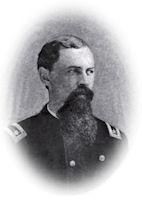
June 18th. At three o’clock this afternoon, the picket line was advanced to a crest, a short distance in front, which was desirable on account of the shelter it afforded the rebel sharpshooters. Of course, it brought on a contest immediately; all the redoubts fired their big guns, and pandemonium broke loose. We fell in and hurried down to the works, but by that time our troops had gained the desired position, and the fighting ceased. We marched back to camp and were just dismissing the parade when a furious fire opened all along the line, and we were hurried back again to the front. The enemy came on this time in long lines of battle, extending over a mile along the works; they drove in the pickets and reserves, and came within sight of our works for the first time. They did not remain long, however. All the guns opened fire, and instantly one continued blaze enveloped forts and redoubts, torrents of leaden hail, and bursting shells were hurled against them; their line soon halted, then broke and ran for shelter, without making a second effort to reach us. They lost a heap of men in this effort, and gained nothing whatever. We remained all night under arms. The slashing in front of the earthworks is very intricate and formidable. All the trees immediately in front were felled, so that they fell away from the works; then the tops and branches were slashed, and tied, and twisted, so that, if we were not shooting, it would take an hour’s time to climb through them; when one imagines a steady line of good soldiers, behind a bulletproof rampart shooting at every man advancing, it is not difficult to imagine the strength of our position. Of course, the line is so constructed that every part is covered by a flanking fire of both musketry and artillery.