Following the American Civil War Sesquicentennial with day by day writings of the time, currently 1863.

June 2012

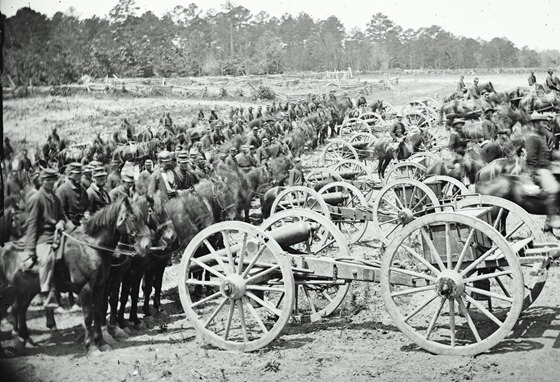
Richmond, Virginia (vicinity). Major (JM) Robertson's Battery of Horse Artillery

From Library of Congress:

Caption from negative sleeve: Major Robertson’s Battery of horse Artillery, near Richmond, June 1862.

Photographed by James F. Gibson

Photograph from the main eastern theater of war, the Peninsular Campaign

Civil War glass negative collection.  Library of Congress Prints and Photographs Division Washington, D.C. 20540 USA

Record page for this image:  http://www.loc.gov/pictures/item/cwp2003005952/PP/

Wikipedia:

The Horse Artillery Brigade of the Army of the Potomac was a brigade of various batteries of horse artillery during the American Civil War.

Jane Eliza Newton Woolsey to her son Charles.

New York, June, ’62.

My dear Charley: Here are lots of scraps for you. Our basket is just going off to the steamer. I hope you will enjoy the gingerbread. We are all anxiety for further accounts since the battles of the last few days. The paper this morning states two deaths on the Knickerbocker of poor wounded men. What trying scenes again for you! I agree with you in all you say of Georgy’s health, but know that persuasion is useless. You ask about coming home. We do not need your aid in getting out of town, however pleasant it would be to have you. There is no prospect of our going at present; we have no place in view at all. . . . Have the rebels cut the telegraph lines, that we get no news from the army? Where are you all to rendezvous now that the White House is given up? Some of the movements seem so mysterious to us—such as this, and the falling back of McClellan’s army to Savage’s Station, and some other strange doings. I hope it will all come out right. Do take care of yourself and the girls. I am so much better satisfied to have you where you are, than with the 22nd. Your Cousins William and Anna have been on to Baltimore to see Lloyd ; they are greatly distressed at the idea of his being sworn in, even for three months! . . .

Farewell dear boy. Mother’s love and blessing to you.

June 18, 1862.—I arrived in Mobile this morning, about 9 A. M., accompanied by Mr. John Fowler and his brother. We had a hard time getting down, as the train was very much crowded. Indeed, I scarcely know how I managed to get on it, as the guard tried to prevent us; my friends, Dr. H. and Captain C., threw me on, minus half of my baggage. I stood on the steps of the car for a little while, when one of the soldiers inside, with true southern gallantry, insisted on my taking his seat. As the car was filled with sick and wounded men, I was unwilling to do so; but from his importunity I was compelled to accept. The intention was a good one, and I received it in the spirit with which it was given, but I did not relish the change. The car was so close and crowded that I could scarcely breathe. I was seated with some very nice men from Missouri, but they certainly had not made use of a certain aqueous fluid that morning in making their toilets. As that liquid is scarce in Mississippi, I excuse them. One seemed anxious that I should have a lock of his hair, as he combed and scattered it around me. Another one bought some plums, and put them in a very greasy hat, some of which he very kindly offered me, mill for politeness’ sake I took them. I had to hold my head out of the window to get fresh air. To add to all, we had no water.

General B. was on the train. He and his staff had the ladies’ car and the baggage-car next, which was the cause of our being so crowded. I could not help wondering what had become of our boasted southern chivalry. It does not do to grumble, as these are war times, and the order of things seems to be reversed; but I could scarcely keep from it, as the car I was in was next to the baggage-car, where I had the felicity of seeing General B. and his staff come, every now and then, and arrange their toilets. The sight of them ought to have consoled me; but alas! for poor, weak humanity, I could not help envying them their comfortable seats. I did not mind so much for myself, men now-a-days seem to think that women have no right to leave our homes, and that the railroads and rail-cars are for their exclusive benefit. I could not but feel for the sick and wounded men who were so crowded, and many of them lying on the floor. If General B. was sick, he should have had a nice seat, but not a whole car; and why should his staff, more than other well soldiers, have so much room?

I heard many remarks about it, but said nothing, as I think it wrong to encourage grumbling at this time. We must expect little annoyances, and, as we are all struggling in one common cause, must not mind them.

My Missouri friends were very kind and attentive, and it gave me great pleasure to listen to them talk over their campaigns.

The country through which we passed was one immense field of corn. We came nearly two hundred and fifty miles, and I scarcely saw an acre of cotton.

On my arrival at home I learned that Mobile had lost fearfully by the late battles near Richmond. Among the wounded and slain are friends whom I have known a lifetime. I called on one lady, who had just received a letter from her son, then in the Virginia army, telling her that his father had been mortally wounded, and is now a prisoner, and his uncle in the same position. The battle of Seven Pines, near the Chickahominy River, was fought on the 31st of May. On the morning of the 1st of June, a part of our army was drawn into an ambuscade and had to retire, thereby leaving our wounded in the hands of the enemy. In the first day’s battle General J. E. Johnston, who was in command, was severely wounded. We were victorious, and had it not been for one of our general’s failing to come up at the right time, we would have captured the whole Federal army, which was under the command of General Keys.

The Eighth Alabama Regiment[1] lost many. It is said that it covered itself with glory in the last battle, and also in that of Williamsburg.

Among the killed are Lieutenant Henry Ellis, and Captain L. F. Summers, an eminent lawyer of this place. Lieutenant Mordicai, son of Dr. Mordicai, is mortally wounded. Lieutenant Josh Kennedy is believed killed by all but his devoted wife. Captain Laughrey and his brother are wounded and prisoners. Lieutenant Branigan is badly wounded, and is also a prisoner. The fate of Captain L. is uncertain; but, from what we can learn of him from men coming from the army, there is little doubt but that he is killed, as the last seen of him was when he had been wounded for the third time, and fell, it was supposed, dead.

The company of which Captain L. was a member, the Emerald Guards, was one of the first which left here for Virginia. It was composed of the members of a fire company. The men in it were principally natives of the “Green Isle of the Ocean;” they who have come forward, like Brian of old, at every call in this eventful struggle, and who, having adopted this land as their own, are determined to maintain her rights at all hazards.

I was at the depot the morning the company left for Virginia. It numbered one hundred and fifteen men. They were dressed in dark green, the emblematic color of Ireland, and carried a very beautiful flag, presented to them by some ladies. It was a Confederate flag on one side, in the center of which was the full-length figure of Washington; on the other side was the harp, encircled with a wreath of shamrocks and the words “Erin-go-Bragh.” Below that again was the Irish war-cry, “Faugh-n-ballaghl” which means “clear the way.” They were escorted by all of the fire companies, with a very fine band of music.

At that time I thought, like many others, that they were going more on a frolic than any thing else, as we could not think it possible that the North really meant to try and subjugate us, and as soon as she saw we were in earnest would let us alone, as we asked nothing from her but that. Alas, how fearfully have our hopes fallen, one after the other I We are not to gain our independence but through the blood of our bravest and best. God grant it has not been spilled in vain! I sincerely trust that the bereaved wives, mothers, and sisters will be enabled in this trying hour to look up to Him for comfort, who has promised to be a father to the fatherless and a friend to the widow. And may they also find consolation in knowing that these loved ones have died the death of heroes, and that

“While the moss of the valley grew red with their blood,

They stirred not, but conquered and died.”


[1] But a remnant of this gallant regiment is now living. It was with General Lee at the time of the surrender. While expecting to be ordered in line of battle they were told to throw down their arms. They took their flag, which they had borne triumphantly through many a battle, and tore it into shreds. Each man, while the tears ran down his cheeks, took a piece to keep as a sacred memento of the past.
June 18.—The fort over Eastern Branch, near Washington, D. C, in the vicinity of the hamlet “Good Hope,” hitherto known as “Fort Good Hope,” was named “Fort Wagner,” in honor of Lieut. Wagner, of the Topographical Engineers, who died of wounds received near Yorktown, on the seventeenth of April last

—Col. Averill returned to the headquarters of General McClellan, on the Chickahominy, from a scout to the Mattapony, in search of a band of guerrillas. They were found to have left the previous day. He destroyed the bridge, took a number of wagons and carts loaded with supplies for Richmond, destroyed a large amount of rebel grain, and captured several important prisoners.

—A reconnoissance was this day made by the Sixteenth Massachusetts, under Col. P. T. Wyman, for the purpose of ascertaining the exact character of the ground in front of the picket-line at Fair Oaks, Va.—(Doc. 135.)

—A band of rebels were attacked by Major Zeley and a party of Union troops, near Smithville, Ark. Captain Jones, their leader, and fourteen of his men were captured. The rebels had four men wounded. Union loss, two killed and four wounded.—A skirmish occurred at Tallahatchie, Flu.

—An expedition composed of four companies of Union troops, under Col. Kimball, sent from New-Orleans to Manchac, La., for the purpose of dispersing a large number of rebels encamped in that place, this day returned to New-Orleans, after having successfully performed the object of its mission. On the approach of the Union force, the rebels decamped, leaving their regimental colors, guns, camp equipage, etc., behind them. The guns were spiked, the colors taken away, and the bridge at Manchac Pass burned.

—Gen. Morgan marched at one A.M. to attack the rebels at Cumberland Gap, but on his arrival there found that they had abandoned that position a few hours before.—(Doc. 136.)

—The bill emancipating the slaves of rebels passed the United States House of Representatives, by a vote of eighty-two against fifty-four.

June 17th.

Yesterday, and day before, boats were constantly arriving and troops embarking from here, destined for Vicksburg. There will be another fight, and of course it will fall. I wish Will was out of it; I don’t want him to die. I got the kindest, sweetest letter from Will when Miriam came from Greenwell. It was given to her by a guerrilla on the road who asked if she was not Miss Sarah Morgan.

Tuesday, 17th—It is very hot. Nothing of importance.

June 17 — To-day I went on the field where we fought on the 6th, and saw the very spot where our lamented Ashby fell.

To Mrs. Lyon.

Camp near Clear Creek, Miss., Tuesday, June 17, 186:2.—I went over to the 16th Regiment, which is located near Corinth, about four miles from here, and stayed all night with Sperry. He is perfectly healthy, and fleshier than I ever saw him. He expects every day to receive his commission as 2d Lieutenant from April 29th. His pay will be $105 per month from that date instead of $20, which he received before. He stands a chance of being Captain within sixty days. I also saw Colonel Bouck, of the 18th. Neither of these regiments can turn out two hundred well men. They have not been in any fight since the battle of Shiloh.

17th. Wrote to Brockway. Part of the Missouri expedition returned with a load of bacon. Tired horses and men. Issued some.

[Battle of Secessionville on James Island]
(To John Adams)

Headquarters 2d Division, James Island, June 17th, 1862.

My dear Uncle:

I write to impose a solemn duty upon you, which involves the lives of thousands of brave men.

Brig.-Gen. Benham is a native of the State of Conn., and I understand it is to his native state he owes his present position. There is only one way for the State to atone for so fatal a blunder — only one way to wipe out the obloquy the State deserves at putting such a man in power — and that is to give its weight to his immediate removal. Let there be no mercy shown to one who shows no mercy. He must be crushed at once, or we are all lost, and even as it is, God only knows whether his folly may not involve us in destruction before any action can be taken. I will not enumerate half the examples of imbecility he has shown, or the wickedness of which he has been guilty. The last act is too real. His folly has culminated in one damning enterprise which must make him eternally infamous.

You will learn from the steamer conveying this, of the shocking battle of the 16th. There will be a struggle to suppress the truth, to call fair names, and to shift the responsibility, but the blood of the murdered men cries out for vengeance. This is no rhetoric. It is solemn truth. The ill-fated enterprise to this island has been characterized by the grossest mismanagement, and the men — poor dumb creatures — have had to suffer privation, exposure, and death, where no excuse can be pleaded in extenuation.

On the night of the 15th, Genl. Benham assembled his officers in council. Generals Wright, Stevens and Williams were present. He unfolded to them his plan of taking the Enemy’s Battery by storm. It was in vain that the other officers entered their earnest protest against a needless work of slaughter. It was useless to suggest that his object could be effected in other ways. His decree was absolute that the work must be stormed in front — and for what? Because visions of another Donelson or Newberne had smothered in his breast every sentiment of mercy. A success would be but little gain to the country, but the éclat might make Benham a Major General. Men might die to win a needless victory, could only his foolish vanity be gratified.

His orders were obeyed, and the next morning’s work attests their folly. But even then all might not have been lost, had not his conduct in the field been marked by weakness, vacillation, and imbecility.

When the action was over, Genl. Benham tried to say that it was only a reconnoissance. If this be so, then let us have a General in command who can reconnoitre without the sacrifice of an eighth of the force engaged. 700 killed, wounded, and missing! Let the dead who died nobly have a voice, I say. Let the wounded lying on their beds of pain, plead their sufferings. Let those who lie in the prison houses of the enemy cry all shame, shame to a General who makes such a reconnoissance! We are growing weary of patriotism. We, who would have liked to have died to show our love to our country, begin to sicken at the thought our country loves us so little as to leave our fate to the control of a man already branded … It is as true as Holy Writ that our bravest men will never fight again with Benham in command.

Don’t be deceived by printed reports of what took place on the 16th. It was a terribly disastrous affair, and remember the author of it.

I wish the public safety would allow me to publish to all what I write you. I do not fear the consequences if it be shown boldly to Benham himself. But I beg of you to do what you can in this matter. Press it with Governor Buckingham. Get Dr. Grant to help you. Let the influential men help you, and for God’s sake act quick, or the army here is sacrificed, and we will begin to investigate too late.

I remain,

Affec’y. but sadly, Your nephew,

W. T. Lusk,
Capt. & A. D. C.