Following the American Civil War Sesquicentennial with day by day writings of the time, currently 1863.

June 2012

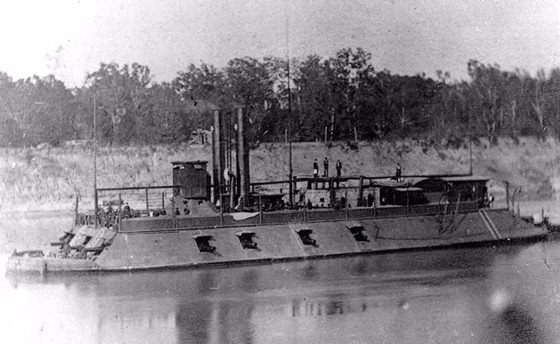
USS_Mound_City_01

From Wikipedia:

(In June 1862), the (Federal) Army of the Southwest under Major General Samuel R. Curtis had been operating in the interior of Arkansas. Curtis believed that Confederate forces of the Trans-Mississippi Department were gathering to attack him. Fearing that he would be cut off, he requested that communications be established between his army and that on the Mississippi River. Either the Arkansas River or the White River would have served his purposes, but the Arkansas was too low for water transport, so an expedition was sent up the White River with intent to give Curtis the aid he had asked for. A single regiment, the 46th Indiana Volunteers, embarked in army transports; they were accompanied by two armored gunboats, Mound City and St. Louis, two unarmored gunboats, and an armed tug. On 13 June, the expedition entered the White River and proceeded uneventfully upstream for four more days.

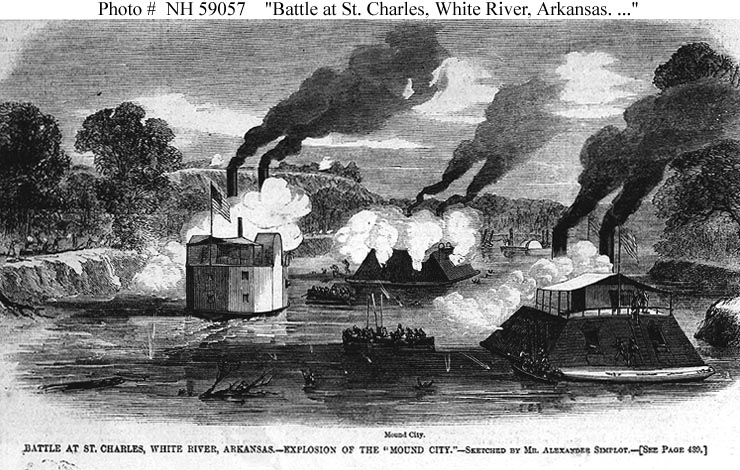
With intent only to slow down the progress of the Union vessels and not to make a determined stand, the Confederates had set up a pair of batteries on the bluffs near St. Charles, Arkansas, some 80 miles (130 km) above the river mouth. The guns were taken from a gunboat which they had then scuttled in the middle of the stream as a further impediment. On 18 17 June, the Federal flotilla arrived at that point; the soldiers went ashore to attack the batteries from the land side, while the two armored gunboats came up the river, Mound City leading. Shots were exchanged between the gunboats and the shore batteries, with nothing exceptional until a chance shot from the upper battery happened to penetrate the casemate of the lead gunboat. The shot killed some men in its passage, but most of the damage it caused occurred when it hit the vessel’s steam drum. Hot steam immediately filled the entire boat, killing and scalding most of the crew. Those who could do so jumped overboard into the river, where Rebel sharpshooters shot them as they tried to swim to safety. By the time the carnage was over, 125 men were dead by the first shot, scalding, drowning, or being shot in the water. An additional 25 were injured by the steam. Among the wounded was Commander Kilty, who survived and later returned to service in the Navy, although he lost his left arm. Only 25 men of the entire crew escaped without major injury. Meanwhile, the soldiers had moved into position to assault the batteries, so the Confederates fled, leaving their wounded and their guns behind.

Despite the almost complete loss of her crew, Mound City had suffered only inconsequential damage that could soon be repaired. First Master John A. Duble of the gunboat Conestoga took temporary command in place of Commander Kilty. Replacements for the crew were taken from other vessels in the expedition, and they went on for another 65 miles (105 km). They then turned back without meeting the Army of the Southwest. Soon enough Curtis was able to move his army to Helena, Arkansas, where he was able to reestablish his communications without the support of the Gunboat Flotilla.

From Department of the Navy Naval History Center:

This action between Federal gunboats and Confederate shore batteries took place on 17 June 1862. USS Mound City was disabled by a shot that penetrated her steam drum, causing heavy casualties among her crew. Other U.S. ships present were the ironclad Saint Louis (seen in the right foreground) and “timberclads” Lexington and Conestoga. The gunboat in left center is one of the “timberclads.”
June 17th. Weather very threatening to-day. About 3 P. M. it became almost dark, but immediately afterwards cleared up without rain or wind; very curious. The firing on the picket line, always continuous; to-day it has been unusually severe, resulting in the death of a great many men, without advantage to either side. Colonel Zook was detailed this morning for twenty-four hours as general officer of the day in charge of picket lines. He took off his shoulder straps and wore ordinary soldier clothes in accordance with orders, as every officer exposing himself is sure to be shot. The works are finished in our front, and are strong and handsome and can never be taken by direct attack, that is certain. Everybody is joking now about “on to Richmond.” These works don’t look much like advancing, and from that point of view are a mistake. I forget whether I ever mentioned the best of all, camp beds. We never think now of using any other, and it is worth noting, even at the risk of doing so twice. Seth gets a barrel from the commissary department, takes off the hoops and loosens the staves; then he drives four crotches into the ground about five feet apart lengthways, and two feet across; places two long poles parallel to each other, resting on the crotches, and lays the barrel staves across them, when the bed is complete. We have two in our tents, covered with red blankets, which look very fine. Inverted cracker boxes, placed on sticks driven in the ground, make the best of tables, and are always to be had for the asking. Received letters and newspapers from home; how much pleasure it gives one to hear from civilization. Here there is nothing but pine trees and sand, not even a ditch or spring to relieve the dull monotony; where there is no water I soon grow dull and stupid. Made out to-day a record of the Fifty-seventh, from the date of its organization, for the War Department. Towards evening the enemy opened all his guns, and a lively bombardment followed; our guns replied, and the row was tremendous. The skirmish line increased its fire so earnestly, we thought certainly this time something was up; at 9 o’clock P. M. we were ordered to fall in, and soon afterwards marched to the works and stacked arms, just in rear of the breastworks manned by Burn’s brigade. The air was alive above us with shells, screeching and howling in their rapid flight. They all went over us and think did no harm to anybody. Remained all night, and at 6 A. M. returned to camp and went to sleep.

Abby Howland Woolsey to her brother.

8 Brevoort Place, June 17th.

My dear Charley: We had just been reading in the Times about the scare at White House when Georgy’s letter arrived. We have read it aloud over the breakfast table, and are now going to enclose it to Mary and Carry at Astoria, that they, too, may have the private version of the affair. It was a bold and very clever dash of the rebels; just what might have been expected, however. They are up to all sorts of thievish, daring things. . . . It would not have been out of place for you all to have been much more frightened than you profess to have been. Georgy’s letter, in fact, we presume, was prepared for home consumption. She always tries to “draw it mild” for our benefit ; is always having a lazy, lovely good time, perfectly well, and in the best of spirits, and as to the scenes of suffering about her, not caring a bit ; has to pinch herself, I dare say, to see that she isn’t stone—thinks she “hasn’t any heart,” etc., etc. Tell her, of course she hasn’t, or won’t have soon—it’s ossifying, that, or something kindred, is what all surgeons die of—suppressed emotion. Tell her we insist on her coming home for a few weeks; now that you are with Eliza, she has not that excuse for staying.—Eliza, of course, we cannot induce to leave, it would be useless to try. Tell Georgy her known imprudence in overdoing herself, her known obstinacy about precautionary and remedial measures, impel me to insist on her taking a northern trip and a little rest just now. . . . Mrs. Gibbons goes back to her Winchester hospital next Monday. I am going up to see her, hear some of her tales and offer what supplies we have on hand. She and her party were obliged to fly for their lives when the rebels drove Banks out, lost on the way their three trunks, containing all their clothing, and Mrs. G. was without a bonnet. They have been very busy sewing up a new outfit, and I hope won’t be interfered with again, though Jackson threatens another raid up the valley with 70,000 men as soon as the harvests are ripe. . . . I have saved our only piece of news till the last—the engagement of Pussy Wheeler; make Georgy guess who to. . . . It is Dr. Ceccarini, the Italian oculist, an accomplished man and skillful surgeon. . . . Mother says, “Tell Charley how glad I am always to get his letters, and tell him that when he cautions Georgy on the subject of health, to be sure to be prudent himself.” You are in a most useful and important place, and we would all rather have you there than in any part of our army.

June 17. [Okolona, Mississippi] —Last evening Judge Thornton heard that his wounded son would be up by the evening train. He, Miss G., and myself went down to the train, but he was not there. As we were going down a guard stopped us; he said the ladies could pass, but not Judge T; and as we could not go without him we were in quite a dilemma. The guard put us all right by telling Judge T. to go off the road, and round a tree which was near, as he had no jurisdiction over any place but the main road.

I intend leaving to-day for home. Mr. Fowler’s brother is much improved in health, and is able to be moved. I regret leaving my kind friends, and all of the patients. The Missourians have got to feel as if they were my brothers.

by John Beauchamp Jones

JUNE 17TH.—It is not yet ascertained what amount of ordnance stores we gained from the battle.

June 17.—Major-General J. C. Hindman, of the rebel army, issued a proclamation to the inhabitants of the Trans-Mississippi District, Arkansas, calling upon all those who were not subject to conscription, to organize themselves into independent companies of mounted troops or infantry, as they might prefer, arming and equipping themselves, and to serve in that part of the district in which they might belong.—(Doc. 134.)

—The rebel batteries at City Point, on the James River, below Fort Darling, Va., opened fire on the Union fleet of gunboats, but the boats returned it so briskly with shell and shrapnel, that the batteries were silenced, and the rebels retired.

—General Wallace assumed command of the city of Memphis, Tenn. His first official act was to take possession of the office of the newspaper Argus. T. Knox and A. D. Richardson were appointed to supervise all editorials which appeared in the newspapers.

—Threats having been made to tear down the Union flags flying over the houses of some of the citizens of Memphis, Tenn., the Provost-Marshal of that city issued an order instructing the guard to shoot down any one attempting to haul down the flag, or offering any insult or molestation to resident citizens who had thus manifested their devotion to the Union.

—The United States gunboats St Louis, Lexington, Conestoga and Mound City, on an expedition up White River, Arkansas, opened fire on a rebel battery at St Charles, while the Forty-third and Forty-sixth Indiana regiments made a land attack, which resulted in the capture of the battery. During the fire a ball entered the steam-drum of the Mound City, and it exploded.—(Doc. 75.)

—This afternoon the stage from Fort Scott was stopped eight miles from Kansas City, Mo., by six men armed with double-barreled shotguns, supposed to belong to Quantrell’s band of guerrillas, and the passengers robbed of seven hundred dollars in money, three gold watches, four revolvers and several overcoats. One passenger saved two thousand dollars, which he had sewed in the linings of his coat, and the express agent’s trunk, containing over ten thousand dollars, was thrown aside as of no value.

Rienzi, Tishomingo Co., Miss., June 16, 1862.

We are camped here enjoying ourselves grandly. As our brigade is scattered over a line of 50 miles we just pitch our headquarters in the quietest spot we can find independent of the command. There are only two companies now out of the 24 within 8 miles of us, and all we have to do with any of them is to send them orders and receive their communications and forward them. In the heat of the day we read and lounge in our tents, and mornings we go to the creek and bathe and then ride a dozen or so miles to keep our horses exercised. I have a clerk, too, for my copying, etc., so I’m a gentleman. Evenings I visit generally some of the half dozen families within a half mile of us of whom I borrow books and in return furnish them with occasional papers. We have splendid water and my health is perfect. This is the healthiest part of the South.

Monday, 16th—It came my turn for the first time to go on fatigue. Our men are throwing up a line of breastworks and building some very strong forts. I worked all day at one of the big forts built for the siege guns. The fort is fifteen feet high, with a ditch in front fifteen feet wide and ten feet deep. At the top within each fort the guns will be mounted on a dirt platform about ten feet high so as to afford a good view in front. When the works are completed on this grand scale it will require one million men to defend them.[1]


[1] These works were never completed, the commanding general having called off the work. It was a good thing that it was discontinued, for the heavy work during the hot weather would have greatly injured the men.—A. G. D.

June 16th, Monday.

My poor old diary comes to a very abrupt end, to my great distress. The hardest thing in the world is to break off journalizing when you are once accustomed to it, and mine has proved such a resource to me in these dark days of trouble that I feel as though I were saying good-bye to an old and tried friend. Thanks to my liberal supply of pens, ink, and paper, how many inexpressibly dreary days I have filled up to my own satisfaction, if not to that of others! How many disagreeable affairs it has caused me to pass over without another thought, how many times it has proved a relief to me where my tongue was forced to remain quiet! Without the blessed materials, I would have fallen victim to despair and “the Blues” long since; but they have kept my eyes fixed on “ Better days a-coming “ while slightly alluding to present woes; kept me from making a fool of myself many a day; acted as lightning rod to my mental thunder, and have made me happy generally. For all of which I cry, “Vivent pen, ink, and paper!” and add with regret, “Adieu, my mental Conductor. I fear this unchained lightning will strike somewhere, in your absence!”

Camp Jones, Flat Top, June 16, 1862. Monday. — A cold morning and a cloudy, clearing off into a bright, cool day.

Last night walked with Captain Warren down to General Cox’s headquarters. Talked book; the general is a reader of the best books, quite up in light literature; never saw the Shakespeare novels; must try to get him “Shakespeare and his Friends.”

The extracts from Richmond papers and Jeff Davis’ address to the soldiers indicates that the Rebels are making prodigious efforts to secure the victory in the approaching struggle. I trust our Government will see that every man is there who can possibly be spared from other quarters. I fear part of Beauregard’s army will get there. Can’t we get part of Halleck’s army there?