September 21—Left here at 6 P.M., marched nine miles, and halted for dinner. Our company being rear guard of the brigade, we had a hard time of it, as the roads are very muddy and we had to keep up all the stragglers. We reached Wakefield at 5 A.M., and laid in the woods and mud for the night.
September 2012
SEPTEMBER 21ST—We have one day of gloom. It is said that our army has retreated back into Virginia.
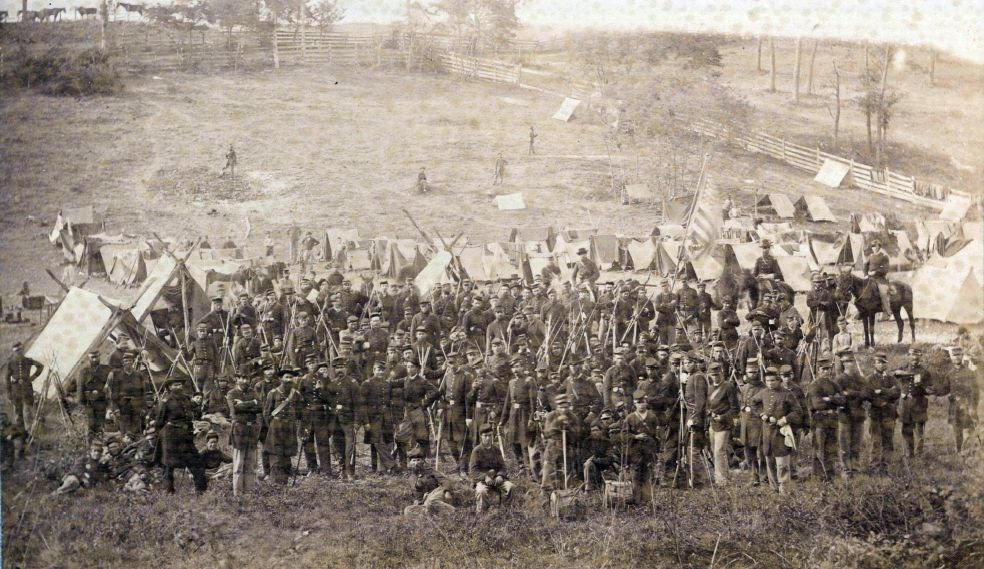
93rd N.Y. Infantry at Headquarters, Army of the Potomac, Antietam, Md. Sept., 1862. (U.S. Army Heritage Collections Online)
September 21st. This morning the Second corps fell in at an early hour and marched to Harper’s Ferry, encamping on Bolivar Heights. The march was very pleasant, the roads being good, and the weather superb. The whole army is in camp in the vicinity, and every hill and valley within sight is dotted over with canvas villages. Harper’s Ferry is one of the picturesque spots in America, delightfully situated in the gap of the Blue Ridge mountains. The Shenandoah here unites with the Potomac, and together they flow between the range of mountains on the way to the deep blue sea. Away off to the southwest the Blue Ridge mountains, with their thickly wooded slopes, form an impenetrable wall on the easterly side of the beautiful valley of the Shenandoah, and to the equally fertile Louden valley on the opposite side of the range.
The town lays in the hollow, at the foot of the heights, and is now of no importance, except as the place where the celebrated John Brown and his followers immortalized themselves. The old blackened walls of the government arsenals, destroyed at the very beginning of the war, stand like grim skeletons in their hideousness, and with the exception of a few straggling huts, is all there is of the place.
September 21.—Munfordsville, Ky., was to-day occupied by a force of Union troops under Col. Edward McCook. They drove out a large force of rebel cavalry, without any Union loss. The rebels lost a colonel and a lieutenant-colonel.
—The United States ram Queen of the West, under the command of Lieutenant-Colonel Lippincott, accompanied by two transports laden with troops, while reconnoitring on the Mississippi River, in the vicinity of Bolivar, Miss., were attacked by a party of rebel guerrillas, who opened fire upon them with grape, canister, and musketry. The Queen of the West returned the fire, which was kept up for half an hour, the rebels pursuing the boats for two miles. Three men were killed and one man wounded on the ram and transports in this affair.
—Cassville, Mo., occupied by about one hundred rebel troops, was this day attacked by a detachment of the First Arkansas cavalry, under the command of Captain Gilstray, and captured, completely routing the rebel force, killing and wounding a number, and taking nineteen prisoners. They also captured a number of horses and fire-arms.
—The officers of the United States Sanitary Commission received at New-York a telegraphic despatch from San Francisco, California, announcing that the citizens of that city had contributed one hundred thousand dollars for the relief of sick and wounded soldiers and seamen of the National army and navy.
—The Union force at Shepherdsville, Ky., under Colonel Granger, commanding the post, were attacked by a body of rebel cavalry; but, after a short skirmish, the rebels were repulsed, with a loss of five killed and twenty-eight taken prisoners.
Rienzi, Saturday, Sept. 20. There was nothing to break the monotony of camp life. Wrote two letters. Washed clothes. In the evening news of another battle at Iuka. They cleaned Price out and chased him four miles; 400 killed on both sides.
20th.—11 o’clock A. M.—I worked too hard yesterday, and was so tired that I could not sleep last night. Fortunate for me that we have not moved to-day; I must have been left. I am feeling better now, however, and if we rest till evening I shall be able to go on. Terrible fighting ahead, within three or four miles, and in hearing of us. I do not know where, nor by what forces. I was stopped writing here by—who comes to me, loaded with packages from home! How appropriate the contents, and what a relief. This morning, put on my last pair of socks, having worn ragged ones for a week, fearing to use the only ones left. The package contains some beautiful ones sent me by good friends, who seem never to forget my needs. I ought to be grateful and I am. A box of cigars, too, very fine ones, from my good friend
B——. I fully appreciate the kindness which dictated this attention, and shall not forget it.
P. M.—I have kept my bed—no, my lie-down on the broad surface of mother earth, with her clean and fragrant spreads and quilts and counterpanes of clover, and now feel rested and refreshed. Was called an hour since, to have all ready for a move. I am packed, and hear that we are to march to-night.
11 P. M.—Called into line from our earthy beds and under the cover of the dark black night, through which peeps a few bright stars we take up our march. Passing Sharpsburg, and one or two log cabin villages, we halted at daylight about two miles southeast of Williamsport, a village on the Maryland side of the Potomac, with a population, I should judge, of five or six hundred.
September 20— It was ten o’clock this morning when we left camp. We moved up the Winchester pike to Bunker’s Hill, and remained there till dusk, when we moved to Smithfield and camped. We passed about two hundred army wagons on the road between Bunker’s Hill and Smithfield. There are a great many troops camped around Bunker’s Hill. The whole country around there was ablaze this evening with camp-fires.
September 20th, Saturday.
General Carter has just received a letter from Lydia, which contains what to me is the most melancholy intelligence — the news of the death of Eugene Fowler,[1] who was killed on the 22d of August, in some battle or skirmish in Virginia. Poor Eugene! . . . Does it not seem that this war will sweep off all who are nearest and dearest, as well as most worthy of life, leaving only those you least care for, unharmed?
Saturday, September 20th.—An official account in the morning’s paper of the surrender of Harper’s Ferry to our men on Sunday last. Colonel Miles, the Federal commander, surrendered, unconditionally, to General Jackson, 11,000 prisoners, 50 pieces of artillery, 12,000 stand of arms, ammunition, quartermaster and commissary stores in large quantities. McClellan attempted to come to the rescue of Harper’s Ferry. A courier was captured, sent by him to Miles, imploring him to hold out until he could bring him reinforcements. General Lee ordered General D. H. Hill to keep McClellan in check, and, for this purpose, placed him on the road near Boonesborough. It is said that McClellan had a force of 80,000 men, and that General Hill, on Saturday and Sunday, kept him in check all day—General Longstreet getting up at night. Next day they attacked him, repulsed and drove him five miles. The details of the battle have not yet appeared. We have further rumours of fighting, but nothing definite. It is impossible for me to say how miserable we are about our dear boys.
The body of Brigadier-General Garland was brought to . this, his native city, and his home, yesterday for interment. He was killed in the battle near Boonesborough. This event was a great shock to the community, where he was loved, admired, and respected. His funeral yesterday evening was attended by an immense concourse of mourning friends. It made my heart ache, as a soldier’s funeral always does. I did not know him, but I know that he was ” the only child of his mother, and she is a widow;” and I know, moreover, that the country cannot spare her chivalric sons.


