Following the American Civil War Sesquicentennial with day by day writings of the time, currently 1863.

Wednesday, December 1, 2010

New Orleans, Dec. 1, 1860. — I understand it now. Keeping journals is for those who can not, or dare not, speak out. So I shall set up a journal, being only a rather lonely young girl in a very small and hated minority. On my return here in November, after a foreign voyage and absence of many months, I found myself behind in knowledge of the political conflict, but heard the dread sounds of disunion and war muttered in threatening tones. Surely no native-born woman loves her country better than I love America. The blood of one of its revolutionary patriots flows in my veins, and it is the Union for which he pledged his “life, fortune, and sacred honor” that I love, not any divided or special section of it. So I have been reading attentively and seeking light from foreigners and natives on all questions at issue. Living from birth in slave countries, both foreign and American, and passing through one slave insurrection in early childhood, the saddest and also the pleasantest features of slavery have been familiar. If the South goes to war for slavery, slavery is doomed in this country. To say so is like opposing one drop to a roaring torrent. This is a good time to follow St. Paul’s advice that women should refrain from speaking, but they are speaking more than usual and forcing others to speak against their will.

______

Note: To protect Mrs. Miller’s job as a teacher in New Orleans, the diary was published anonymously, edited by G. W. Cable, names were changed and initials were often used instead of full names — and even the initials differed from the real person’s initials.

At this time, when the attention of the whole country is centered upon the gallant State of South Carolina, in speculation as to the course she will pursue, it will be both seasonable and interesting to present some views in the city of Charleston, where the secession seems to be vigorous and demonstrative.  We have selected a few sketches of the prominent buildings, in advance of other illustrations of these stirring times of more vivid interest.

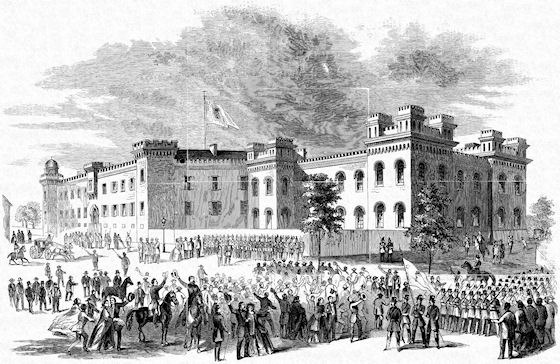
The Government Arsenal in in Charleston, S.C. – This extensive, handsome and important building, which we illustrate this week, is at the present time an object of peculiar interest.  In the present state of popular excitement in Charleston, this great depot of arms and ammunition is watched with great care and peculiar jealousy.  It was reported on the 10th, that an attempt had been to remove the arms, &c., to Fort Moultrie, but had been resisted by the people.  A later report states that it had been seized by the people, but the report was entirely unfounded.

The Government Arsenal in in Charleston, S.C.

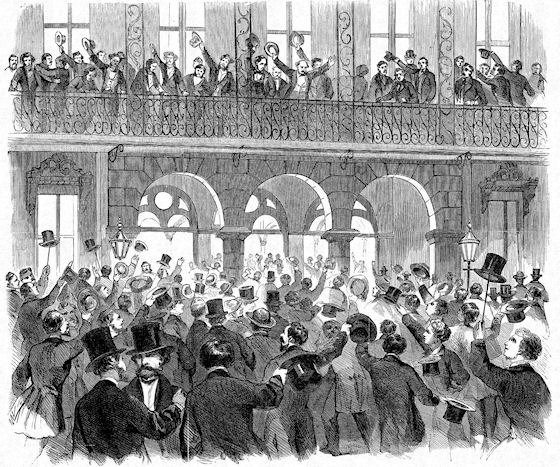
Secession Meeting at the Mills House. – We present in connection with the present secession movement in the South, a sketch of an enthusiastic meeting in favor of secession, held in front of the popular hotel, the Mills House.  The speeches were decidedly in favor of immediate secession, and every Southern sentiment was cheered most vociferously.

Secession Meeting at the Mills House.

Mother to Eliza:

Saturday Morning, Dec., 1860.

My dear Eliza: Your very modest little, “may I Mother?” leads me to an immediate reply. Yes, my dear child, come and welcome, just as often as you possibly can and never feel it necessary to ask if you may come home, for this you know is only another home. I am happy to enclose you a foreign letter bringing still further pleasant news. How much we have all to be thankful for that the travellers have so much enjoyment and so little interruption to it. Dear Mary finds, I dare say, comfort enough in the little new baby to compensate in a great measure for all the suffering consequent upon its arrival.

What do you think of Felice added to Una? Our opinions will be useless now, however, as before the last letters reach, the baptism will have been done. Did you see the paragraph stating that the continual assassinations in the streets of Rome render it unsafe to strangers and to residents after dark! This is very comforting to anxious families who have friends there! Hatty and Carry are certainly having a gay time at Naples. Just think of Vesuvius, a hurried dinner, rush to the Crocelli to meet a party of naval officers, a fourteen-oared boat excursion, dancing, and other festivities on board the Admiral’s ship-of-war, supper, etc., etc., all on one day! And after that the return civility of an egg nogg party! I am very glad they are under the care of a clergyman and his wife!

.
.
FORT MOULTRIE, S.C., December 1, 1860.

Col. S. COOPER,

Adjutant-General U. S. A.:

“Two Charlestonians who were down here to-day remarked to me that as soon as the State seceded she would demand the surrender of the forts, and that if not given up, they would be taken.”

COLONEL: I have the honor to acknowledge the receipt of your letter of the 28th ultimo, and regret that I have to report that things look more gloomy than the day at the date of my last communication. Captain Seymour, just returned from the city, reports that the excitement there is very great. Col. E. B. White and other gentlemen, with whom he conversed, stated that the people of Charleston would not allow another man or any kind of stores to be landed at or for these forts. They say that anything which indicates a determination on the part of the General Government to act with an unusual degree of vigor in putting these works in a better state of defense will be regarded as an act of aggression, and will, as well as either of the other acts mentioned above, cause an attack to be made on this fort.

Two Charlestonians who were down here to-day remarked to me that as soon as the State seceded she would demand the surrender of the forts, and that if not given up, they would be taken; but that this would not be done sooner unless some action on the part of the Government proved that it was preparing to hold possession of them.

The agent of the boat which brought the 24-pounder howitzer and ammunition is severely censured for having brought them, and the agent of the steamer James Adger was told that any vessel bringing troops here would not be safe in this harbor. Since writing the above I have seen Assistant Surgeon Crawford, who has also been in the city. He says that never until to-day did he believe that our position was critical. One of his friends told him that we would have trouble in less than fifteen days. He thinks that they will first attempt to take Fort Sumter, which they (justly) say will control this work. Castle Pinckney they regard as theirs already. Mr. King, the intendant of this island, told the doctor that as soon as the act of secession was passed a demand would be made on me to surrender this fort. All these remarks lead to the same conclusion–a fixed purpose to have these works. The question for the Government to decide–and the sooner it is done the better–is, whether, when South Carolina secedes, these forts are to be surrendered or not. If the former, I must be informed of it, and instructed what course I am to pursue. If the latter be the determination, no time is to be lost in either sending troops, as already suggested, or vessels of war to this harbor. Either of these courses may cause some of the doubting States to join South Carolina.

I shall go steadily on, preparing for the worst, trusting hopefully in the God of Battles to guard and guide me in my course. I think it probable that in the present highly excited state of these people, the sending of the detachment of Engineer laborers to Castle Pinckney may bring on that collision which we are so anxious to avoid. I shall consult with Captain Foster on his return to the island, and if convinced that it will lead to that result, will assume the responsibility of suspending the execution of that plan for the present. This fort, in consequence of the unfinished state of our repairs, &c., is not in a condition for inviting an attack. Captain Seymour says that he is satisfied they intend erecting a battery on the upper end of this island, to command the inner channel. I do not know what course to advise. They are making every preparation (drilling nightly, &c.) for the fight which they say must take place, and insist on our not doing anything. We are now certainly too weak to fight. Were we to guard against a surprise, our men, if surrounded by only an undisciplined mob, would soon be worn out by fatigue.

I learn from Captain Ord that attempts have been made, by offers of heavy sums, to induce men at Old Point to join a Southern army. I have not heard that any attempts have been made to tamper with our men, who thus far cheerfully perform the arduous and ceaseless duties imposed upon them in consequence of the smallness of the command.

I ought, perhaps, to mention, as an indication of the expectation of the citizens of Charleston, that three friends of the ladies of our officers have within a day or two been pressed most urgently to go to the city to stay with them there.

I am, colonel, respectfully, your obedient servant,

ROBERT ANDERSON,

Major, First Regiment Artillery, Commanding.