FORT SUMTER, S.C., January 9, 1861.
(Received A. G. O., January 12.)
Col. S. COOPER, Adjutant General:
COLONEL: I have the honor to send herewith the correspondence which took place to-day between the governor of South Carolina and myself in relation to the firing by his batteries on a vessel bearing our flag. Lieutenant Talbot, whose health is very much impaired, will be the bearer of these dispatches, and he will be enabled to give you full information in reference to this and to all other matters.
I am, colonel, your obedient servant,
ROBERT ANDERSON,
Major, First Artillery, Commanding.

[Inclosures.]

FORT SUMTER, S.C., January 9, 1861.
To his Excellency the GOVERNOR OF SOUTH CAROLINA:
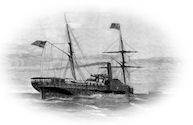
SIR: Two of your batteries fired this morning upon an unarmed vessel bearing the flag of my Government. As I have not been notified that war has been declared by South Carolina against the Government of the United States, I cannot but think that this hostile act was committed without your sanction or authority. Under that hope, and that alone, did I refrain from opening fire upon your batteries. I have the honor, therefore, respectfully to ask whether the above mentioned act–one, I believe, without a parallel in the history of our country or of any other civilized government–was committed in obedience to your instructions, and to notify you, if it be not disclaimed, that I must regard it as an act of war, and that I shall not, after a reasonable time for the return of my messenger, permit any vessels to pass within range of the guns of my fort. In order to save, as far as in my power, the shedding of blood, I beg that you will have due notification of this my decision given to all concerned. Hoping, however, that your answer may be such as will justify a further continuance of forbearance upon my part,
I have the honor to be, very respectfully, your obedient servant,
ROBERT ANDERSON,
Major, First Artillery, Commanding.
_________
STATE OF SOUTH CAROLINA, EXECUTIVE OFFICE,
Headquarters, Charleston, January 9, 1861.
Maj. ROBERT ANDERSON,
Commanding Fort Sumter :
SIR: Your letter has been received. In it you make certain statements which very plainly show that you have not been fully informed by your Government of the precise relations which now exist between it and the State of South Carolina. Official information has been communicated to the Government of the United States that the political connection heretofore existing between the State of South Carolina and the States which were known as the United States had ceased, and that the State of South Carolina had resumed all the power it had delegated to the United States under the compact known as the Constitution of the United States. The right which the State of South Carolina possessed to change the political relations which it held with other States under the Constitution of the United States has been solemnly asserted by the people of this State in convention, and now does not admit of discussion. In anticipation of the ordinance of secession, of which the President of the United States has received official notification, it was understood by him that sending any re-enforcement of the troops of the United States in the harbor of Charleston would be regarded by the constituted authorities of the State of South Carolina as an act of hostility, and at the same time it was understood by him that any change in the occupation of the forts in the harbor of Charleston would in like manner be regarded as an act of hostility. Either or both of these events, occurring during the period in which the State of South Carolina constituted a part of the United States, was then distinctly notified to the President of the United States as an act or acts of hostility; because either or both would be regarded, and could only be intended, to dispute the right of the State of South Carolina to that political independence which she has always asserted and will always retain. Whatever would have been, during the continuance of this State as a member of the United States, an act of hostility, became much more so when the State of South Carolina had dissolved the connection with the Government of the United States. After the secession of the State of South Carolina, Fort Sumter continued in the possession of the troops of the United States. How that fort is at this time in the possession of the troops of the United States, it is not now necessary to discuss. It will suffice to say that the occupancy of that fort has been regarded by the State of South Carolina as the first act of positive hostility committed by the troops of the United States within the limits of this State, and was in this light regarded as so unequivocal that it occasioned the termination of the negotiations then pending at Washington between the Commissioners of the State of South Carolina and the President of the United States. The attempt to re-enforce the troops now at Fort Sumter, or to retake and resume possession of the forts within the waters of this State, which you abandoned, after spiking the guns placed there, and doing otherwise much damage, cannot be regarded by the authorities of the State as indicative of any other purpose than the coercion of the State by the armed force of the Government. To repel such an attempt is too plainly its duty to allow it to be discussed. But while defending its waters, the authorities of the State have been careful so to conduct the affairs of the State that no act, however necessary for its defense, should lead to an useless waste of life. Special agents, therefore, have been off the bar to warn all approaching vessels, if armed or unarmed, and having troops to re-enforce the forts on board, not to enter the harbor of Charleston, and special orders have been given to the commanders of all forts and batteries not to fire at such vessels until a shot fired across their bows would warn them of the prohibition of the State. Under these circumstances, the Star of the West, it is understood, this morning attempted to enter this harbor, with troops on board, and having been notified that she could not enter, was fired into. The act is perfectly justified by me. In regard to your threat in regard to vessels in the harbor, it is only necessary to say that you must judge of your own responsibilities. Your position in this harbor has been tolerated by the authorities of the State, and while the act of which you complain is in perfect consistency with the rights and duties of the State, it is not perceived how far the conduct which you propose to adopt can find a parallel in the history of any country, or be reconciled with any other purpose of your Government than that of imposing upon this State the condition of a conquered province.
F. W. PICKENS.
_________
FORT SUMTER, S.C., January 9, 1861.
General TOTTEN:
MY DEAR SIR: I have only a moment to write by Lieutenant Meade [?], who comes with dispatches from Major Anderson. I wish to assure you, however, that the officers of your corps are doing everything in their power to make this work impregnable, even with the present small garrison of seventy men. We even mount all the guns, as we can do it much more rapidly than the garrison. We have twenty-nine guns on the first tier and eleven on the barbette tier. Four 8-inch columbiads are ready to mount to-morrow. I shall place the 10-inch on the parade as mortars.
The firing upon the Star of the West this morning by the batteries on Morris Island opened the war, but Major Anderson hopes that the delay of sending to Washington may possibly prevent civil war. The hope, although a small one, may be the thread that prevents the sundering of the Union. We are none the less determined to defend ourselves to the last extremity. I am in want of funds, and would respectfully urge that as soon as possible $15,000 may be placed to my credit in New York. In haste.
Very respectfully,
J. G. FOSTER,
Captain, Engineers.
P. S.–I beg to refer you to Lieutenant Meade [?] for particulars.
J. G. F.